
Make B2B Customer Experience a Revenue Discipline Through Orchestration
A B2B customer experience strategy is an orchestrated set of customer journeys designed to produce measurable business outcomes, not a collection of satisfaction surveys. We recommend treating it as a growth discipline: align every journey metric to retention and revenue, then build the roadmap outward from there. The sections below walk through the framework, the metrics, and a practical sequence for getting from assessment to scaled capability.
TL;DR:
- Building a successful B2B customer experience strategy requires aligning every journey metric to retention and revenue, not just satisfaction.
- Managing multiple stakeholders and longer cycles means that designing for outcomes and account-level measurement is essential for effective journey orchestration.
- Leaders should adopt a small set of KPIs, including net revenue retention, time-to-value, and adoption depth, to demonstrate tangible impact and secure ongoing investment.
- As buyer behavior shifts toward self-directed research and digital channels, strategies must prioritize channel continuity and targeted use of AI to maintain seamless experiences.
- Integrating brand positioning with customer journeys reduces internal coordination costs and creates a cohesive experience that directly supports growth objectives.
Table of Contents
- What is B2B customer experience, and who shapes it?
- Why B2B CX matters: the business case and the barriers
- B2B vs B2C: what changes when you design CX for organizations
- Core pillars of a practical B2B CX framework
- How digital-first buying and omnichannel habits should shape your design
- Mapping journeys and orchestrating touchpoints for value
- Measuring CX in terms the CFO already trusts
- Implementation roadmap: pilot, prove, scale
- What progress on this actually looks like
- Why brand strategy is the missing lever in most CX programs
- Where to get hands-on help building this
- FAQ
- Sources
What is B2B customer experience, and who shapes it?
B2B customer experience covers every interaction a business customer has with your organization, but the defining feature is that it rarely involves a single decision-maker. Multiple stakeholders (procurement, end users, finance, executive sponsors) co-create value across a journey that can run for months or years, which means a strategy built for a single consumer rarely survives contact with a buying committee.
It helps to separate two ideas that often get blurred. A touchpoint is a single interaction, like a support ticket or a renewal call. A journey is the sequence of touchpoints a customer actor experiences while pursuing a goal, such as “get live on the platform” or “justify renewal to my CFO.” Strategy lives at the journey level, because that is where value gets created or lost.
In practice, B2B CX typically shows up in a few recurring places:
- Pre-sale research and evaluation, where buyers compare options largely on their own terms.
- Onboarding and implementation, where early friction predicts churn months later.
- Ongoing support and account management, where consistency matters more than speed alone.
- Renewal and expansion, where past experience either compounds into growth or erodes trust.
Each of these stages has its own owner inside most organizations, which is exactly why orchestration, not ownership, becomes the strategic question.
Why B2B CX matters: the business case and the barriers
The case for investing in B2B CX is financial before it is anything else. Leading organizations now treat experience as “Total Experience” tied to “Total Value,” measuring trust and value realization rather than satisfaction alone, and they tie those metrics directly to the way their CFOs evaluate the business, according to KPMG’s research on connecting experience to growth. Programs that fail to make that translation are the ones that get cut when budgets tighten.
The internal barrier is less about belief and more about fragmentation. When customer data, journey ownership, and success metrics sit in separate systems and separate teams, the cost shows up as duplicated effort, inconsistent messaging, and slow decisions. Academic research on customer journey management capability confirms this directly: the capability that creates loyalty also creates a “dark side” of rising internal coordination costs as the number of touchpoints grows, unless governance and shared KPIs keep pace.
Coordination costs rise with touchpoint complexity unless governance keeps pace. That single finding should reshape how leaders plan CX investment: more channels and more personalization only pay off when paired with the orchestration to manage them.
A compact KPI set that most executive teams will accept without a fight includes:
- Net revenue retention, which captures both churn and expansion in one number.
- Time-to-value, measuring how quickly a new account reaches its first meaningful outcome.
- Customer lifetime value, tracked by segment rather than as a single blended figure.
- Adoption depth, the share of purchased capability actually in active use.
B2B vs B2C: what changes when you design CX for organizations
Consumer CX playbooks tend to fail in B2B settings for a structural reason: the buyer and the user are often different people, and the decision passes through several hands before anything gets signed. Cycles stretch over months, and a single bad handoff between sales and service can undo a year of relationship-building.
That difference pushes B2B strategy toward outcome-driven design rather than moment-by-moment delight. Instead of optimizing a single interaction, the target becomes a specific, named outcome, what researchers describe as a target experience (TX) statement, such as “trusted advisor within 48 hours” or “effortless onboarding,” rather than a vague goal like customer satisfaction, as described in research on target experience and B2B CXM strategy. A TX statement gives teams something concrete to design and measure against.
Three practical shifts follow from this:
- Design for committees, not individuals, mapping each stakeholder’s distinct goals within one account journey.
- Measure at the account level, since individual contact satisfaction can mask account-wide risk.
- Invest in orchestration and governance early, because longer cycles multiply the number of handoffs that can go wrong.
Core pillars of a practical B2B CX framework
A workable B2B CX strategy rests on a small number of pillars that teams can audit and build against without needing a large transformation budget up front.
- Target experience (TX) definition. Write specific, qualitative outcome statements for each major journey instead of generic satisfaction goals.
- Journey and value stream mapping. Map the sequence of actions and actors tied to a specific business outcome, not just a generic “customer journey.”
- Data and platform unification. Bring customer data into a shared view so sales, service, and success teams work from the same facts.
- Orchestration and routing. Build the handoff rules and shared KPIs that keep a journey coherent as it crosses team boundaries.
- Enablement and governance. Give frontline teams the authority and training to act on journey insights, with clear ownership for exceptions.
- Measurement tied to business outcomes. Connect every journey metric back to retention, expansion, or time-to-value.
A related decision is whether to run CX reactively or proactively. Responsive customer experience management waits for signals (complaints, churn risk scores, support volume) and reacts to them, which works well for mature, stable journeys with low variability. Proactive CXM designs the target experience before problems occur and is better suited to high-value accounts or journeys with a history of coordination failures. Most organizations need both, applied selectively rather than universally.
Early activities under each pillar look different depending on where you start, but a reasonable first quarter includes a cross-functional workshop to draft TX statements, a customer journey analytics (CJA) pilot on one high-value journey, and a small-scope pilot to test whether proposed changes move the needle before wider rollout.
Pro Tip: Start journey mapping with the single account segment that generates the most expansion revenue; the lessons transfer faster than starting with your highest-complaint segment.
How digital-first buying and omnichannel habits should shape your design
Buyer behavior has shifted decisively toward self-directed research, and strategy needs to catch up. 61% of B2B buyers now prefer a rep-free buying experience for research, with younger buyers showing particularly strong self-service preferences, according to Gartner’s findings on B2B buying behavior. That does not mean sellers become irrelevant: buyers still want expert help for complex, high-stakes decisions, which means the design question is not “remove the rep” but “know exactly when the rep should appear.”
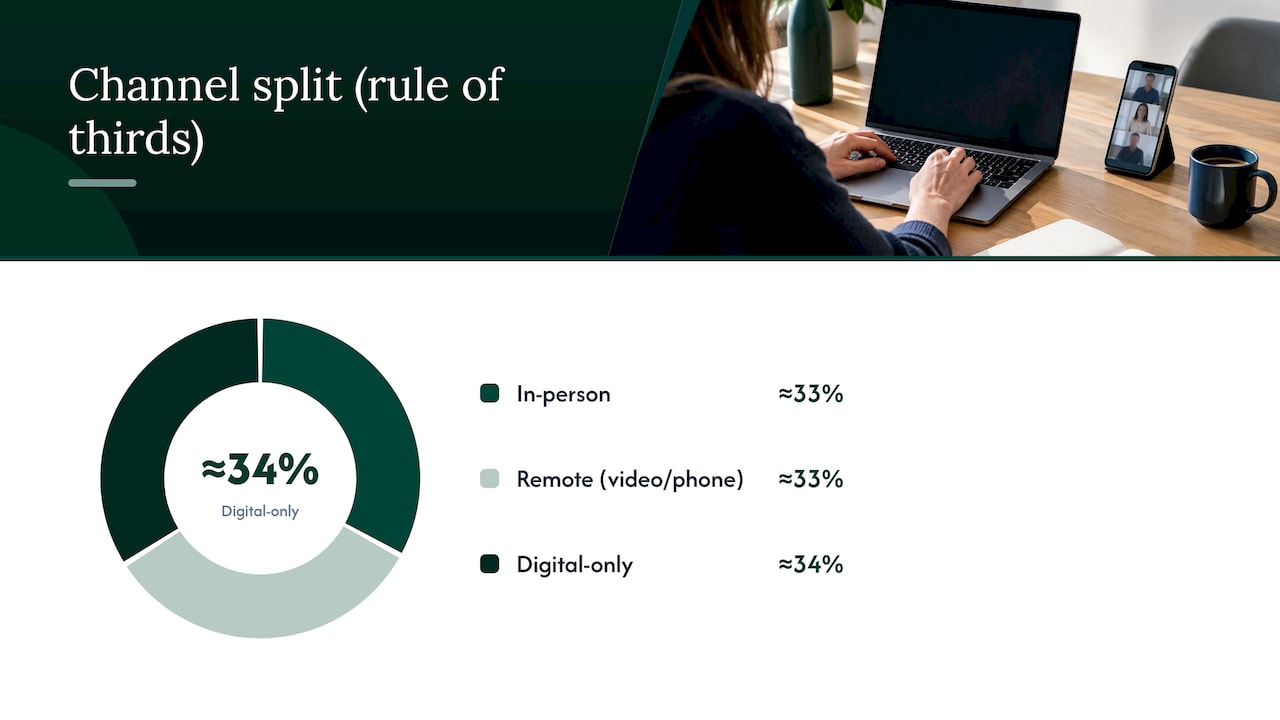
Omnichannel complexity compounds this. B2B buyers use multiple interaction channels across a single purchase journey, typically around ten, and tend to follow a rough rule of thirds among in-person, remote, and digital-only interactions, according to McKinsey’s research on B2B growth. A strategy that treats each channel as a separate workstream will fragment the experience exactly where buyers expect continuity.
Practical design rules follow from this evidence:
- Default to self-service for research and low-stakes transactions, reserving human sellers for complex configuration, pricing negotiation, or risk mitigation.
- Design for channel continuity, so a conversation started in chat can resume in email or a call without the customer repeating context.
- Pilot generative AI internally first, using it for seller enablement and journey analysis before exposing it directly to customers, a sequencing that Gartner’s service leader survey also supports as the lower-risk path.
Partners like Betterpresence build specifically around this kind of AI-assisted digital presence, which is worth evaluating if your internal pilot shows promise but your team lacks the capacity to build the tooling in-house.
Mapping journeys and orchestrating touchpoints for value
Journey mapping in B2B only works when it accounts for multiple actors pursuing related but distinct goals inside one account. A practical sequence looks like this:
- Identify the business outcome the journey serves, such as “renew without a competitive re-evaluation,” not just “improve the renewal experience.”
- List the actors involved, from the economic buyer to the day-to-day user, and note where their goals diverge.
- Plot the touchpoints each actor encounters, marking which ones are value-anchored (directly tied to the outcome) versus incidental.
- Flag the handoff points between teams, since this is where coordination costs tend to concentrate.
- Define shared KPIs and routing rules for each handoff, so ownership is clear before a problem occurs rather than after.
Academic work on B2B journeys supports this actor-centered approach, noting that value propositions often emerge during the journey itself rather than being fixed at the point of sale, and that institutional alignment across phases, not just at the start, determines whether value gets realized, per research on B2B customer journey axioms.
On tooling, resist the urge to add a new platform for every gap you find. Each additional system is another source of internal friction unless it genuinely replaces, rather than supplements, an existing tool. Our analysis of why CX breaks down between corporate functions covers this pattern in more detail: most orchestration failures trace back to mismatched language and processes between teams, not a missing piece of software.
Measuring CX in terms the CFO already trusts
CX metrics earn durable budget when they map onto numbers finance already tracks. A compact dashboard should include net retention, time-to-value, expansion rate, and adoption depth, each broken out by account segment rather than reported as a single company-wide average. Net Promoter Score still has a role, but mainly as an early-warning signal rather than as the primary measure of program success. It correlates loosely with loyalty; it does not explain which journey is driving the number up or down.
An executive dashboard that works tends to share a few traits:
- One page, one narrative, showing the three or four metrics leadership actually references in planning meetings.
- Segment-level detail available on demand, so a single bad account doesn’t distort the headline trend.
- A direct line from metric to dollar figure, so a one-point adoption gain is expressed as retained or expanded revenue, not just a percentage.
Building the business case means working backward from a financial outcome: pick the journey most connected to churn or expansion, baseline its current metric, and forecast what a realistic improvement is worth in revenue terms before asking for budget. KPMG’s guidance on connecting experience to Total Value frames this as the central shift leading organizations have made: CX measurement has moved from tracking satisfaction to tracking value realization.
Pro Tip: Translate every CX metric into a revenue sentence before presenting it: “a 5-point adoption gain in this segment is worth roughly $X in reduced churn risk” lands harder than the percentage alone.
Implementation roadmap: pilot, prove, scale
A credible rollout moves in deliberate stages rather than attempting an enterprise-wide relaunch.
- Pick one pilot, a single value stream and a single journey within it, ideally one tied to a clear revenue signal like renewal or expansion.
- Define success metrics and baseline them before making any change, so the pilot has something concrete to beat.
- Assign a small cross-functional team with explicit decision rights, pulling from sales, service, and whichever function owns the journey’s main touchpoints.
- Run the pilot for a fixed window, typically one quarter, and resist the temptation to expand scope mid-cycle.
- Review results against baseline, and only then decide whether to consolidate tooling, automate repeatable steps, or extend the journey redesign to adjacent accounts.
- Build the governance model you’ll need at scale before scaling, including shared KPIs and routing rules, since retrofitting governance after rollout is far harder than designing it alongside the pilot.
The sequencing matters more than the specific tools chosen. Teams that scale before proving value on one journey tend to inherit the coordination costs the pilot was supposed to help them avoid.
What progress on this actually looks like
Two illustrative patterns show up often enough to be worth naming, even without attaching specific company names.
- A faster time-to-value pilot: narrowing onboarding to the three steps a new account actually needs to reach first value, rather than the full feature tour, tends to shorten time-to-value and reduce early churn risk.
- A renewal journey redesign: giving the account team visibility into product usage data before the renewal conversation, instead of relying on a quarterly check-in call alone, tends to catch disengagement early enough to intervene.
Both patterns share a trade-off worth naming directly: each new data feed or handoff rule adds a small coordination cost even as it improves the outcome. The mitigation is the same one covered earlier: shared KPIs and clear routing rules keep that cost from compounding as the journey scales. Our broader library on brand and growth strategy includes further detail on how these patterns play out across different account structures.
Why brand strategy is the missing lever in most CX programs
Most CX programs treat positioning and experience as separate workstreams, which is backward. A business’s positioning sets the promise a customer journey has to deliver on, and when the two drift apart, customers notice the gap long before any dashboard does. Brand, in this sense, isn’t a marketing layer sitting on top of the experience. It’s the strategic thread that should run through product, marketing, and sales decisions alike, because a journey only feels coherent to a customer when those functions are telling the same story.
That is the thinking behind frameworks like the Golden Spiral and Brand-Backed Performance, which exist to connect positioning work directly to measurable performance rather than treating brand as a creative exercise disconnected from growth. When product, marketing, and sales are aligned around one clear position, the resulting customer journey tends to need far less internal coordination to stay consistent, which is the coordination cost problem most CX programs are quietly fighting without naming it.
— Quincy
Where to get hands-on help building this
If the roadmap above makes sense but your team lacks the bandwidth or the internal alignment to execute it, that gap is exactly where we work. Some consulting engagements focus on connecting positioning to the metrics that matter for growth, which means CX work doesn’t sit in isolation from the sales and marketing decisions shaping it.
We offer a few entry points depending on where you’re starting:
- Customer Experience strategy work, built to connect journey design directly to retention and revenue outcomes.
- Brand Strategy and Brand Positioning engagements, for teams whose CX problems trace back to inconsistent positioning.
- Growth and Go-to-Market Strategy advisory, for organizations redesigning how product, marketing, and sales work together.
- Executive workshops and speaking sessions, useful for aligning a leadership team before a larger rollout.
Visit Quincysamycia to see which engagement fits your situation, or explore our speaking and workshop options if a facilitated session is the right first step.
FAQ
What is the difference between B2B and B2C customer experience?
B2B customer experience involves multiple stakeholders making a shared decision over a longer cycle, while B2C typically involves one buyer making a faster, more individual choice. B2B strategy has to account for committee dynamics, account-level measurement, and longer-term value realization rather than single-moment satisfaction.
How do you measure the ROI of a B2B CX strategy?
The most credible approach ties CX metrics directly to financial outcomes like net revenue retention, time-to-value, and expansion rate rather than relying on satisfaction scores alone. Leading organizations build this connection explicitly, translating experience metrics into the same language finance teams use to evaluate performance and growth.
Do B2B buyers still want to talk to a salesperson?
Many buyers prefer to research independently: 61% prefer a rep-free experience for the research phase of a purchase. That preference is strongest in early research, while complex configuration, pricing, and risk decisions still tend to involve a seller.
How many channels does a typical B2B buying journey involve?
B2B buyers use an average of ten interaction channels across a single purchase, following a rough split between in-person, remote, and digital-only interactions, according to McKinsey’s B2B research. This is why channel continuity, not channel count, is the design priority.
What services help a business improve its customer experience strategy?
Engagements focused on customer experience mapping, journey orchestration, and brand positioning can help connect experience work to measurable growth. We offer this type of advisory through our Customer Experience and Brand Strategy services, built around frameworks that tie positioning directly to performance outcomes.
Sources
- Gartner: B2B buyers prefer rep-free research (report coverage)
- Creating Total Value: Connecting experience and performance to drive growth in B2B (KPMG)
- Customer journey management capability in business-to-business markets: Its bright and dark sides and overall impact on firm performance
- Five fundamental truths: how B2B winners keep growing (McKinsey)