13 Brand Promise Examples and a Repeatable Formula
A brand promise is the internal commitment a company makes about the experience it will deliver, expressed so clearly that customers can feel it at every touchpoint. A workable model looks like this: “We promise [specific audience] [a measurable benefit] delivered through [the mechanism that makes it believable].” The examples below and the method that follows show how that template holds up in practice.
TL;DR:
- Measuring the promise with specific numbers or standards is essential, as many brands fail by lacking clear, verifiable metrics.
- Operational alignment ensures the promise is consistently delivered across all customer touchpoints, not just stated in marketing.
- Conducting an audit to identify where current experiences contradict the promise is a critical first step before refining messaging.
- Promises based on genuine capabilities and proof outperform aspirational or vague statements that cannot be operationalized.
Table of Contents
- Notable brand promise examples and what they teach
- What makes a brand promise strong enough to keep
- How to write a brand promise step by step
- Keeping the promise: operations, KPIs, and governance
- How a brand strategist turns a promise into growth
- What the examples get wrong more often than right
- Turning your brand promise into a growth plan
- Sources
- FAQ
Notable brand promise examples and what they teach
Some of the most recognizable brand promises work because they compress a complex business decision into one memorable commitment. Others succeed because they are painfully specific about the one thing customers can count on. Looking at a range of them, across industries and promise types, shows what separates a promise that sticks from one that just sounds nice.
- Geico: “15 minutes could save you 15% or more on car insurance.” This is a measurable promise: it names a time frame and a savings figure, so customers can test it themselves rather than take the brand’s word for it.
- Nike: “To bring inspiration and innovation to every athlete in the world.” Nike’s promise is aspirational and inclusive (it defines “athlete” as anyone with a body), which lets the brand stretch across apparel, footwear, and technology without breaking its own logic.
- Apple: Simplicity and design quality across every product and interaction. Apple rarely states this as a slogan, but the promise is enforced through consistent industrial design and software behavior, which is what makes it believable.
- Starbucks: A consistent “third place” experience between home and work. The promise is emotional and experiential, and it is delivered through store design, staff training, and menu consistency rather than through price or speed.
- Coca-Cola: Happiness and shared moments, delivered through consistent taste and ubiquitous availability. The promise is almost entirely emotional, which works because the product itself rarely changes, giving the brand a stable platform to build feeling on.
- BMW: “The Ultimate Driving Machine,” a functional promise about performance and engineering that is reinforced by decades of motorsport investment and consistent product positioning.
- Walmart: “Save Money. Live Better.” A functional, price-led promise that ties a rational benefit (savings) to an emotional outcome (a better life), which is a common structure for value-focused retailers.
- Allstate: “You’re in good hands.” A simple emotional promise about protection and reassurance, built to reduce the anxiety that comes with buying insurance before anything has gone wrong.
- FedEx: Reliable, fast, trackable delivery, historically distilled into “When it absolutely, positively has to be there overnight.” This is a functional promise with a built-in measurement: the package either arrives on time or it does not.
- Southwest Airlines: Low fares, no change fees, and a more human flying experience. The promise is functional and differentiated in an industry where most competitors compete on the same complaints.
- HubSpot (B2B): Helping businesses grow better through software and education. This is a useful model for B2B teams because it ties a broad mission to a specific customer outcome (growth) rather than a product feature list.
- Datadog (B2B): Full visibility into infrastructure and applications so engineering teams can find and fix problems before customers notice. It works because “before customers notice” is a standard the customer can actually evaluate.
- Zappos: Service so good customers do not think twice about ordering, backed by free returns and a famously long customer service leash. The promise is operational: it is delivered through policy, not copywriting.
What ties these together is not a single format. Some are measurable (Geico, FedEx), some are emotional (Coca-Cola, Allstate), some are functional (BMW, Southwest), and some are aspirational (Nike). What every one of them shares is a mechanism the customer can point to: a number, a policy, a design standard, or a consistent ritual that proves the promise is not just a tagline.
What makes a brand promise strong enough to keep
A brand promise only works if it survives contact with real customers, which means it has to pass a few practical tests before it ever reaches a headline or a homepage. Brand authorities generally converge on five building blocks: clarity, believability, relevance, differentiation, and deliverability.
- Clear: Could a new employee repeat it back correctly after hearing it once? If not, it is too abstract.
- Believable: Does the company already have proof it can deliver this, or is it aspirational marketing? Customers sense the gap quickly.
- Relevant: Does it address something the target customer actually cares about, not just something the company is proud of?
- Differentiated: Would a competitor’s customer recognize this as something their own brand does not offer?
- Deliverable: Can every team, not just marketing, actually execute on this promise daily?
- Measurable: How will customers, not just the company, know whether the promise was kept?
Common red flags include vague adjectives like “premium” or “trusted” with no proof behind them, promises that set an impossible or unverifiable standard, and internal teams that have never agreed on what the promise actually means operationally.
Pro Tip: Read your draft promise out loud to someone outside the company; if they can’t repeat the core benefit back to you in one sentence, rewrite it.
How to write a brand promise step by step
A brand promise does not start with a slogan. It starts with research into what customers actually value, then gets tightened until it is specific enough to measure and deliver.
- Research (brand or research lead): Interview customers and frontline staff to find the one experience gap or strength that comes up repeatedly.
- Define the benefit (brand strategist): State the single outcome the customer gets, not the feature that produces it.
- Make it measurable (marketing and operations together): Attach a number, a time frame, or an observable standard wherever possible.
- Test it (cross-functional team): Share the draft with sales, support, and product teams to confirm it can be delivered consistently.
- Publish and monitor (brand owner): Roll it out internally first, then externally, with a plan to track whether it holds up.
A simple formula to copy: “We promise [audience] [benefit] through [mechanism], measured by [metric].” How-to guides consistently recommend converting vague language into an outcome the customer can perceive and measure.
A few before-and-after rewrites show the shift:
- Before: “We deliver premium customer service.” After: “We resolve support tickets within four hours, or a manager follows up personally.”
- Before: “We’re innovative.” After: “We ship one major product update every quarter, based on direct customer requests.”
- Before: “We care about our customers.” After: “Every customer gets a named account contact who responds within one business day.”
Each rewrite trades a feeling for a fact, which is what turns a slogan into a promise.
Keeping the promise: operations, KPIs, and governance
A promise written in a brand deck means nothing until it shows up at the counter, on the call, or in the app. That requires mapping the promise against every stage of the customer journey, from first contact through renewal, and flagging any touchpoint where the experience contradicts the words.
- Map it: List every touchpoint (website, sales call, onboarding, support, billing) and mark where the promise is currently being met, ignored, or broken.
- Measure it: Track a small number of KPIs tied directly to the promise, such as response time SLAs, preference scores, or repeat purchase rate, rather than generic brand awareness metrics.
- Govern it: Assign a single executive owner, train frontline staff on what the promise means in practice, and build an escalation path for when delivery slips.
- Review it: Put the promise on a recurring leadership agenda, not just a marketing one, so operational drift gets caught early.
The financial case for doing this work is direct. Kantar’s analysis of over 100 retail banks found that brands aligning their promise with the delivered experience scored 61 on preference, compared with 32 for brands with a negative gap, a difference of roughly 29 points. The same research found that promises built on genuine difference, not just trust, cut churn by around half once the promise-experience gap closes.
How a brand strategist turns a promise into growth
Most brand promise failures are not writing problems, they are operating problems: the line sounds right, but no one owns it past the launch meeting. That gap between the promise and delivered experience is the specific failure The Golden Spiral™ and Brand-Backed Performance™ are built to close, connecting the promise to positioning, product, and sales so it survives contact with real operations rather than living in a slide deck.
A practical starting point for any team is a short pilot:
- Audit: Map the current promise, stated or implied, against what customers actually experience today.
- Redesign: Tighten the promise using the clarity and measurability tests above.
- Baseline: Pick one or two KPIs tied to the promise and start tracking before making any public claims.
Teams that want outside support on this usually take one of three paths: a positioning audit to find the gap, a workshop to align leadership on one promise, or an ongoing advisory relationship to keep the promise honest as the business scales, often partnering with Media & Content Services from Stratton Media Solutions.
What the examples get wrong more often than right
Most advice on brand promises treats the writing as the hard part, when the writing is usually the easy part. The examples that circulate most, Geico’s 15 minutes, FedEx’s overnight guarantee, are memorable precisely because the operations behind them were built first and the line came second. Teams that reverse that order end up with a promise that photographs well and fails in practice.
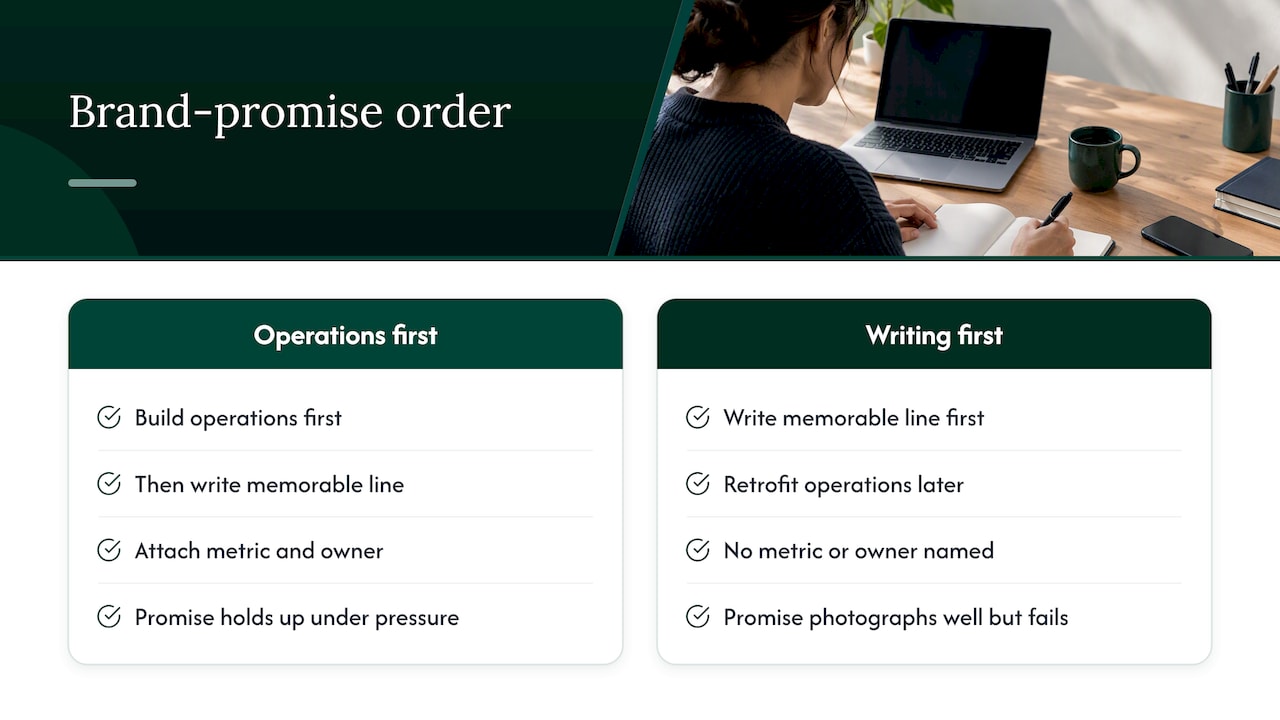
The bigger blind spot is measurement. Many companies can recite their brand promise but cannot name the metric that would tell them if they broke it recently. A promise without an owner and a number attached to it is a mission statement wearing a disguise.
If you take one thing from this, prioritize the audit over the copywriting. Find where your current experience already contradicts what you claim, fix that gap first, and only then tighten the language. A modest, accurate promise that holds up under pressure beats an inspiring one that does not.
— Quincy
Turning your brand promise into a growth plan
Writing the line is the easy part. The Branded Agency works with founders and executive teams on brand positioning that connects a promise to product, marketing, and sales, so the commitment holds up under real customer pressure instead of drifting apart from what teams actually deliver.
- A positioning audit to find where your current experience already contradicts your stated promise.
- A leadership workshop to align teams around one promise before it ships.
- An advisory relationship that keeps the promise measurable as the business scales.
Explore the frameworks behind this approach or book a speaking engagement to align your leadership team around a promise worth keeping.
Sources
- What Is A Brand Promise, And How Can You Create One? — Forbes
- 3 Easy Steps to Build Your Brand Promise + Examples — HubSpot
- Mind the gap: why customer experience and brand need to get closer — Kantar
- The 5 building blocks of an effective brand promise — Adobe
FAQ
What is an example of a brand promise?
Strong examples always name a benefit the customer can measure or feel directly.
What is Nike’s brand promise?
Nike’s promise is to bring inspiration and innovation to every athlete in the world, defining “athlete” broadly enough to include anyone with a body. It is an aspirational promise, reinforced through product design and marketing rather than a single measurable metric.
What is Disney’s brand promise?
Disney’s promise centers on creating magical, memorable family experiences, delivered consistently across parks, films, and consumer products. It is an emotional promise, reinforced by tightly controlled storytelling and service standards across every touchpoint.
What is the brand promise of Coca-Cola?
Coca-Cola’s promise centers on happiness and shared moments, built on a product whose taste and availability rarely change. It is an emotional promise rather than a functional one, which gives the brand a stable platform for consistent global messaging.
How is a brand promise different from a tagline?
A brand promise is an internal operating commitment that guides how a company behaves across every touchpoint, while a tagline is the external line used in marketing. Treating the promise as an internal alignment tool first keeps the public-facing line honest.