$5,000–$75,000: How US Businesses Should Budget Brand Strategy
Expect to pay somewhere between $5,000 and $75,000 for professional brand strategy work in the US, depending on scope, with full strategic rebrands running higher. A reasonable starting point is a scoped four to six week sprint rather than a sprawling identity overhaul.
TL;DR:
- The typical cost for a small business brand strategy sprint ranges from $8,000 to $35,000, depending on scope and level of detail.
- Deeper rebranding projects, including naming and visual identity, generally cost between $30,000 and $95,000, with larger programs surpassing $100,000.
- Most US-based brand strategists bill hourly between $100 and $300, with project durations varying from four weeks for sprints to six months for full rebrands.
- The main cost drivers include research, messaging, naming, visual identity development, and rollout, with process complexity increasing hours and fees.
- Avoid overspending by ensuring positioning is solid before designing visual assets and staging initiatives rather than aiming for a full-scale, one-time overhaul.
Table of Contents
- How Much Does Brand Strategy Cost by Project Tier?
- What Actually Drives the Cost of a Branding Project?
- How Do You Choose the Right Budget and Investment Level?
- What Do Sample Brand Strategy Budgets Look Like?
- How Long Does Brand Strategy Take and What ROI Should You Expect?
- Why Author Experience and Frameworks Matter for This Estimate
- Where Business Owners Overspend on Brand Strategy
- Get Expert Guidance on Your Brand Strategy Investment
- Sources
- FAQ
How Much Does Brand Strategy Cost by Project Tier?
Brand strategy pricing splits into four rough tiers, and knowing which one you’re shopping in saves you from comparing a $3,000 freelance sprint to a $90,000 agency engagement and wondering why the deliverables look nothing alike.
Entry-level (under $5,000). This buys you a solo consultant or a very lean freelance engagement: a positioning statement, maybe a messaging outline, and light competitive research. You won’t get stakeholder workshops or a full visual identity system here. It’s useful for pre-revenue startups or side projects that need direction, not polish.
Boutique and small agency ($5,000 to $30,000). This is where most small and mid-size businesses land. A four to six week brand sprint in this range typically runs $5,000 to $15,000, covering discovery interviews, a positioning workshop, core messaging, and a basic visual refresh. Larger budgets in this band usually include a style guide and some implementation support for your website and sales materials.
Strategic rebrand ($30,000 to $150,000+). Full rebrands with deep research, naming, comprehensive visual identity, and multi-channel rollout commonly fall between $15,000 and $75,000, with larger programs that include extensive asset libraries and messaging systems reaching $20,000 to $100,000 or more. Clutch’s data on agency projects broadly backs this up, with average branding costs sitting between $10,000 and $49,999 and reported averages closer to $71,652 for full-scope work.
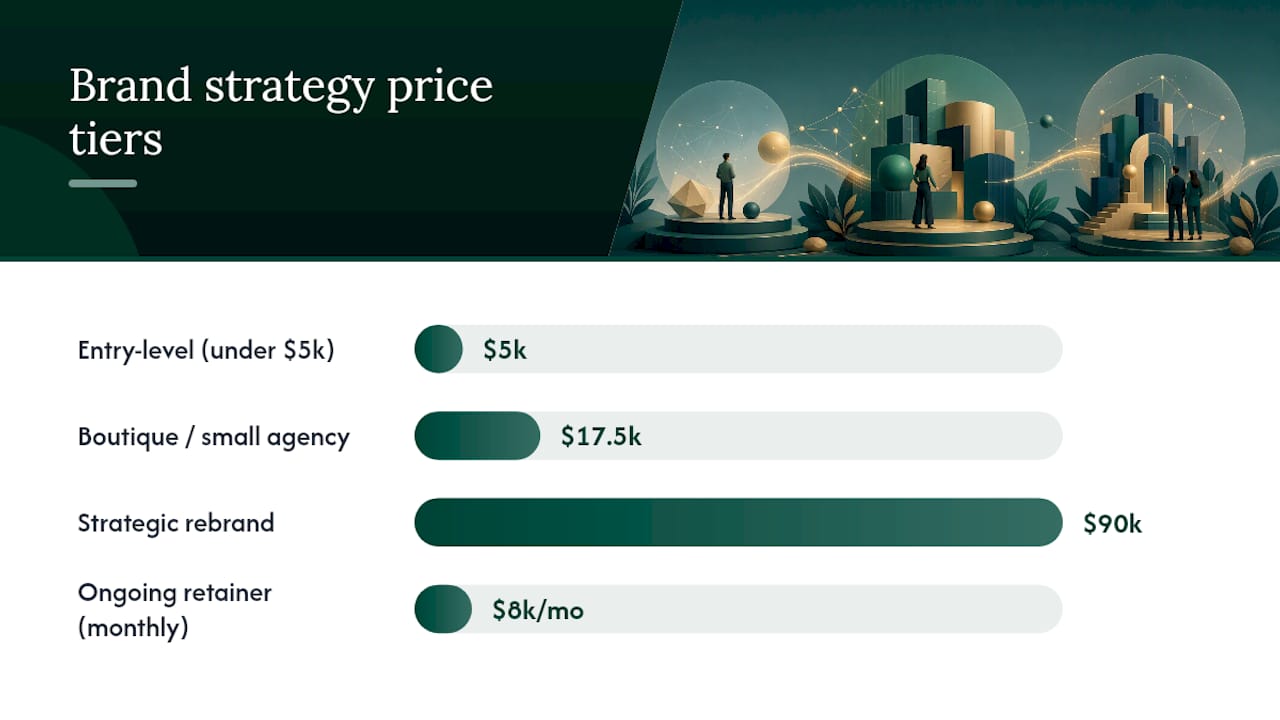
Ongoing retainers ($1,000 to $15,000 per month) can include services like small business SEO to help further execute your brand strategy. Once the core strategy is built, many businesses keep a strategist or small team on retainer to guide execution, refine messaging as the market shifts, and audit brand consistency across new channels. Clutch’s pricing data shows retainer structures scaling with the number of deliverables and touchpoints involved.
Deliverables and price move together in a fairly predictable way:
- Entry-level: positioning statement, light research, basic messaging
- Boutique: discovery, one to two workshops, messaging framework, logo or visual refresh
- Strategic: deep research, naming, full identity system, brand guidelines, rollout support
- Retainer: ongoing strategic guidance, brand audits, campaign alignment
Hourly rates track the same pattern. US brand strategists typically bill $100 to $300 per hour, with agency rates clustering around $100 to $149 per hour according to Clutch. Costs scale fastest once you add stakeholder workshops, multiple rounds of naming, or a large asset library, since those line items eat hours in a way a simple positioning refresh never does.
What Actually Drives the Cost of a Branding Project?
Every branding invoice breaks down into a handful of components, and understanding what each one actually takes to produce helps you spot padding in a proposal.
- Discovery and research (10 to 20 hours typical): stakeholder interviews, competitive audits, customer surveys
- Positioning and messaging (15 to 30 hours): defining your differentiation, writing core message pillars, testing language with real prospects
- Naming (10 to 40 hours, if in scope): trademark screening alone can eat a third of this
- Visual identity (20 to 60 hours): logo, color, typography, and the guidelines that keep it consistent
- Rollout and implementation (varies widely): applying the new brand across your website, sales decks, packaging, and signage
Clutch’s aggregated data puts average agency hourly rates for branding work at $100 to $149, with a typical full project landing around $71,652 and stretching across roughly eight months from kickoff to launch.
Vendor type changes these numbers more than most business owners expect. A solo freelancer might charge $75 an hour but take twice as long on research because they’re doing every task themselves. A boutique agency built for this work often moves faster because specialists handle research, writing, and design in parallel, even if the blended rate looks higher on paper. Full-service agencies carry more overhead, project management layers, and account staff, which is part of why their rates commonly sit at the top of the $100 to $149 hourly band or beyond.
One thing that catches business owners off guard: US hourly bands run noticeably higher than what agencies overseas often quote for comparable work. That gap explains a lot of the sticker shock when a US founder gets a lowball bid from an offshore vendor and a completely different number from a domestic strategist.
How Do You Choose the Right Budget and Investment Level?
Picking the right tier isn’t about finding the cheapest option that technically checks the box. It’s about matching spend to what your business actually needs right now.
- Assess your stage and urgency. A pre-seed startup validating a market needs a sprint, not a six-figure identity system. A company facing a competitive threat or a confusing market position needs deeper strategic work now, even if it costs more.
- Weigh revenue against complexity. A single-product company with a clear buyer needs less research than a multi-segment business selling to three different buyer types.
- Vet vendors on process, not just price. Ask what discovery looks like, how many revision rounds are included, who owns the final files and IP, what the implementation handoff includes, and whether they can show real client outcomes, not just pretty logos.
- Decide staged versus big-bang. Staging spend across a sprint, then a full identity phase, then rollout, lets you validate direction before committing the bigger check.
BCG’s pricing research frames the smartest spending decisions around where cost, competition, and customer value intersect, which is exactly how brand budgets should work too. Don’t spend heavily on visual polish if your real problem is that customers don’t understand what you sell.
Build in a 10% to 15% contingency for scope creep, because it almost always shows up.*
What Do Sample Brand Strategy Budgets Look Like?
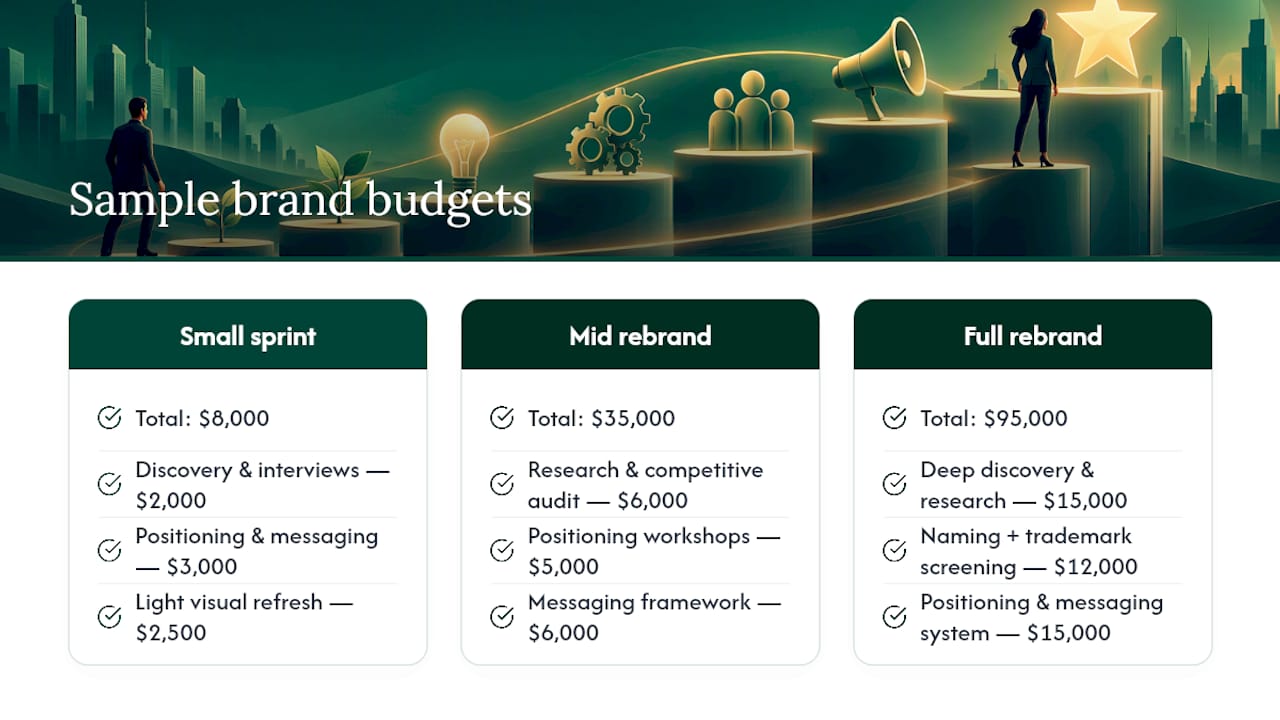
Concrete numbers help more than percentages when you’re building a proposal for leadership. Here’s how three real-world scopes typically break down.
Small business sprint (total: roughly $8,000). Discovery and stakeholder interviews ($2,000), positioning and messaging ($3,000), light visual refresh ($2,500), one round of revisions ($500).
Mid-market rebrand (total: roughly $35,000). Research and competitive audit ($6,000), positioning workshops ($5,000), messaging framework ($6,000), full visual identity ($12,000), brand guidelines ($4,000), implementation support ($2,000).
Strategic full rebrand (total: roughly $95,000). Deep discovery and customer research ($15,000), naming with trademark screening ($12,000), positioning and messaging system ($15,000), comprehensive visual identity ($25,000), brand guidelines and asset library ($10,000), multi-channel rollout ($18,000).
Costs typically expand beyond these totals when a project adds international trademark searches, packaging design, or a large multi-location rollout, since each of those introduces its own specialist fees.
How Long Does Brand Strategy Take and What ROI Should You Expect?
Timelines scale with scope in a fairly predictable way. A focused brand sprint runs four to six weeks. A positioning engagement with workshops and messaging development takes six to twelve weeks. A full rebrand with naming, visual identity, and rollout commonly takes three to six months, sometimes longer when trademark clearance or a multi-market launch is involved.
ROI shows up on two different clocks. Short term, watch:
- Lead quality and inbound inquiry relevance
- Conversion lift on your website or sales materials
- Campaign performance once new messaging goes live
Longer term, track pricing power, customer retention, and lifetime value. Stripe’s pricing research makes the connection explicit: how a brand is positioned directly shapes what customers are willing to pay and how they perceive value, which is exactly why strong identity work correlates with pricing leverage over time. Recognizable brands also carry a measurable awareness advantage, as consumer recognition surveys of top US logos illustrate. Build KPIs and milestone checkpoints directly into your contract so you’re not guessing whether the investment worked six months after the invoice clears.
Why Author Experience and Frameworks Matter for This Estimate
Pricing guidance means little without a framework connecting spend to outcomes. Quincy Samycia built The Golden Spiral™ and Brand-Backed Performance™ around a specific premise: brand strategy only earns its budget when it’s tied to measurable business performance, not just visual polish. That’s the lens behind every tier and line item above. Quincy’s approach through The Branded Agency treats positioning as a growth lever connecting product, marketing, and sales, which is why the higher-tier budgets above assume implementation support, not just a deliverable handoff.
Where Business Owners Overspend on Brand Strategy
The biggest overspend trap is buying a full visual identity system before positioning is solid, which means paying twice when the logo has to change anyway. The second is skipping stakeholder workshops to save money, which produces a brand nobody internally believes in. The third is treating a rebrand as one big-bang purchase instead of staging it. If a vendor can’t explain their process or won’t discuss who owns your files, walk away.
— Quincy
Get Expert Guidance on Your Brand Strategy Investment
Most businesses either overpay for a rebrand they didn’t need or underinvest in the positioning work that actually drives pricing power and customer acquisition. Quincysamycia connects brand strategy directly to measurable growth outcomes, using frameworks like The Golden Spiral™ to make sure every dollar spent on positioning, messaging, or identity ties back to performance you can track, not just assets you can admire.
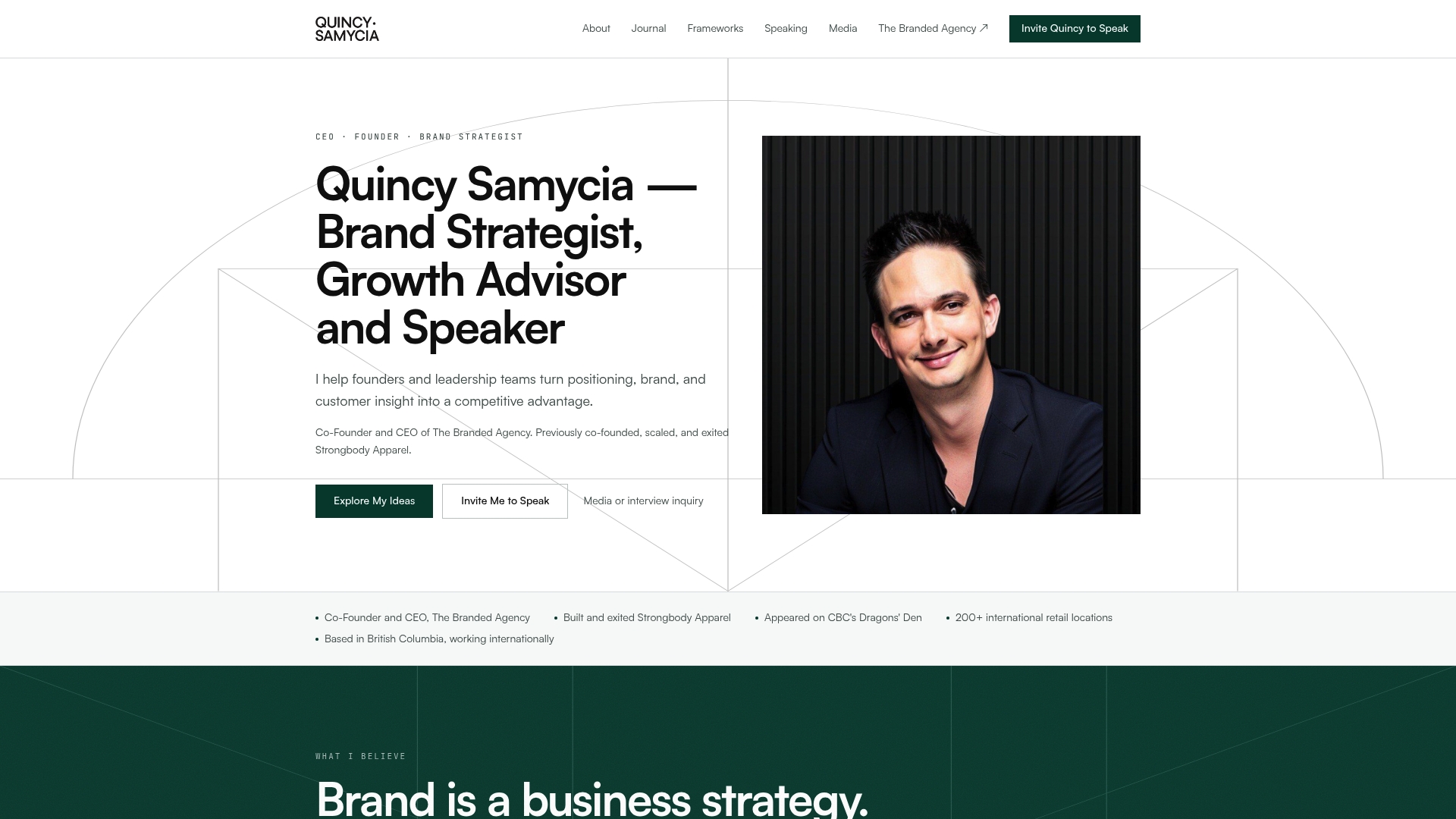
Quincy’s services span brand strategy, positioning, go-to-market planning, and executive advisory, so whether you need a focused sprint or a full rebrand roadmap, the scope is built around your actual growth stage rather than a one-size-fits-all package. If your team is weighing a speaking engagement or workshop as part of a broader brand initiative, speaking availability is worth exploring too. The next step is simple: reach out through the Quincysamycia site to discuss your scope and get a proposal built around your specific budget and timeline.
Sources
- Branding Pricing Guide — Clutch
- Brand Strategist Cost 2026 — WhatShouldICharge
- The unified theory of pricing — BCG
- Branding costs breakdown — DesignRush
FAQ
What Is the 3-7-27 Rule in Branding?
The 3-second rule describes how long it takes a consumer to form a first impression of a brand. Brand recognition usually requires multiple consistent exposures over time before recall solidifies. It’s used informally to argue for consistent, repeated brand touchpoints rather than a one-time launch push.
Is $500 Too Little for a Logo?
For a standalone logo with no strategy work behind it, $500 can buy a usable mark from a freelancer, though it typically won’t include research, multiple concepts, or a full guidelines document. If the logo needs to reflect real positioning and messaging work, pair it with a strategy phase, since entry-level branding engagements with research start closer to $5,000.
What Are the 5 C’s Relevant to Branding?
Frameworks vary here, so there’s no single universal “5 C’s” of branding, but common versions include company, customers, competitors, collaborators, and climate (market context). Treat any version as a starting checklist for discovery research rather than a rigid formula.
Do I Own the Logo if I Pay Someone to Design It?
Ownership depends entirely on the contract, not on payment alone. Most professional agreements transfer full copyright to the client upon final payment, but some freelancers retain rights or license usage instead, so confirm IP ownership terms in writing before the project starts.
How Much Does Quincysamycia Charge for Brand Strategy?
Pricing for Quincysamycia’s brand strategy, positioning, and advisory services is scoped to each engagement and available on request. Reach out through the Quincysamycia site for a proposal matched to your budget and growth stage.