
Ship Brand Strategy: 5 Deliverables With Templates and a Phased Plan
Every brand strategy engagement should hand you five things: a discovery or brand audit, a positioning statement, a messaging architecture, a set of brand guidelines covering visual and voice, and a rollout plan with real assets. Skip any one of these and you get an expensive workshop instead of a working strategy. This guide breaks down what belongs in each deliverable, what’s essential versus optional, and how to scope the work by timeline and budget.
TL;DR:
- Every brand engagement must include a discovery or brand audit along with a clear, testable positioning statement to prevent guessing and misalignment.
- A messaging architecture should translate the positioning into practical language with supporting proof points, and governance rules must be attached to ensure consistency and maintenance.
- Identity deliverables, such as logos, colors, typography, and tone of voice, require strict usage rules and should extend to physical brand assets if applicable.
- Activation deliverables like rollout plans, content templates, and channel asset specs are essential for executing strategy consistently across channels and markets.
- Connecting deliverables to measurable outcomes, with clear ownership and procedural governance, ensures brand work impacts real business metrics rather than remaining superficial or unused.
Table of Contents
- The Brand Strategy Deliverables Checklist: Essential vs. Optional
- What Counts as a Brand Strategy Deliverable, and Why It Matters
- Core Strategy Deliverables: Discovery, Positioning, and Messaging
- Identity Deliverables: Visual and Voice Systems
- Activation Deliverables: Rollout Plans and Channel Assets
- Scoping Brand Strategy Deliverables: Timelines and Costs
- Putting Deliverables to Work: Handoffs and Governance
- Copyable Templates: Briefs, Messaging Maps, and Rollout Plans
- Connecting Deliverables to Measurable Outcomes
- What I’d Prioritize by Company Stage
- Work With Quincy Samycia to Build and Implement These Deliverables
- Sources
- FAQ
The Brand Strategy Deliverables Checklist: Essential vs. Optional
Not every project needs every deliverable, and treating a rebrand and a quick positioning refresh the same way wastes money on both ends. Here’s how to sort the essential from the nice-to-have based on what stage your brand is actually at.
Essential (every engagement needs these):
- Brand audit / discovery summary — the evidence base for every decision that follows; skipping this means guessing.
- Positioning statement — a single, testable sentence defining who you serve and why you win.
- Messaging architecture — the pillars, proof points, and language that make positioning usable by sales and marketing.
- Brand guidelines (visual + voice) — the rules that keep every team’s output looking and sounding like one brand.
- Rollout / activation plan — the phased plan that gets the strategy off the page and into channels.
Recommended (add for most mid-size or growth-stage projects):
- Competitive and category mapping — a perceptual map that shows exactly where you’re differentiated versus assumed.
- Content templates (homepage hero, sales deck opener, campaign brief) — reusable so teams stop rewriting from scratch.
- Governance playbook — approval flows and version control so the guidelines don’t rot in a shared drive.
Optional (situational, based on scale or complexity):
- Full design system — beyond guidelines, for teams shipping product UI or many packaging SKUs.
- Internal brand training program — worth it once you have more than a handful of people touching brand assets.
- Executive workshop series — useful when leadership alignment is the actual blocker, not the creative work.
A pure launch project usually needs everything in the essential tier plus governance. A rebrand demands deep discovery and a longer activation runway. An iterative refresh might only need updated messaging and a lighter guidelines pass.
What Counts as a Brand Strategy Deliverable, and Why It Matters
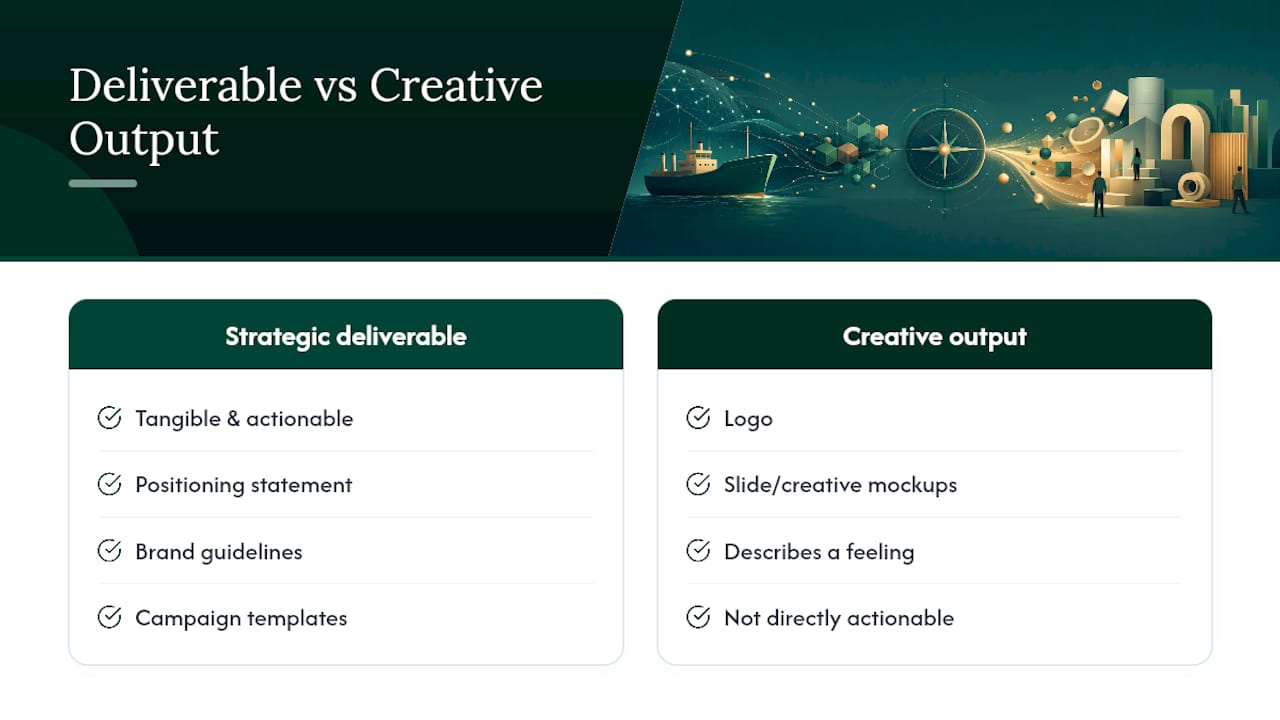
A brand strategy deliverable is any tangible output, document, or system that turns a strategic decision into something a team can actually use. That includes documents like a positioning statement, systems like brand guidelines, templates like a campaign brief, and governance rules like an approval workflow. If it can’t be handed to someone and acted on, it isn’t a deliverable. It’s a slide.
The point of the deliverable is to support decisions across functions that rarely talk to each other. Marketing needs messaging that doesn’t contradict what sales is saying on calls. Product needs positioning language that matches what’s actually being built. Hiring needs voice guidelines so a new copywriter doesn’t have to reverse engineer the brand from old blog posts. A strong brand strategy has to be practical enough to produce decision rules, not just describe a feeling.
There’s a real difference between strategic artifacts and creative outputs, and conflating them is one of the more common mistakes teams make when scoping a project. A positioning statement is a strategic artifact. A logo is a creative output. Both are necessary, but they’re not interchangeable, and an agency that jumps straight to logo concepts without a positioning deliverable is building the creative on sand. You need the strategic layer first because it’s what the creative team, and later the content team, and later the sales team, all get evaluated against. Without it, feedback on creative work becomes a matter of taste instead of a check against agreed criteria.
This is also where a lot of brand projects quietly fail. The strategy deck gets presented, everyone nods, and then nothing changes because the deliverable never got translated into a rule anyone has to follow. A brand strategy that can’t be tested against a real decision, a real headline, a real sales objection, is decoration.
Core Strategy Deliverables: Discovery, Positioning, and Messaging
The strategic layer of a brand project has four parts, and each one builds on the last.
Discovery and brand audit. This deliverable should include stakeholder interviews (leadership, sales, customer success), customer interviews, a brand perception analysis, and a SWOT built from evidence rather than assumption. The output is usually a findings summary, not a pretty document. It exists to surface where internal perception and customer perception diverge, which is almost always wider than leadership expects.
Competitive and category mapping. A perceptual map plots competitors against the two or three attributes customers actually weigh when choosing (price versus trust, simplicity versus power, and so on). This isn’t decoration. It’s the tool that tells you whether your intended differentiator is actually open territory or already claimed by three other companies.
Positioning statement. The format that holds up best under pressure is simple: for [ideal customer] who [has this problem], [brand] is the [category] that [differentiator], because [proof]. One sentence. If your positioning statement needs a paragraph to explain, it’s not done yet. Positioning is a decision, not a tagline exercise, and it should read like a choice you’re prepared to defend, not a wish list of adjectives.
Messaging architecture. This is where positioning becomes language people can actually use. A working messaging system needs a hero proposition, three to four supporting pillars, and proof points and objection-handling language that transfers cleanly to sales and product surfaces. Each pillar should carry at least one concrete proof point, whether that’s a case study, a metric, or a testimonial, because a pillar with no evidence behind it is just a claim waiting to be challenged.
- Hero proposition: one sentence, the single thing you want remembered.
- Three to four pillars: the supporting reasons the hero claim is true.
- Proof point per pillar: a number, a case, or a named result.
- Elevator lines: 10 second, 30 second, and two minute versions for different rooms.
None of this is useful without decision rules attached. A good positioning deliverable includes governance items: who approves messaging changes, how often the statement gets revisited, and what triggers a re-test (a new competitor, a pivot, a plateau in win rates).
Pro Tip: Before you sign off on a positioning statement, run it against four real surfaces: your homepage hero, your sales deck’s opening slide, a LinkedIn company header, and your onboarding email. If the language doesn’t fit naturally into all four, the positioning is still too abstract to ship.
A typical strategy engagement for a mid-market company takes 4 to 8 weeks to move through this stage, assuming stakeholder interviews don’t stall out. That timeline holds up well for a company in the $2 million to $20 million revenue range. Larger organizations with more approval layers should expect it to stretch.
Identity Deliverables: Visual and Voice Systems
Identity deliverables are where strategy becomes something people see and hear, and the level of detail here determines whether your brand looks consistent across twelve channels or falls apart the moment a freelancer touches it.
A logo system deliverable isn’t just the mark. It needs usage rules, minimum clearspace, and every legitimate variation (horizontal, stacked, icon-only, one-color) specified with exact proportions. Without this, someone in six months will stretch the logo to fit a banner ad and nobody will stop them because the rule was never written down.
Color and typography need the same rigor. A palette deliverable should specify primary and secondary colors with exact hex or Pantone values, plus accessible contrast pairings so text stays readable on brand backgrounds. Typography needs a defined scale (heading sizes, body sizes, line heights) and rules for when the display font gets used versus the workhorse text font.
Photography and art direction guidelines matter more than most teams budget for. This deliverable should include example images that represent the brand’s mood, framing, and lighting, plus a short list of what to avoid (stock photo clichés are the usual offender). Pair this with tone of voice rules: three or four adjectives that describe how the brand sounds, backed by before-and-after microcopy examples so a copywriter can see the difference between generic and on-brand in practice.
Here’s where scope decisions matter. Full brand guidelines cover the essentials above and are enough for most companies running marketing, sales collateral, and a website. A full design system, with component libraries, UI patterns, and interaction states, is only necessary if you’re shipping a product interface or managing dozens of packaging SKUs. Commissioning a design system when you just need guidelines is a common way projects blow their budget.
- Logo usage and variation rules.
- Color palette with accessible contrast pairings.
- Typography scale and hierarchy rules.
- Photography and art direction reference set.
- Voice adjectives with real microcopy examples.
If your brand shows up on physical goods (uniforms, event materials, packaging), the guidelines deliverable should extend to those touchpoints too. A partner resource like Cwear’s blog on corporate presentation is a useful reference for teams working through how branded apparel and physical materials should carry the same visual rules as the digital assets.
Activation Deliverables: Rollout Plans and Channel Assets
Strategy and identity mean nothing if nobody executes them consistently. Activation deliverables are the practical artifacts that get a brand strategy out of the guidelines document and into the market.
- Launch or rollout plan. This should name phases (soft launch, full launch, sustain), assign an owner to each channel, and set measurement KPIs upfront, not after the campaign runs. A rollout plan without an owner attached to each line item is a wish list.
- Content templates. Homepage hero copy, a sales deck opening slide, an email sequence outline, and a campaign brief template all belong here. These exist so every new campaign doesn’t start from a blank page and drift from the messaging architecture.
- Channel asset specs. Social creative templates (dimensions, safe zones, logo placement), display ad specs, and packaging rules if physical products are involved. Specificity here prevents the classic problem of five people making five slightly different versions of the same ad.
- Governance artifacts. A brand playbook that consolidates the guidelines into something a new hire can read in twenty minutes, a short training session for teams touching brand assets regularly, and an approval flow that says who signs off on what.
The commercial upside of getting this stage right is real. One documented rebrand case, Vivantis’s redesign, saw a 30% sales increase after launch specifically because the identity work and the retail rollout were built to reinforce the same strategic decisions rather than treated as separate projects. That’s the pattern worth copying: identity and activation succeed together or fail together.
Scoping Brand Strategy Deliverables: Timelines and Costs
Budgeting a brand project starts with matching scope to what you’re actually trying to fix. A quick positioning sprint (audit plus positioning plus a lightweight messaging pass) is the fastest path and usually the right call when the core issue is a confused pitch, not a broken identity. A full strategy and identity project adds the visual and voice system on top. An enterprise rollout adds multi-market activation, governance training, and often a longer stakeholder alignment phase before any creative work starts.
Timelines follow project complexity fairly predictably. A typical mid-market engagement runs 4 to 8 weeks for the strategic deliverables (audit through messaging), with usable outputs appearing within 30 to 90 days of kickoff. Add identity work and expect another 4 to 6 weeks depending on the complexity of the visual system. Activation and rollout timelines vary the most, since they depend on how many channels and markets you’re launching into simultaneously.
What actually drives cost:
- Research depth: a handful of stakeholder interviews costs far less than customer research across multiple segments and geographies.
- Number of channels: three channels versus fifteen is not a linear cost increase, it’s closer to exponential once you add asset variations.
- Asset complexity: a static logo system is cheap relative to a full component-based design system.
- Stakeholder alignment: more decision makers means more rounds of revision, and revision rounds are where budgets quietly balloon.
Phasing the work protects both budget and quality. A reasonable minimum viable sequence looks like this: Phase 1 delivers the audit and positioning statement so leadership can align on direction before spending on creative. Phase 2 delivers messaging architecture and core identity assets (logo, color, type). Phase 3 delivers the rollout plan and channel-specific templates. Each phase should have its own minimum viable deliverable rather than waiting for one giant reveal at the end.
On staffing, the split usually works like this: internal teams own the customer relationships that feed discovery interviews, final approval authority, and day-to-day governance once guidelines ship. An outside advisor or agency typically owns the audit synthesis, the positioning and messaging drafting, the identity system, and the initial rollout plan structure. Presenting these tradeoffs to leadership clearly up front, rather than discovering budget gaps mid-project, is what separates smooth engagements from the ones that stall at the halfway mark.
Putting Deliverables to Work: Handoffs and Governance
A deliverable that sits in a shared drive without an owner is worse than no deliverable at all, because it creates a false sense that the brand problem is solved. Getting the handoff right matters as much as producing the document.

Every deliverable needs a named recipient and a next action attached. The positioning statement goes to marketing leadership and sales enablement, with the next action being a sales script update. The brand guidelines go to design and any external creative vendors, with the next action being a template audit of existing materials. The rollout plan goes to whoever owns each channel, with the KPI dashboard as the next action.
Governance checklist to keep the brand from drifting after launch:
- Schedule a guidelines refresh review at least once a year, sooner if the market shifts.
- Assign one person as the approval gatekeeper for anything customer-facing.
- Keep version control on the guidelines document itself; date every revision.
- Run a short training session whenever more than two new people join teams that touch brand assets.
- Revisit positioning if win rates plateau or a new competitor enters your category.
The most common failure mode isn’t bad creative work. It’s an abstract deliverable with no owner. A positioning statement nobody was assigned to implement gets forgotten within a quarter. The fix is almost always procedural rather than creative: assign the owner before the deliverable is even finished, not after.
Pro Tip: Test every strategic deliverable against a real surface before calling it done. If your positioning statement can’t be dropped into a homepage headline or a cold email opener without heavy rewriting, it’s still too abstract to hand off.
Copyable Templates: Briefs, Messaging Maps, and Rollout Plans
Having the structure in front of you beats staring at a blank document. These skeletons are meant to be filled in, not admired.
Positioning brief fields: ideal customer profile, the specific situation or problem they’re in, the promise your brand makes, the proof that backs the promise, and the call to action or next step you want them to take.
Messaging map (filled with placeholders):
| Element | Placeholder content |
|---|---|
| Hero proposition | “[Brand] helps [audience] achieve [outcome] without [common pain point].” |
| Pillar 1 | Speed: proof point = case study or benchmark |
| Pillar 2 | Reliability: proof point = customer retention stat or guarantee |
| Pillar 3 | Simplicity: proof point = time-to-value metric |
| Objection response | “Isn’t this just [competitor category]? Here’s the difference: [proof].” |
Brand guideline skeleton: brand story summary, logo usage rules, color palette with hex codes, typography scale, photography direction, voice adjectives with example copy, and a governance/approval section.
Rollout plan skeleton:
| Phase | Owner | Channel | KPI | Target date |
|---|---|---|---|---|
| Soft launch | Marketing lead | Email + owned social | Open rate, engagement | Week 1 |
| Full launch | Cross-functional lead | Paid + PR + web | Traffic, conversion lift | Week 3 |
| Sustain | Channel owners | All active channels | Retention of messaging consistency | Ongoing |
Connecting Deliverables to Measurable Outcomes
Deliverables only matter if they move a number leadership cares about, and that’s the gap most brand strategy work never closes. The Golden Spiral™ framework prioritizes deliverables in sequence, so teams build the audit and positioning before spending on identity work that would otherwise have to be redone. Brand-Backed Performance™ takes it a step further by choosing the KPIs first (win rate, sales cycle length, retention) and designing each deliverable specifically to move one of them, rather than producing generic brand assets and hoping they help.
This is the difference between a brand project that produces a nice-looking guidelines PDF and one that changes how a sales team closes deals. Quincy’s proprietary frameworks were built around advisory work with organizations running more than 200 international retail locations, where the cost of a vague deliverable shows up fast in comp store performance, not just brand perception surveys.
What I’d Prioritize by Company Stage
If you’re a startup, skip the full design system and put your budget into a sharp positioning statement and a messaging architecture that survives a sales call. Growth stage companies need the rollout plan and governance playbook more than they think; that’s usually where the drift starts. Enterprises should spend the most time on stakeholder alignment before any creative work begins, because a beautiful guidelines document that three divisions ignore is a wasted budget.
The tradeoff executives struggle with most is sequencing: they want identity work first because it’s visible, but audit and positioning have to come first or the identity gets rebuilt anyway. Present the roadmap in phases with a minimum viable deliverable per phase, and tie each phase to a KPI leadership already tracks. That’s what gets budget approved twice, not just once.
— Quincy
Work With Quincy Samycia to Build and Implement These Deliverables
Most teams don’t need more brand assets sitting unused in a drive. They need someone to sequence the deliverables, tie each one to a metric, and make sure the guidelines actually change behavior across product, marketing, and sales. This approach is designed to close the gap between generic strategy decks and actionable plans by ensuring that audits, positioning, messaging, and rollout plans are aligned with measurable business outcomes from the start.
A typical engagement starts with a short diagnostic conversation about where your brand strategy is stalling, whether that’s a positioning problem, a rollout that’s fallen apart, or guidelines nobody follows. From there, Quincy scopes the specific deliverables your stage actually needs, not the full list by default. If your team is weighing a workshop format for leadership alignment versus a retained advisory relationship, the speaking and workshop page covers what those sessions look like in practice. For a full look at the frameworks behind the approach, visit the brand strategy frameworks page and book a diagnostic call to see which deliverables should come first for your business.
Sources
- Brand Strategy Package: What Should Be Included - DesignX
- Brand Strategy: The Complete Guide for Business Leaders in 2026 | MarkCMO
- Brand strategy 101: A marketing pro explains the important elements of a company branding plan
FAQ
What Are the 7 Key Elements of Brand Strategy?
A widely used model includes purpose, positioning, consistent presence, emotional connection, flexibility, employee advocacy, and competitive awareness, though different frameworks group these slightly differently. The key requirement across every version is that these elements translate into decision rules, not just descriptive language.
What Are the 5 Pillars of Brand Strategy?
Most practical models converge on five: who you serve, what position you occupy, why you win against alternatives, how you prove it, and what your brand sounds and looks like. These five map directly to the discovery, positioning, proof point, and identity deliverables covered above.
What Are the 4 C’s of Brand Strategy?
Definitions vary across sources, but a common version centers on clarity, consistency, credibility, and connection, essentially a shorthand check for whether your deliverables are usable, applied uniformly, backed by proof, and resonant with your audience.
What Are Some Examples of Brand Strategy Deliverables?
Common examples include a brand audit summary, a positioning statement, a messaging architecture document, full brand guidelines covering visual and voice rules, and a rollout plan with channel-specific templates. Frameworks like Quincy Samycia’s Golden Spiral™ sequence these deliverables so each one builds toward a measurable outcome instead of sitting as a standalone document.