One Page KPI Map for CMOs to Link Brand and Performance Marketing
Brand marketing builds long-term customer preference, and performance marketing drives immediate, measurable actions. Both are necessary, and the real work is not choosing between them but measuring them together. Brand spend compounds over years; performance spend converts demand that already exists. The practical move for 2026 planning is to align your measurement stack and budget cadence so both get credit for what they actually do.
TL;DR:
- A 1% increase in brand awareness correlates with a 0.4% lift in sales in the short run and a 0.6% lift over the long run.
- The 60/40 brand to performance split suits established, stable businesses as a starting point; new launches need more brand, while mature products may favor performance.
- Marketing mix modeling estimates channel contributions over time, lift studies test campaign effects, and digital touchpoint attribution misses much offline and upper funnel influence.
- Brand and performance teams should share a planning calendar and KPI, such as customer lifetime value or contribution margin, and review both dashboards together.
- Budget decisions should use marginal return on marketing investment, which measures the return from the next dollar rather than the average across past spending.
Table of Contents
- What brand marketing and performance marketing actually mean
- Key differences at a glance
- How channels map to the funnel, and why that map is incomplete
- Measuring what matters: ROMI, CLV, MMM, and reporting to the C-suite
- Deciding where to put the next marketing dollar
- Building the integration playbook: performance branding in practice
- How a brand-performance methodology ties strategy to measurable growth
- Why most integration efforts stall, and what has to change
- How we help teams turn this into an operating model
- FAQ
- Sources
What brand marketing and performance marketing actually mean
Brand marketing builds awareness, preference, and equity over time. It shapes how people feel about a company before they ever search for it, and its payoff shows up months or years later. Classic brand work includes television, public relations, sponsorships, and content campaigns built to shape perception rather than close a transaction.
Performance marketing works on a much shorter clock. It targets acquisition, leads, and conversions, and it lives on experiments: change the creative, change the bid, measure the lift within days. Search ads, direct response social, and programmatic retargeting are the usual tools, and success is judged by cost per acquisition or return on ad spend almost in real time.
The two disciplines overlap more than most org charts admit. Owned channels, creative assets, and customer data platforms increasingly serve both functions at once:
- A brand video can be cut down into a performance-ready retargeting asset.
- A customer data platform (CDP) built for performance targeting also feeds brand lift and segmentation analysis.
- Website and app experiences built for conversion still carry brand positioning in every pixel.
HBR’s analysis of brand and performance coordination treats this overlap as the starting point for better planning, not an exception to manage around.
Key differences at a glance
The clearest way to separate the two is by what each one optimizes for and who owns the number.
- Objective: brand marketing builds preference and recall; performance marketing drives a conversion or a lead.
- Timescale: brand effects play out over quarters and years; performance effects show up in days or weeks.
- KPIs: brand leans on awareness, consideration, and share of voice; performance leans on cost per acquisition, conversion rate, and return on ad spend.
- Creative focus: brand creative sells a feeling and a story; performance creative sells a specific offer with a clear next step.
- Team ownership: brand often sits with a chief marketing officer or brand lead; performance often sits with growth or demand generation.
- Reporting cadence: brand gets reviewed quarterly or annually; performance gets reviewed weekly or even daily.
A common myth is that brand is unmeasurable while performance is pure math. Brand tracking, lift studies, and marketing mix modeling all produce numbers, just on a longer timeline than a dashboard refresh.
How channels map to the funnel, and why that map is incomplete
Most marketers place channels on a funnel diagram: television and audio up top for brand, search and retargeting at the bottom for performance, with social and video spread across the middle. That map is useful for a kickoff meeting and wrong in practice, because a single channel can serve both jobs depending on the format and the audience.
The IPA’s effectiveness research frames media choices around three dimensions instead of funnel position: scale, efficiency, and time. A broad-reach channel can be less efficient per impression but scale profits further because it reaches people who were never going to search for the brand in the first place. A narrow, highly efficient channel caps out fast because it is only ever talking to people who already intend to buy.
Technology has made the old split less defensible. Customer data platforms, automatic content recognition on connected television, and identity resolution tools now let marketers track brand exposure through to a purchase event, closing a measurement gap that used to force brand and performance teams to report in entirely different languages.
Pro Tip: Before adding a new channel to the media plan, ask which of the three dimensions it is meant to win: reach, cost efficiency, or speed. A channel chosen for the wrong reason rarely survives the next budget review.
Measuring what matters: ROMI, CLV, MMM, and reporting to the C-suite
Return on marketing investment is the most requested number in any budget meeting, and it is also the most misused. A single blended ROMI figure hides which dollar is doing the work. AMA’s guidance on ROMI recommends marginal ROMI instead: the return on the next dollar spent, not the average return across everything already spent. That distinction changes budget decisions, because the next dollar into an already-saturated channel often returns far less than the average suggests.
Three measurement approaches fill different gaps:
- Marketing mix modeling (MMM) estimates the contribution of each channel, including brand channels, using historical spend and sales data over time.
- Multi-touch attribution (MTA) tracks digital touchpoints close to conversion but misses offline and upper-funnel influence almost entirely.
- Controlled experiments and lift studies isolate cause and effect for a specific campaign or channel when done well.
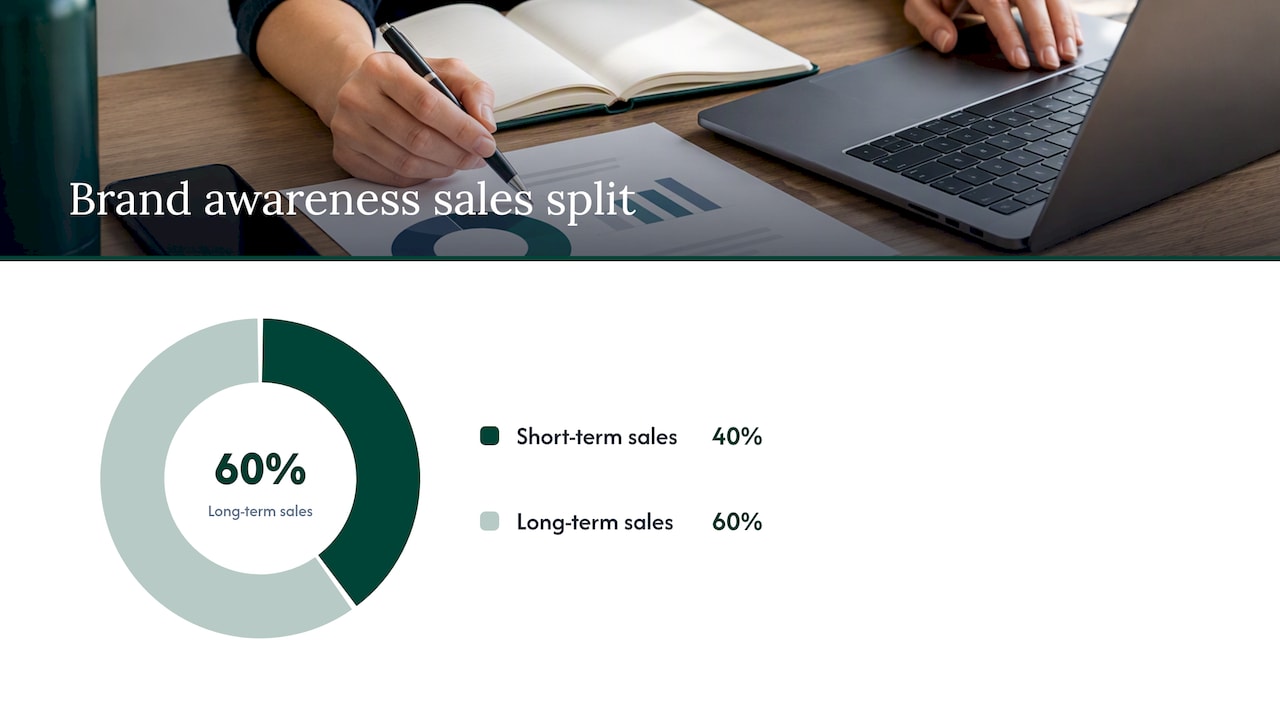
A 1% increase in brand awareness correlates with a 0.4% lift in short-term sales and a 0.6% lift in long-term sales. That single data point is the clearest evidence that brand spend is not a separate bucket from performance results; it feeds the same sales line on two different timelines.
When you report to a CFO, lead with customer lifetime value, marginal ROMI, and contribution to profit rather than impressions or click-through rate. Finance leaders fund what connects to the business model, and a channel’s effect on CLV makes a far stronger case than a cost-per-click chart.
Deciding where to put the next marketing dollar
The right split between brand and performance spend depends on where the business sits, not on a fixed formula. A few questions settle most of the debate before the budget meeting even starts.
- What stage is the product in: launch, growth, or maturity? New products usually need more awareness spend to create demand that does not yet exist.
- What is the customer lifetime value relative to acquisition cost? A high-LTV business can afford more patience on brand payoff.
- What are margins like? Thin margins favor the faster, more measurable return of performance channels.
- What are competitors doing right now? A competitor land grab in paid search can force a short-term performance response regardless of the long-term plan.
- How urgent is the growth target this quarter versus this year?
The familiar 60/40 brand-to-performance split, discussed in IPA’s recent effectiveness coverage, is a reasonable starting point for an established, stable business. It is not a rule. McKinsey’s performance branding research shows practitioners using marketing mix modeling to shift that ratio by lifecycle stage, weighting brand heavier at launch and performance heavier at maturity.
Building the integration playbook: performance branding in practice
Uniting brand and performance is an operating model change, not a slogan. The AMA’s guidance on brand and demand integration outlines three structural moves that make the shift stick.
First, the organization needs a shared goal and a joint planning calendar. When brand and performance teams set budgets on separate cycles and report to separate KPIs, every quarter becomes a negotiation instead of a plan. A single planning cadence, reviewed together, forces the trade-off conversation to happen early instead of after the money is spent.
Second, a marketing operations function or CDP ownership needs to sit between the two teams, not inside either one. That function owns the identity data, the measurement stack, and the shared reporting layer, which is what makes it possible to connect a brand impression on television to a purchase three months later.
Third, the measurement stack itself needs three layers working together: brand tracking and lift studies for upper-funnel effect, marketing mix modeling for channel-level contribution over time, and in-channel experiments for fast, tactical optimization. None of the three replaces the others.
A practical campaign checklist for integrated teams:
- Write creative briefs that serve both a brand message and a lower-funnel offer in the same asset family.
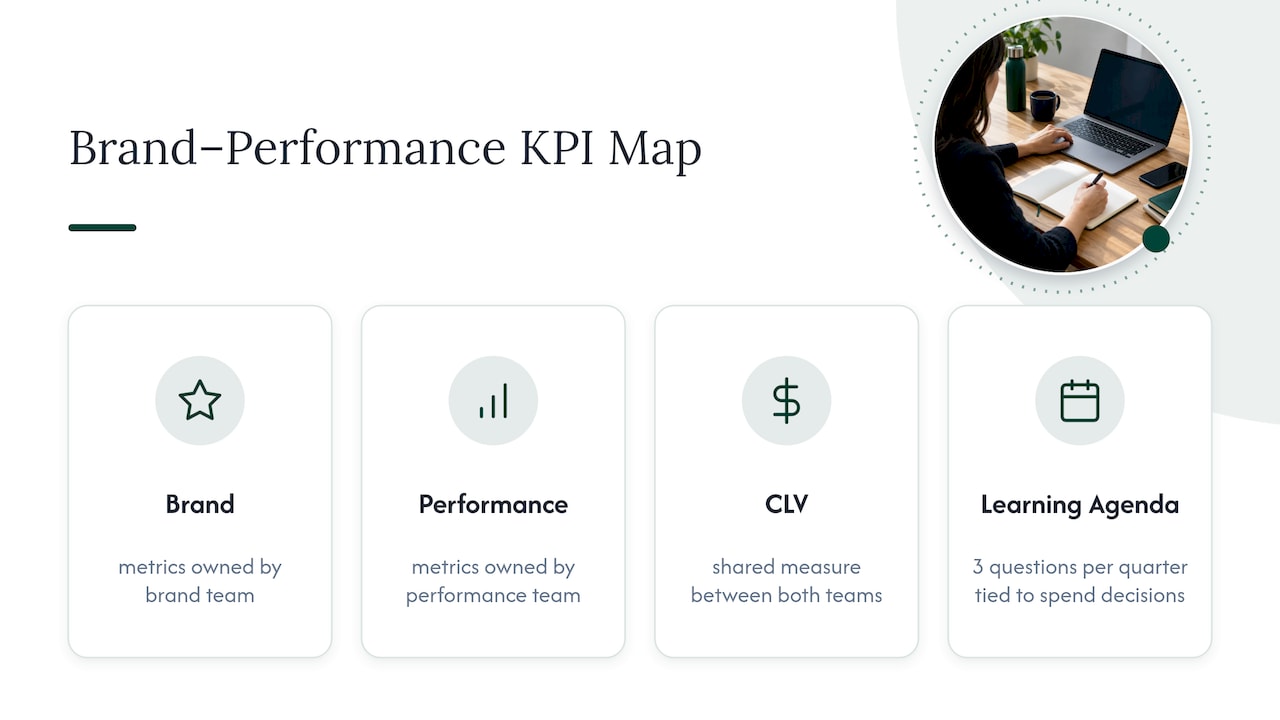
- Fund a quarterly learning agenda: a short list of specific questions the next round of spend is designed to answer.
- Review brand tracking and performance dashboards in the same meeting, not sequential ones.
- Set one shared KPI, such as CLV or contribution margin, that both teams report against.
Pro Tip: Give every major campaign a one-line learning agenda item before launch, something like “does extending reach into a new audience segment lift branded search volume.” A campaign without a question to answer rarely produces a usable answer.
How a brand-performance methodology ties strategy to measurable growth
The frameworks we use at The Branded Agency, including The Golden Spiral™ and Brand-Backed Performance™, start from the position that brand is a business strategy, not a marketing line item. Positioning work only pays off when product, marketing, and sales are pulling in the same direction, which is why a brand audit and a performance audit should never happen in separate rooms.
A one-page KPI map, naming which metric belongs to brand, which belongs to performance, and which one sits in the middle as a shared measure like CLV, resolves more budget arguments than another deck ever will. The same applies to a short learning agenda: three questions per quarter, each tied to a specific spend decision, keeps both teams honest about what the money is actually testing.
Why most integration efforts stall, and what has to change
The most common failure mode is not a lack of data: it is two teams reporting different numbers to the same executive and letting that executive pick a winner. Integration fails when brand and performance leaders treat the budget conversation as a competition rather than a shared forecast.
Leaders who get this right track a different set of signals after integration: branded search volume moving alongside paid campaigns, marginal ROMI improving as budgets shift by lifecycle stage, and a single planning document that both teams actually use. None of that requires new technology so much as a willingness to let one shared number, not two competing ones, define success.
— Quincy
How we help teams turn this into an operating model
Most organizations do not need another campaign idea. They need a structure that connects positioning, measurement, and go-to-market decisions so brand and performance stop competing for the same budget meeting. Through Brand Strategy, Brand Positioning, and Growth and Go-to-Market Strategy engagements, we work directly with founders and executive teams to build that structure: a shared KPI map, a planning cadence, and a measurement approach that ties brand work to the business outcomes a CFO actually cares about.
If your team is weighing where the next quarter’s budget should go, a workshop or keynote session is a practical place to start the conversation with your leadership team.
FAQ
What is the 3-3-3 rule in marketing?
The 3-3-3 rule is a planning heuristic used in some marketing teams to structure testing or content cadence, such as three channels, three messages, and three timeframes, though definitions vary by practitioner. It is not a standardized industry framework with a single authoritative source, so treat it as a planning aid rather than a fixed rule.
What are the five C’s of branding?
The five C’s commonly cited in branding discussions are company, customers, competitors, collaborators, and climate, used as a scan of the forces shaping a brand’s position. Definitions vary across sources, so treat the framework as a starting checklist rather than a fixed standard.
What are examples of performance marketing?
Performance marketing includes search engine ads, paid social campaigns built for direct response, programmatic retargeting, and affiliate or partner marketing, all optimized toward a measurable action like a sale or a lead. These channels are typically evaluated using cost per acquisition and conversion rate rather than brand recall. Partners that manage this work directly, such as PocketMarketer.ai’s customer acquisition engines for SaaS companies, focus on exactly these paid acquisition and conversion tactics.
What are the 7 pillars of branding?
Commonly referenced pillars of branding include purpose, positioning, personality, perception, promise, presentation, and performance, though the exact list varies between frameworks and authors. There is no single official version, so treat any seven-pillar list as one practitioner’s organizing structure rather than an industry standard.
Should a growing company spend more on brand or performance marketing?
The right split depends on product stage, margin, and customer lifetime value rather than a fixed ratio. A heuristic like 60/40 brand to performance is a reasonable starting point for an established business, but a new product launch typically needs heavier brand investment to create demand that does not exist yet.
Sources
- When it comes to brand building, awareness is critical — Nielsen
- Performance branding and how it is reinventing marketing ROI — McKinsey
- How brand building and performance marketing can work together — Harvard Business Review