
Map and Prioritize Category Entry Points with 7W Research and the 3C’s
Category entry points are the situations, needs, emotions, and occasions that trigger someone to consider a product category at all, and they matter because a brand’s mental availability, its likelihood of being noticed and bought, depends on how many of these triggers connect to it. Jenni Romaniuk and the Ehrenberg-Bass Institute tie CEP coverage directly to penetration, and teams track progress with a metric called mental market share.
TL;DR:
- Focusing on a small number of high-priority CEPs driven by credibility and competition offers better long-term growth than spreading efforts across many entry points.
- Using the 7W framework helps teams generate and map relevant situational cues, emotional states, and triggers specific to their category and audience.
- Validating CEPs through triangulation methods like surveys, interviews, and behavioral data ensures they reflect actual buyer behavior rather than just stated intentions.
- Building consistent brand-to-CEP links with repeated creative pairing in broad channels enhances recognition and supports sustained mental availability.
- Tracking mental market share and network size over time provides actionable insights into how well CEP strategies strengthen brand presence in key buying moments.
Table of Contents
- What category entry points are: types and examples
- The 7W framework for generating candidate CEPs
- How to identify CEPs in practice
- How to prioritize CEPs using the 3C’s
- Turning priority CEPs into creative content, assets, and channels
- Measuring CEP impact and tracking mental availability
- B2B considerations when mapping and activating CEPs
- Practitioner method: pairing CEP mapping with Brand-Backed Performance™
- Why CEP discipline wins the long game
- How Quincy Samycia can help with category entry point strategy
- Sources
- FAQ
What category entry points are: types and examples
A category entry point is any situational cue, internal or external, that makes someone think of a category before they think of a brand. CEPs operate as the basic unit of mental availability, and they tend to fall into recognizable groups.
- Functional: a practical need, like “my laptop battery died” or “we need a payroll system before year end.”
- Emotional: a mood or feeling, like wanting comfort food after a bad day or wanting to feel confident before a client pitch.
- Social: a shared moment, like hosting friends for dinner or presenting a proposal to a leadership team.
- Routine: habitual moments, like a Monday morning coffee run or a weekly vendor status call.
- Seasonal: calendar-driven triggers, like back-to-school shopping or fiscal-year budget renewals.
- Life-stage: major transitions, like moving into a first apartment or a company scaling past fifty employees.
Coverage needs both breadth and depth. Owning a handful of entry points deeply helps in the moments people already associate with your brand, but owning many entry points broadly is what keeps you in consideration across the full range of buying occasions, which is where most category volume actually sits.
The 7W framework for generating candidate CEPs
The W-questions give teams a repeatable prompt set for surfacing entry points before narrowing the list. This structure guides identification and mapping of CEPs so the output can later be scored and prioritized.
- Why: What need or goal starts the search? Example: “why” a business buys accounting software: to avoid tax penalties.
- When: What moment in time triggers it? Example: end of quarter, renewal deadline, product launch week.
- Where: What location or channel prompts the thought? Example: at a trade show, scrolling LinkedIn, in a retail aisle.
- With whom: Who else is involved? Example: buying with a co-founder, a spouse, or a procurement committee.
- With what: What else is being used alongside it? Example: paired with a CRM, a moving truck, a wedding venue.
- While: What else is happening at the same time? Example: while commuting, while onboarding new hires.
- How feeling: What emotional state surrounds the moment? Example: anxious before an audit, excited before a launch.
Run this as a workshop prompt set with cross-functional teams, sales included, and capture every raw answer before filtering.
How to identify CEPs in practice
Generating a long list is the easy part. Confirming which entry points actually exist among real buyers takes structured research, not guesswork.
- W-question surveys: field the seven prompts to a representative sample, code open-text answers into themes, then quantify how often each theme appears.
- Laddering interviews: ask “why does that matter” repeatedly to move past surface answers into the emotional or contextual drivers people rarely volunteer first.
- Search and social triangulation: cross-check survey themes against search query patterns and social listening to confirm they show up in unprompted behavior.
- Behavioral and transactional data: compare stated triggers against actual purchase timing and channel data to catch gaps between what people say and what they do.
Surveys alone tend to miss less articulated triggers, which is why laddering and mixed-data triangulation matter for surfacing emotional and contextual entry points that a checkbox question won’t catch. A market research partner like US Market Intelligence can support this kind of triangulation when internal teams lack the bandwidth for it.
Design a discovery study to generate the full CEP list, then a separate tracking study to monitor movement over time. Mixing the two goals in one instrument usually produces a list that’s too short for discovery and too noisy for tracking.
Pro Tip: Run laddering interviews before you finalize your survey questions, since the language people actually use should shape how you phrase the quantitative prompts.
How to prioritize CEPs using the 3C’s
Not every entry point deserves equal investment, and a scoring approach built on Credibility, Competitiveness, and Commonality helps teams sequence the work instead of spreading effort evenly.
- Credibility: can your brand plausibly deliver on this occasion, based on what you already sell and how you’re perceived?
- Competitiveness: how contested is this entry point, and do rivals already own the mental association?
- Commonality: how much category volume actually passes through this occasion?
Score each candidate CEP against the three criteria, plot them on a matrix, and let the pattern dictate sequencing: defend the entry points you already own, contest the high-volume ones still in play, and plant flags in low-competition space before rivals notice it. This turns a long brainstorm list into a short list worth funding.
Turning priority CEPs into creative content, assets, and channels
A prioritized CEP list only matters once it shows up in what people actually see and remember. Building durable brand-to-CEP links takes broad-reach creative that names the occasion directly and pairs it with a distinctive brand asset, repeated consistently across time.
- Name the occasion explicitly in the creative rather than implying it.
- Pair the occasion with a consistent distinctive asset, a color, sound, or character, so recognition builds over repeated exposure.
- Repeat the pairing across enough time and enough placements that it becomes automatic.
Broad-reach channels, brand television, wide social placements, and display, tend to outperform narrowly targeted performance media for this job, mainly because light category buyers drive most volume and narrow targeting rarely reaches them. Map each priority CEP to a specific asset and channel combination before production starts, and check that combination against your existing brand codes so the new work reinforces rather than fragments them. Storyline Pros documents examples of campaigns built around this kind of occasion-to-asset pairing.
Pro Tip: Build one asset-to-CEP map per quarter rather than per campaign, so creative teams aren’t reinventing the pairing logic every time a brief lands.
Measuring CEP impact and tracking mental availability
Mental market share, your share of the total brand-CEP links in a category, is the primary measure to track, alongside network size (how many distinct CEPs your brand connects to) and prompted or unprompted recall for each link.
- Track mental market share and network size through a recurring brand-tracking wave.
- Use share of search or branded search trends as a lighter proxy between full tracking waves.
- Run prompted brand-CEP link surveys to confirm which associations are strengthening or fading.
Share of search and prompted link surveys work as practical proxies when a full tracking study isn’t feasible every quarter, and treating CEP coverage as a continuous diagnostic rather than a one-time audit keeps the data useful. Movement on these metrics tends to be gradual, so set quarterly check-ins against directional movement and reserve firm targets for annual reviews.
B2B considerations when mapping and activating CEPs
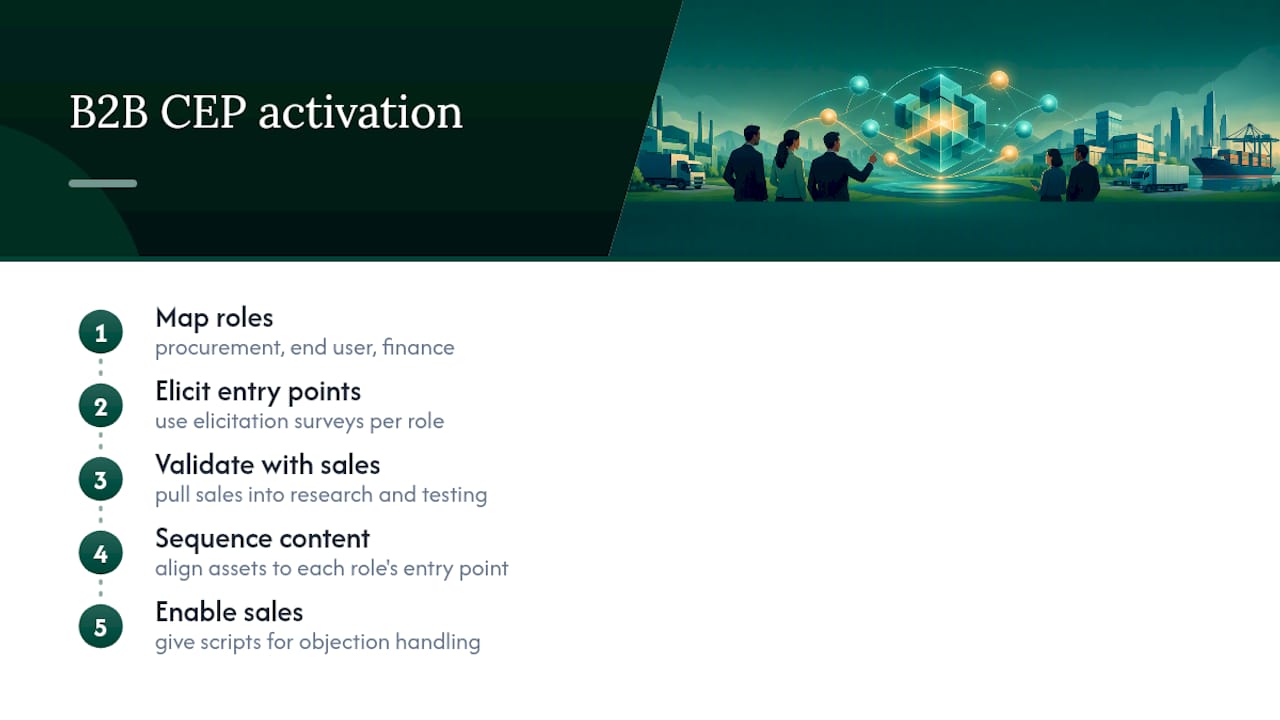
B2B categories complicate CEP work because purchase cycles stretch across months and multiple stakeholders weigh in before a deal closes. Elicitation-style surveys and role-based mapping account for this by asking each stakeholder type, procurement, end user, finance, about the entry points relevant to their part of the decision.
Sales teams are a direct line to validate which CEPs actually surface in live conversations, so pull them into the research rather than treating CEP work as a marketing-only exercise. Once roles are mapped, sequence content and demand-generation assets to meet each stakeholder at their own entry point, which also gives sales enablement a clearer script for objection handling.
Practitioner method: pairing CEP mapping with Brand-Backed Performance™
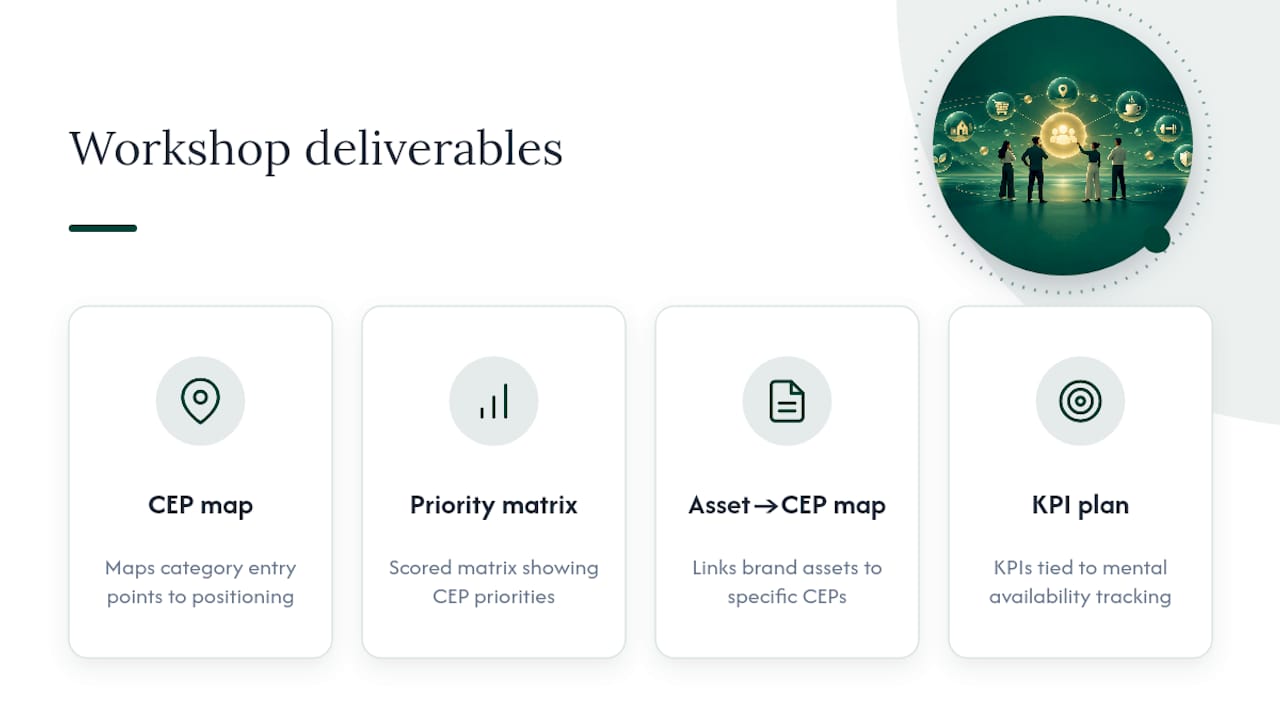
CEP mapping fits naturally into positioning as a decision rather than a slogan exercise, and Quincy Samycia’s Golden Spiral™ framework uses that same logic to connect entry points to brand claims. A typical workshop produces four deliverables: a CEP map, a scored priority matrix, an asset-to-CEP map and a KPI plan tied to mental availability tracking.
Why CEP discipline wins the long game
Most teams try to own every entry point at once and end up owning none of them clearly. The disciplined approach is breadth first, sequenced by the 3C’s, with creative effort concentrated on a short list rather than smeared across a long one. Spreading production budget thin across ten CEPs usually buys weaker recall than committing to three done well.
— Quincy
How Quincy Samycia can help with category entry point strategy
Turning a CEP map into a growth plan is where most internal teams stall, which is exactly where Quincy Samycia’s brand strategy and growth advisory work picks up. Engagements typically combine CEP workshops, priority scoring, and creative activation planning with a KPI plan that ties back to measurable business performance rather than brand metrics alone.
Clients working through this process typically leave with a scored CEP matrix, an asset map ready for production, and a tracking plan their team can run quarterly. Visit Quincysamycia to see the full range of services, or check the speaking page if you’re looking to bring this framework to a team offsite or conference.
Sources
- Category Entry Points Framework: Build Mental Availability Step by Step | Never Always, Never Never
- Category Entry Points in B2B: Linking Buying Situations to Brand Sales
- Category Entry Points — The Hidden Driver of Market Share
- Category Entry Points Research: What Starts the Shopping Trip
FAQ
What is a category entry point?
A category entry point is a situational cue, an internal need, an emotion, an occasion, or an external prompt, that triggers someone to think of a product category before they think of any specific brand. Brands that connect to more of these entry points tend to achieve greater market share because they’re mentally available in more buying moments.
What are the 7 W’s used to find CEPs?
The 7W framework prompts teams to ask why, when, where, with whom, with what, while, and how feeling about a buying occasion, generating raw material for a CEP list. This structure comes from CEP research applied to both consumer and business categories.
How do you prioritize which CEPs to target first?
Score each candidate CEP against credibility, competitiveness, and commonality, then sequence investment toward entry points your brand can credibly own, where competition is winnable, and where category volume is meaningful. This 3C’s approach turns a long brainstorm list into a short, funded plan.
How is CEP success measured?
The core measure is mental market share, your share of total brand-CEP links compared to competitors, tracked alongside network size and prompted recall for each link. Share of search and prompted link surveys serve as lighter proxies between full tracking waves.
Do category entry points work differently in B2B?
Yes, B2B buying involves longer cycles and multiple stakeholders, so CEP research uses elicitation surveys and maps entry points to specific buyer roles like procurement or end users. This role-based approach also helps align sales enablement content with the entry points that surface in live deals.