
CDP vs CRM: 3 Procurement Ready Scenarios for Marketing Leaders
A CDP unifies first-party behavioral data for activation, while a CRM is the operational system of record for contacts, deals, and service. Most sales-driven teams need a CRM first. Marketing teams managing anonymous traffic and personalization add a CDP, and multi-channel businesses typically need both, sequenced correctly. The sections below walk through the differences, decision criteria, and integration patterns that justify this.
TL;DR:
- Most businesses should prioritize fixing CRM data hygiene before investing in a CDP, unless significant personalization opportunities are lost to anonymous traffic.
- CDPs unify behavioral data and resolve identities across devices, while CRMs focus on structured contact, deal, and service data linked to known contacts.
- A CRM is essential for managing sales pipelines and support workflows, whereas a CDP is best for audience segmentation and cross-channel activation.
- Integration between systems typically involves real-time profile enrichment in the CRM and event syncing for marketing purposes, with data privacy controls being critical.
- Vendors should demonstrate open APIs, clear identity resolution benchmarks, and governance documentation; certification from the CDP Institute confirms core capabilities.
Table of Contents
- What is a customer data platform (CDP)?
- What is a customer relationship management system (CRM)?
- Head-to-head comparison: the differences that matter for purchase decisions
- When to choose a CDP, a CRM, or both: decision criteria and use cases
- Integration and data flow: practical architectures for CDP and CRM
- Implementation effort, costs, and timeline considerations
- Trust signals and standards: RealCDP and how to verify vendor claims
- How brand strategy shapes platform choice and implementation
- Expert perspective: future-proofing your data stack
- How we help with CDP and CRM strategy and vendor selection
- FAQ
- Sources
What is a customer data platform (CDP)?
A customer data platform is packaged software that builds a persistent, unified customer database accessible to other systems. The CDP Institute frames the defining trait as accountability for identity and data structure, not where processing happens. That distinction matters because plenty of tools borrow the “CDP” label without actually owning identity resolution.
Core functions break into four buckets: ingesting data from every touchpoint (web, app, point of sale, support tickets), storing full-detail event-level history rather than rolled-up summaries, resolving identities across devices and channels into one profile, and making unified segments available to ad platforms, email tools, and personalization engines.
Buyers generally choose between two deployment models. Packaged CDPs arrive with prebuilt connectors and a front-loaded integration process, trading higher license fees for less internal engineering work. Warehouse-native, or composable, CDPs sit on top of a data warehouse a company already owns, which lowers licensing costs but shifts ongoing identity logic and maintenance onto an internal engineering team.
The most common misconception is that a CDP is a fancier CRM or a replacement for one. It is not: a CDP typically has no concept of a sales pipeline, a support ticket queue, or an account owner. Its value shows up where CRMs fall short, stitching together anonymous website visits, app events, and ad clicks into a single behavioral record that can trigger a personalized email or suppress a wasted ad impression. Teams that expect a CDP to manage deal stages or support cases are solving the wrong problem with the wrong tool.
What is a customer relationship management system (CRM)?
A CRM is the system of record for known contacts, companies, deals, and service history. Everything inside it maps to a named person or organization that the business has already identified through a form fill, a sale, or a support interaction.
Primary users are sales reps tracking deal stages, account managers monitoring renewals, and support teams logging tickets and resolution times. A CRM organizes the business process around a person or company, not around every click that person makes across the internet.
The data model reflects that purpose. A CRM stores structured objects such as contact records, opportunity stages, and case histories, with audit trails showing who changed what and when. Reporting centers on pipeline metrics: win rates, average deal size, time to close, and ticket resolution speed. A CDP, by contrast, stores raw behavioral events at a scale and granularity a CRM was never built to hold.
CRM is the right first investment for any business with a sales team, a renewal process, or a support queue, regardless of size. If reps are tracking deals in spreadsheets or support requests live in shared inboxes, that gap costs more in lost revenue and slow response times than any marketing personalization a CDP could add. Fix the operational foundation before layering on behavioral sophistication.
Head-to-head comparison: the differences that matter for purchase decisions
The two systems diverge on every dimension that matters for a purchase decision, and the gap explains why one rarely substitutes for the other.
- Primary user: CRMs serve sales, account management, and support; CDPs serve marketing, analytics, and product teams building segments and personalization.
- Data scope: CRMs hold structured records tied to known contacts; CDPs hold raw behavioral events, including anonymous visitor activity, at far higher volume.
- Identity model: CRMs match records to a single known contact ID; CDPs perform identity resolution across devices, cookies, and offline touchpoints to stitch anonymous and known activity together.
- Update speed: CRM records update when a rep logs an action; CDP profiles can update in near real time as events stream in, depending on the architecture.
- Primary use cases: CRMs drive pipeline management and service workflows; CDPs drive audience segmentation, suppression, and cross-channel activation.
- Cost model: CRMs are typically seat-based and predictable; CDPs carry usage-based licensing plus engineering overhead that scales with data volume.
CDP and CRM serve different jobs by design, not by vendor limitation. Industry guidance consistently finds that CDPs unify behavioral and transactional data for activation while CRMs remain the system of record for deals and service, and that most multi-channel organizations end up needing both.
Concretely, a CRM record might show “Contact: Jane Doe, Deal Stage: Negotiation, Last Call: September 3.” A CDP profile for the same person might hold hundreds of events: every product page viewed, every cart abandonment, every email open, tied together through identity resolution before Jane ever filled out a form. Neither system can produce the other’s output, which is why swapping one for the other, instead of connecting them, is the most common procurement mistake.
When to choose a CDP, a CRM, or both: decision criteria and use cases
Before signing a contract, run through a short checklist: team size and whether sales or marketing drives revenue, the volume of anonymous traffic, whether personalization is a stated goal, how clean current CRM data actually is, and whether pipeline reporting needs already outstrip what a CRM can deliver on its own.
Three business scenarios tend to map cleanly onto recommendations:
- B2C ecommerce with high site traffic usually needs a CDP early, since most visitors are anonymous and personalization directly affects conversion.
- B2B SaaS with a sales-led motion typically needs a CRM first and adds a CDP only once marketing has enough behavioral volume to justify the investment.
- Enterprise omni-channel retailers generally need both running in parallel, since in-store, app, and web data all require unification while sales and service still need a dedicated system of record.
Sequencing matters as much as the choice itself. Practitioners generally recommend fixing CRM hygiene before adding a CDP, since a CDP amplifies existing data problems rather than solving them. The exception is a business already losing significant personalization opportunity to anonymous traffic, where waiting for perfect CRM hygiene costs more than moving in parallel.
Resourcing is the detail most roadmaps underestimate. Cross-functional ownership across marketing, product, analytics, and engineering determines whether a CDP investment pays off; leaving it solely to marketing is a common reason implementations stall.
Pro Tip: Audit your CRM’s duplicate and incomplete-record rate before evaluating any CDP vendor; that number predicts your implementation timeline better than any feature list.
Integration and data flow: practical architectures for CDP and CRM
The two systems typically connect in both directions. A CDP feeds unified, enriched profiles into a CRM so sales sees full behavioral context on a lead. A CRM, in turn, sends deal and service events back to the CDP so marketing can suppress ads to active negotiations or build churn-risk segments from support tickets.
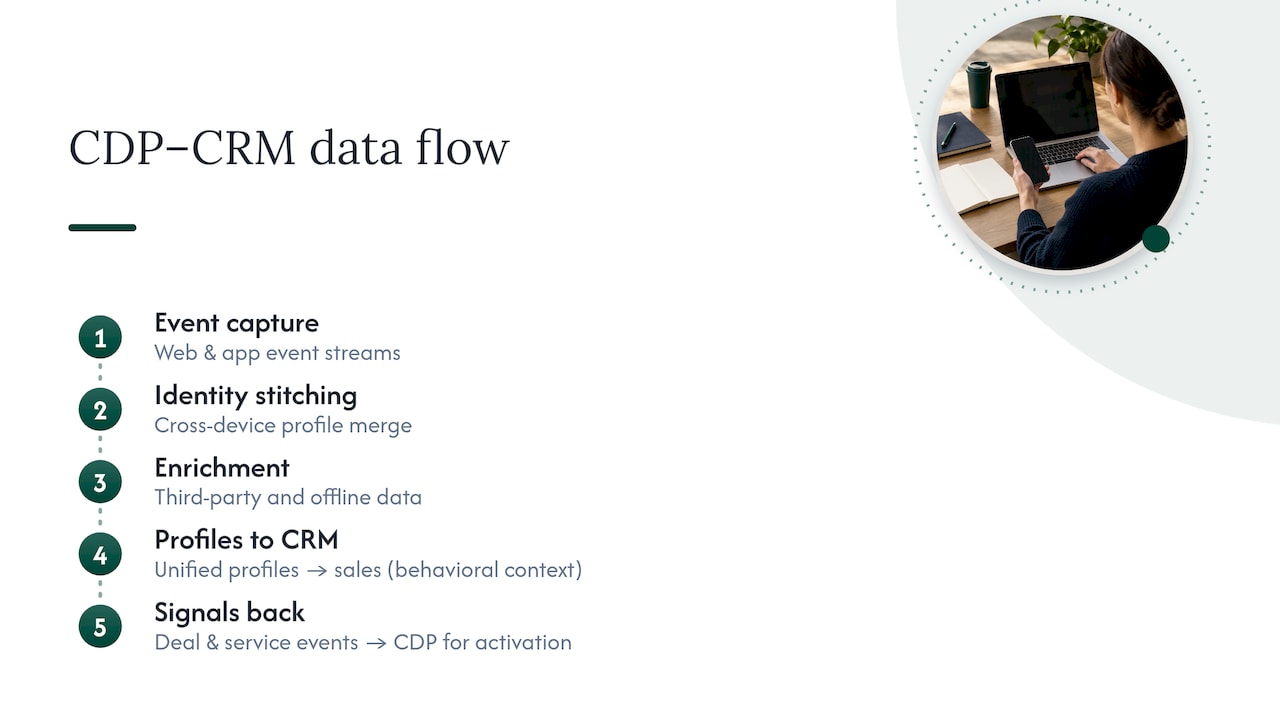
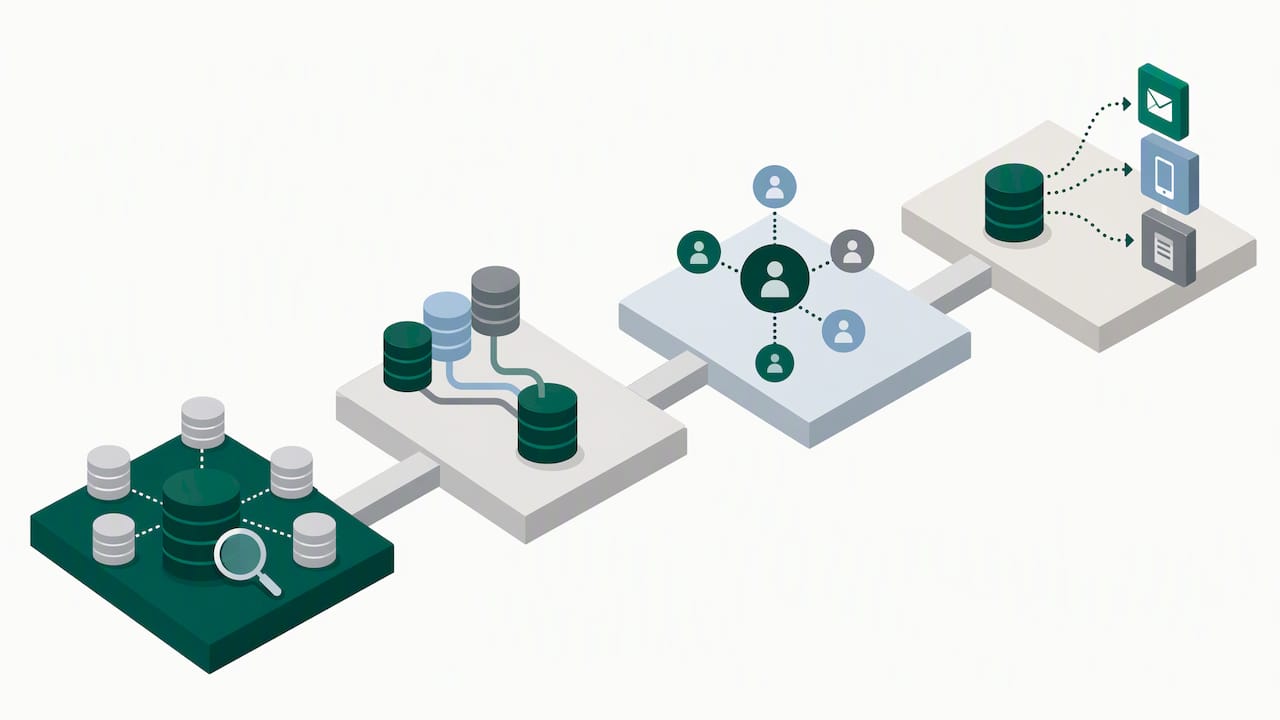
The plumbing underneath involves event capture from web and app sources, identity stitching across devices, enrichment from third-party or offline data, and export connectors to ad platforms and email systems. Forrester’s implementation checklist names data ingestion, governance, profile assembly, and audience selection as the core deployment tasks buyers need to plan around before go-live.
Real-time versus batch matters more than most buyers expect. Real-time identity resolution supports on-site personalization and cart-abandonment triggers; batch syncing, often hourly or daily, is fine for email segmentation but useless for in-session personalization.
Consent and access controls deserve equal weight: confirm how PII is masked, who can query raw event data, and whether the architecture supports regional consent requirements before data ever reaches an ad platform.
Implementation effort, costs, and timeline considerations
CRM costs are predictable: seat-based licensing scales linearly with headcount. CDP costs are not, since usage-based pricing plus the engineering overhead of identity logic and ongoing operations can grow faster than expected as data volume increases.
Hidden costs tend to cluster in three places: integration work connecting source systems, data cleanup before a CDP can produce reliable profiles, and ongoing operational staffing to maintain identity rules as new data sources appear. Warehouse-native CDPs shift more of this cost permanently into engineering headcount rather than license fees.
Rollout typically moves through discovery and data audit, pilot integration with one or two sources, identity resolution testing, and phased activation, often spanning several months rather than weeks. The most common pitfall is skipping the data audit and discovering mid-implementation that the source systems cannot support the identity model the vendor promised.
Before signing, negotiate clear proof-of-concept success criteria and exit terms so a stalled implementation does not turn into a multi-year contract with no off-ramp.
Trust signals and standards: RealCDP and how to verify vendor claims
RealCDP is the CDP Institute’s independent certification verifying that a product delivers core CDP capabilities, including persistent unified profiles, identity resolution, open access, and governance controls, rather than just a dashboard sitting on top of a data warehouse.
During a demo, ask vendors directly for API openness documentation, identity-resolution latency benchmarks, and a written data governance model. A product that cannot answer these clearly is often a warehouse UI relabeled as a CDP rather than a system built around the seven-part standard the certification checks.
How brand strategy shapes platform choice and implementation
Platform selection is a brand decision as much as a technical one. A fragmented customer record produces inconsistent messaging regardless of how sophisticated the underlying system is. In our work, the implementations that succeed share one trait: clear cross-functional governance tied to measurable customer experience outcomes, not just data volume or feature counts. Alignment across product, marketing, and sales determines whether a CDP or CRM investment actually moves the metrics that matter.
Expert perspective: future-proofing your data stack
CDP and CRM capabilities are converging, and the buyers who win will prioritize composability and open governance over locked-in feature bundles. Pick systems with open APIs, demand a documented identity model, and assign clear data ownership before signing anything.
How we help with CDP and CRM strategy and vendor selection
Choosing between a CDP, a CRM, or both is a brand and operations decision, not just a technology purchase, and we help leadership teams make that call with clarity instead of guesswork.
- We run Brand Strategy and Brand Positioning engagements that connect platform choice to how customers actually experience your business.
- Our Customer Experience work maps where data gaps break the experience across teams.
- Our AI and Marketing Strategy and Founder and Executive Advisory services help leadership teams set governance before a vendor contract locks them in.
For teams evaluating composable architectures, Vetros builds data products for warehouse-native setups, and NEXTmsp supports procurement for AI and data projects. See our full service list at Quincysamycia or book an executive workshop through our speaking page.
FAQ
Is Salesforce a CRM or a CDP?
Salesforce is best known as a CRM, built around sales, service, and account management workflows. Enterprise vendor explainers frame CDP capabilities as a separate function supporting marketing activation, distinct from core CRM operations.
What are the 4 types of CRM?
CRM platforms are commonly grouped by function: operational (managing day-to-day sales and service processes), analytical (reporting on pipeline and customer data), collaborative (sharing customer information across departments), and strategic (centering the business around long-term customer relationships). Definitions vary by vendor, so confirm which type a specific product emphasizes before buying.
Is a CDP part of a CRM?
No, a CDP is a separate system built to unify behavioral and anonymous data at a scale and granularity CRMs were not designed to hold. The two commonly integrate, with CDPs feeding enriched profiles into CRMs and CRMs sending deal and service events back, but one does not contain the other.
Is Microsoft Dynamics a CDP?
Microsoft Dynamics is primarily a CRM platform for sales, service, and operations, not a certified CDP. Buyers evaluating any platform’s CDP claims should check for RealCDP certification, which verifies persistent unified profiles, identity resolution, and governance controls rather than relying on marketing language alone.
Do I need both a CDP and a CRM?
Many multi-channel businesses need both: a CRM to manage known contacts, deals, and service, and a CDP to unify behavioral data across anonymous and known touchpoints for personalization. Industry guidance generally recommends fixing CRM hygiene first, then adding a CDP once anonymous traffic or personalization needs justify it.