For Founders: Make Founder Led Branding a Revenue Engine in 90 Days
Founder-led branding uses the founder’s visible credibility as the company’s primary trust engine, shortening sales cycles and generating inbound demand without a big paid-media budget. The single best next step is a positioning audit, not a content calendar: know what the founder is credible to say before deciding where to say it. It works best for early-stage B2B, services, and consumer brands where a buyer needs to trust a person before they trust a product. It works poorly, or becomes a liability, when the founder is the only source of content and nobody has a plan to back that up.
TL;DR:
- Founder-led branding is most effective when the founder clearly defines their niche, problem focus, and factual credibility before creating content or engaging in outreach.
- Regular, targeted engagement in relevant communities and repurposing long-form content can generate inbound leads and accelerate trust transfer to buyers.
- Scaling efforts into a hybrid model with a small support team helps maintain founder voice while increasing content volume and distribution.
- Tracking leads, CRM tags, and profile visits provides more accurate indicators of progress than vanity metrics like followers or impressions.
- The approach requires patience, with early signals after 90 days and significant market authority typically developing over 6 to 12 months.
Table of Contents
- What Is Founder-Led Branding, Exactly?
- Why Founder-Led Branding Works: The Trust Mechanics
- Positioning First: The Frameworks Behind Founder Content
- Where to Publish: A Channel Playbook by Mode
- Scaling Founder-Led Branding Without Losing the Founder’s Voice
- How to Measure Whether Founder-Led Branding Is Working
- The Mistakes That Turn Founder Branding Into a Liability
- A 90-Day Starter Plan for Founder-Led Branding
- Quincy Samycia’s Approach to Founder-Led Branding
- What Founders Get Wrong About Their Own Visibility
- Get Expert Help Building Your Founder-Led Brand
- Sources
- FAQ
What Is Founder-Led Branding, Exactly?
Founder-led branding is the deliberate use of a founder’s public presence, expertise, and story as the company’s central trust signal. It differs from personal branding for founders in one important way: personal branding can exist for its own sake (a founder building a reputation regardless of the business), while founder-led branding is always tethered to a commercial outcome. It also differs from ordinary brand-led marketing, which routes messaging through a company identity, logo, and voice rather than a named human being.
The distinction matters because founder-led branding invites customers into the product journey directly. Buyers see the person behind the decisions, not just the decisions, and that visibility builds trust that converts to business outcomes in a way anonymous brand messaging rarely does on its own.
Founder-led marketing tends to run in four distinct modes, and most founders only use one or two:
-
Content: essays, posts, and video where the founder shares a point of view, a lesson, or a prediction.
-
Community: participating in spaces the target buyer already occupies, answering questions, and showing up consistently rather than broadcasting.
-
Reciprocity: doing favors, introductions, and small acts of generosity that earn goodwill and, eventually, distribution.
-
Founder-as-product: cases where the founder’s expertise IS the offer, such as advisory work, workshops, or speaking.
A practical breakdown of these four modes notes that they must be driven by clear positioning first. Skipping straight to content without deciding what the founder should be known for is the most common reason founder-led efforts stall.
Founder-led branding is a strategic asset when the buying decision involves real risk, a long sales cycle, or a category where competitors look interchangeable. It’s largely unnecessary for low-consideration purchases, commodity products, or businesses where the founder has no differentiated expertise to share. Forcing it in those cases just adds noise.
Why Founder-Led Branding Works: The Trust Mechanics
Buyers extend trust to people before they extend it to companies. That’s not a marketing theory, it’s how humans have always evaluated risk: a recommendation from a specific person carries more weight than a claim from an institution. Founder-led branding exploits that bias honestly, by putting a real person’s judgment and track record in front of the buyer instead of hiding behind a brand voice.
Trust transfer, in one line: when a founder demonstrates expertise publicly and consistently, buyers borrow that credibility and apply it to the product, which is why founder content routinely outperforms brand-account content on engagement and, more importantly, on conversion.
Commentary on the trust economy has found that consumers and buyers increasingly favor human-led brands over faceless brand accounts across a wide range of purchase contexts, from consumer goods to complex B2B software.
The commercial payoffs show up in a few predictable places:
- Faster deals: prospects who’ve already absorbed a founder’s thinking arrive at sales calls pre-sold on the approach, not just the product.
- Inbound leads: content that establishes a point of view attracts buyers who self-select, which lowers acquisition cost.
- Recruiting: candidates apply to founders they’ve followed, which shrinks the hiring funnel for scarce talent.
None of this replaces a sales process or a good product. It removes friction from both, which is a different thing than replacing them.
Positioning First: The Frameworks Behind Founder Content
Every founder-led effort that stalls out has the same root cause: nobody decided what the founder should be known for before publishing started. Positioning isn’t a tagline. It’s a decision about which narrow territory the founder owns, and a narrow territory beats a broad one every time, because a signal that fits everyone positions the founder against nobody.
Here’s a repeatable way to build that positioning, in three parts:
- Who: name the specific buyer or persona, not a general market. “Series A SaaS founders raising their next round” beats “startup founders.”
- Problem: state the specific, recognizable pain that persona has, in their language, not yours. “Stuck explaining what the product does in one sentence” beats “brand confusion.”
- Credibility: attach a factual clause, not an adjective. “Because I built and sold a positioning consultancy that worked with 40 startups” beats “because I’m passionate about branding.”
That third part is the one founders skip most often, and it’s the one that matters most. A positioning sentence built on a factual credibility clause converts noticeably better than one built on enthusiasm, because buyers can verify a fact and can’t verify a feeling.
Once positioning is locked, pick three to five content pillars that map directly to it. Pillars are the recurring topics the founder returns to, not a random assortment of things that seemed interesting that week. If the positioning is “I help Series A founders fix confusing pricing pages,” the pillars might be: pricing page teardowns, objection handling frameworks, case studies from past clients, and commentary on competitor pricing moves. Every piece of content should trace back to one of those four things.
Pro Tip: Run a quick fit test before committing to a pillar: could a competitor’s founder post the exact same piece under their own name and have it feel just as credible? If yes, the pillar is too generic. Rewrite it until only your founder could have written it.
The difference between narrow and diffuse positioning shows up fast. A founder who posts “thoughts on leadership” one week, “why our product is great” the next, and “a story from my childhood” after that has no positioning at all, just a content habit. A founder who consistently writes about one recognizable problem, from one credible angle, builds a reputation buyers can describe to their colleagues in a sentence. That’s the whole test: can a stranger repeat back what this founder is known for after seeing three posts?
Where to Publish: A Channel Playbook by Mode
Positioning tells you what to say. Channel choice determines who actually sees it, and the right channel depends heavily on which of the four modes the founder is leaning on.
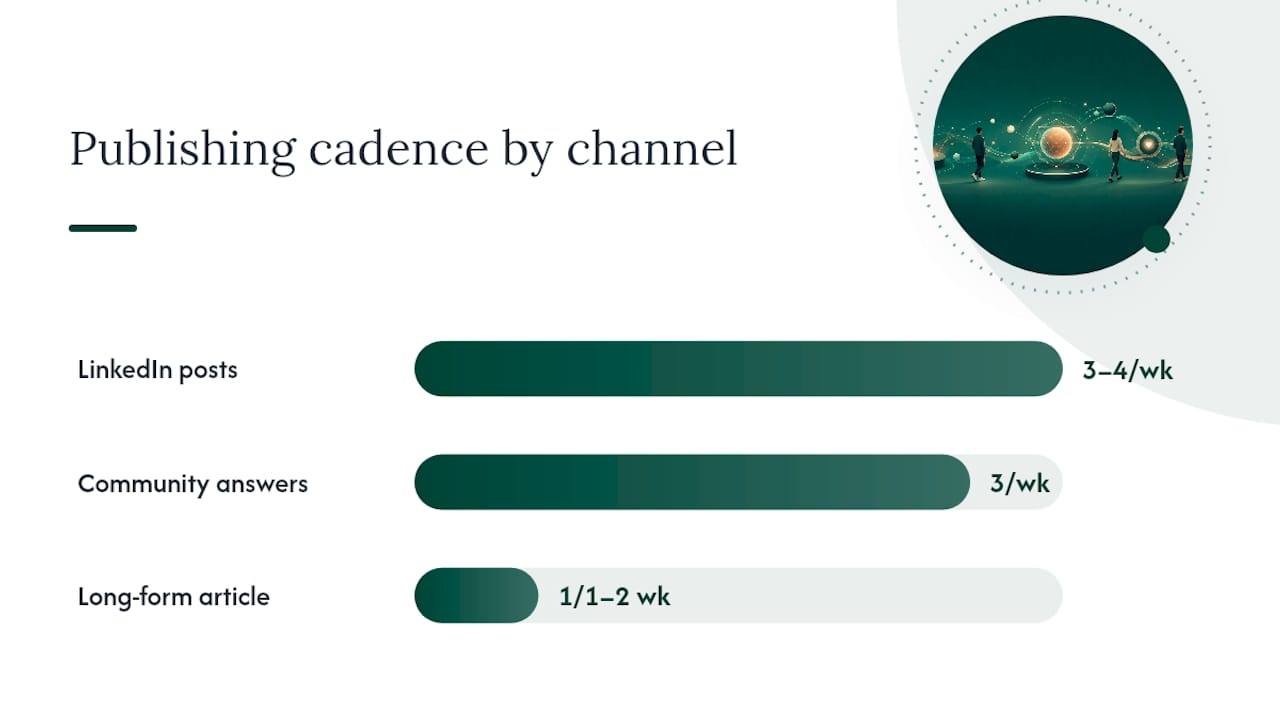
For content mode, LinkedIn remains the default channel for B2B founders, largely because the platform still rewards individual profiles over company pages. A workable cadence is three to four posts a week, built around a single flagship long-form piece published every one to two weeks. One long-form article should generate several days of shorter posts, since repurposing is the real multiplier on founder time: a single long-form essay can be repurposed into multiple shorter posts and other content formats.
Long-form posts and email newsletters earn priority when the buying decision is complex enough to need explanation, not just a headline. If the product requires a demo to understand, the founder’s writing should do some of that explaining before the sales call ever happens.
- LinkedIn: native posts, short case studies, and contrarian takes on industry norms.
- Newsletter: the deeper version of the LinkedIn post, sent to people who’ve already opted in.
- Community: Slack groups, subreddits, and niche forums where the target buyer already asks questions.
- Reciprocity: unpaid intros, guest appearances, and specific, useful replies to other people’s posts.
- Video and podcast: best used for founders who communicate more naturally out loud than in writing, and best measured by whether it drives profile visits, not view counts.
Community and reciprocity deserve more attention than most founders give them, because these modes can generate real distribution without a large following. A founder with 200 LinkedIn connections who answers thoughtfully in three relevant Slack communities every week can out perform a founder with 10,000 followers who never engages with anyone.
Pro Tip: Treat every guest podcast appearance or community answer as a distribution deposit, not a one-off favor. Track who you’ve helped; those relationships are where reciprocity eventually turns into inbound introductions.
Scaling Founder-Led Branding Without Losing the Founder’s Voice
Founder-led branding has a ceiling: one person’s calendar. The path past that ceiling is what practitioners call founder-plus, a hybrid model where the founder still generates the highest-leverage material and a team handles volume, repurposing, and distribution. Founder-driven content tends to outperform brand-team content on trust, but a hybrid model scales best for most growing companies, because pure founder output eventually can’t keep pace with demand.
There are three practical delegation models, roughly in order of how much founder time they require:
- Translator/fractional support: a ghostwriter or fractional content lead interviews the founder weekly and turns raw thinking into finished posts. The founder’s time cost drops to 30 to 60 minutes a week.
- Hybrid model: the founder writes flagship pieces personally, and a small team repurposes them into shorter formats, handles scheduling, and manages community replies.
- Full handoff: a content team operates independently using an established voice guide and past founder material as source data, with the founder reviewing only occasionally. This works only after positioning is stable and well documented.
Most companies should start with the translator model, move to hybrid once volume becomes unsustainable, and treat full handoff as a later-stage option, not a starting point.
Whichever model you choose, extraction and approval need a rhythm. A weekly 30-minute interview, where a writer pulls out the founder’s actual opinions and stories, produces far better material than asking a founder to sit down and “write something.” Approval should be fast, ideally same-day, so the content doesn’t go stale waiting on a signature.

Voice guardrails matter more as delegation increases. Document the founder’s actual opinions, phrases they’d never use, and topics that are off-limits, before handing content creation to anyone else. Without that, founder-plus content starts to sound like nobody, which defeats the entire point of the exercise.
How to Measure Whether Founder-Led Branding Is Working
The biggest measurement mistake founders make is watching search visibility, AI-discoverable credibility, and inbound demand instead of just follower counts. Growth in search visibility, AI-discoverable credibility, and inbound demand matters far more than audience size, because a smaller, more targeted following that converts beats a large, passive one every time.
Weekly leading indicators are easy to track and give a fast read on whether content is landing:
The attribution step is where most founders lose the thread. Tagging CRM entries with a specific source field, and noting in deal notes when a prospect mentions a specific post, is what turns “we think content is helping” into a number an executive team can act on.
Set expectations honestly. Early signals of content impact such as engagement and inbound messages often appear within about three months. Six to twelve months is closer to realistic for the founder to be recognized as an authority a buyer would reference unprompted. Anyone promising faster is selling something.
The Mistakes That Turn Founder Branding Into a Liability
The most common failure mode is chasing vanity metrics. Impressions and follower growth feel good and mean almost nothing on their own; a founder can rack up both while pipeline stays flat. The fix is the CRM tagging habit described above, applied from week one, not bolted on after a year of untracked posting.
Inconsistent positioning is the second most common problem. A founder who pivots their public point of view every few months, chasing whatever topic is trending, never builds the recognizable territory that makes founder-led branding work in the first place.
A few other patterns to watch for:
- Extraction without backfill: pulling great material out of a founder’s head without documenting it anywhere, so institutional knowledge leaves if the founder does.
- Total dependency: revenue that stops moving the moment the founder stops posting, with no other channel or team member able to sustain momentum.
- Approval bottlenecks: content sitting for weeks waiting on founder sign off, killing the cadence that made the strategy work.
- No documented voice guide: making it impossible to delegate without the brand losing its recognizable tone.
The practical control is simple: set a trigger point, maybe when founder-sourced content drives more than half of pipeline, where the team formally starts building a founder-plus model instead of waiting for burnout to force the decision.
A 90-Day Starter Plan for Founder-Led Branding
A 90 day sequence gives founders enough runway to test the approach honestly before deciding whether to invest further. Here’s how to structure it.
Weeks 1 through 4: foundation.
- Write and stress-test the positioning sentence using the who, problem, credibility template.
- Run two extraction interviews to surface the founder’s real opinions, stories, and case examples.
- Publish one flagship long-form piece that anchors the chosen positioning.
Weeks 5 through 8: momentum.
- Repurpose the flagship piece into five to seven shorter posts across the primary channel.
- Join two to three relevant communities and commit to weekly, substantive replies, not drive-by comments.
- Set up CRM tagging so any inbound lead can be traced back to specific content.
Weeks 9 through 12: decide.
- Publish a second flagship piece and repeat the repurposing cycle.
- Review the leading indicators: profile visits, inbound DMs, and any CRM-tagged deals.
- Decide whether to move into a translator or hybrid delegation model based on actual volume and results, not gut feeling.
Signals to watch for by the end of week 12:
- At least a handful of inbound messages that reference specific content, not generic outreach.
- A measurable uptick in profile visits from the target persona defined in week one.
- Enough founder fatigue, or enough demand, to justify bringing in delegated support.
If none of those show up by day 90, the positioning likely needs revisiting before adding more content volume on top of it.
Quincy Samycia’s Approach to Founder-Led Branding
Quincy Samycia has spent his career helping organizations turn brand positioning into a measurable growth lever, work reflected in the more than 200 international retail locations that have applied his positioning methods. His core premise, that brand is a business strategy rather than a marketing decoration, applies directly to founder-led branding: a founder’s visibility only compounds into value when it’s anchored to the same positioning discipline that governs the rest of the company.
Two proprietary frameworks map cleanly onto the playbook covered here. The Golden Spiral™ structures how positioning, content, and customer experience reinforce each other over time, rather than existing as separate workstreams. Brand-Backed Performance™ gives that structure a measurement layer, connecting founder visibility to the pipeline and performance metrics executives actually track.
Client engagements built on these frameworks typically start with a positioning audit, similar to the who, problem, credibility exercise outlined above, before any content plan gets built.
What Founders Get Wrong About Their Own Visibility
Most founders either treat their visibility as vanity or as a burden, and both framings miss the point. The right framing is closer to a capital investment: founder time spent on positioning and a handful of flagship pieces compounds, while time spent chasing daily post frequency mostly doesn’t.
Speed and durability trade off against each other here. A founder who posts constantly builds an audience faster than one who publishes deliberately, but that audience often evaporates the moment the posting stops, because there was never a real point of view underneath it. Durable positioning takes longer to build and survives the founder stepping back.
The right move for most leaders isn’t a full commitment or nothing. It’s a small, measured experiment, a single positioning sentence and one flagship piece, tracked against real pipeline signals for 90 days, before deciding whether to go further.
— Quincy
Get Expert Help Building Your Founder-Led Brand
Reading a playbook gets you the framework. Applying it to your actual positioning, your actual pipeline, and your actual sales cycle is a different job, and it’s the one Quincy Samycia does for a living. Where most agencies sell content production, Quincy starts a level up: a positioning audit that decides what the founder should be known for before a single post gets written, so the content that follows actually compounds instead of just accumulating.
Engagements typically begin with a short diagnostic, mapping current positioning against buyer language and competitor claims, then move into the Golden Spiral™ and Brand-Backed Performance™ frameworks to connect that positioning to measurable growth outcomes. Companies that need a heavier lift, an executive workshop or a keynote to align leadership before scaling founder visibility, can book Quincy directly for speaking and workshop engagements. If your founder-led content has stalled or never had a clear positioning behind it, start with the frameworks page and request a consultation to see where the gap actually is.
Sources
- This Strategy Drives Startup Success: Founder-Led Marketing
- Favors
- Founder-Led Marketing: What It Is & How to Do It Right (2026)
- Founder-led content strategy (HubSpot startup resources)
FAQ
What Is Founder-Led Marketing?
Founder-led marketing is the practice of using a founder’s visible expertise, opinions, and story as the primary channel for building trust and generating demand, rather than relying solely on a company brand voice.
What Are Founder-Led Companies?
Founder-led companies are businesses where the founder remains the public face of the brand, actively shaping customer perception through content, community involvement, or direct advisory work, rather than operating anonymously behind a corporate identity.
Who Is Better, CEO or Founder, for Brand Visibility?
Founders generally carry more credibility for brand visibility because their story is tied to the company’s origin and risk taken, though a long-tenured CEO with deep category expertise can build comparable trust over time.
What Is Founder Branding?
Founder branding is the deliberate shaping of a founder’s public reputation and expertise into a recognizable, narrow positioning that customers, investors, and talent associate directly with the company. Frameworks like Quincy Samycia’s Golden Spiral™ treat this positioning as a business asset, not a side project.
How Long Does Founder-Led Branding Take to Show Results?
Early signals, engagement, inbound messages, and a few tagged pipeline deals, typically appear within 90 days, while meaningful market authority tends to take 6 to 12 months of consistent execution.