
Keynote Speaker Fees: What to Budget in the US in 2026
Most US organizations pay somewhere between $10,000 and $50,000 for a professional keynote, and the real number depends on who is speaking, when, where and what you ask them to customize. The fee on the quote is also only part of the bill. Travel, production, recording rights and a contingency cushion all change what you actually spend.
This guide is written for the person holding the budget: a founder planning an offsite, a marketing lead building a conference, an executive assistant asked to “find someone good.” It covers the typical ranges, the factors that move them, the costs people forget, and how to decide how much a keynote is worth to you.
TL;DR
- The most common keynote budget in the US is $10,000 to $50,000. A 2024 planner survey put the average overall budget at $22,449, and 47% of planners in that range.
- Fees follow demand, expertise and customization more than any formula. Celebrity names cost many times more than specialists, and attendees rarely ask for them.
- Add travel, production and a contingency to the quoted fee. Get cancellation, recording and expense terms in writing before you sign.
- Book early. Conference season and year-end weeks fill up, and short notice leaves you with fewer speakers and less leverage.
- Match the speaker to the business problem. A relevant expert at a mid-range fee usually beats a famous name at three times the price.
Table of Contents
- What keynote speakers charge in the US
- What drives a keynote speaker’s fee
- What the fee usually does and does not cover
- Contract terms that change the real cost
- How to set your keynote budget
- How to get more from a mid-range budget
- Our perspective: pay for the outcome, not the stage time
- If your keynote is about brand and growth
- A pre-booking checklist
- FAQ
- Sources
What keynote speakers charge in the US
There is no price list for keynotes. Speakers set their own fees, many do not publish them, and the same person may quote differently for a corporate retreat and an association conference. What you can do is think in tiers.
| Tier | Typical fee range | Who is usually in it |
|---|---|---|
| Emerging or regional | Under about $10,000 | Authors with a first book, practitioners with a strong local reputation, newer professional speakers |
| Established professional | About $10,000 to $30,000 | Experienced business speakers, founders and executives with a clear point of view and a track record on stages |
| High-profile expert | About $30,000 to $75,000 | Bestselling authors, well-known executives, widely quoted thought leaders |
| Celebrity and headline names | Six figures and up | Former officeholders, entertainers, media figures |
These tiers are a synthesis of the ranges that US speaker marketplaces and planners commonly cite, not a published scale, and individual speakers sit outside them all the time. Treat them as a way to orient your budget conversation, not as a quote.
Two data points are worth anchoring on. The PCMA survey of speakers and planners found an average keynote budget of $22,449, with the most common range, chosen by 47% of respondents, between $10,000 and $50,000. That is a better guide to what organizations actually spend than the top-of-the-market numbers that dominate search results.
Why celebrity fees distort the picture
When people search for keynote fees, they often land on lists of famous names with fees that run into the hundreds of thousands. Those figures are estimates, they come with heavy logistics (security, travel for an entourage, strict content limits), and they describe a market almost no company is shopping in.
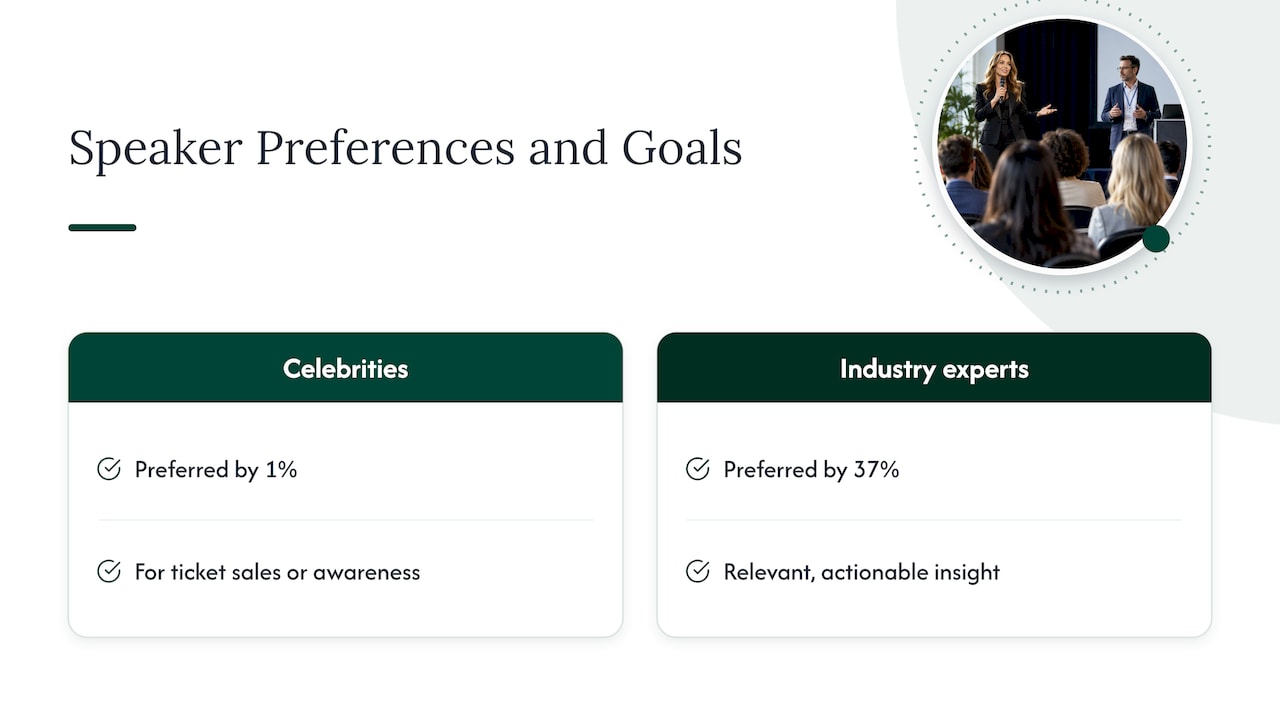
They also do not match what audiences want. Freeman research reported by PCMA found that only 1% of surveyed attendees preferred celebrity speakers, against 37% who preferred industry leaders and experts offering relevant, actionable insight. The guidance from that piece is sensible: stretch for a celebrity only when your goal is ticket sales or broad awareness, not when your goal is to change how a team works.
What drives a keynote speaker’s fee
Two speakers with similar résumés can quote very differently. These are the levers.
Demand and name recognition
A speaker who gets booked every week can afford to be selective, so the fee rises until the calendar stops overflowing. Visibility, a recent bestseller or a viral talk all push the number up. A speaker with deep expertise but a quieter profile may offer more substance per dollar.
Customization
A stock talk delivered as-is costs less than a keynote built around your strategy, your customers and your internal vocabulary. Customization means pre-event interviews, reading your materials, tailoring examples and sometimes rewriting the opening. That is real work, and it is usually where a keynote starts to feel like it was written for your room.
Format and length
A 45-minute keynote is the standard reference point. Add a Q&A, a fireside chat, a breakout workshop or a leadership dinner and the engagement grows. Virtual appearances generally cost less than in-person ones because they remove travel and shorten the time commitment, though how much less varies by speaker. Many speakers publish no virtual rate, so ask.
Timing and scarcity
Spring and fall conference seasons and the weeks around fiscal year-ends are the crowded stretches. Booking six to twelve months ahead is the common recommendation for getting your first choice and some negotiating room. Eight weeks out, you may be choosing from whoever is still free, and paying whatever that requires.
Audience and stakes
A keynote for 80 people at a leadership offsite is not priced like a main-stage session for 3,000 attendees at a ticketed event. Audience size, whether the event is internal or public, and whether the session will be recorded or promoted all factor in.
Geography
A speaker based in your city saves you airfare and hotel nights and may offer a lower fee for a local event. Remote or international travel adds both cost and time away from the speaker’s calendar.
What the fee usually does and does not cover
The headline number typically covers preparation, the delivery itself, and a short window around it for sound checks and a brief conversation with your team. It often does not cover the following.
- Travel and lodging. Business or first-class airfare, hotel, ground transport and meals are commonly billed separately or built into a flat travel fee. Clarify which, and who sets the class of travel.
- Production and AV. Wireless mics, confidence monitors, slide support and recording are normally the event’s responsibility.
- Extra sessions. Breakouts, workshops, executive roundtables and meet-and-greets are usually priced separately or require a bundled rate.
- Recording and distribution. See the next section, because this one catches people out.
- Agency or bureau commissions. If you book through an intermediary, ask who is paying for it. Often the commission is built into the quoted fee rather than added on top, but not always.
A speaker fee schedule is the document that spells out what the presenter charges, which expenses the hiring organization pays, and when payments are due. Ask for one, or draft your own, before you commit.
Contract terms that change the real cost
Recording rights
Under US copyright law, a speaker working as an independent contractor generally keeps the copyright in their material unless the contract assigns it, and a generic work-for-hire clause often does not settle the question for a standalone keynote. If you plan to put the recording on your intranet, sell it, or clip it for social media, negotiate a specific license or assignment up front. Doing it afterward is slower and usually more expensive. For anything with legal weight, such as an assignment of rights, have your own counsel review the language.
Cancellation and rescheduling
Cancellation terms vary, but a sliding scale is common. A typical arrangement requires full payment if you cancel within 30 days of the event, because rebooking a date that close is nearly impossible for the speaker. Read the terms before you sign, and ask what happens if the speaker must cancel, including whether a substitute or a refund is offered.
Payment schedule
A deposit at signing with the balance due before or on the event date is common. If your finance team pays on 60-day terms, say so early, so it does not collide with the speaker’s schedule.
How to set your keynote budget
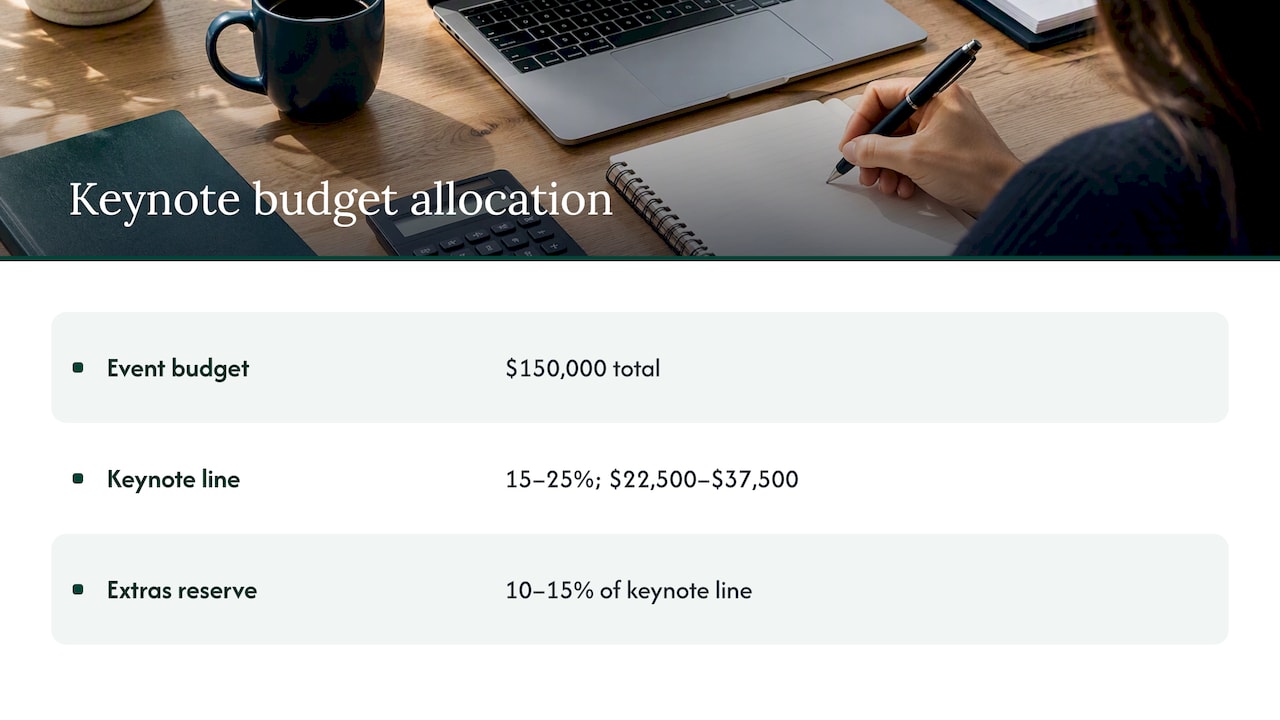
Start from the event, not the speaker. Experienced planners typically let keynote fees take up about 15 to 25% of the total event budget, and recommend holding another 10 to 15% in reserve for customization requests, added sessions or production changes. That guidance comes from a speaker bureau’s published fee analysis, so treat it as a rule of thumb rather than a standard. Your numbers will differ if the keynote is the main reason people attend, or if it is one session among many.
A simple worked example: you are running a two-day customer summit with a $150,000 total budget. At 15 to 25%, the keynote line lands between $22,500 and $37,500. Hold back a further 10 to 15% of the keynote line for extras, and you have a defensible range to take into conversations with speakers.
Get the decision group involved early
Budgets rarely belong to one person. The PCMA benchmark found that nearly 70% of planners involve two to five people in speaker decisions. Write down why the fee is justified: the outcome you want, the audience, and what you are comparing against. A one-page rationale makes the approval conversation much easier.
How to get more from a mid-range budget
You do not need $50,000 to get a keynote people remember. These moves stretch a budget.
- Choose relevance over fame. Pick someone who has done the work your audience does. Attendees reward practical insight.
- Book early and be flexible on dates. A weekday or shoulder-season slot can lower the price and widen your choices.
- Bundle. A keynote plus a workshop or leadership session from the same person often costs less than hiring two people, and the workshop turns inspiration into action.
- Go local or virtual when it fits. Both reduce travel cost and sometimes the fee.
- Brief the speaker properly. A 30-minute call about your audience, your goals and your sensitive topics does more for the outcome than another $5,000 on the fee.
- Ask what is negotiable. Recording rights, travel class, session length and payment timing are all places where a reasonable request can save real money.
Our perspective: pay for the outcome, not the stage time
We work with founders and executive teams on brand strategy, positioning and growth, and we speak on those subjects. That gives us two views of keynote fees: the one from the stage and the one from the people who book us.
The biggest mistake we see is treating a keynote as a standalone event. A 45-minute talk can reset how a room thinks about a problem. It cannot, on its own, change how product, marketing and sales behave on Monday. The talks that pay for themselves are the ones where the organizer knows what should be different afterward: a sharper way to explain what the company does, a shared definition of the customer, a leadership team that agrees on where to compete.
So we encourage organizers to ask a different question than “what does it cost?” Ask what the audience should do differently in 30 days, and whether the speaker has operated in the situation they are describing. Our own perspective comes from building brands in the real world, including exit experience and work behind more than 200 international retail locations, and that operator’s lens is why we tie any talk back to measurable business performance rather than applause.
It is also why we would rather you spend on a relevant specialist than stretch for a name. If your goal is clarity and alignment inside your company, the best-known person in the room is rarely the best fit. The right fit is the person who has faced your problem and can explain how they solved it, then give your team a way to keep going once the lights come up.
— Quincy
If your keynote is about brand and growth
If your event or leadership offsite is built around positioning, differentiation or go-to-market alignment, we would be glad to talk. Quincy speaks to executive teams, founders and marketing organizations, and can pair a keynote with a working session on your own brand strategy. We do not publish a fee, because the right scope depends on your audience, format and goals. Start on our speaking page to share the details of your event, or see the broader work we do on brand strategy, positioning and growth advisory.
A pre-booking checklist
Before you sign, confirm each of these in writing.
- The total fee, and what it includes (length, Q&A, customization, prep calls)
- Travel and lodging: who books, what class, and whether it is billed at cost or as a flat fee
- Additional sessions and their price
- Recording, clipping and distribution rights, spelled out as a license or assignment
- Cancellation and rescheduling terms from both sides
- Deposit, balance and invoice timing
- AV and room requirements
- Who your point of contact is on both sides, and when the pre-event call happens
FAQ
How much does a keynote speaker cost?
Most US organizations budget between $10,000 and $50,000 for a professional keynote. In the PCMA survey, the average overall budget was $22,449 and 47% of planners fell in that range. Emerging speakers can charge less, and celebrity names charge far more.
Why don’t speakers publish their rates?
Fees depend on the audience, format, date, travel and customization, so one number rarely fits. Many speakers also prefer to understand the event before quoting. Asking for a range early, along with your date and audience size, usually gets a useful answer.
Is a more expensive keynote speaker a better one?
Not necessarily. A higher fee reflects demand, visibility and sometimes customization, not guaranteed results in your room. Research reported by PCMA found that attendees prefer relevant experts over celebrities, so fit and preparation matter more than price.
What other costs should I plan for?
Budget for travel, lodging, production and AV, and any extra sessions. Keep a reserve of 10 to 15% of the keynote line for changes, and clarify who owns recordings if you plan to share the talk afterward.
How far ahead should I book?
Six to twelve months ahead is the common recommendation, especially for spring and fall conference seasons and fiscal year-end periods. Booking about eight weeks out is possible but narrows your choices and weakens your negotiating position.