
Four Question Readiness for Marketing Automation vs CRM for Founders
For most early-stage companies, fix CRM and go-to-market alignment first, then layer in marketing automation once your data is clean and your lifecycle stages are defined. The exception is if you already have organized contact data, a repeatable sales process, and simply too many leads for reps to follow up on manually, marketing automation earns priority. Either way, the first move is the same: audit your data before buying anything.
TL;DR:
- Most companies should prioritize fixing CRM data quality and defining sales processes before investing heavily in marketing automation.
- A score of six or higher on a readiness framework indicates teams are prepared for automation, while lower scores require CRM cleanup first.
- Proper system integration relies on governance, shared lifecycle stages, and initial test syncs, not just selecting the best software.
- ROI from CRM appears within two to three months, but marketing automation benefits take longer and depend heavily on user adoption and data cleanliness.
- Weak positioning and brand clarity can undermine both CRM and automation efforts, making strategic alignment a necessary foundation before technology deployment.
Table of Contents
- Marketing Automation vs CRM: Which One Deserves Your Budget First?
- What’s the Right Sequence for Rolling This Out?
- How Much Should You Budget, and When Will You See Returns?
- Why Do CRM and Marketing Automation Integrations Fail?
- Quincy Samycia’s Perspective: Brand as the Missing Layer
- What Is Marketing Automation, Exactly?
- How Do CRM Features Actually Compare to Marketing Automation?
- When Should You Use Marketing Automation vs CRM?
- How Does Each System Change Daily Sales and Marketing Work?
- What Are Some Well-Known Marketing Automation and CRM Tools?
- The Real Mistake Founders Make in This Decision
- Ready to Align Your Team Before You Automate?
- Sources
- FAQ
Marketing Automation vs CRM: Which One Deserves Your Budget First?
The honest answer depends on what’s actually broken, not on which tool has the flashier demo. Marketing automation and CRM software solve different problems in the same pipeline: automation generates and nurtures leads before a salesperson ever talks to them, while CRM manages the relationship and the deal once someone is qualified. Together they form one continuous system from first click to signed contract, and that’s exactly why picking one in isolation is the wrong question.
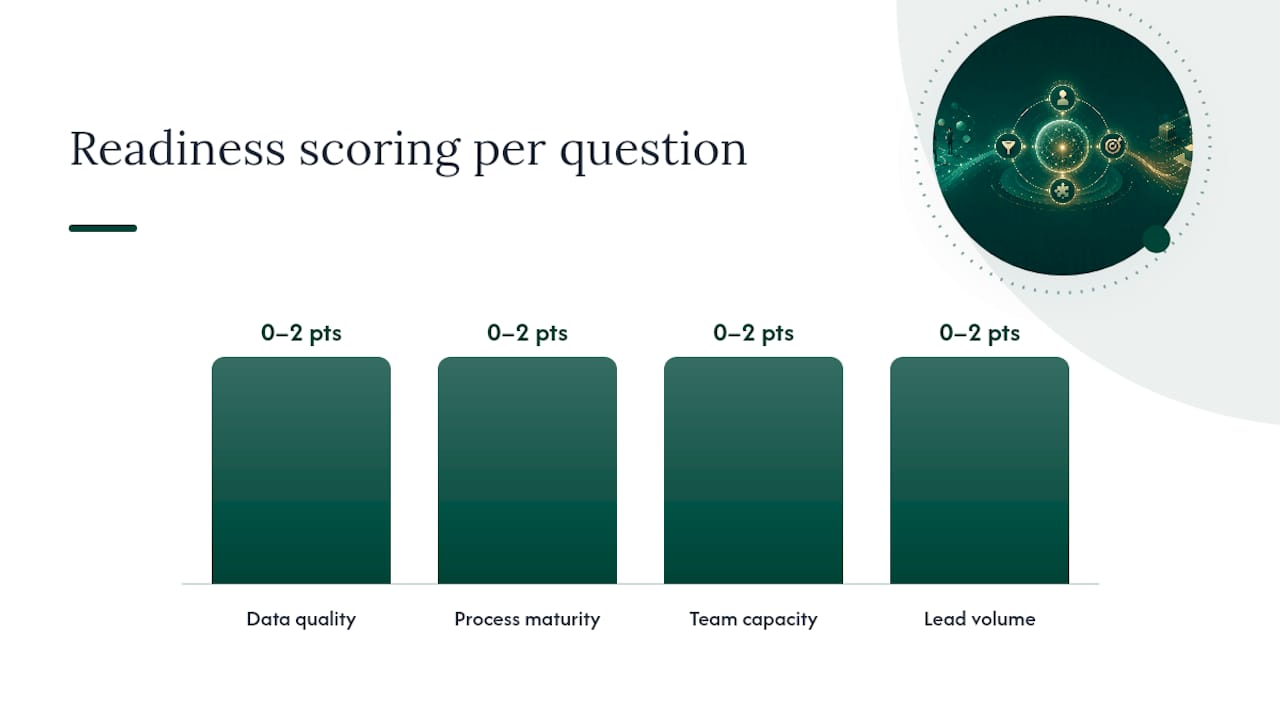
Here’s a diagnostic that cuts through the noise. Answer these honestly before spending a dollar.
Map the outcome to the system that actually drives it:
- Need more qualified leads in the pipeline? That’s a marketing automation problem, assuming your targeting and content are already sound.
- Deals stalling, sales forecasting unreliable, reps working from spreadsheets? That’s a CRM and process problem.
- Leads coming in but nobody can tell which ones close? That’s a data and lifecycle definition problem, and no software fixes it until you do.
Ask these four readiness questions:
- Data quality: Is your contact and account data deduplicated, with consistent fields across every list you own?
- Process maturity: Do your reps follow a documented sales process, or does each one freestyle?
- Team capacity: Does anyone own lifecycle definitions, lead scoring rules, and campaign hygiene, or would automation just run unsupervised?
- Lead volume: Are you generating enough volume that manual nurture is genuinely the bottleneck, not a symptom of weak positioning?
Score each question 0 to 2 (0 = not ready, 2 = fully ready). A total of 6 or higher across data, process, and capacity means you’re ready for marketing automation now. Below that, CRM cleanup and alignment work comes first, because automating on top of a broken process just automates the breakage faster. Alignment tactics like joint account planning and shared persona documents tend to move the readiness score more than any new software purchase does, according to research on go-to-market alignment.
What’s the Right Sequence for Rolling This Out?
Once you know your diagnosis, the path splits into two phased plans over several months. Pick the one that matches your score from the framework above.
Path A: CRM-first (score below 6)
- Days 1 to 30: Deduplicate contact and account records, define lifecycle stages (lead, MQL, SQL, opportunity, customer) in writing, and assign a single owner for data hygiene.
- Days 31 to 60: Document the sales process stage by stage, build basic pipeline reporting, and train reps on consistent CRM logging.
- Days 61 to 90: Introduce lightweight scoring rules and evaluate whether lead volume now justifies automation.
Path B: Automation-ready (score 6 or higher)
- Days 1 to 30: Configure lead capture, scoring, and nurture sequences on top of your existing CRM, not as a separate silo.
- Days 31 to 60: Set up bidirectional sync and test it with sample records before trusting it with real leads.
- Days 61 to 90: Build attribution reporting that connects a closed deal back to the campaign that started it.
Involve your head of sales and your most senior marketer in every sprint review, not just IT. Track pipeline velocity, lead-to-opportunity conversion, and data completeness weekly, since these move faster than revenue and give you an early read.
Pro Tip: Before connecting any systems, run a test sync with 20 dummy records and check both directions. If a change in the CRM doesn’t show up in marketing automation within minutes, you have a one-way sync, and one-way syncs are the single most common cause of sales working from stale lists.
Skipping the integration pre-check is how teams end up automating messy data instead of fixing it, which produces more noise, not less.
How Much Should You Budget, and When Will You See Returns?
Most of the spend in year one goes to three places: the software subscriptions themselves, the data cleanup and migration work, and the training time it takes for sales and marketing to actually use the new process consistently. That last item gets underestimated constantly, and it’s usually the one that determines whether the investment pays off at all.
Typical costs break down roughly like this:
- CRM licensing and setup: ongoing per-seat cost plus a one-time data migration effort.
- Marketing automation licensing: often priced by contact volume, which means a messy database inflates your bill before it inflates your pipeline.
- Internal or consulting hours: lifecycle mapping, scoring rules, and playbook creation, which is labor, not software.
Timeline to measurable ROI varies by path. CRM-first teams typically see cleaner pipeline reporting within 60 to 90 days, since that’s a process fix, not a demand-generation play. Marketing automation ROI takes longer to surface because it depends on lead volume compounding over a full sales cycle. Realized return depends heavily on adoption. CRM ROI is frequently eroded by poor adoption and disconnected data, not by the software itself falling short.
For executive reporting, track lead-to-opportunity conversion rate, sales cycle length, and the percentage of closed deals with a traceable first-touch source. Those three numbers tell you whether the system is working before revenue growth confirms it.
Why Do CRM and Marketing Automation Integrations Fail?
Integration failure almost never looks dramatic. It looks like a rep working a lead list that’s three weeks stale, or marketing reporting a spike in conversions that sales has never heard of. Roughly a large majority of teams deploy marketing automation alongside a CRM, but plenty never architect the connection correctly, and that gap is where revenue quietly leaks out.
The failure modes repeat across companies:
- Misaligned lifecycle stages: marketing calls something an MQL that sales doesn’t recognize as sales-ready, so leads sit untouched.
- One-way syncs: data flows from automation into the CRM but not back, so sales activity never reaches marketing’s scoring model.
- Dirty data at the source: duplicate records and inconsistent fields get automated instead of fixed, multiplying the mess.
The fix is governance, not more software. Define shared lifecycle stages before connecting anything, write them down where both teams can see them, and configure deduplication rules before the first sync runs live. Set a service-level agreement for lead follow-up time between marketing handoff and sales contact, and review it monthly. Watch for early warning signs: a rising gap between MQL count and sales-accepted leads, or attribution reports that don’t match sales’ own pipeline view. Either one means the sync or the lifecycle definitions need attention now, not next quarter. Cross-functional breakdowns like these tend to follow predictable patterns between corporate functions once you know what to look for.
Quincy Samycia’s Perspective: Brand as the Missing Layer
Most of the CRM-versus-automation debate skips a variable that determines whether either system performs: positioning. Weak brand clarity inflates customer acquisition cost regardless of what software sits underneath it, because sales and marketing end up compensating for confusion with volume instead of precision.
The bridge between strategy and sales works best as a living system, not a one-time handoff. Dynamic playbooks and two-way feedback loops between frontline teams and strategy let positioning actually reach the people talking to customers, instead of dying in a slide deck.
That’s the logic behind frameworks like The Golden Spiral™, which ties positioning directly to the segment playbooks reps use daily. When brand clarity is weak, the website and messaging become the leverage points that need fixing before automation can perform. Investing in software before positioning is settled tends to automate confusion at scale.
— Quincy
What Is Marketing Automation, Exactly?
Marketing automation is software that generates, scores, and nurtures leads before a salesperson gets involved. Its core job is running repetitive marketing tasks at a volume no human team could sustain manually.
The functional core includes a few standing pieces. Lead capture pulls contacts from forms, landing pages, and content downloads into a shared database. Lead scoring assigns points based on behavior and firmographic fit, so marketing can tell a browsing visitor from a buying-committee member. Nurture sequences send targeted emails or content based on where a lead sits in the funnel, without a human writing each one individually. Segmentation groups contacts by industry, behavior, or lifecycle stage so messaging stays relevant instead of generic.
The output of a functioning marketing automation setup isn’t more email. It’s a ranked list of leads, tagged with enough context that sales can prioritize the right conversation first. Marketing automation generates and nurtures leads before sales ever touches them, which is precisely why it fails when there’s no clean handoff point waiting on the other end. A tool that scores leads brilliantly but hands them to a sales team with no defined process just moves the bottleneck downstream.
How Do CRM Features Actually Compare to Marketing Automation?
The two systems overlap just enough to cause confusion, and differ just enough to cause real damage when treated as interchangeable.
| Function | Marketing automation | CRM |
|---|---|---|
| Primary job | Generate and nurture leads pre-sale | Manage relationships and deals post-qualification |
| Core unit | Campaign and lead score | Deal, contact, and account record |
| Typical owner | Marketing team | Sales team |
| Main output | Qualified leads ranked by readiness | Closed deals and forecast accuracy |
| Data direction | Pushes scored leads forward | Pulls activity and outcome data back |
| Failure mode | Nurturing leads nobody follows up on | Working stale or duplicate records |
The differences between CRM and marketing automation get sharper once you look at what each tracks over time. Marketing automation measures engagement (opens, clicks, content downloads, form fills). CRM measures commitment (calls booked, proposals sent, contracts signed). Neither metric substitutes for the other, and reporting on only one gives leadership a distorted view of pipeline health.
Bidirectional sync is what makes the comparison matter in practice. Without it, marketing keeps scoring leads sales has already rejected, and sales keeps missing signals that a “cold” lead just re-engaged with a pricing page. Proper integration architecture connects lead capture, scoring, nurture, handoff, and revenue attribution into one traceable line, not five disconnected tools.
When Should You Use Marketing Automation vs CRM?
The use cases split cleanly once you stop thinking of these as competing purchases and start thinking of them as covering different moments in the buyer’s journey.
Marketing automation fits when:
- You’re running content-driven demand generation and need to score which downloads actually indicate buying intent.
- Your sales cycle involves multiple touches before someone is ready to talk to a rep.
- You need to re-engage a large list of dormant contacts without manually emailing each one.
CRM fits when:
- You need pipeline visibility across multiple reps and deal stages.
- Forecasting accuracy matters to your leadership team or your board.
- Account management and renewal tracking are part of the sales motion, not just new-logo acquisition.
A seed-stage startup selling to a handful of enterprise accounts often needs CRM discipline far more than automation, since the sales cycle depends on relationship depth, not lead volume. A product-led company with thousands of self-serve signups usually needs automation’s scoring and nurture logic first, because no sales team can manually triage that volume. The mistake is assuming your company fits the same profile as the last one you read a case study about. Match the use case to your actual sales motion, not to what a competitor announced in a funding press release.
How Does Each System Change Daily Sales and Marketing Work?
The workflow shift is where most of the resistance to these tools shows up, and it’s worth naming honestly instead of glossing over it.
For marketing teams, automation changes the job from “send a campaign” to “manage a scoring model and a set of nurture rules that run without daily supervision.” That’s a shift toward systems thinking, and it requires someone who understands both the content and the logic behind why a lead score triggers a specific email. Teams that skip this and just import old email blasts into an automation tool get the same results with more overhead.
For sales teams, CRM adoption changes the job from “remember who to call” to “log every interaction so the system can tell you who to call next.” Reps resist this initially because it feels like extra data entry, and it is, until the CRM starts surfacing leads they would have otherwise forgotten. The workflow only improves once logging becomes habit rather than an afterthought.
The friction point between the two teams is the handoff moment itself. When lifecycle stages are clearly defined, a lead moving from “marketing qualified” to “sales accepted” is a smooth, almost invisible transition. When they aren’t, it becomes a recurring argument about whose fault it is that a lead went cold, and that argument itself is usually the clearest sign the systems were never actually integrated.
What Are Some Well-Known Marketing Automation and CRM Tools?
Naming categories matters more than naming brands here, since the right fit depends entirely on your sales motion and team size, not on which platform has the biggest marketing budget.
On the CRM side, tools range from lightweight, contact-focused platforms built for small sales teams to enterprise systems with deep forecasting, territory management, and custom object support. The right choice usually comes down to how complex your sales process actually is today, not how complex you expect it to become in three years.
On the marketing automation side, options split between platforms built for high-volume email and lead scoring, and broader demand-generation suites that also handle paid media attribution and account-based marketing. Some vendors bundle CRM and automation into a single platform specifically to avoid the integration overhead that trips up so many teams; that trade-off can make sense for a company still building out its data infrastructure. Companies further along the migration process, especially those consolidating systems after a merger or a platform switch, often lean on migration specialists like Facet Cloud to move data cleanly instead of dragging duplicate records into a new system.
Whatever combination you land on, the tool matters less than the discipline behind lifecycle definitions and data hygiene that sits underneath it.
The Real Mistake Founders Make in This Decision
The conventional advice treats this like a shopping decision: pick the CRM with the best reviews, pick the automation platform with the best integrations, done. That advice is backwards. The research is consistent on this point: integration architecture and adoption discipline determine outcomes far more than which platform you choose. A mediocre CRM with clean data and a defined lifecycle beats a best-in-class automation suite bolted onto chaos every time.
The judgment worth acting on is simple. Readiness beats feature lists. Founders who skip the diagnostic and jump straight to automation because it promises faster lead volume usually end up automating their own confusion, then blaming the software when the numbers don’t move.
What to prioritize first: get one page written down that defines your lifecycle stages, gets sales and marketing to agree on what “qualified” actually means, and only then evaluate which system needs the next dollar. That single document prevents more wasted spend than any vendor comparison ever will.
Ready to Align Your Team Before You Automate?
If this framework surfaced gaps between what your product promises, what marketing says, and what sales actually pitches, that gap is costing you conversions right now, before either system gets touched. Experts work with founders and growth teams to close that gap directly, using a structured diagnostic instead of a generic audit.
An engagement typically includes a diagnostic scorecard that pinpoints where alignment is breaking, a 90-day rollout plan tied to your specific readiness score, segment playbooks sales teams can use in live conversations, and an integration checklist built for your data situation. It fits leaders who need product, marketing, and sales speaking the same language before spending on new software.
Explore the brand strategy frameworks behind this approach, including The Golden Spiral™, or book a speaking engagement to walk your leadership team through the diagnostic live. If you’re ready to start the conversation directly, visit Quincysamycia to get in touch.
Sources
- CRM and Marketing Automation: Complete Guide to Business Growth
- CRM and Marketing Automation: Integration Architecture for B2B
FAQ
Should a startup buy CRM or marketing automation first?
Most early-stage startups should fix CRM data and sales process first, then add marketing automation once lifecycle stages are defined and lead volume justifies it.
What’s the core difference between CRM and marketing automation?
Marketing automation generates and nurtures leads before a sale; CRM manages the relationship and deal once a lead is qualified, and the two need to sync to form one pipeline.
How long does it take to see ROI from these systems?
CRM-first teams often see cleaner pipeline reporting within 60 to 90 days, while marketing automation ROI typically takes longer since it depends on lead volume compounding across a full sales cycle.
What causes most CRM and marketing automation integration failures?
Misaligned lifecycle stages and one-way data syncs are the most common failure points, and both stem from skipping governance before connecting the systems.
Can brand strategy really affect CRM or automation performance?
Yes. Weak positioning inflates customer acquisition cost regardless of software, and firms like Quincysamycia focus on fixing that alignment layer before recommending any technology investment.