Positioning Frameworks: Test a Position in a 60 to 90 Minute Workshop
The frameworks worth your time are April Dunford’s five-component method, Geoffrey Moore’s positioning statement, Jobs-to-be-Done, and perceptual or centrality-distinctiveness mapping. Start with none of the writing. Run a 60 to 90 minute competitive-alternatives workshop using Dunford’s sequence, and you’ll leave with a testable positioning hypothesis instead of another slogan nobody can defend.
TL;DR:
- Run a 60 to 90 minute Dunford workshop by listing alternatives, including doing nothing, before mapping capabilities, customer value, best fit customers, and category.
- Draft one or two Moore style statements only after the category and audience are clear, using them to align teams around a testable claim.
- Validate drafts over seven weeks with 5 to 10 customer interviews, a short perceptual survey, one live channel test, and two alignment checkpoints across teams.
- Use perceptual or centrality and distinctiveness mapping after drafting when survey evidence must connect customer perceptions with sales or pricing outcomes.
- Name one positioning owner, set a review cadence, and revisit the alternatives when win rates slip, new buyer types appear, or competitors copy claims.
Table of Contents
- What each major positioning framework actually does
- April Dunford’s five-component method and how to run it
- Geoffrey Moore, Jobs-to-be-Done, and mapping: how they complement Dunford
- Templates and examples you can adapt today
- How to run a rapid positioning workshop and validate it in seven weeks
- How frameworks become deliverables and measurable outcomes
- What positioning means and why a framework beats guesswork
- Keeping product, marketing, and sales aligned on one position
- What successful framework application tends to look like
- Mistakes that quietly undermine good frameworks
- Revisiting positioning as markets and customers shift
- Why governance decides whether positioning survives
- How we help you put these frameworks to work
- FAQ
- Sources
What each major positioning framework actually does
Every framework here solves a different problem, and knowing which one fits your situation saves weeks of circular debate.
- April Dunford’s method maps what you’re truly competing against before anyone drafts a statement, best for products entering a market with unclear or shifting alternatives.
- Geoffrey Moore’s positioning statement compresses a decision into one testable sentence, best once you already know your category and audience and need internal alignment fast.
- Jobs-to-be-Done surfaces the functional, emotional, and social reasons customers hire a product, best for uncovering why people actually switch.
- Perceptual mapping and centrality-distinctiveness (C-D) analysis plot how customers perceive you against rivals on two axes, and the C-D map approach ties those perception scores to business outcomes like pricing power and sales.
The tradeoff is speed against rigor. Dunford and Moore move fast with workshops and interviews, qualitative and opinionated by design. Perceptual and C-D mapping take longer because they usually need a small survey, but they give you a number to defend when someone in a board meeting asks “says who.”
April Dunford’s five-component method and how to run it
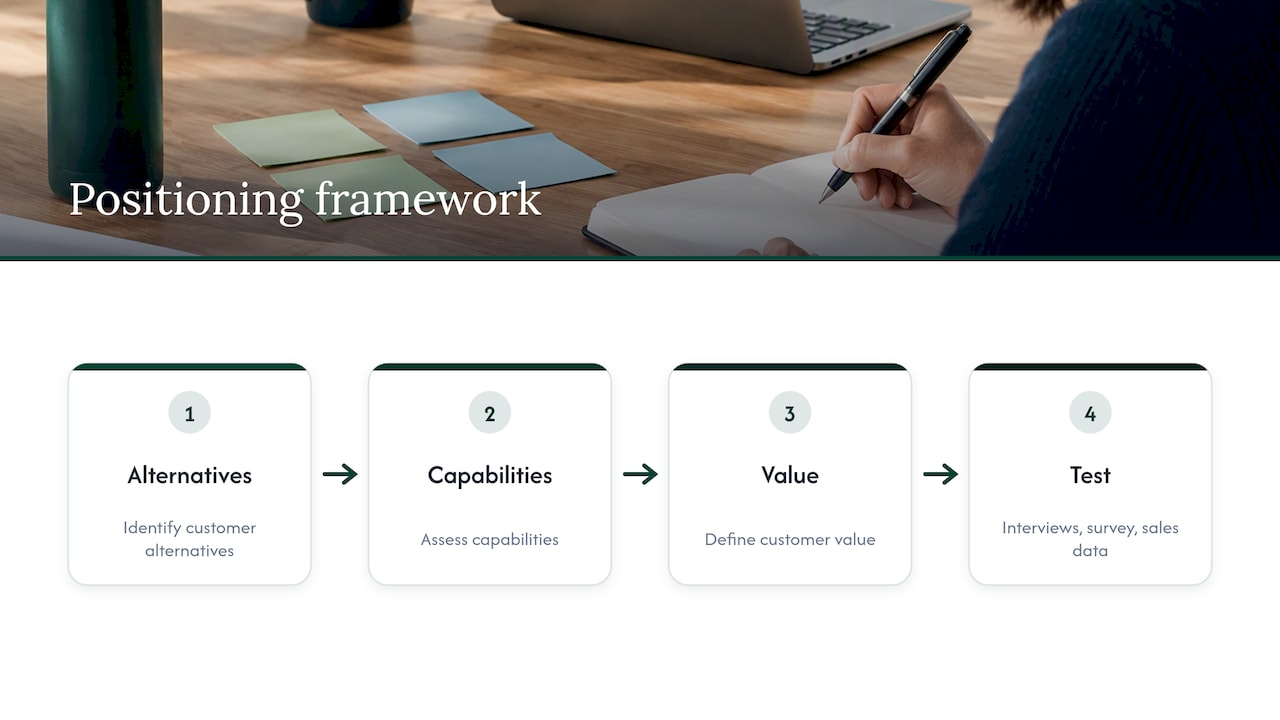
Dunford’s sequencing works because it forces you to establish facts before you write a single marketing sentence, and the practitioner workflow lays out five steps in a strict order.
- List competitive alternatives, including doing nothing, which anchors the whole exercise in the customer’s actual decision set rather than your product roadmap.
- Isolate differentiated capabilities, the specific things you do that those alternatives don’t.
- Translate capabilities into customer value, stating what each capability actually lets the customer achieve.
- Define best-fit customer characteristics, the traits that make your value obvious rather than theoretical.
- Select the market category that makes that value land fastest with the audience you just defined.
Alternatives come first because starting with a statement risks defending assumptions nobody has tested. Your deliverable checklist after this exercise: a documented alternatives list, a capability-to-value matrix, and one or two draft positioning statements ready for customer testing.
Pro Tip: Write your competitive alternatives list before you open any slide deck. If the list only has direct competitors and not “spreadsheets” or “doing nothing,” you haven’t finished the exercise.
Geoffrey Moore, Jobs-to-be-Done, and mapping: how they complement Dunford
Dunford tells you what to decide. Moore, Jobs-to-be-Done (JTBD), and perceptual mapping give you the tools to express and verify that decision.
- Moore’s positioning statement template (“For [target customer] who [need], [product] is a [category] that [key benefit], unlike [alternative], we [differentiator]”) is the compression step, useful once you have Dunford’s inputs and need one sentence everyone in the company can repeat.
- JTBD interviews ask what job the customer was trying to get done, what triggered the search, and what they tried before, surfacing functional needs alongside emotional and social ones that a feature list never captures.
- Perceptual mapping plots brand or product perceptions across two axes chosen for the category, while the C-D map method specifically scores centrality and distinctiveness and connects those scores to sales and pricing outcomes.
- Run a perceptual or C-D study during validation, after your Dunford and Moore drafts exist, so the survey tests a real hypothesis instead of fishing for one.
Each framework answers a different question: Moore answers “what do we say,” JTBD answers “why do they buy,” and mapping answers “where do we actually sit versus where we think we sit.”
Templates and examples you can adapt today
Copy-ready templates shorten the distance between a workshop and a working positioning statement.
Moore’s template, filled for a generic B2B SaaS example: “For operations managers at mid-size logistics firms who need real-time shipment visibility, RouteTrack is a fleet-management platform that cuts manual tracking time, unlike spreadsheet-based tracking, we update status automatically from carrier data.” A consumer example: “For parents who want screen time that teaches, a learning tablet app is a kids’ education tool that replaces passive video apps with guided lessons, unlike general tablets, we build every session around a measurable skill.”
The Dunford canvas needs five filled fields: competitive alternatives, differentiated capabilities, value statements, target customer characteristics, and category choice. A short filled example: alternatives, “manual spreadsheets and generic CRM fields;” capability, “automated shipment-status sync;” value, “fewer missed delivery windows;” target, “logistics teams managing over 50 daily shipments;” category, “fleet visibility software.”
For perceptual maps, pick two axes that matter to the category, such as “price” against “ease of use,” plot your brand and your named alternatives, then read the result through a C-D lens.
| Map element | What it shows | How to read it |
|---|---|---|
| Centrality | How relevant the brand is seen within the category | Higher centrality correlates with stronger consideration |
| Distinctiveness | How different the brand appears from alternatives | Low distinctiveness often signals a pricing disadvantage |
| Bubble size | Typically scaled to sales or market share | Useful for spotting underpriced, highly distinctive brands |
More filled examples and downloadable templates live in our positioning map examples guide.
How to run a rapid positioning workshop and validate it in seven weeks
A good workshop produces hypotheses, not finished copy, and a short validation sprint after it tells you whether those hypotheses hold up.
- Prework (before the session): send attendees a one-page prompt asking them to list who they think the competitive alternatives are.
- Workshop, minutes 0 to 20: brainstorm competitive alternatives as a group, including non-obvious ones like internal spreadsheets or inaction.
- Minutes 20 to 50: map differentiated capabilities against those alternatives in a simple matrix.
- Minutes 50 to 75: translate the top capabilities into customer-value statements and draft best-fit customer traits.
- Minutes 75 to 90: draft one or two Moore-style positioning statements as testable hypotheses, not final copy.
The seven-week validation plan that follows: run 5 to 10 customer interviews using JTBD questions, field a short perceptual survey, test messaging in one live channel, and hold two internal alignment checkpoints with product, marketing, and sales. Watch for preference lift and win-rate change, since combining short interviews with a small perceptual survey produces usable signals faster than a large-scale study, making it a practical way to test a hypothesis before a full rollout.
How frameworks become deliverables and measurable outcomes
We built our own methodology, Brand-Backed Performance™, around the same idea: a positioning hypothesis only matters once it shows up in pricing power, sales conversations, and customer experience. The Golden Spiral™ structures engagements around repeatable artifacts, a competitive-alternatives map, a capability-to-value matrix, and a positioning statement tied to measurable targets, rather than a one-time deck. Readers can request adapted versions of these templates directly through our frameworks overview.
What positioning means and why a framework beats guesswork
Positioning is the strategic work of defining a distinct place in customers’ minds relative to the alternatives they’d otherwise choose, and that distinct place drives demand, loyalty, and margins more reliably than a product’s feature list alone. It sits inside the broader STP model, segmentation, targeting, positioning, and is typically expressed through statements and perceptual maps that compare how customers see competing options along shared dimensions, according to OpenStax’s Principles of Marketing.
Frameworks matter because positioning decided by committee instinct tends to reflect internal politics more than customer reality. A structured sequence, alternatives first, then capabilities, then value, forces the same discipline every time instead of whichever idea won the last meeting. It also makes the result testable: a positioning statement derived from a framework can be checked against interviews, a survey, or sales data, while a slogan written from a brainstorm can only be argued about.
Scholarly reviews of the topic find no single agreed definition of positioning, with separate perspectives built around competition, category ownership, consumer perception, and differentiation. That’s one more reason a framework helps: it picks one coherent lens and applies it consistently instead of mixing all four at once.
Keeping product, marketing, and sales aligned on one position
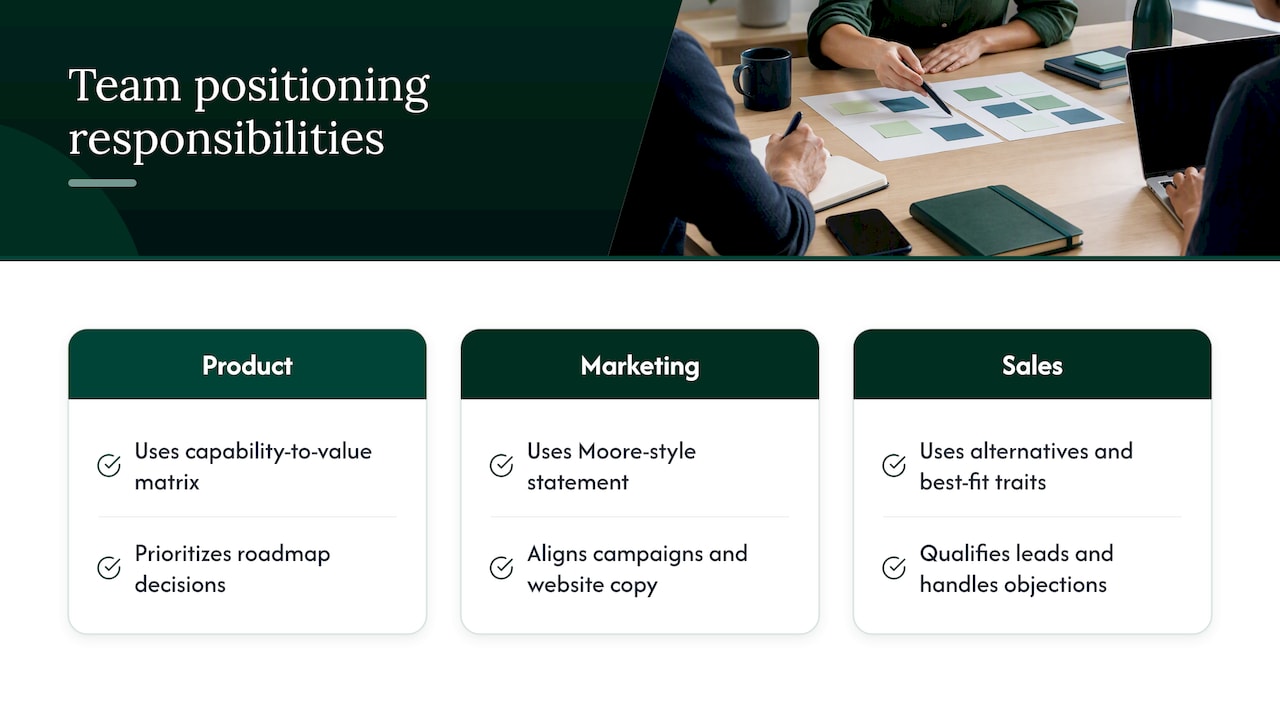
A positioning framework only pays off when every function that touches the customer works from the same inputs. Product teams need the capability-to-value matrix to prioritize roadmap decisions that reinforce the position rather than drift from it. Marketing needs the Moore-style statement as the backbone for messaging, campaigns, and website copy, so the same value claim shows up everywhere a prospect looks. Sales needs the competitive-alternatives list and the best-fit customer traits to qualify leads and handle objections without improvising a different story in every call.
The failure mode is predictable: product ships a feature the positioning never mentioned, marketing launches a campaign built on a different value claim, and sales pitches a category nobody agreed on. Each team technically has “a position,” but none of them match. Guarding against that means treating the Dunford canvas and the positioning statement as shared documents, reviewed in the same room by all three functions, not handed down from one department to the others. Our guidance on linking positioning to pricing decisions walks through how to carry that same alignment into pricing and KPI conversations, since pricing is often where misalignment becomes visible first.
What successful framework application tends to look like
The pattern that shows up across well-run positioning work is consistent: teams that start with competitive alternatives and work toward a statement, rather than starting with a slogan and backfilling justification, end up with positions that survive contact with real customers. The practitioner sequencing behind this treats the statement as the last step precisely because that order avoids internal bias, letting the evidence shape the words instead of the other way around.
The common thread in cases where positioning sticks is governance as much as cleverness: someone owns the position, revisits it on a schedule, and treats customer-facing language as downstream of the framework rather than a replacement for it. Where positioning work stalls or gets rewritten every quarter, the usual cause is that no one ran the alternatives-first exercise at all, so the “position” was really just a tagline competing with other taglines for internal approval.
Mistakes that quietly undermine good frameworks
The most common pitfall is writing the positioning statement before doing any of the upstream work, which locks a team into defending an assumption instead of testing one. A close second is confusing points-of-difference with points-of-parity. Credible positioning needs both: points-of-parity establish that you belong in the category at all, while points-of-difference create the actual preference, and skipping parity makes a differentiated claim sound implausible.
Teams also tend to list competitors instead of alternatives, missing the “do nothing” or “spreadsheet” options that are often the real competition for attention and budget. Another frequent error is treating a perceptual map as decoration rather than data, plotting a chart without connecting it back to a pricing or sales metric, which is the entire value of a C-D mapping approach in the first place. Finally, positioning work often dies from lack of ownership: it gets created once for a launch, then nobody updates it as the market or the competitive set changes, so it quietly goes stale while every other part of the business keeps moving.
Revisiting positioning as markets and customers shift
Positioning isn’t a document you finish, it’s a hypothesis you keep testing. The competitive-alternatives list that was accurate last year may be missing a new category entrant or a cheaper workaround customers have started adopting instead. Revisit the Dunford canvas whenever you notice win rates slipping against a specific competitor, when a new type of buyer starts showing up in deals, or on a fixed cadence, many teams use a yearly review paired with a lighter quarterly check.
Updating the position doesn’t always mean rewriting the statement. Sometimes the capabilities and value still hold, but the best-fit customer description needs to expand or narrow based on who’s actually converting. Other times a full perceptual remap is worth running, particularly if a centrality-distinctiveness assessment shows your distinctiveness eroding as competitors copy your messaging. Our rebrand checklist for leaders walks through how to decide whether a shift warrants a light refresh or a full repositioning effort, which matters because the two require very different levels of internal sign-off.
Why governance decides whether positioning survives
The wording matters less than who owns it after the workshop ends. Positioning drifts not because the framework was wrong but because no one revisited it, no one had authority to say no to a conflicting campaign, and no executive treated it as a business decision rather than a marketing exercise.
Practical governance means naming one owner, setting a review cadence, and building alignment checkpoints into product and sales planning, not just marketing’s. Leaders should sponsor that cadence and the cross-functional review, covered in more depth in our piece on executive tradeoffs in repositioning.
— Quincy
How we help you put these frameworks to work
Running the workshop is the easy part. Keeping the position consistent across product, marketing, and sales as the business grows is where most teams need support.
- Brand Positioning and Brand Strategy engagements apply the Dunford sequence and the Moore statement template directly to your competitive set.
- Growth and Go-to-Market Strategy work connects the resulting position to launch plans and pricing.
- Customer Experience mapping checks that the position holds up at every touchpoint, not just in the pitch deck.
Expect a structured engagement built around the frameworks in this guide rather than a generic branding exercise, with the templates and deliverables adapted to your category. See the full range of services and start a conversation on our Brand Strategy Frameworks page.
FAQ
What is a brand positioning strategy?
A brand positioning strategy is the deliberate set of decisions about which competitive alternatives you’re up against, what makes you different, and which customers that difference matters to most. It’s typically documented through a positioning statement and tested against real customer perception data rather than left as an internal assumption.
What is the 3 7 27 rule of branding?
There’s no single, widely agreed definition tied to that specific rule in the academic or practitioner sources reviewed here. Treat claims about it with caution and rely on documented frameworks like Dunford’s five-component method or Moore’s positioning statement instead.
What are some examples of positioning?
A B2B SaaS example: “For operations managers who need real-time visibility, our platform is a fleet-management tool that eliminates manual tracking, unlike spreadsheets.” A consumer example: “For parents who want screen time that teaches, our app is a learning tool built around measurable skills, unlike generic tablets.” Both follow the Moore positioning statement structure.
What does strategic positioning refer to?
Strategic positioning refers to treating your market position as a business decision, not just a messaging exercise, tying it to product priorities, pricing, and sales conversations. It’s grounded in identifying competitive alternatives first and translating differentiated capabilities into provable customer value before any statement gets written.
How do I choose the right positioning framework for my business?
Start with Dunford’s method if your competitive alternatives are unclear or shifting, since it forces that clarity first. Use Moore’s statement template once you already know your category and need one sentence for internal alignment, and add perceptual or C-D mapping when you need a number to validate the hypothesis against sales or pricing outcomes.
Sources
- Mind the Product: How to position your product (practitioner workflow)
- OpenStax Principles of Marketing — Product positioning
- Journal article: definition and outcomes of brand positioning