Stop Losing Deals: 7 Point Sales Enablement Strategy for Leaders
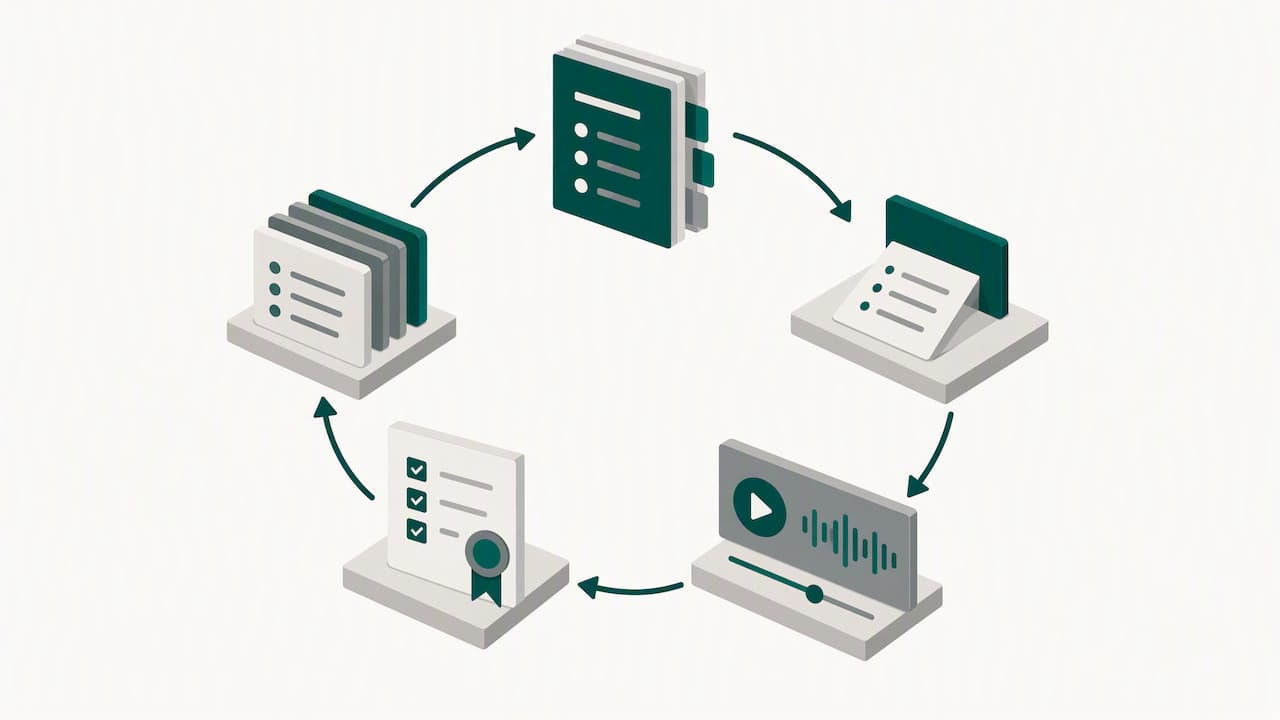
A sales enablement strategy is a formal program that equips sellers with the right content, training, coaching, and operations to increase quota attainment and win rates. It works by connecting four parts, content, training, coaching, and measurement, into one system instead of four disconnected initiatives. Done well, it shortens ramp time and gives managers a repeatable way to turn new skills into daily seller behavior.
TL;DR:
- A formal, charter-driven enablement program improves ramp speed, win rates, and quota attainment by systematically aligning content, training, coaching, and measurement.
- Building a sales enablement strategy requires a current-state assessment, clear charter, SMART goals, pilot programs, and iterative scaling based on measurable outcomes.
- Content must be mapped to buyer stages, stored in a discoverable repository, and tied directly to deal outcomes to maintain trust and relevance.
- Effective onboarding and ongoing education hinge on milestone-based milestones, skill demonstrations, and micro-modules that reinforce targeted behaviors.
- Manager coaching routines, clear adoption nudges, and leadership role modeling are essential to turn training into sustained seller behavior change.
Table of Contents
- What is sales enablement, and where does it fit in your go-to-market?
- Core elements of a modern sales enablement framework
- How do you build and launch a sales enablement strategy?
- Content strategy for enablement: production, discoverability, and impact
- Designing onboarding and continuing education that actually sticks
- Coaching, adoption, and manager enablement to convert training into behavior change
- Technology and tool categories: what to buy for which job
- Measurement: build a leading and lagging indicator stack
- Scaling and governance: charter, operating model, and quality control
- Quincy Samycia’s perspective: tying enablement to brand-backed performance
- What the data actually tells us about sales enablement
- How we can help you build or audit your enablement strategy
- FAQ
- Sources
What is sales enablement, and where does it fit in your go-to-market?
Sales enablement is the function that gives sellers the content, skills, and processes they need to have better conversations with buyers, and to close more of them. It is not a single tool or a training event. It is an ongoing program with a budget, an owner, and a set of services that other teams can request.
Enablement sits at the intersection of sales, marketing, and learning and development. Marketing produces messaging and campaigns; enablement translates that into something a rep can use in a live deal. L&D builds learning infrastructure; enablement decides what sellers actually need to learn and when. Sales operations manage systems and territory design; enablement makes sure those systems support how reps actually sell.
Forrester’s research on enablement leaders found that the role requires multi-disciplinary competencies spanning strategy and execution, which is why enablement often reports differently depending on company size and sales motion.
The practical benefits show up in three places:
- Faster ramp: new hires reach full productivity sooner when onboarding, content, and coaching are aligned rather than scattered across departments.
- Higher win rates: sellers close more deals when they can find the right case study or competitive answer at the moment they need it.
- Better quota attainment: managers coach more consistently when they have a shared playbook and scorecard instead of improvising.
Enablement works best when it has a clear charter, which we cover next, rather than existing as a loose collection of trainings and slide decks.
Core elements of a modern sales enablement framework
A sales enablement framework is the set of building blocks that turn scattered training and content efforts into one coordinated program. Gartner’s guidance on enablement frames the function around alignment, tools, and executive sponsorship, and most mature programs include the same seven components.
- Charter and governance: a written document naming the program’s scope, owner, sponsor, and the services it provides to sales.
- Content strategy and content operations: a system for creating, tagging, storing, and retiring sales content so reps can find what they need in seconds.
- Onboarding and ongoing training: structured learning paths for new hires and refreshers for tenured reps, tied to specific skills and products.
- Sales coaching and manager enablement: tools and cadences that help frontline managers reinforce training in live deals, not just in classrooms.
- Enablement operations and production model: the staffing and workflow that decide who builds what, and how requests get prioritized.
- Measurement and analytics: a dashboard connecting training and content activity to pipeline and revenue outcomes.
- Technology and integrations: the systems, usually a content hub, a learning platform, and a CRM, that make the other six pieces usable day to day.
The CSO Insights Fifth Annual Sales Enablement Study found that organizations using a formal, charter-based approach report significantly better business impact than those running enablement informally. The same research notes that enablement maturity has grown only steadily over time, with content strategy and cross-team collaboration remaining the most common gaps. That gap is usually the difference between a program that sellers trust and one they route around.
Pro Tip: Write your charter before you build a single piece of content. It forces agreement on scope before anyone argues about priorities.
Each element depends on the others. A content library without a tagging system gets ignored. A training program without manager coaching fades within weeks. Treat the seven pieces as one system with a single owner, not seven side projects.
How do you build and launch a sales enablement strategy?
Building a sales enablement strategy is a sequence, not a single planning session. Each step produces an input the next step needs, so skipping ahead to “build content” before assessing gaps tends to produce assets nobody uses.
- Run a current-state assessment. Interview sales leaders and a cross-section of reps, pull win-rate and ramp-time data by cohort, and audit existing content for usage and relevance. You are looking for where deals stall and where reps improvise instead of following a process.
- Draft a sales enablement charter. Name the program’s sponsor, scope, target audiences, and the specific services enablement will provide, such as onboarding, competitive content, or deal coaching. The CSO Insights study ties this document directly to sustained business impact, because it clarifies what enablement owns and what it does not. Securing a committed executive sponsor at this stage, not after launch, is what gives the charter teeth; our piece on executive tradeoffs covers how to get that buy-in before it becomes a blocker.
- Set SMART goals and map them to KPIs. Pick two or three outcomes, for example reducing new-hire ramp time or improving win rate in a specific segment, and attach leading and lagging metrics to each one so progress is visible before quarterly revenue numbers arrive.
- Design your initial programs. Build one onboarding pilot, one or two priority playbooks for your toughest competitive scenarios, and a manager coaching routine. Keep the first version narrow enough to finish in a quarter.
- Pilot, measure, and iterate before scaling. Launch with a single team or region, track your leading indicators weekly, and adjust content and coaching based on what reps actually use. Forrester’s research points to prioritized pilots with tight measurement as the pattern that reduces risk and speeds adoption, compared with a full rollout on day one.
Pro Tip: Give your pilot a hard end date and a predefined decision point: expand, adjust, or kill. Open-ended pilots rarely get evaluated honestly.
Once the pilot proves out, scale the same structure to additional teams rather than rebuilding it from scratch each time. The charter and KPI framework from step two should carry forward unchanged, which is the entire point of writing them down first.
Content strategy for enablement: production, discoverability, and impact
Content is the piece of enablement sellers interact with most often, and it is also where most programs lose trust. The fix starts with mapping content to the moments reps actually face, not to an abstract buyer journey that lives only in a slide deck.
- Map content types to buyer stages and seller moments: a discovery-call guide, an objection-handling one-pager, and a late-stage ROI calculator each serve a different point in the deal, and each should be labeled that way.
- Build a single source of truth: one searchable repository with consistent tagging by persona, stage, product, and industry, so reps stop asking colleagues for the “latest version” of a deck.
- Set a production cadence and retirement rule: review content quarterly, and archive anything that has not been opened or downloaded in that window.
- Track content’s influence on pipeline, not just downloads: tie specific assets to the deals where they were used and compare win rates against deals that did not use them.
HubSpot’s enablement framework guidance notes that companies with an established content strategy see measurable gains in quota attainment and win rate, but only when content is actively discoverable and used by reps rather than sitting in a shared drive. That single condition, discoverability, explains why two companies with similar content libraries can see very different results.
Cross-functional alignment matters here too. Content built by marketing without sales input tends to answer the wrong question at the wrong stage, and content built by enablement without marketing input tends to drift off brand. Treat content strategy as a shared function between the two teams, with enablement deciding what reps need and marketing contributing the production resources.
Designing onboarding and continuing education that actually sticks
New-hire onboarding is the clearest proof point for an enablement program, because ramp time is easy to measure and highly visible to sales leadership. HubSpot’s guidance recommends building onboarding around measurable milestones rather than a fixed curriculum length, which is where a 30/60/90 structure earns its place.
- Days 1 to 30: product and market fundamentals, CRM and tool setup, and shadowing calls. The deliverable is passing a product knowledge check, not completing a course.
- Days 31 to 60: role-specific learning paths, live call participation with manager feedback, and a first solo discovery call.
- Days 61 to 90: full deal ownership with structured coaching, a formal certification on competitive positioning, and a documented transition out of the onboarding path.
Beyond the first 90 days, sustain learning through short, targeted micro-modules tied to specific skills rather than long annual refreshers. A five-minute module on handling one objection, delivered right before a rep’s next relevant call, holds attention better than a two-hour session covering ten topics at once.
Certification and reinforcement close the loop. Require reps to demonstrate a skill, through a recorded call review or a manager-led role play, rather than simply marking a module complete. Programs that skip this step tend to see training completion rates that look strong on paper while seller behavior stays unchanged.
Coaching, adoption, and manager enablement to convert training into behavior change
Training changes what a rep knows. Coaching changes what a rep does. The gap between those two is where most enablement programs lose their return, because managers rarely get the same investment that reps receive.
- Set a coaching cadence: weekly one-on-one deal reviews, monthly skill-focused coaching sessions, and quarterly calibration across managers to keep standards consistent.
- Give managers a scorecard, not just a conversation guide: a simple rubric for evaluating calls against the skills the training actually covered.
- Use adoption nudges: in-CRM prompts, leaderboard visibility, and recognition tied to using new playbooks, not just to hitting quota.
- Tie incentives to behavior, not only outcomes: reward reps for using a new competitive battlecard correctly, even before it shows up in a closed deal.
Pro Tip: Equip managers before you launch reps into a new program. A manager who cannot coach a skill will undercut even well-designed training within a month.
Role modeling matters as much as any formal mechanism. When sales leaders visibly use the same playbooks and language in their own deal reviews, adoption spreads faster than any mandate from enablement alone.
Technology and tool categories: what to buy for which job
Enablement technology should follow strategy, not replace it. Before evaluating any platform, know which job you are solving for, since most programs end up with overlapping tools that do the same thing poorly rather than one tool that does a single job well.
- Content repository: centralizes and tags sales assets so reps can search by stage, persona, or product instead of asking a colleague.
- Learning management system: delivers onboarding paths, micro-modules, and certification tracking in one place.
- Coaching and conversation intelligence: records and analyzes sales calls to support manager feedback and skill tracking.
- Analytics and reporting: connects training completion and content usage data to CRM pipeline and revenue outcomes.
When evaluating any category, check four things: does it integrate with your CRM, can reps actually find what they need inside it, does it produce usable reports without manual exports, and how much friction does it add to a rep’s daily workflow. A tool that scores well on features but poorly on adoption friction will sit unused within a quarter.
Pilot new technology with a single team before a full rollout, and run a simple cost check before committing budget. A lightweight model, the kind of spreadsheet-based decision tool offered by Frac CFO’s optimization and decision modeling, can help you weigh licensing costs against projected ramp-time or win-rate gains before you sign a multi-year contract.
Measurement: build a leading and lagging indicator stack
Enablement leaders earn executive trust by reporting a stack of indicators, not a single ROI number pulled from a vendor’s case study. Sales Enablement Collective’s measurement guidance recommends pairing leading indicators, which show whether reps are engaging with the program, against lagging indicators, which show whether that engagement is moving revenue.
Leading indicators worth tracking:
- Training completion rates, broken down by role and cohort.
- Content utilization, measured as views, downloads, and reuse in live deals.
- Playbook and battlecard usage, tracked where your CRM or content platform allows it.
- Coaching frequency, measured as completed one-on-ones against your target cadence.
Lagging indicators worth tracking:
- Quota attainment, segmented by tenure and by onboarding cohort.
- Win rate, compared before and after a specific program launch.
- Deal velocity, measured as average days in each pipeline stage.
- Average deal size, tracked to catch unintended tradeoffs when reps chase speed over value.
A measurement stack beats a single ROI multiple because it lets you diagnose problems early. The Sales Enablement Collective notes that pairing training completion and content usage with quota attainment and win rate gives enablement leaders a credible story for executives, since a drop in a leading indicator often explains a lagging one before it shows up in quarterly revenue.
Present the dashboard as a narrative, not a spreadsheet dump: start with the business outcome, then show which leading indicators moved first and which program drove the change.
Scaling and governance: charter, operating model, and quality control
Scaling enablement from one team to the whole sales organization requires the same governance discipline that got the pilot approved in the first place. Without it, programs that worked for ten reps collapse under the weight of a hundred.
- Revisit your charter at each scaling milestone: confirm the sponsor, scope, and services still match what the broader organization needs.
- Choose an operating model deliberately: a centralized team gives consistency but can slow down to local requests, a distributed model gives speed but risks fragmented messaging, and a hybrid model, a small central team supporting regional enablement partners, is the most common compromise at scale.
- Define a RACI for content and training: name who creates, who approves, who distributes, and who measures each asset, so ownership does not blur as more teams get involved.
- Protect quality with a review cycle: require a documented sign-off before any new playbook or training module ships to more than one team.
Gartner’s framework for enablement emphasizes that the operating model choice is not permanent. As the business and sales motion evolve, the right balance between centralized and distributed enablement shifts with it, which is why the charter should be reviewed, not just filed away.
Quincy Samycia’s perspective: tying enablement to brand-backed performance
Most enablement programs treat content, training, and coaching as separate workstreams. Our frameworks, including The Golden Spiral™ and Brand-Backed Performance™, start from a different premise: a sales conversation is a brand experience, and the positioning gaps that show up in a lost deal usually trace back to unclear messaging upstream, not a skills gap on the call itself.
In practice, that means applying the same discipline we use in brand strategy work to enablement: a documented stop-doing list that forces a program to retire outdated content and trainings before adding new ones, as outlined in our approach to growth tradeoffs, and explicit executive tradeoffs written into the charter rather than left implicit. Readers can find more on how these patterns play out across client engagements in our journal.
Enablement fails less often from a lack of content than from a lack of clarity about what the business has decided to stop doing.
— Quincy
What the data actually tells us about sales enablement
The research is consistent on one point: formality beats improvisation. Organizations with a documented charter outperform those running enablement as a loose set of initiatives, yet most programs still treat the charter as paperwork to finish after launch rather than the document that makes launch coherent.
The conventional advice oversells technology and undersells governance. Teams buy a content platform or a conversation intelligence tool expecting adoption to follow, when the research points the other way: discoverability and manager coaching determine whether a tool gets used, not the tool’s feature set.
If you take one thing from this playbook, prioritize the charter and the manager coaching cadence before any content or technology decision. Content can be rebuilt. A program launched without sponsorship or a coaching routine rarely gets a second chance to earn trust from the sales floor.
— Quincy
How we can help you build or audit your enablement strategy
If your sales enablement strategy needs a clear charter, a positioning check, or an outside read on why content and training aren’t converting into win-rate gains, help is available to close that gap.
- Brand and positioning audits identify where your messaging, not just your training, is costing you deals.
- Growth and go-to-market strategy engagements connect enablement priorities to a broader commercial plan.
- Workshops and executive sessions, detailed on our speaking page, give your sales and marketing leaders a shared framework in a single working session.
Engagements are scoped to your team’s stage and goals, with deliverables and timelines set during an initial conversation rather than off a fixed template. Visit Quincysamycia to start that conversation and see which engagement fits where your program stands today.
FAQ
What is a sales enablement strategist?
A sales enablement strategist is the person responsible for designing and running the enablement charter, including content strategy, training design, coaching programs, and measurement. They typically report into sales or marketing leadership and work across both functions to keep messaging, training, and content aligned.
What are the three pillars of sales enablement?
Most practitioner frameworks describe three pillars as content, training, and coaching, supported by a fourth layer of measurement and operations that ties the three together. HubSpot’s enablement framework organizes its guidance around this same structure, treating measurement as the thread connecting the others rather than a separate pillar.
What are the four pillars of enablement?
Definitions vary across sources, but a common version expands the three core pillars, content, training, and coaching, into four by adding operations and measurement as its own pillar. This version emphasizes that a dashboard and a production model are as essential to a working program as the content and training themselves.
What is a sales enablement plan?
A sales enablement plan is the tactical document that lays out specific programs, timelines, and owners under the broader enablement charter, such as a 30/60/90 onboarding rollout or a quarterly content production schedule. It translates the charter’s goals into concrete deliverables that a team can execute and measure within a set period.
Sources
- CSO Insights: Fifth Annual Sales Enablement Study (Highspot community PDF)
- Sales Enablement Collective: Sales metrics guidance
- HubSpot: Building a sales enablement framework
- Forrester: Five Critical Competencies for Sales Enablement Leaders
- Gartner: The who, what, how and why of sales enablement