Finish a Working Service Blueprint Mapping in One Workshop
Service blueprint mapping is a single-page operational diagram that lines up what a customer does with the internal work, people, and systems that make it happen. Its job is to expose the handoffs and delays customers never see but always feel. Run a focused workshop lasting a few hours, where you will walk away with an actionable blueprint, not just a pretty diagram.
TL;DR:
- Service blueprints reveal internal handoffs and delays behind customer frustrations by mapping customer actions alongside frontstage, backstage, and support processes in detail.
- Effective blueprints focus on one core scenario, with clear ownership and elapsed time annotations to turn visualizations into actionable diagnostics.
- They are most valuable for cross-departmental services, omnichannel experiences, or high-stakes interactions that require precise coordination and ownership.
- Building a blueprint involves cross-functional support, frontline research, low-fidelity mapping, validation workshops, and regular reviews to maintain accuracy and relevance.
- Common pitfalls include scope creep, policy-only research, unassigned ownership, missing time data, and lack of version control.
Table of Contents
- What Is Service Blueprint Mapping, Exactly?
- What Goes in the Five Lanes and Three Lines?
- When Should You Build a Service Blueprint?
- How Do You Create a Service Blueprint in Five Steps?
- Which Tools Fit Each Stage of the Blueprint?
- What Mistakes Most Often Break a Service Blueprint?
- What Does a Finished Service Blueprint Look Like?
- Why Blueprint Gaps Are Really Brand Gaps
- Get Hands-On Help Running Your Blueprint Workshop
- Sources
- FAQ
What Is Service Blueprint Mapping, Exactly?
A service blueprint is a diagram that visualizes the relationship between a customer’s journey and the organizational components, meaning people, props, and processes, that support it. It works across five horizontal layers and three diagnostic lines, which is what separates it from a simple flowchart. Customer journey maps, process maps, and service blueprints get confused constantly, but they answer different questions.
- Customer journey map: shows how a customer feels and behaves across a relationship, with no internal detail.
- Service blueprint: shows the customer’s actions alongside the exact internal steps, systems, and people producing them.
- Process map: shows internal workflow only, with no customer perspective at all.
A journey map tells you where a customer gets frustrated. A blueprint tells you why, because it exposes the backstage handoff that caused it. Many teams pair the two: build the journey map first to find the moment that hurts, then build a blueprint of that specific moment to fix it. A process map still has a place when you need pure operational detail with no customer lens attached, like a compliance checklist.
What Goes in the Five Lanes and Three Lines?
Every blueprint runs on five horizontal swim lanes, each answering a distinct question about who does what and where.
- Physical evidence: the tangible things customers see or touch at each step, like a confirmation email, a signed contract, or a physical office.
- Customer actions: the steps the customer takes, in order, left to right.
- Frontstage: employee actions the customer can observe directly, like a sales call or a support chat.
- Backstage: employee actions happening behind the scenes that the customer never sees, like underwriting a loan or provisioning an account.
- Support processes: the internal systems, vendors, and policies that backstage staff depend on, like a CRM or a fulfillment partner.
Three lines cut across these lanes and carry most of the diagnostic power. The line of interaction sits between customer actions and frontstage, marking every point of direct contact. The line of visibility sits between frontstage and backstage, marking the boundary of what customers can actually see. The line of internal interaction sits between backstage and support processes, marking where staff depend on other departments or vendors.
Statistic Callout: Annotating backstage steps with named owners and elapsed time turns a vague complaint into evidence a leadership team can act on. As one practitioner framework puts it, a line like “contract review took four days, owned by legal” is what actually drives a fix, not a general sense that onboarding feels slow.
Add arrows to show handoffs between lanes, elapsed time next to each backstage box, an owner’s name or title on every step, and a metric where one exists (call volume, error rate, cycle time). That’s what turns a diagram into a working diagnostic tool.
When Should You Build a Service Blueprint?
Blueprints earn their keep when a service crosses departments, channels, or handoff points that nobody owns end to end. A few situations call for one specifically:
- Cross-functional services: onboarding, claims processing, or support escalations that touch sales, ops, and support all at once.
- Omnichannel experiences: a customer who starts in an app, calls a hotline, then visits a location, where each handoff is a chance to drop the ball.
- Repeatable, high-stakes moments: renewal, upgrade, or offboarding flows where a single failure point repeats at scale.
If you’re mapping how a customer feels over a long relationship with no interest in internal mechanics yet, start with a journey map instead. If you’re documenting a purely internal workflow with no customer touchpoint, a process map is faster and just as accurate. When you do build a blueprint, map one core scenario, not your entire service catalog. A blueprint that tries to cover every product line at once becomes unreadable and nobody will maintain it.
How Do You Create a Service Blueprint in Five Steps?
You can run this whole method in a single workshop day, or spread it across two weeks if research needs more runway. The sequence matters more than the calendar.
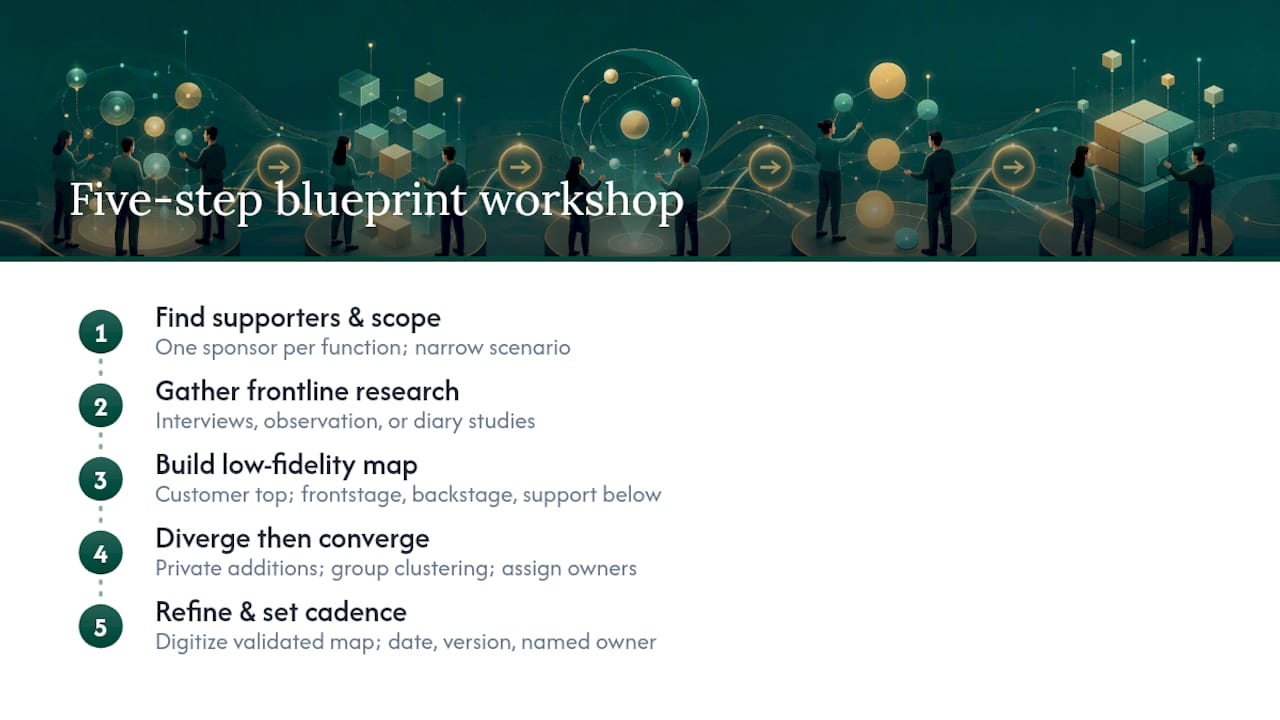
1. Find cross-functional support and scope the scenario. Before you touch a whiteboard, get one sponsor from each function the blueprint will touch, operations, product, support, sales, whoever owns a lane. Without that buy-in early, the blueprint dies the moment it surfaces an uncomfortable finding about someone’s team. Pick one scenario: not “onboarding” broadly, but “onboarding for a mid-market client between contract signature and first invoice.” Narrow scope is what makes the 5-step framework actually finishable.
2. Gather research focused on employees, not policy docs. Interview frontline staff who do the work daily, not just the manager who wrote the process document. Contextual inquiry, meaning watching someone actually process a claim or onboard a client in real time, catches workarounds that never make it into a training manual. Diary studies work well when the cycle is too long to observe live, like a 30-day fulfillment process. Practitioner guidance is consistent on this point: how work is supposed to happen and how it actually happens are usually two different documents, and only frontline observation closes that gap.
3. Build a low-fidelity map, left to right. Start with customer actions across the top, in chronological order, using sticky notes or a spreadsheet grid. Then fill in frontstage actions directly beneath each customer step, backstage work beneath that, and support processes at the bottom. Don’t polish anything yet. A messy first draft with gaps you can see is more useful than a clean draft that hides what you don’t know.
4. Validate with a diverge-and-converge workshop. Bring your cross-functional group together for a structured session: individuals add missing steps privately first, without discussion, for roughly 90 minutes. Then spend 60 to 90 minutes converging as a group, clustering duplicate entries and assigning an owner to every backstage box. This diverge-then-converge pattern exists specifically to stop the loudest person in the room from steering the whole map. While you converge, add elapsed time estimates and flag pain points with a distinct color or symbol.
5. Refine into a distributable artifact and set a cadence. Move the validated draft into whatever fidelity tool fits your audience, then add a version number, a date, and a named owner responsible for the next review. Set a recurring check, quarterly works for most teams, so the blueprint gets updated instead of going stale in a shared drive nobody opens again.
Pro Tip: Resist the urge to fully digitize the blueprint before validation. A shaky sticky-note version that a room full of frontline staff can argue with beats a beautiful Figma file that nobody feels ownership over.
Which Tools Fit Each Stage of the Blueprint?
Fidelity should track your stage, not your budget. Jumping straight to a polished design tool before you’ve validated anything usually means rebuilding it twice.
- Spreadsheets: fast to edit, easy for anyone on the team to update, and ideal for digitizing sticky notes from a workshop into something searchable. This is where most first drafts should live.
- Collaborative canvases (FigJam, Miro): built for real-time workshops, letting a distributed group add sticky notes simultaneously and cluster them live. The tradeoff is that canvases get messy fast without a facilitator actively organizing as you go.
- Design tools (Figma, Illustrator, Lucid): worth the extra setup time once you need a presentation-ready artifact for executives, but they demand design skill most ops teams don’t have on staff, and locking a blueprint into a static file makes it harder to update later.
Weigh data protection and accessibility too. A spreadsheet on a shared drive is easy for a compliance team to audit; a canvas tool with external guest links is not always.
What Mistakes Most Often Break a Service Blueprint?
Most failed blueprints share the same handful of root causes, and every one of them is avoidable.
- Scope creep: mapping an entire service line instead of one scenario turns the blueprint into a wall of sticky notes nobody can read or maintain.
- Policy-only research: building the map from process documents alone, skipping frontline interviews, produces a blueprint of how work is supposed to happen, not how it actually does.
- No named owner: a backstage step with no accountable person attached rarely gets fixed, no matter how clearly the blueprint flags the delay.
- No elapsed time: a step without a time annotation reads as a guess; a step marked “four days” reads as evidence.
- No versioning: a blueprint with no date or review cadence gets built once, presented once, and forgotten within two quarters.
Pro Tip: Put the review date directly on the blueprint itself, not in a separate project tracker. A visible “Next review: Q2 2027” line at the bottom does more to force accountability than any calendar reminder.
What Does a Finished Service Blueprint Look Like?
A mini blueprint for client onboarding, covering the scenario from signed contract to first invoice, might run four columns: sign contract, kickoff call, intake and setup, first invoice sent. Each column carries one line per swim lane: physical evidence might be “signed PDF” then “calendar invite” then “welcome packet” then “invoice email.” Customer actions run parallel underneath: sign, join call, submit intake form, receive bill.
Backstage rows are where the useful discoveries usually surface:
- Legal reviews the contract while sales has already told the client kickoff starts Monday, creating a two-day gap nobody accounted for.
- Intake data gets typed into the CRM by ops, then retyped into the billing system by finance, a duplicated entry point that invites errors.
Two fixes typically fall out of this: give legal a 48-hour service-level target with sales notified automatically on completion, and connect the CRM and billing system so intake data flows once. Track time-to-kickoff and data-entry error rate as your two metrics, and you’ll know within a quarter whether the fixes held.
Why Blueprint Gaps Are Really Brand Gaps
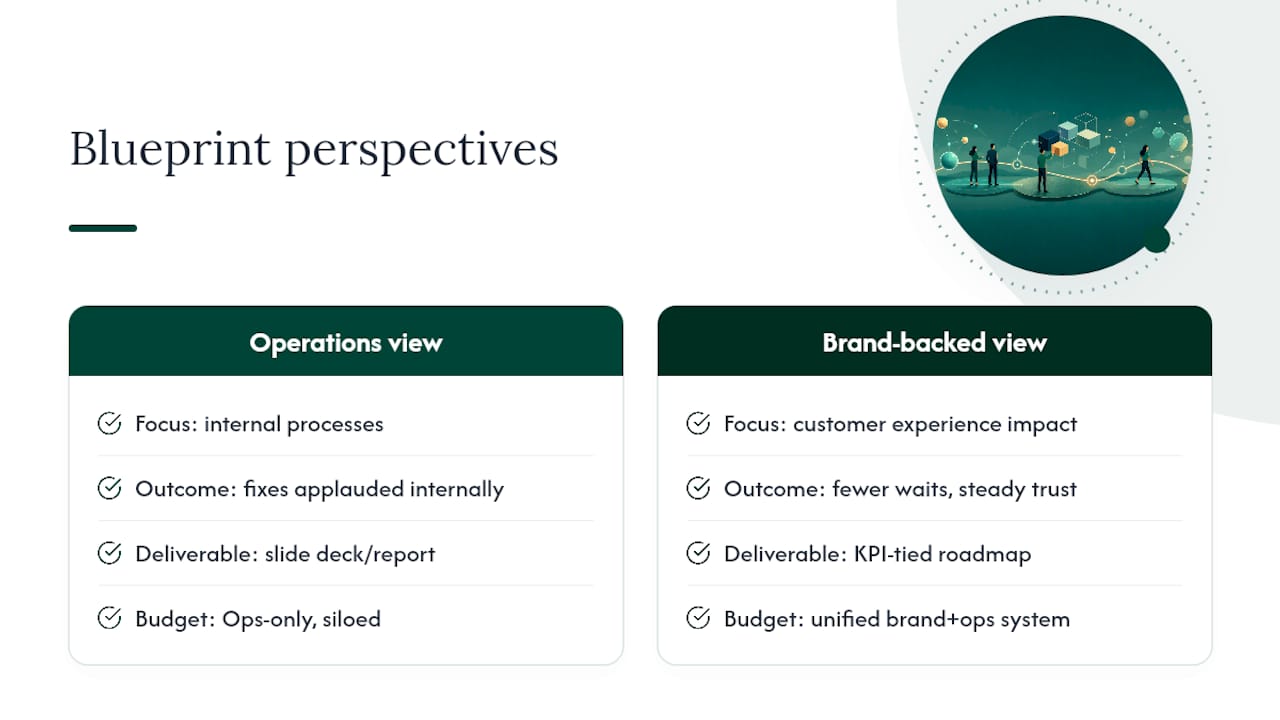
Most teams treat a service blueprint as an operations exercise. That undersells it. Every handoff delay a blueprint surfaces, that four-day contract review, that duplicated intake entry, is a moment where the brand promise a company makes in its marketing collides with what actually happens on the ground. Customers don’t experience your positioning statement. They experience the wait.
What I push clients toward is turning blueprint findings into a prioritized roadmap tied to specific KPIs, not a slide deck that gets applauded once and archived. If a backstage delay is costing you renewal rate or referral volume, that finding belongs on the same roadmap as your next brand campaign, evaluated with the same rigor. This is the core premise behind frameworks like Brand-Backed Performance™: brand and operations are not separate budgets competing for attention, they are one system that either compounds or erodes trust with every customer interaction.
— Quincy
Get Hands-On Help Running Your Blueprint Workshop
A spreadsheet template gets you started, but a facilitated workshop gets you finished, with a room full of stakeholders who actually agree on what the blueprint shows and who owns each fix. That’s the gap Quincysamycia closes for teams who don’t have the internal bandwidth or neutral facilitator to run this cross-functionally without politics getting in the way.
An engagement typically produces a validated blueprint artifact, named owners on every backstage step, a prioritized roadmap tied to measurable outcomes, and a review cadence your team actually keeps. Quincysamycia’s Founder and Executive Advisory and Customer Experience services apply this alongside frameworks like The Golden Spiral™ to connect what the blueprint finds to brand and revenue outcomes, not just a cleaner org chart. Teams that prefer a live, facilitated session can also book a workshop or keynote engagement built around blueprinting and cross-functional alignment. Reach out through the site to scope your first session.
Sources
For the canonical structure and terminology, the NN/g definition of service blueprints is the standard reference most practitioners cite. Collaborative canvas templates are available through Miro’s service blueprint guide and Figma’s resource library. For an operational example of documenting timelines and named owners outside service design specifically, see how an EOR process maps its own steps and turnaround time.
- Service Blueprints: Definition
- How to create a service blueprint, effectively
- Service blueprint example and template
FAQ
What Is a Service Blueprint Used For?
A service blueprint is used to diagnose where a service breaks down internally, showing customer actions alongside the frontstage and backstage work that produces them. Teams use it to find handoff delays, assign ownership, and prioritize fixes that actually change the customer experience.
How Is a Service Blueprint Different From a Customer Journey Map?
A journey map shows how a customer feels and behaves without internal detail, while a service blueprint adds the five internal swim lanes and three diagnostic lines that explain why a moment in that journey happens the way it does. Most teams build the journey map first, then blueprint the specific moment that needs fixing.
How Long Does It Take to Build a Service Blueprint?
A focused workshop covering one scenario, from initial research to a validated low-fidelity draft, typically runs 2 to 4 hours once cross-functional stakeholders are in the room. Refining that draft into a high-fidelity, presentation-ready artifact following the 5-step framework usually adds another few days of iteration.
What Tools Should I Use to Build One?
Start with a spreadsheet or sticky notes for your first low-fidelity draft, then move to a collaborative canvas like Miro or FigJam for live workshop sessions. Reserve polished design tools like Figma for the final version you present to executives.
Does Quincysamycia Offer Blueprint Workshops?
Yes, Quincysamycia’s Customer Experience and Founder and Executive Advisory services include facilitated blueprint workshops that produce a validated artifact, named owners, and a prioritized roadmap. Current pricing is available directly through the site, since engagements are scoped to each team’s situation.