
Startup Brand Strategy for Founders: Make Brand a Growth Metric
Startup brand strategy is the set of business-level choices about who you serve, what you promise and how every touchpoint delivers on it, not just a logo and a color palette. Start this week by running a short discovery with early customers and key stakeholders, then draft a one-line positioning and a brand script. Treat the result as version one, because you will refine it as you learn.
TL;DR:
- Define positioning through four elements: target customer, category, point of difference, and evidence; reject any claim the team cannot support in sales conversations.
- Interview founders, early employees, advisors, and customers before settling the brand script; ask buyers about problems, alternatives, and the words they use.
- Keep the first brand system lean: positioning, core messages, simple identity, and key touchpoints; defer custom artwork and review performance on a fixed schedule.
- When pitching investors, lead with verifiable customers, revenue, or partnerships; passion and concrete storytelling help most when those signals already support the narrative.
- Choose two or three channels based on customer and business model, then test one message variable at a time against reply, signup, or conversion rates.
Table of Contents
- What is startup brand strategy, and how does it differ from marketing?
- Why does brand strategy matter for startups?
- Which core components do you need to define?
- How do you build a startup brand step by step?
- How can founder identity work as an early brand asset?
- What is a minimum viable brand, and how do you stay lean?
- Which early digital channels move the needle?
- How do you measure brand progress and the signals investors weigh?
- How do you gather customer feedback and fold it into your brand?
- What pitfalls cause brand drift, and how do you avoid them?
- How does brand strategy connect to business strategy and product?
- How we frame brand strategy as a measurable growth capability
- Ready to put your startup brand strategy to work?
- FAQ
- Sources
What is startup brand strategy, and how does it differ from marketing?
Startup brand strategy is the organizing logic behind your choices. It decides who you are for, what you stand for, what you promise and how that promise shows up in the product, the sales call and the support inbox. Marketing is how you spread that logic: campaigns, ads, emails, content calendars. If marketing is the megaphone, brand strategy is the message the megaphone carries and the reason anyone believes it.
The distinction matters because founders often hire a designer or launch a campaign before they have decided what the company should mean to anyone. The result is polished output with no point of view. A systematic review of research on branding in new ventures frames branding as a strategic asset that goes beyond communication. For a young company with no history, no distribution and no track record, brand helps establish legitimacy in an uncertain market.
Here is a practical way to separate the two:
- Brand strategy governs: who your ideal customer is, the category you compete in, your point of difference, your promise, your tone of voice and the experience you refuse to compromise on.
- Brand strategy also governs: what you say no to, such as features, channels and customers that pull you away from your positioning.
- Marketing executes: the campaigns, landing pages, ad creative, webinars and email sequences that carry the strategy to market.
- Marketing tests: which words, offers and channels move people, using the strategy as the guardrail.
- Product and sales express: the same promise through onboarding, pricing, demos and follow-up.
A quick test: if you removed your logo and name from your homepage, would a stranger still know what you do, for whom and why you are different? If not, the problem is strategy, and no amount of campaign spend will fix it. Brand strategy comes first because every later decision gets cheaper and faster when the core choices are already made.
Why does brand strategy matter for startups?
Early-stage companies face a credibility gap. You ask people to trust an unknown name with their money, their data or their careers, and you have few reviews, few logos and little proof. Brand work narrows that gap. The research on new venture branding describes it as a way to compensate for missing history and distribution by signaling who you are and what you stand for.
The payoff shows up in places founders care about most:
- Customer trust. A clear, consistent promise makes a new name feel safer to try.
- Hiring. Candidates join companies whose purpose they can explain to their friends.
- Differentiation. In a crowded category, a sharp position keeps you from competing on price alone.
- Investor confidence. A coherent story backed by evidence reads as a team that knows its market.
On that last point, research on how startups communicate with funders is useful. A study of business-to-investor marketing finds that investor decisions depend on both costly signals, such as customers, revenue and partnerships, and costless signals, such as passion and concreteness. Brand strategy is how you make sure those signals add up to one believable story rather than a scattered set of claims.
The research finding: Investor decision-making draws on both costly signals (customers, revenue, partnerships) and costless signals (passion, concreteness), and the pull of passion and concreteness depends on how many costly signals the startup can show. In plain terms, enthusiasm helps most when real proof stands behind it.
Delaying brand work does not save money. It defers the cost. Without a clear position, the team makes dozens of small decisions inconsistently: a homepage headline that says one thing, a pitch deck that says another, a sales script that says a third. Later, you pay to unwind that confusion through a rebrand, a rewritten site, retrained salespeople and customers who no longer know what you do. A few focused days of strategy upfront prevent months of cleanup, and they give every future hire and contractor a shared reference point.
Which core components do you need to define?
You do not need a hundred-page guideline. You need a short set of components, defined clearly enough that anyone on the team can apply them. Use this list to create or audit what you already have.
Positioning. Write a statement in four parts: your target customer, the category you compete in, your point of difference and the proof that backs it up. For example: “For operations leads at mid-size logistics firms, our platform is the route-planning tool that cuts dispatch time without replacing your existing software, proven by pilots with regional carriers.” If any of the four parts is vague, the statement will not hold up in a sales conversation.
Value proposition. This is the specific outcome the customer gets, stated in their words rather than yours. It should name the problem, the result and the reason you can deliver it.
Message hierarchy. Build messages in layers so you never improvise under pressure:
- Elevator pitch: a concise pitch that says what you do and why it matters.
- Key benefits: a short list, each tied to a customer outcome.
- Proof points: customer results, pilots, partnerships, credentials and data you can show.
- Supporting details: features, integrations, pricing logic and technical specifics for people who want depth.
Identity. Prioritize the elements that carry the most weight first. Confirm your name is usable: check trademark conflicts, domain availability and how it reads aloud. Then settle a logo, a small set of visual rules (colors, type, imagery style) and a one-page usage guide. Defer anything fancy, such as custom illustration systems or motion libraries, until the basics are working.
Experience and touchpoints. Map where customers actually meet you: the website, the first sales call, onboarding, product emails, support replies and invoices. For each, ask whether it expresses the same promise. A brand that sounds confident on the homepage but slow and generic in support will lose the trust it just earned.
Voice. Pick a few personality traits and write example sentences for each: one that sounds like you and one that does not. This is the fastest way to keep a growing team writing in one voice.
Pro Tip: Run a “cover the logo” audit on your website, pitch deck and onboarding emails. If a competitor could swap in their name and the copy would still work, rewrite it until it could only be yours.
How do you build a startup brand step by step?
This workflow produces a minimum viable brand in a manageable timeframe, rather than stretching the work out. Time-box each phase so the work does not expand to fill the calendar.
-
Discovery. Interview a few internal stakeholders, such as founders, early employees and advisors, to surface what each believes the company is for. Then run rapid customer interviews, asking what problem they were trying to solve, what alternatives they considered and what words they use to describe you. Finish with a quick landscape scan: list the alternatives your customers consider and note how each describes itself. Research on brand building in B2B high-tech startups recommends co-creating positioning with early stakeholders and customers instead of imposing identity from the top down, which improves alignment and reduces risk.
-
Positioning workshop. Gather the founders and trusted voices and work through a one-page brand script covering key items: people (who you serve), purpose (why you exist), promise (what they can count on), product (how you deliver) and personality (how you sound). Draft the positioning statement from the previous section and pressure-test it against what customers said in discovery. Cut anything the team cannot defend with evidence.
-
Design decisions. Prioritize what launch actually needs: name, logo, color and type choices, a simple template for decks and a consistent set of web headlines. Defer the rest, including extended icon sets, brand films and merchandise. The goal is consistency, not completeness.
-
Launch plan. Coordinate every touchpoint to say the same thing: update the website headline and about page, the pitch deck, the email signature, the LinkedIn company page, the sales script and the onboarding sequence. Plan a few micro-experiments, such as alternative versions of a landing page headline or an outbound email, so you learn which message earns the strongest response.
-
Iterate regularly. Set a short test cycle with clear success metrics: reply rate on outreach, conversion on the landing page, demo-to-trial rate and the words prospects repeat back to you. Keep what works, rewrite what does not and record the change so the team always works from the current version.
The numbered flow above is a loop, not a line. Each cycle of interviews and tests sharpens the script. The research on agile branding in the start-up context treats brand strategy as a dynamic capability that lets startups recalibrate messaging efficiently through iterative, data-informed adjustments, which is exactly the habit this process builds.
Pro Tip: Put a date on the calendar for your first brand review before you launch. Without a scheduled checkpoint, the first version quietly becomes permanent, and the gaps between what you say and what customers experience widen unnoticed.
A few notes on avoiding common stalls. Do not wait for perfect interviews; five honest conversations beat fifty imagined ones. Do not let the workshop turn into wordsmithing; settle meaning first and polish phrasing later. And do not hand the whole process to an outside party and walk away, because the founders need to own the reasoning to apply it consistently.
How can founder identity work as an early brand asset?
In young companies, the founder often is the brand for a while. Research on founders and their brands in small firms finds that founder identity frequently becomes intertwined with the corporate brand, and that leaning on the founder’s presence can create distinctiveness and early trust. It also warns that the shift away from a founder-centered brand needs careful management. That tension is the whole game: use the founder’s story to win early trust, and plan from day one for the company to stand on its own.
Tactics that work:
- Founder-authored content. Write about the problem you set out to solve and what you are learning. Specific, honest posts do more for credibility than generic thought leadership.
- Visible bios. Put the founding team’s background on the site and deck, tied to why you are qualified to solve this problem.
- Selective media and speaking. Choose a few venues where your audience gathers rather than chasing every mention. Speaking is one route, and we cover it on our speaking page.
- Investor-facing storytelling. Pair your personal narrative with the proof investors weigh most: customers, revenue and partnerships.
Guardrails that keep you from becoming a bottleneck:
- Set a professionalization timeline. Decide now that, by a specific milestone such as your first sales hire or reaching a customer milestone, the company brand takes the lead role and the founder moves to a supporting one.
- Document the story. Move your origin story, language and stances from your head into a shared brand script so others can tell it accurately.
- Spread the voice. Give early team members and customers room to speak for the company, so recognition does not depend on one person.
- Separate the person from the promise. Make sure the customer’s reason to buy is about the outcome you deliver, not only about trusting you personally.
Done well, founder visibility gets you through the period when you have no other proof, and a documented brand lets you hand the baton without losing momentum.
What is a minimum viable brand, and how do you stay lean?
A minimum viable brand, or MVB, is the smallest set of brand decisions that gets your team aligned and gives the market something clear to react to. You can produce it quickly, test it against real feedback and improve it, rather than waiting for a polished identity that may not survive your first pivot. The review of branding in new ventures points toward this kind of lean, legitimacy-building approach for young firms operating under uncertainty.
Five rules keep an MVB useful:
- Define the core promise. One sentence about what customers can always count on from you.
- Keep scope tight. Decide only what launch requires: positioning, key messages, a simple identity and the primary touchpoints.
- Document guardrails. Write down what is fixed (promise, voice, name) and what is flexible (taglines, campaign themes, imagery).
- Test in the market. Treat each message as a hypothesis and watch how real prospects respond.
- Iterate on a schedule. Review on a fixed rhythm and update the single source of truth when you learn something.
The agile side matters just as much. The agile branding research describes a mindset that treats brand strategy as a dynamic capability, recalibrating messaging through iterative, data-informed adjustments. In practice, that means setting feedback loops with customers and sales, naming the two or three metrics you will watch, and keeping version control on your messaging so everyone uses the current wording rather than a stale slide from months ago.
Pro Tip: Keep a one-page “brand changelog” listing each messaging change, the date, the reason and the result. When you pivot, you will know which parts of your brand to carry forward and which were only tied to the old direction.
Which early digital channels move the needle?
Channels should follow your business model and your customer, not the other way around. With limited budget, pick two or three and do them well.
- Website and search. Your site is the one asset you fully own. Make the homepage state your position plainly, build a few pages around the questions buyers actually search and measure what brings qualified visitors. If discoverability in search and AI assistants is a priority, a specialist such as Velveteen focuses on helping companies become easier for search engines and systems like ChatGPT to recommend.
- LinkedIn for B2B. Founder and company posts, short case vignettes and direct outreach work well where buyers are professionals.
- Product-led content and email. Demos, tutorials and onboarding emails keep new users engaged and reinforce the promise after signup.
- Targeted paid. Use paid channels to capture demand you have already tested organically, not to find your message from scratch.
Run low-cost experiments with a simple structure: write a hypothesis (“Leading with speed will beat leading with price”), pick a metric (click-through, reply rate or signup rate), choose a realistic sample and set a clear result window. Change one variable at a time so you know what caused the difference.
Content that builds a brand early includes founder narratives about the problem you are solving, short case vignettes showing a customer’s before and after, and product demos that let people see the promise in action.
How do you measure brand progress and the signals investors weigh?
Keep measurement light. A handful of indicators, reviewed on a fixed rhythm, is enough in the early stage.
- Search and mention trends. Are more people searching for your name and category terms, and is your name appearing in relevant conversations?
- Content engagement. Track replies, saves, shares and time on key pages rather than raw impressions.
- Lead quality. Are the people arriving a better fit than before, and do they describe your value in your words?
- Conversion lifts. Compare conversion on pages and emails before and after messaging changes.
Investors look for evidence that a clear story is backed by proof. The business-to-investor marketing study separates costly signals, such as customers, revenue and partnerships, from costless ones, such as passion and concreteness, and shows that the effect of passion and concreteness depends on how strong the costly signals are. So lead with proof you can verify, then use consistent, specific messaging to make that proof memorable.
Takeaway for founders: Passion and concreteness work best when they sit on top of credible customers, revenue or partnerships, so build your narrative around real traction first.
To summarize progress for investors, build a one-slide narrative: the positioning in a sentence, the three brand actions you took this period, the metric each one moved and the next experiment. That single slide links brand activity to growth in language investors already trust.
How do you gather customer feedback and fold it into your brand?
Feedback is only useful if it changes something. Build a small, repeatable system rather than collecting opinions in bulk.
- Customer interviews. Talk to a few customers every month and ask open questions: why they chose you, what they almost chose instead and how they describe you to colleagues. Capture exact phrases.
- Sales and support calls. Review recordings or notes for the objections and questions that come up repeatedly. These show where your messaging is unclear.
- Short surveys. Ask one or two questions at key moments, such as after onboarding, and keep them optional.
- Message tests. Put two versions of a headline or email in front of real prospects and compare results.
- Stakeholder co-creation. The research on B2B high-tech startup branding emphasizes treating brand building as a relational process and gathering feedback from early stakeholders to shape positioning.
To incorporate feedback, tag each insight by theme, look for patterns across multiple sources before acting and then update the brand script and changelog. If customers keep using a word you never chose, consider adopting it. If they keep misunderstanding a claim, rewrite it. The point is to let customers refine the brand without letting any single opinion steer it.
What pitfalls cause brand drift, and how do you avoid them?
Brand drift happens when the promise on paper and the experience in practice slowly separate. It rarely comes from one big mistake. It comes from many small, unexamined ones.
Common pitfalls:
- Designing before deciding. A polished identity built on unclear positioning has to be redone.
- Inconsistent messaging. The deck, website and sales calls each tell a slightly different story.
- Chasing every opportunity. Taking on customers or features outside your position blurs what you stand for.
- Over-relying on the founder. When the brand lives only in one person’s head, it changes whenever their focus does.
- Skipping the review. Without a scheduled check, small edits pile up unnoticed.
How to prevent drift:
- Keep a single, current brand script that everyone can find.
- Use the guardrails from your MVB to decide what is fixed and what can flex.
- Onboard each new hire with the positioning and voice, and give them two sample rewrites to practice.
- Audit key touchpoints quarterly against the promise.
- Say no deliberately. A clear position is as much about what you decline as what you accept.
How does brand strategy connect to business strategy and product?
Brand strategy should not sit in a marketing silo. It is the translation of your business strategy into a promise the market can understand, and product development is where that promise is kept or broken. If you promise simplicity and ship a confusing interface, customers believe the product, not the slogan.
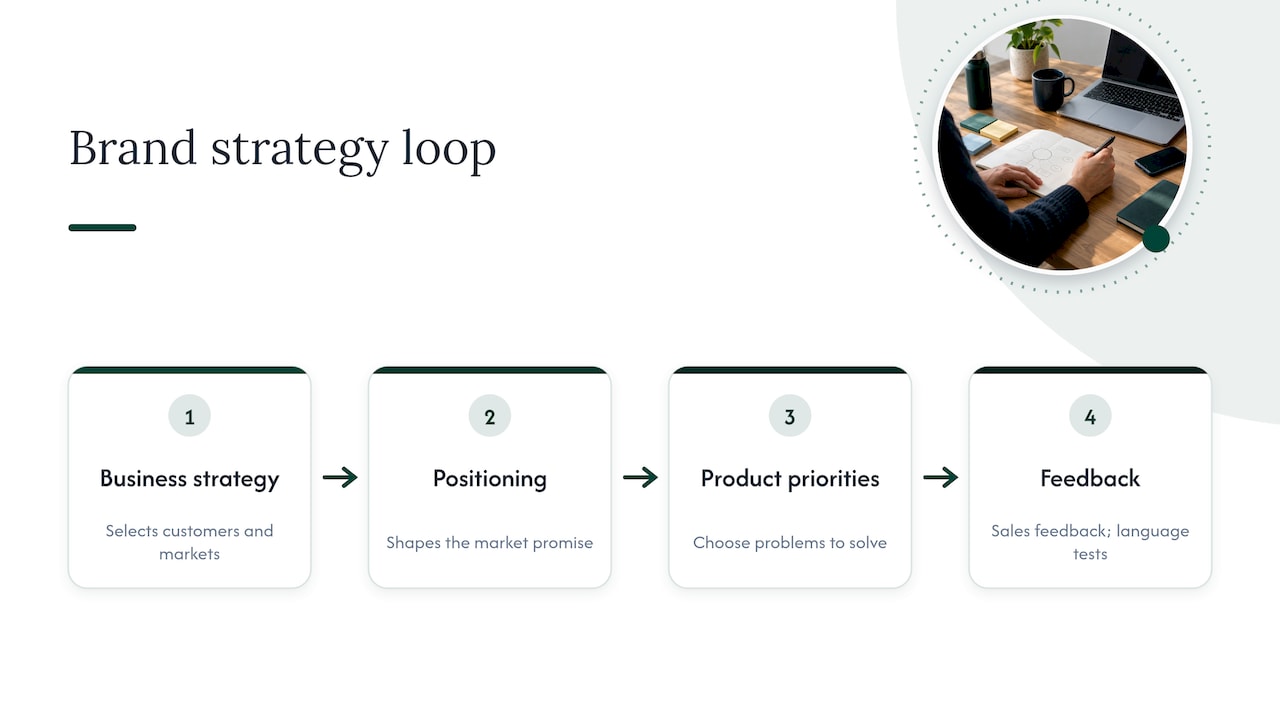
Treat the connection as a loop. Your business strategy decides which customers and markets you pursue, which shapes your positioning. Your positioning, in turn, tells product which problems deserve attention first and which requests to decline. Sales feeds back what buyers actually say, and marketing tests the language. When these functions share one brand script, roadmap debates get easier because you can ask a plain question: does this strengthen the promise we made?
A practical habit is to add a brand check to product and go-to-market planning. Before approving a feature, a pricing change or a new segment, ask whether it fits your position and how it would be explained in one sentence. If the answer is awkward, either the idea or the positioning needs work. That discipline keeps strategy, product and brand pointing the same way as you grow.
How we frame brand strategy as a measurable growth capability
Our view is operational. We treat brand as a business strategy that should show up in measurable performance, and we work to align product, marketing and sales around one clear position. A typical engagement moves through an audit of where the brand stands today, a workshop to settle positioning, a roadmap that sequences the work and support during execution. Our frameworks, including The Golden Spiral™ and Brand-Backed Performance™, give teams a shared structure for connecting clarity to results. Everything in this article is something you can start on your own, and we will gladly help you go further.
— Quincy
Ready to put your startup brand strategy to work?
If you want a partner to turn this playbook into a working position, we offer brand strategy, brand positioning, growth and go-to-market strategy, customer experience mapping, AI and marketing strategy, founder and executive advisory, and speaking. You get an advisor who connects brand clarity to measurable outcomes, so your team spends less time debating wording and more time acting on a plan everyone shares.
A first engagement typically includes:
- An audit of your current positioning, messaging and touchpoints.
- A workshop with your leadership team to settle the brand script and positioning.
- A roadmap that sequences launch, experiments and measurement.
Ready for the next step? Visit our site to see how we work.
FAQ
What are the four C’s of brand strategy?
There is no single official list, but a common version covers customer, company, competitors and context. You study who you serve, what you can credibly deliver, how alternatives position themselves and the market conditions you operate in. Together they inform a positioning you can defend.
What is the 3 7 27 rule of branding?
It is a popular rule of thumb that people need repeated exposure to a brand before they remember and trust it. The exact formula is not established here, so treat it as a reminder that consistency over time can build recognition rather than as a proven formula.
What are the four types of branding strategies?
Definitions differ, but commonly cited approaches include personal branding, product branding, corporate branding and service branding. Startups often begin with a founder-led approach and move toward a corporate brand, as research on founder identity and small-firm brands suggests.
When should a startup start working on its brand strategy?
Start before you scale spending on marketing or design. A lean first version, built from customer and stakeholder input, gives your team a shared direction and can be refined as you learn.
How is startup brand strategy different from a logo or visual identity?
Visual identity is one expression of the strategy, not the strategy itself. Strategy sets the position, promise and experience, and identity makes them recognizable. Settling the strategy first prevents costly redesigns later.
Sources
- Branding in New Ventures: A Systematic Review of Extant Research and Future Research Directions
- The brand-building process of B2B high-tech startups in an omni-digital environment
- Evaluating the potential of agile branding: opportunities and challenges in the start-up context | Humanities and Social Sciences Communications
- Business-to-Investor Marketing: The Interplay of Costly and Costless Signals - Greg Nyilasy, Shangwen Yi, Dennis Herhausen, Stephan Ludwig, Darren W. Dahl, 2025