
Founders: Brand Backed Startup Growth Strategy With 12 Week Sprints
Prioritize positioning and retention before you scale acquisition: position, then funnel, then test, then retain, then scale. Before you spend another dollar on ads or outbound, check two numbers: your activation rate (how fast new users hit real value) and your CAC payback period. If either is broken, scaling acquisition just multiplies the leak.
TL;DR:
- Scaling acquisition too early can amplify leaks if activation rates and CAC payback periods are not within sustainable parameters.
- Prioritizing product-market fit validation and retention experiments ensures a strong foundation before channel scaling or paid campaigns.
- Focusing on one proven channel and conducting hypothesis-driven tests helps avoid wasted effort and clarifies true costs and conversion rates.
- Progression through phases relies on concrete signals: stable funnel drop-offs, confirmed CAC payback, and flattened retention curves, before increasing spend.
- A disciplined 12-week growth sprint with clear metrics, decision gates, and a single objective accelerates learning and prevents burnout or misallocated resources.
Table of Contents
- What Is the Best Startup Growth Strategy to Start With?
- A Five-Phase Roadmap for Scaling a Startup
- How Do You Choose Which Growth Experiments to Run First?
- Which Metrics Actually Tell You It’s Safe to Scale?
- Run Growth in 12-Week Sprints With a Weekly Scoreboard
- Quincy Samycia’s Frameworks for Brand-Backed Growth
- Building Your Team Around Each Growth Stage
- Funding Strategies That Match Each Growth Phase
- Competitive Analysis and Differentiation That Actually Matter
- Turning Customer Feedback Into Product Decisions
- Metrics That Matter Once You’re Past Early Retention
- Aligning Go-to-Market Strategy With Each Growth Phase
- When to Choose Speed Over Discipline
- Work With Quincy Samycia on Your Growth Strategy
- Sources
- FAQ
What Is the Best Startup Growth Strategy to Start With?
Founders love to skip to the fun part: paid channels, growth hacks, viral loops. That instinct usually backfires, because structured growth guidance from Harvard Business School treats acquisition and retention as one connected system, not two separate projects. If the retention side is weak, every acquisition dollar just pays to refill a leaky bucket.
Here is the priority order that actually holds up once you run it against real cohorts.
- Validate product-market fit signals before anything else. Look for organic referrals, usage that grows without prompting, and customers who get upset when you suggest removing a feature. CB Insights attributes roughly 35% of startup failures to building something the market never wanted, the single most preventable cause on that list.
- Run retention experiments before acquisition experiments. Test onboarding tweaks, in-app nudges, or a simplified first session. A 5-point lift in 30-day retention often changes your economics more than doubling ad spend.
- Pick one channel and exhaust it. Resist the urge to test five channels at once. A single-channel-first approach forces you to learn what actually works instead of diluting attention across too many experiments.
- Structure every test as a real hypothesis, not a guess. Write down what you expect, why, and what result would prove you wrong before you launch anything.
- Fix your positioning before you fix your funnel. A confused value proposition kills conversion at every stage, so brand and message clarity is leverage, not decoration.
On product-market fit, the fastest tell isn’t a survey score. It’s watching whether usage compounds without you pushing it. If your best customers are dragging in their coworkers unprompted, you have something real. If you’re the one doing all the pushing, you don’t yet.
Retention-first tactics don’t need to be complicated. Look at your worst-performing cohort from the last 90 days and ask what happened in their first session. Often the fix is deleting a step, not adding a feature. Jobs-to-be-done research from Harvard Business Review is useful here: understanding the actual outcome a customer hired your product for tells you which step in onboarding is friction and which step is the point.
Single-channel focus means picking the channel your ideal customer profile already uses and refusing to touch a second one until the first is repeatable. That could be SEO content, cold outbound, a partnership channel, or paid search. It rarely matters which one you pick first. What matters is that you run it long enough to know its real cost and conversion rate, not just its first-week numbers.
Conscious testing means every experiment has a written hypothesis, a defined sample size or run length, and a decision rule set in advance. The most common mistake founders make is calling a test after three days because the early numbers looked good (or bad). Early numbers are almost always noisy.
Brand and positioning work belongs on this list because it’s the cheapest lever with the widest blast radius. A sharper positioning statement improves conversion at every stage of the funnel simultaneously, from the first ad click to the sales call to the onboarding email. Poor brand architecture can quietly cap growth long after the product itself is solid, which is why brand structure problems tend to resurface at every fundraising round if they’re never addressed.
Pro Tip: Before running a single acquisition test, write your positioning statement in one sentence a stranger could repeat back correctly. If nobody on your team can do that from memory, fix that first. It will outperform almost any growth hack you could run instead.
A Five-Phase Roadmap for Scaling a Startup
Growth work fails most often when founders skip phases, not when they pick the wrong tactic. A staged approach, moving from positioning to funnel to testing to retention to scale, mirrors the sequencing in the 3M ARR growth framework, and it gives you clear gates instead of a vague sense that you should “just grow faster.”
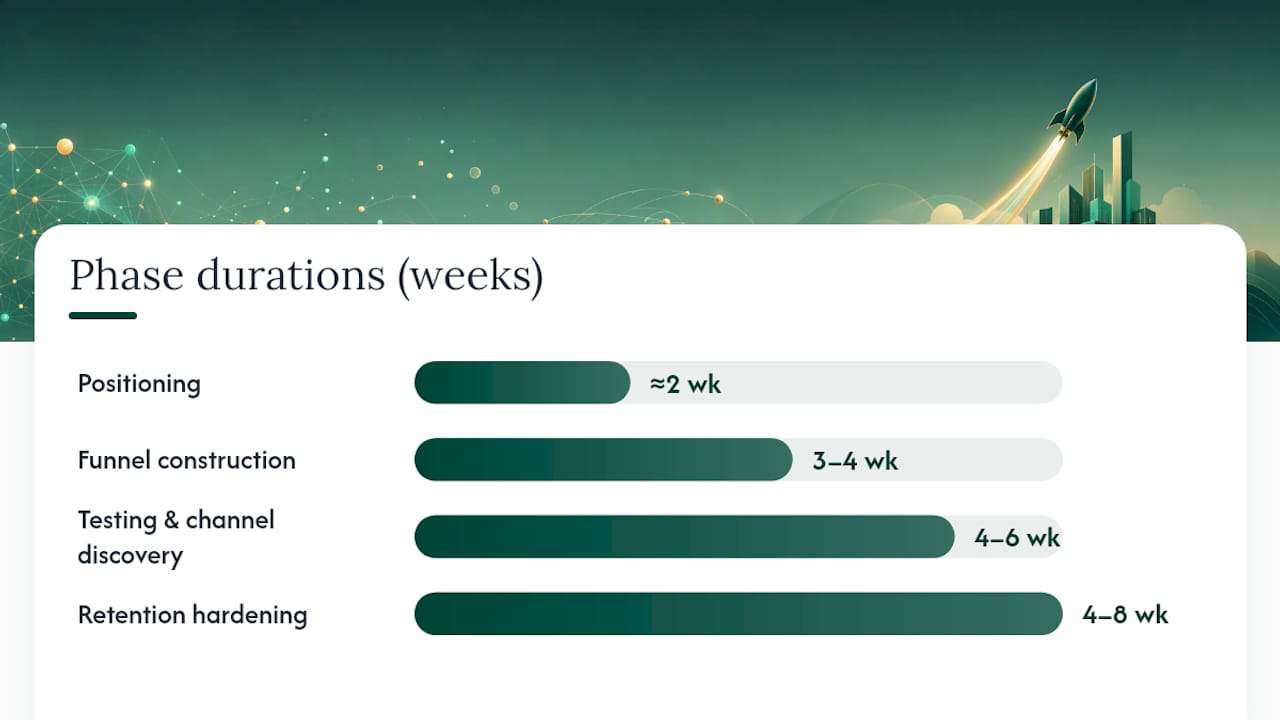
- Positioning and narrative (roughly 2 weeks). Define your ideal customer profile, your core value proposition, and the language your best customers already used to describe their problem. Success looks like a positioning statement your team can repeat consistently without a script.
- Funnel construction (roughly 3 to 4 weeks). Build the minimum viable funnel: landing page, signup flow, first-session experience, and a way to track where people drop off. Success looks like a funnel with instrumented stages, even if conversion rates are still mediocre.
- Testing and channel discovery (roughly 4 to 6 weeks). Run structured experiments across a short list of channels to find the one your ICP responds to. Success looks like one channel producing a repeatable, if modest, conversion rate.
- Retention hardening (roughly 4 to 8 weeks, often running in parallel with phase 3). Fix onboarding, reduce time-to-value, and address the top two or three reasons customers churn. Success looks like a 30-day retention curve that flattens instead of trending toward zero.
- Scale (ongoing, only once gates are cleared). Increase spend and headcount on the channel that’s already proven, and start layering in a second channel. Success looks like CAC payback under your target threshold with retention holding steady as volume increases.
This sequencing isn’t arbitrary. A staged growth model built around problem-solution fit, product-market fit, go-to-market fit, and unit economics before scaling reflects the same logic: each phase is a precondition for the next one working. Skip positioning and your funnel converts poorly no matter how much traffic you drive to it. Skip retention and your acquisition spend never pays back.
The weighting shifts by business model. A B2B SaaS company usually needs more time in phase 1, since enterprise buyers punish vague positioning hard and sales cycles expose weak narratives fast. A product-led growth company can compress phases 1 and 2 because the product itself does positioning work through the free trial experience, but it needs to spend far more time in phase 4, since PLG companies live or die on self-serve activation rates. A marketplace has to solve a harder version of phase 3, because it’s really running two funnels at once (supply and demand) and neither one works without the other reaching critical mass.
The signals that tell you it’s safe to move forward are concrete, not vibes. Move from phase 2 to phase 3 when your funnel has stable, measurable drop-off points, even if the absolute numbers are bad. Move from phase 3 to phase 4 when you’ve found at least one channel with a CAC you can calculate with confidence. Move from phase 4 to phase 5 only when retention curves have flattened and your CAC payback period is inside a range you can sustain with your current runway. Founders who scale before these gates clear almost always end up rebuilding the funnel later, at a much higher cost, with investors watching.
How Do You Choose Which Growth Experiments to Run First?
Start with your ICP, not your tactics. Map out where your ideal customer already spends attention, whether that’s a specific community, search behavior, or a category of publications they trust, then rank the two or three channels that intersect most tightly with that map. Everything else gets ignored for now.
An experiment worth running has four things written down before it start: the hypothesis, the metric that proves or disproves it, the sample size or run length needed for a real read, and the decision you’ll make either way. Skipping any one of these is how teams end up chasing noise. A test that ran for four days with 40 signups isn’t data. It’s a coin flip dressed up as an insight.
- Write the hypothesis as a single sentence: “If we do X, then metric Y will change by Z, because [reason].”
- Set a minimum sample size before you look at results, not after you’re tempted to stop early.
- Decide your run length in advance, usually one to two full weeks minimum for anything touching conversion.
- Define your stop-loss: what result means you kill this test and move on without relitigating it.
The weekly cadence that keeps this from becoming chaos is simple: every week, make exactly three decisions. What to kill, what to double down on, and what new thing to test next week. More than three decisions a week usually means you’re not being disciplined about prioritization; fewer than three usually means you’re not testing enough. Playbooks built for 2026 note that AI tools can now execute tests faster than ever, but the bottleneck has shifted to human judgment on what to test and how to read the result, not execution speed.
Noisy early signals are the biggest trap in this whole process. Don’t trust a result until you’ve hit your predetermined sample size, and don’t let a single good or bad week override a trend that’s held for a month. If you’re weighing a founder-led sales motion against a self-serve product-led approach, the tradeoffs are covered well in this comparison of PLG versus founder-led sales for seed-stage SaaS, which is worth reading before you commit resources to either path.
Pro Tip: Keep an explicit “stop doing” list next to your experiment backlog. Every time you add a new test, ask what you’re going to stop doing to make room for it. Teams that only add never subtract end up running eight mediocre experiments instead of three sharp ones.
Which Metrics Actually Tell You It’s Safe to Scale?
Four numbers matter more than everything else combined: activation rate, retention rate, CAC, and payback period. Get these wrong and no amount of clever positioning saves you from scaling a broken system.
Activation is the percentage of new users or customers who reach a defined “aha” moment within a set window, often their first session or first week. Define it narrowly. “Signed up” is not activation. “Completed the action that correlates with long-term retention” is. Measure it by cohort, weekly, so you can see whether changes to onboarding are actually moving the number.
Retention gets measured the same way, typically as a 30-day or weekly retention curve per cohort. The shape of the curve matters more than any single data point: a curve that keeps declining toward zero means you don’t have product-market fit yet, no matter how good your top-line growth looks. A curve that flattens, even at a modest level, means people who stick around tend to stay.
CAC (customer acquisition cost) is your total sales and marketing spend divided by new customers acquired in that period. LTV (lifetime value) is the revenue you expect from an average customer over their lifetime with you, usually estimated from average revenue per account divided by your churn rate. Payback period is how many months of revenue it takes to recoup your CAC. As a working example: if CAC is $1,200 and a customer pays $150 a month, payback is 8 months. Most early-stage investors prefer to see payback periods within a sustainable range before they’re comfortable with aggressive scaling.
The threshold that matters most: don’t scale acquisition spend meaningfully until payback is inside a range your runway can absorb, and retention curves have already flattened. Scaling before that just accelerates cash burn on a system that hasn’t proven it converts spend into durable revenue.
Retention’s multiplier effect on CAC room: Research on customer retention has found that a 5% improvement in retention can lift profits by 25% to 95%, depending on the industry, according to analysis cited in modern startup growth frameworks. That’s not a rounding error. A modest retention fix often creates more sustainable CAC headroom than an aggressive discount on ad spend ever could.
Run Growth in 12-Week Sprints With a Weekly Scoreboard
Growth work stalls when it has no rhythm. A 12-week sprint gives you enough time to see real signal from experiments while forcing a hard checkpoint before you drift into next quarter without reassessing anything.
- Set one sprint objective, not five. Pick the single metric that matters most right now (activation, one channel’s CAC, or 30-day retention) and organize every experiment around moving it.
- Cap experiments at three to five running at once. More than that and your team stops learning cleanly, because you can’t attribute results to a specific change.
- Build a weekly scoreboard with three to five metrics. A typical version tracks weekly signups, activation rate, 30-day retention, CAC by channel, and cash runway in months. Keep it on one screen, not buried across five dashboards.
- Hold a 30-minute weekly review, same day and time every week. Walk the scoreboard, make your three decisions (kill, double down, test next), and stop there.
- Close every sprint with a written retro. What moved, what didn’t, and what the next sprint’s single objective should be.
Sprint objectives shift by stage. Pre-PMF, the objective is almost always validating retention signal, not growth rate. Early PMF, the objective becomes finding one repeatable channel and proving CAC payback within range. Once you’ve hit predictable GTM, the objective shifts to weekly growth rate itself, since Paul Graham’s YC framework treats a consistent 5% to 7% weekly growth rate as a strong benchmark and 10% as exceptional for startups at that stage.
Keeping velocity high without burning out your team comes down to scope discipline. Running fewer experiments with clear hypotheses beats running many sloppy ones, and a sprint that ends with one clear learning is more valuable than one that ends with five ambiguous results nobody trusts.
Quincy Samycia’s Frameworks for Brand-Backed Growth
Brand strategy usually gets treated as decoration, something to fix after growth is already working. Quincy Samycia’s approach inverts that: positioning is treated as operational infrastructure, not marketing polish, and it gets built during phase 1, not bolted on later.
A framework for aligning product, marketing, and sales around a single, coherent narrative before any acquisition spend goes out the door helps ensure the value proposition sales says, the copy on the landing page, and what the product actually delivers are the same story told three ways. Misalignment here is one of the quietest funnel killers, because it shows up as unexplained drop-off at every stage rather than one obvious failure point.
An approach that connects narrative to measurable outcomes during phase 2 and beyond tracks how positioning clarity moves conversion rate, retention, and customer lifetime value over time, rather than treating brand work as unmeasurable.
Frameworks like these aim to move a specific set of numbers:
- Funnel conversion rate, by removing narrative friction at each stage
- Onboarding activation, by making the value proposition match the actual first-use experience
- Retention and LTV, by attracting customers whose expectations match what the product delivers
Founders working through phase 1 can run a focused four-hour positioning sprint using these tools, walking away with a single-sentence positioning statement, a mapped ICP, and a first-draft narrative aligned across product, marketing, and sales. Full details on the frameworks are available for founders who want to see the structure before committing to an engagement.
Building Your Team Around Each Growth Stage
Hiring ahead of your growth stage burns cash on capacity you can’t use yet. Hiring behind it means you cap growth you’ve already proven works. Match your team to the phase you’re actually in, not the one you hope to be in next quarter.
In the positioning and funnel phases, you need generalists: a founder or early hire who can write copy, run basic analytics, and talk to customers directly. Specialization here is usually premature, since the roles themselves haven’t been defined by real data yet.
Once you’re in the testing and retention phases, bring in your first dedicated growth or marketing hire, someone who can own the experiment backlog and the weekly scoreboard without needing constant founder oversight. This is also the point where a part-time or fractional specialist, in performance marketing, lifecycle, or brand strategy, often outperforms a full-time generalist hire, since the work is deep but not yet full-time in scope.
Scale-phase hiring looks different again. This is when you build channel specialists (a paid acquisition lead, a content lead, a partnerships lead) because you’ve already proven which channel deserves that investment. Hiring a specialist before you’ve validated the channel just adds payroll to an unproven bet.
Organizational structure should track the same logic: flat and founder-led through positioning and funnel work, then adding a lightweight growth function during testing and retention, then departmentalizing only once you’re scaling a proven motion. Restructuring too early creates coordination overhead with nothing yet to coordinate.
Funding Strategies That Match Each Growth Phase
Capital allocation should follow the same phase logic as everything else, because raising or spending ahead of validation is one of the fastest ways to burn runway on assumptions instead of evidence.
During positioning and funnel phases, resources go almost entirely toward founder time and cheap validation work, not paid acquisition. This is typically pre-seed or seed capital, and the discipline here is resisting the urge to spend on ads before you know your funnel converts at all.
Once you’re in testing and retention phases, allocate a defined, capped budget toward channel experiments, enough to reach real sample sizes, but not so much that a failed test threatens runway. A common mistake is spending an entire month’s marketing budget testing one channel instead of splitting it across a couple of hypotheses.
Scale-phase funding looks different: this is where a larger seed extension or Series A round typically gets deployed, because you’re now funding proven unit economics rather than hoping to find them. Investors evaluating a raise at this stage want to see the CAC payback and retention numbers discussed earlier, not a pitch deck full of projections.
Resource allocation across all phases should follow a simple rule: spend scales with proof, not with ambition. A round raised to “accelerate growth” without a validated channel and clean payback math usually just accelerates the burn rate instead.
Competitive Analysis and Differentiation That Actually Matter
Most competitive analysis exercises produce a feature comparison table nobody uses again. The version that actually helps your growth strategy starts from positioning, not features.
Map your competitors by the job customers hire them for, not by their marketing category. Two products that look identical on a feature list might be solving completely different jobs for different customers, and two products that look nothing alike might be direct substitutes in the customer’s mind. This is where jobs-to-be-done thinking earns its keep again: it reframes competition around the outcome the customer wants, not the product category analysts assign you to.
Differentiation tactics that hold up over time are usually structural, not cosmetic. A pricing model built around a different unit of value, a distribution channel competitors haven’t touched, or a narrower ICP focus that lets you speak with more precision than a broader competitor can. Differentiation that lives only in adjectives (faster, easier, smarter) tends to evaporate the moment a competitor copies the messaging, because there’s nothing structural underneath it.
Run this analysis quarterly, not once at launch. Markets shift, competitors reposition, and a differentiation angle that worked at seed stage can become table stakes by the time you’re scaling.
Turning Customer Feedback Into Product Decisions
Feedback loops fail most often because they’re one-directional: customers talk, someone takes notes, and nothing measurable changes. A working loop closes that circuit and feeds directly into your experiment backlog.
Set up at least two feedback channels that operate on different timescales. A fast one (in-app prompts, support ticket tagging) that surfaces friction within days, and a slower one (customer interviews, quarterly surveys) that surfaces deeper positioning or feature gaps over months. Both matter, but they answer different questions.

The integration point that most teams miss is connecting feedback directly to your retention metrics, not just your product roadmap. If customers repeatedly mention confusion during onboarding, that’s not just a UX note, it’s a leading indicator showing up before it hits your 30-day retention curve. Treating feedback as an early warning system, rather than a suggestion box, is what separates teams that catch churn before it happens from teams that only diagnose it after the cohort data confirms the damage.
Iterative development works best when it’s tied to the same weekly cadence as your growth experiments. A product change based on feedback should get the same hypothesis, same sample size discipline, and same decision rule as a marketing test. Feedback that doesn’t lead to a testable hypothesis is interesting, but it isn’t yet actionable.
Metrics That Matter Once You’re Past Early Retention
Early-stage metrics (activation, 30-day retention, CAC payback) tell you whether you’re ready to scale. A different set of metrics tells you whether scaling is actually working once you’re in motion.
Viral coefficient measures how many new customers each existing customer brings in on average. A coefficient above 1 means your product grows on its own momentum; below 1, and growth depends entirely on paid or manual acquisition continuing indefinitely. Most products never cross 1, and that’s fine, but tracking the trend tells you whether your referral or sharing mechanics are improving or decaying.
Churn rate decline, tracked over multiple quarters rather than a single snapshot, tells you whether your retention fixes are compounding or whether you’ve plateaued. A churn rate that improved once after a product fix and then stalled is a signal to look for the next structural issue, not to assume the work is done.
Revenue growth rate, measured month over month or quarter over quarter, becomes the primary scale-stage metric once weekly signup growth stops being the most informative number. At scale, a company can have flat or even declining signups while revenue grows through expansion revenue and lower churn, which is a healthier pattern than raw user growth with poor retention. Weekly growth benchmarks that matter pre-PMF, like the 5% to 7% range Paul Graham cites, get replaced by revenue-based targets once your GTM motion is repeatable.
Aligning Go-to-Market Strategy With Each Growth Phase
A go-to-market strategy that made sense at $10,000 in monthly revenue often actively hurts you at $200,000. GTM alignment means revisiting your motion at each phase gate, not locking in an approach at launch and running it unchanged for two years.
In the positioning and funnel phases, your GTM motion should be manual and high-touch almost by necessity: founder-led sales calls, direct outreach, hands-on onboarding. This isn’t inefficient, it’s how you learn what messaging and what customer segment actually convert, information you can’t get from a scaled, automated motion yet.
During testing and retention phases, your GTM starts to semi-automate around whichever channel proved repeatable, while retention work keeps founders close enough to customers to catch onboarding friction directly. This is often where the PLG-versus-sales-led decision gets made in earnest, and it’s worth revisiting how that tradeoff plays out for seed-stage SaaS before committing your team structure to one path.
By the scale phase, GTM should be running with defined playbooks, specialist owners per channel, and a forecasting model built on validated CAC and payback numbers rather than founder intuition. A GTM motion that never evolves past its founder-led origins usually becomes the ceiling on growth, not the accelerant it once was.
When to Choose Speed Over Discipline
Founders ask me constantly whether they should just move faster and skip the sequencing. Sometimes speed wins: a narrow window, a fast-moving market, a competitor closing in. But most founders who say they need speed actually mean they’re avoiding the harder work of positioning clarity. Bring in outside help when you’ve validated retention but can’t get GTM to repeat consistently. That’s usually a positioning problem, not a tactics problem, and it’s exactly where structured frameworks like The Golden Spiral™ earn their cost. Run experiments internally when you’re still pre-PMF. No consultant replaces direct customer contact at that stage.
— Quincy
Work With Quincy Samycia on Your Growth Strategy
Some growth advisors treat positioning as measurable infrastructure instead of a branding exercise done later. If you’ve validated retention but can’t get your funnel or GTM motion to repeat, that often indicates a positioning gap, not a tactics gap.
If you’re heading into a fundraise or a leadership offsite and need your whole team aligned on the same narrative, a workshop or keynote engagement gets that done in a day rather than dragging out over a quarter of Slack threads. If you’re earlier in the process and want a structured audit of where your positioning is actually costing you conversion, the frameworks page lays out how an engagement is scoped, what you walk away with, and how it connects to the metrics covered above. For teams that need executive alignment more than a deep audit, the speaking and workshop offerings are built for exactly that. Either way, the next step is the same: book a conversation and find out which engagement actually fits where you are.
Sources
- How to Develop Business Growth Strategies That Drive Results (HBS Online)
- Know Your Customers’ ‘Jobs to Be Done’ (HBR)
- How to Grow a Startup (2026 Growth Framework) - AIM Elevate
FAQ
What are some effective growth strategies for startups?
The most effective strategies sequence work rather than running everything at once: validate product-market fit, fix retention, then focus on one acquisition channel until it’s repeatable. Brand and positioning clarity, tackled early through frameworks like The Golden Spiral™, tends to lift conversion at every stage of that sequence.
What is the 80/20 rule for startups?
Applied to growth, it means roughly 80% of your results come from a small set of high-leverage activities, usually one channel, one core retention fix, and one positioning statement, rather than spreading effort across many tactics at once. The practical version: pick the few experiments most tied to your current phase’s goal and ignore the rest until those are exhausted.
Is it true that 90% of startups fail?
Failure rates vary by source and definition, but CB Insights analysis attributes around 35% of startup failures specifically to building something the market didn’t need, making early validation one of the most controllable risk factors founders have.
What are the 7 stages of a startup?
Definitions vary across sources; some frameworks use five stages (positioning, funnel, testing, retention, scale) as covered above, while others expand to seven by splitting funding rounds or hiring phases into separate steps. There’s no single universal standard, so the more useful approach is picking a phase model, like the five-stage roadmap outlined here, and tracking clear gates between each one.
When should a startup scale its acquisition spend?
Only once activation and retention curves have flattened and CAC payback sits inside a range your runway can sustain, typically under 12 months for most early-stage companies. Scaling spend before those two conditions hold usually just accelerates burn on a funnel that hasn’t proven it converts.