
Executives: A Thought Leadership Strategy You Can Measure
A thought leadership strategy is a business-anchored program that uses original insight, storytelling, and design to move buying groups toward a decision and produce measurable commercial results. The right approach starts with objectives, not topics: define what pipeline, pricing power, or retention outcome you’re chasing, build one research-backed flagship asset, activate it across buying-group roles, and track outcomes on a dashboard, not just impressions. It takes real executive sponsorship and a governance structure to work.
TL;DR:
- Effective thought leadership should be built around clear business objectives, like pipeline influence or customer retention, with measurable success metrics tied to each goal.
- A research-backed flagship asset is essential, incorporating proprietary data and expert insights, before creating derivative content tailored to specific buying-group roles.
- Distribution channels must align with the buying group’s map, prioritizing LinkedIn for leadership visibility, email for nurturing, and research reports for strategic invitations.
- Engagement metrics like views and shares are insufficient; the focus should be on account-specific interactions, qualified conversations, and influence on deals over time.
- Common pitfalls include starting with trendy topics instead of business questions, under-resourcing research, and neglecting activation and governance to ensure content credibility and commercial impact.
Table of Contents
- What Is a Thought Leadership Strategy and Why Does It Matter?
- Building a Stepwise Thought Leadership Framework
- Who Are You Actually Writing For in the Buying Group?
- Where Should Thought Leadership Actually Get Published?
- How Do You Measure Whether Thought Leadership Is Working?
- What Mistakes Kill Most Thought Leadership Programs?
- Turning Insight Into a System: The Golden Spiral and Brand-Backed Performance
- Where to Invest, and What to Stop Doing
- Get Help Building a Thought Leadership Program That Ties to Revenue
- Sources
- FAQ
What Is a Thought Leadership Strategy and Why Does It Matter?
Most executives think of thought leadership as a content category. Treat it instead as a revenue lever with a research budget attached. The programs that actually move the needle start by defining a business outcome, not a content calendar, and they hold themselves accountable to it the same way you’d hold a paid media channel accountable.
The objectives worth building around are narrow and specific:
- Consideration: getting into the conversation before a prospect issues an RFP.
- Pipeline influence: shortening sales cycles or increasing the win rate on deals where your point of view was present.
- Pricing confidence: reducing discount pressure because buyers already trust your judgment.
- Customer retention: giving existing accounts a reason to see you as a strategic partner, not a vendor.
The evidence backs this up more directly than most marketing leaders expect.
By the Numbers: Edelman and LinkedIn surveyed roughly 3,500 management-level professionals and found 73% of B2B buyers use thought leadership to judge a company’s competence, and 86% said a company that publishes consistently is more likely to get invited to their next RFP.
That second number is the one CFOs tend to underweight. It isn’t about brand warmth. It’s about literally getting a seat at the table before the deal is even structured. Executive thought leadership done well changes who gets invited to bid, and companies that skip the research step lose that invitation to competitors who didn’t.
The Content Marketing Institute’s ongoing research points at the same gap from a different angle: most B2B marketers report they create thought leadership, but far fewer manage it as a resourced, measured program. That gap between “we publish things” and “we run a strategy” is exactly where the commercial upside gets left on the table.
Building a Stepwise Thought Leadership Framework
A thought leadership plan fails most often because it starts with a topic instead of a business question. FT Longitude’s work across more than 50 global brands makes the same warning explicit: effective thought leadership combines interesting data, real storytelling, and design, but only after commercial objectives and success measures are locked down. Skip that step and you end up with content nobody asked for.
Here’s the sequence that holds up under executive scrutiny.
-
Clarify objectives before topics. Write down the specific business outcome (pipeline, pricing, retention, category creation) and the metric that will prove it happened. If you can’t name the metric, you’re not ready to pick a topic.
-
Map audiences and buying groups. Identify who actually influences the decision, not just who reads your LinkedIn posts. This includes economic buyers, technical evaluators, end users, and internal champions.
-
Claim topic ownership. Pick a perspective narrow enough that you can defend it against a direct challenge. “AI will change marketing” is not a position. “Most AI content governance fails because it skips brand judgment first” is one you can build a program around.
-
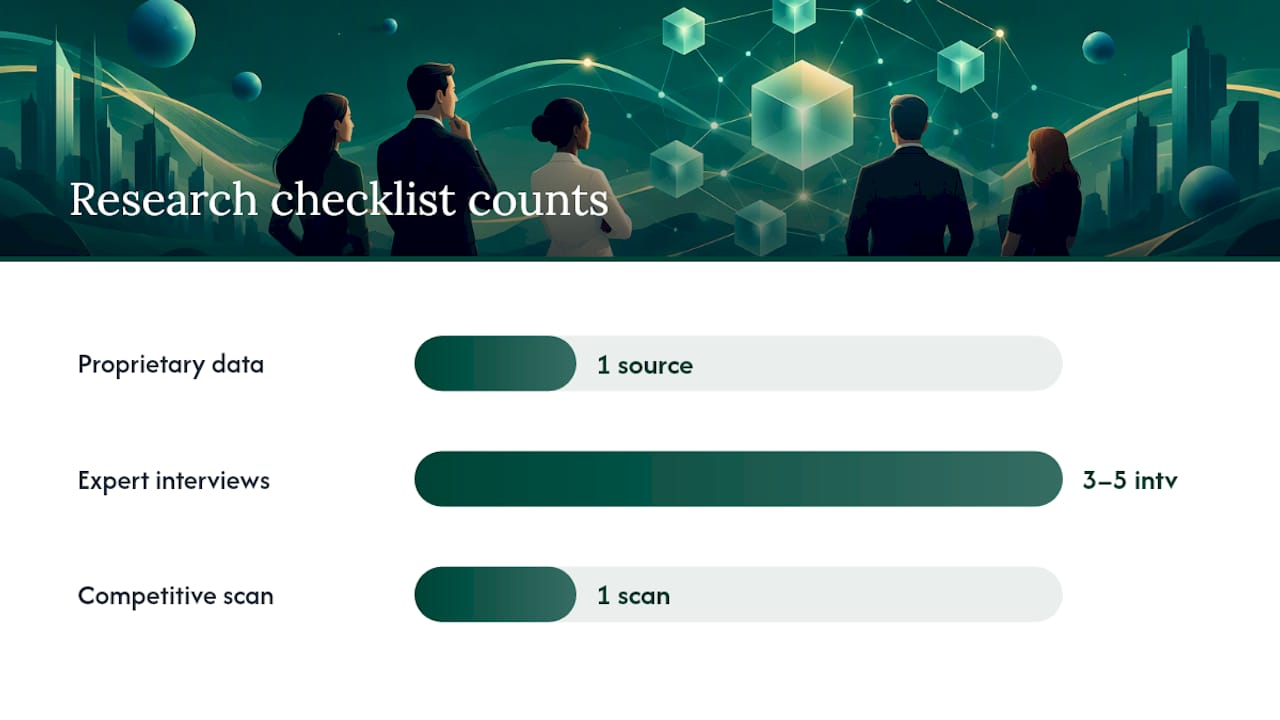
Do the research and gather evidence. This is the step most teams cut, and it’s the one buyers notice most. A minimum research checklist includes: one proprietary data source (survey, usage data, or client pattern analysis), three to five expert or client interviews, and a competitive scan of what’s already been said on the topic so you’re not repeating consensus.
-
Design the flagship asset. This is the single research-backed piece that anchors everything else, usually a report, a framework document, or a keynote deck. It should be built to be dismantled later, not just published once.
-
Build the repurposing system. Map every audience segment to a derivative format before you publish the flagship piece, not after. A minimum repurposing map includes: an executive LinkedIn post, a short video walkthrough, a role-specific one-pager for each buying-group segment, and a sales enablement summary.
-
Set the channel plan and cadence. Decide where each derivative lives and how often new material goes out. Consistency matters more than volume; a monthly cadence sustained for a year outperforms a burst of ten posts in one week.
-
Put sales enablement and governance in place. Sales needs a one-page brief for every flagship asset: the core claim, the objection it answers, and the exact link or file to send. Governance means someone senior signs off on claims before publication, and that person is accountable for accuracy, not just tone.
-
Measure and iterate. Review the dashboard quarterly against the original objective from step one, and kill anything that isn’t producing a leading indicator toward that outcome.
Minimum deliverables for a functioning framework: one written brief per flagship asset (objective, audience, thesis, proof points), a research checklist teams reuse every cycle, and a repurposing map that ties every buying-group role to a specific derivative asset.
Governance doesn’t need to be heavy to be real. A workable model has three roles: an executive sponsor who owns the thesis and approves claims, a program lead (often in marketing) who runs the calendar and repurposing system, and a subject-matter contributor (often a founder, CEO, or senior technical leader) who supplies the raw insight the whole system depends on. Without that third role, you get polished content with nothing underneath it. Governance failures here often trace back to internal language inconsistency that never got resolved before the content went external.
Pro Tip: Build your flagship asset’s brief before you write a single word of content. If the brief can’t state the business objective, the target buying-group role, and the proof point in three sentences, the asset isn’t ready to move to production.
Resourcing is the honest constraint most plans ignore. A credible program needs someone spending at least a quarter of their time on research and editorial direction, plus real access to the executive or founder whose perspective anchors the thesis. Developing thought leadership without that access produces generic commentary dressed up as insight, and buyers can tell the difference within a paragraph.
Who Are You Actually Writing For in the Buying Group?
Forrester’s buying-group research puts a number on something most marketers sense intuitively: an average of roughly 13 people participate in a typical B2B purchase decision. A single flagship asset aimed at “the buyer” is aimed at nobody in particular. Gartner frames this in terms of jobs the buying group has to complete, from problem identification through supplier selection, and each job calls for a different kind of proof.
Map your derivative assets to roles, not job titles alone:
- Economic buyer (CFO, VP of Finance): wants a tight ROI brief with numbers, not narrative. Give them the cost-of-inaction case in one page.
- Technical evaluator: wants a detailed case study or methodology breakdown that shows the mechanism, not just the outcome.
- End user: wants a practical walkthrough or short video that answers “will this make my week easier.”
- Internal champion: wants a visionary point-of-view piece they can forward internally to build consensus without having to explain it themselves.
- Procurement or legal: wants clarity on process and terms, usually the least glamorous asset but often the one that unblocks a stalled deal.
The operational handoff matters as much as the content itself. Marketing should flag engagement from a named account (a download, a repeat visit, a forwarded asset) directly into the CRM so sales knows a specific buying-group member is active. When a technical evaluator downloads the methodology brief, that’s the moment to bring in a subject-matter expert, not a generic follow-up email. Treat these signals as a handoff protocol, not a report you review once a month.
Where Should Thought Leadership Actually Get Published?
Channel choice should follow the buying-group map, not the other way around. LinkedIn remains the strongest channel for CEO personal branding and founder visibility because it puts the human voice directly in front of peers and prospects without an editorial filter. Email newsletters work best for nurturing people who’ve already engaged once, since they reward consistency more than reach. Speaking engagements and webinars do something neither channel can: they put a named executive in a room (physical or virtual) with warm buying-group members already primed to make a decision.
Owned research reports deserve their own line item. They’re the slowest to produce and the hardest to activate, but they’re also the asset most likely to get a company invited into a buyer’s shortlist, per the Edelman-LinkedIn RFP finding cited earlier.
- Prioritize LinkedIn for founder and executive visibility; it’s the lowest-friction channel for building a leadership brand for founders.
- Use email for nurturing accounts that have already touched a flagship asset once.
- Reserve speaking and webinars for warm, high-intent accounts where a live Q&A can close a credibility gap fast.
- Treat the research report as the anchor, not a one-off; everything else derives from it.
Gartner’s guidance on the buying journey adds a useful correction here: buyers move faster and with more confidence when digital content is paired with a human touchpoint, like a sales rep following up after a webinar. Pure digital distribution without any human layer tends to stall exactly at the point a deal needs momentum.
Activation shouldn’t stop at publishing. A working checklist includes paid amplification behind the flagship asset (even a modest LinkedIn budget outperforms zero budget), direct PR outreach pitching the research to trade press, applying for speaking slots at industry events using the flagship data as the pitch, and direct outreach to named target accounts with the specific derivative asset built for their role.
Pro Tip: Before you publish, write down which three named accounts you want to see engage with the flagship asset in the first 30 days. If none of them do, the distribution plan needs a rework before the content plan does.
Keeping an eye on how AI is shifting content discovery matters too. Governance around AI-assisted content should sit inside the same approval gate as human-written material, since the credibility risk is identical either way.
How Do You Measure Whether Thought Leadership Is Working?
Views and shares tell you almost nothing about whether a thought leadership strategy is producing revenue. They’re diagnostic, not decisive; useful for spotting which topics resonate, useless for justifying budget to a CFO. The dashboard that actually earns executive trust connects content activity to named accounts and pipeline movement.
Leading indicators worth tracking weekly:
- Named-account engagement (a specific company, not an anonymous visitor, downloading or viewing an asset).
- Qualified conversations generated directly from a piece of content.
- Speaking or podcast invitations tied to the flagship topic.
- Workshop or advisory inquiries referencing the research.
Business outcomes worth reviewing quarterly:
- Pipeline influenced (deals where a buying-group member engaged with a thought leadership asset before the deal closed).
- Win rate on influenced deals versus non-influenced deals.
- Pricing or discount variance on influenced deals.
- RFP invitations received without a formal sales outreach preceding them.
By the Numbers: CMI’s ongoing B2B research finds most marketers still measure engagement at a much higher rate than they measure business impact or brand authority. Pacesetter organizations close that gap by tracking outcomes, not just clicks.
Instrumenting this doesn’t require exotic tooling. Flag content-engaged accounts in the CRM the same way you’d flag a demo request. Track digital behavior signals (repeat visits, time on a research page) as a warmth indicator, and build a short feedback loop where sales reports back monthly on which pieces actually got referenced in live deal conversations. Review the full dashboard quarterly, not monthly. Thought leadership moves slower than a paid campaign, and reviewing it on too tight a cycle just produces noisy, misleading conclusions.
What Mistakes Kill Most Thought Leadership Programs?
The failures repeat across industries because they’re structural, not creative. Fix the structure and most of the symptoms disappear on their own.
- Topic-first planning. Choosing a subject because it’s trendy, not because it maps to a business objective, is the single most common failure and the hardest to reverse once a calendar is built around it.
- Weak or absent research. Content built on opinion alone reads as opinion. Buyers can tell within a paragraph whether original research sits underneath the claims.
- Under-resourcing. Assigning thought leadership to whoever has spare time guarantees inconsistent quality and an inconsistent voice.
- Weak distribution. A brilliant flagship asset with no activation plan behind it is a document sitting on a server, not a strategy.
- Disguised pitches. Content that pivots to a sales pitch two paragraphs in destroys the credibility the whole program depends on.
The fixes are less dramatic than the failures. Put a governance gate in place so nothing publishes without sign-off on both accuracy and independence from sales messaging. Set a research standard (minimum one proprietary data point per flagship asset) and hold to it even when it slows the calendar down. Build an executive activation playbook so the sponsor knows exactly what’s expected of them each quarter, not left to guess. And keep a stop-doing list: retire formats and topics that consistently produce low engagement and no pipeline signal, no matter how much internal affection they’ve built up.
Turning Insight Into a System: The Golden Spiral and Brand-Backed Performance
Most flagship assets die after one publication cycle because they were built as a single deliverable instead of a system. The Golden Spiral™ framework treats a flagship idea the way a product team treats a core feature: one strong insight, engineered from the start to expand outward into every format a buying group needs, rather than shrunk down after the fact into a few social posts.
A working checklist for turning raw intellectual property into a durable flagship asset looks like this:
- Confirm the core claim is specific enough to be wrong (a real position, not a platitude).
- Attach at least one proprietary data point or pattern observed across client work.
- Draft the executive-voice version first, then derive every other format from it.
- Map each derivative to a named buying-group role before publication, not after.
- Assign a governance owner accountable for accuracy and consistency across every derivative.
Brand-Backed Performance™ applies that same repurposing map at the business level: connecting the flagship insight to product positioning, sales conversations, and customer experience so the idea isn’t just marketing collateral, it’s the operating thesis for how the business talks about itself everywhere. That’s the difference between content marketing and a genuine leadership brand for founders. Case-specific outcomes and client results using this framework are available directly through consultation, since the specifics vary by industry and starting position.
Pro Tip: Test your flagship thesis on a skeptical peer before you build a single derivative asset from it. If they can summarize your position back to you in one sentence, buying-group members will too.
Where to Invest, and What to Stop Doing
If you’re building a thought leadership content strategy with limited time and budget, put the money into one research-backed flagship asset before you fund a broader content calendar. Everything downstream (LinkedIn presence, sales enablement, speaking placements) works better when it’s derived from something that took real research to produce, and worse when it’s improvised.
Stop the busywork that feels productive but produces no leading indicator: generic commentary posts with no proprietary insight, content calendars built around trends instead of buying-group jobs, and any asset published without a governance owner accountable for its accuracy. A strong positioning decision up front does more for a thought leadership program than a year of scattered content ever will. Measurement discipline, applied from day one, is what separates a program from a habit.
— Quincy
Get Help Building a Thought Leadership Program That Ties to Revenue
An effective operator’s alternative to a generic content agency offers a positioning-first system that connects flagship insight to product, sales, and customer experience to help move pipeline. That’s the gap most in-house teams and agencies never close, because they treat thought leadership as a content deliverable instead of a business strategy.
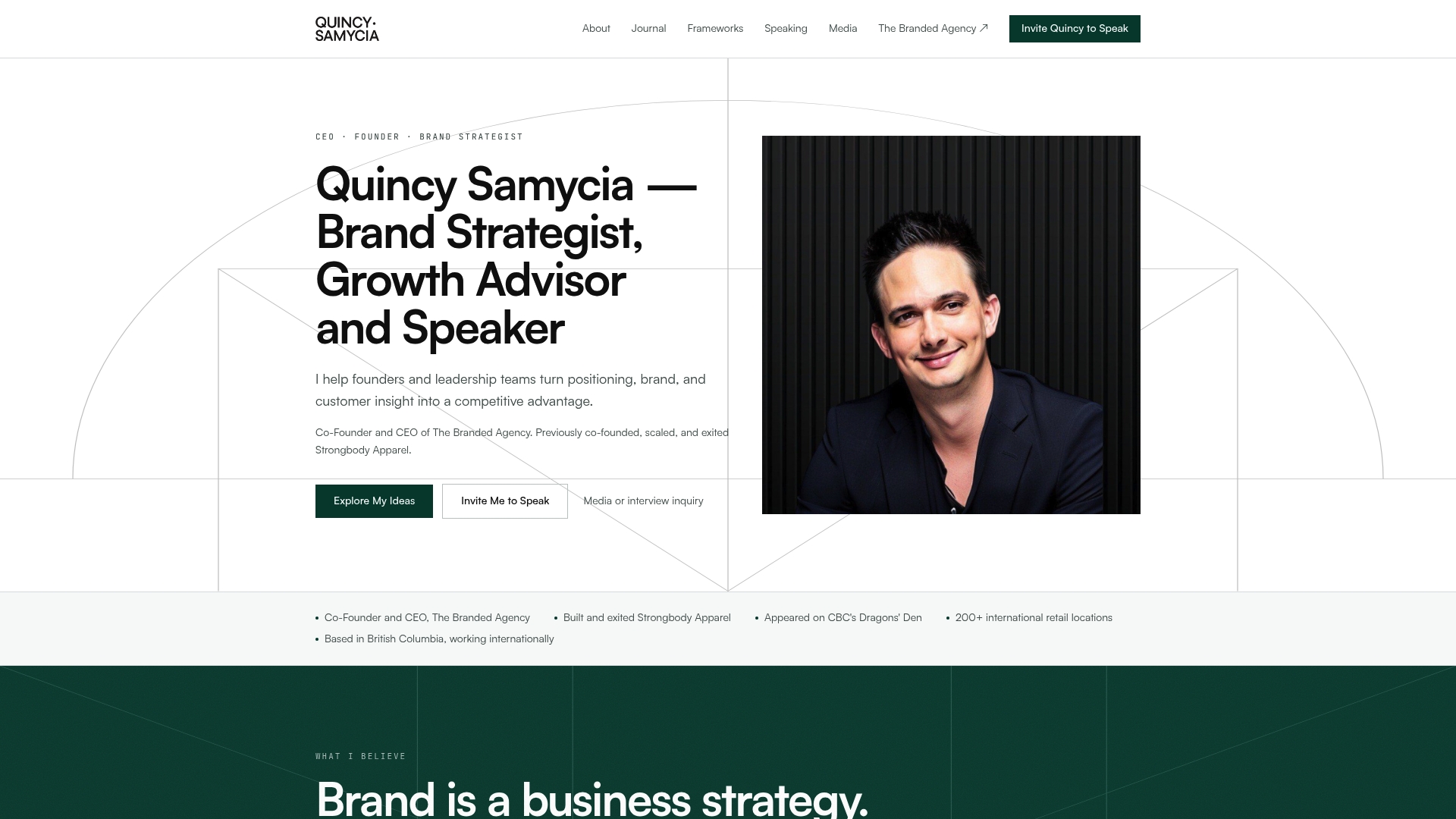
Quincy Samycia works directly with founders and executive teams on brand strategy, positioning, and go-to-market strategy, including the research and governance work that a serious thought leadership plan requires. For leaders who want a flagship idea built and activated through proprietary methods like The Golden Spiral™ and Brand-Backed Performance™, the frameworks page walks through how the system connects to measurable outcomes. If your team needs an executive voice on stage to anchor the strategy, the speaking page covers keynote and workshop engagements built around exactly this kind of flagship thinking. The next recommended step is to connect through the primary site to explore a working session on current positioning and identifying the biggest revenue-influence gap.
Sources
- 2024 Edelman-LinkedIn B2B Thought Leadership Impact Report
- The visual storytelling tools that give your thought leadership an edge
- The verdict is in: it’s buying groups for the win
- B2B content and marketing trends research
FAQ
What Is an Example of a Thought Leadership Strategy?
A strong example is a company publishing one original research report on a narrow, defensible position, then deriving an executive LinkedIn post, a short video, role-specific one-pagers, and a sales enablement brief from that single piece. The key is that every derivative traces back to one researched thesis rather than a scattered content calendar.
What Is the Thought Leadership Strategy Framework?
The core framework runs through nine steps: clarify objectives, map buying-group audiences, claim topic ownership, gather original research, design a flagship asset, build a repurposing system, set channels and cadence, put sales enablement and governance in place, then measure and iterate quarterly. Skipping the objectives step is the most common reason programs stall.
What Are the Three Types of Thought Leadership?
Definitions vary across the industry, but a common breakdown separates executive thought leadership (a named leader’s personal voice and point of view), organizational thought leadership (research and reports published under the company brand), and product-adjacent thought leadership (insight tied closely to a specific capability or category the company sells into). Most mature programs run all three simultaneously but anchor them to the same flagship thesis.
What Are the Objectives of Thought Leadership?
The core objectives are consideration (getting invited into deals early), pipeline influence (shortening sales cycles and lifting win rates), pricing confidence (reducing discount pressure), and retention (giving existing customers a reason to see the relationship as strategic). Programs that skip naming these objectives up front tend to measure engagement instead of business impact, which makes the whole effort hard to defend at budget time.
How Long Does It Take to See Results From Thought Leadership?
Leading indicators like named-account engagement and qualified conversations can appear within weeks of activating a flagship asset, but pipeline influence and pricing confidence typically take one or two full sales cycles to show up clearly. Reviewing results quarterly, rather than monthly, tends to produce more reliable conclusions about what’s actually working.