Brand Playbook Examples: What the Best Ones Include
The best brand playbooks are short on decoration and long on decisions. They tell a team who the brand is for, what it promises, how it sounds, how it looks and who has the final word when someone disagrees. Below are real examples worth studying, a 12-part structure you can copy, and the mistakes that turn a playbook into a PDF nobody opens.
TL;DR
- A brand playbook (also called a brand guide, brand book or brand handbook) puts positioning, voice, visuals and governance in one document your whole team can use.
- Study IBM for clarity, Mailchimp for voice and tone, and the UK Office for National Statistics for a public, practical visual system.
- Write positioning first. Visual rules without strategy behind them are decoration.
- Name an owner and a review cadence, or the playbook will drift out of date within a year.
- Build it in 90 days: research and positioning, then messaging and codes, then rollout and training.
Table of Contents
- What a brand playbook is, and what it is not
- Brand playbook examples worth studying
- The 12 sections of a playbook that works
- A worked example: positioning and proof for a B2B service firm
- Brand guidelines examples by company stage
- Where playbooks fail
- A brand playbook template you can start with today
- Building it in 90 days
- Our perspective: a playbook is a business tool
- When to bring in an advisor
- FAQ
- Sources
What a brand playbook is, and what it is not
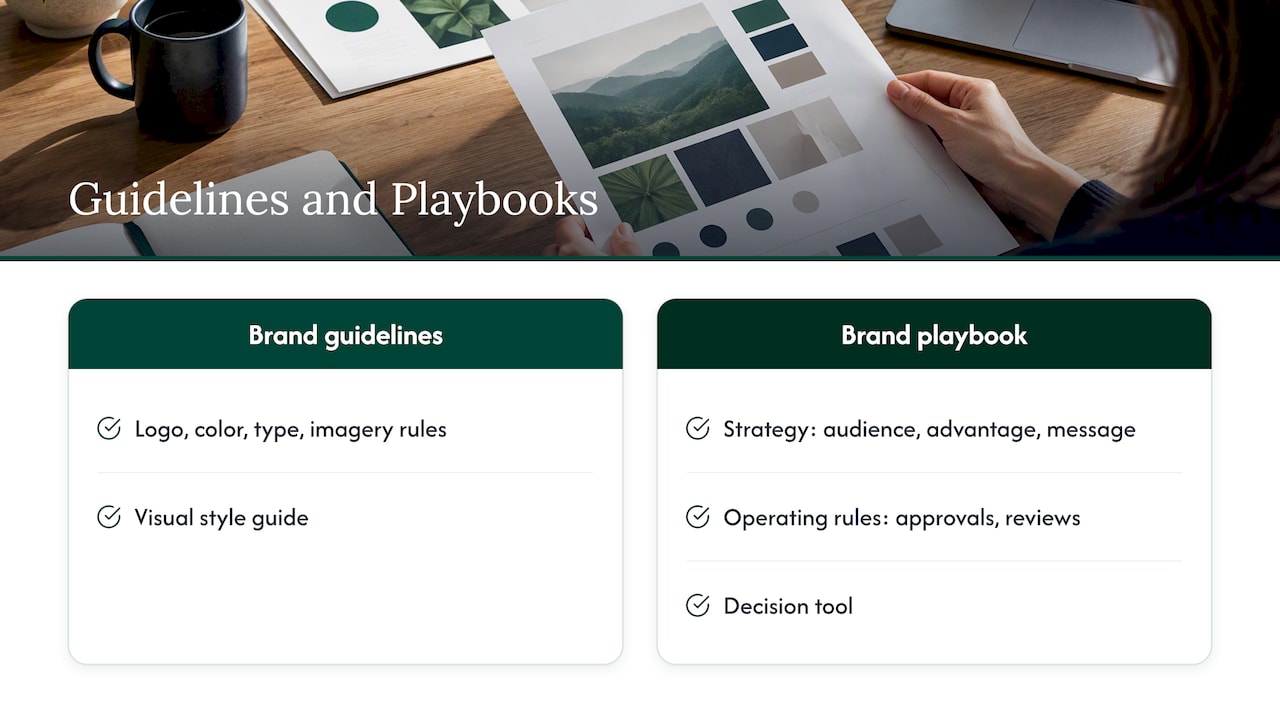
People use the terms loosely. “Brand guidelines” usually means the rules for logo, color, type and imagery. A “brand playbook” goes further: it also holds the strategy (who you serve, why you win, what you say) and the operating rules (who approves what, how often it is reviewed). “Brand handbook” and “brand book” sit somewhere in between, depending on who wrote them.
The distinction matters because most of the top-ranking examples online are visual style guides. They are useful for design inspiration. But if you are a founder or a marketing lead, your bigger problem is rarely the exact hex value of your blue. It is that sales says one thing, the website says another and the product team names features however they like.
A good playbook fixes that. It is a decision tool, not a logo-usage poster.
Brand playbook examples worth studying
You will not copy a global company’s playbook. You can borrow what each one does best.
IBM: clarity over entertainment
IBM publishes its design thinking openly. Its event brand expression guidance explains that every brand expression comes from a master brand architecture aligned with the IBM Design Language, and that every element created for events serves that master brand. The lesson: one system, applied everywhere, with a stated reason behind each rule. Brand governance writers point to IBM and Mailchimp as examples of guidelines that put clarity ahead of entertainment.
What to borrow: explain the principle before the rule. A team that understands why will make the right call in situations the document never anticipated.
Mailchimp: voice and tone you can actually use
Mailchimp’s content style guide has a voice and tone section that separates the two ideas and explains how each applies to the brand. Voice is the consistent personality. Tone shifts with the situation.
That split is practical. A 2026 marketing leadership report from the B2B CMO Project makes a similar point: the voice should read like an ideal colleague, and an error message should sound different from a celebratory notification while remaining recognizably the same brand.
What to borrow: write down two or three situations (a pricing page, a support reply, a launch announcement) and show how the tone moves while the voice stays put.
Office for National Statistics: a public, practical system
The UK’s Office for National Statistics keeps its brand guidelines in a public service manual. The page introduces the organization, explains how the identity builds trust and recognition, and lets people explore core visual elements, design guidance and downloadable assets.
A public-first mindset has a side effect. Brand governance experts note that open style guides force teams to keep quality high, and partners and agencies can find what they need without asking for files over email.
What to borrow: put the assets and the rules in the same place. If people must email someone to get the logo, they will grab an old one from a deck.
Retail and consumer brands: short and visual
Roundups of retail brand books tend to praise the same trait: brevity. The better ones state core values plainly and keep the rules short enough that a store manager or a freelancer will read them. If your people are not designers, copy that discipline.
The 12 sections of a playbook that works
A free brand guidelines outline from Brandbooks lays out twelve parts, from brand foundation through to governance. That structure is a sound starting point. Here it is, with what we would push you to put in each part.
| # | Section | What goes in it |
|---|---|---|
| 1 | Foundation | Story, mission, vision, and the one-sentence reason the company exists |
| 2 | Positioning | Target customers, competitive frame, promise and proof |
| 3 | Personality | Three to five traits, each with a “we are / we are not” line |
| 4 | Logo rules | Versions, clear space, minimum size, misuse examples |
| 5 | Color | Palette with HEX, RGB and CMYK values |
| 6 | Typography | Hierarchy and fallback fonts |
| 7 | Graphic language | Shapes, icons, patterns, illustration style |
| 8 | Photography | Subject, framing, what to avoid |
| 9 | Tone of voice | Voice principles plus tone by situation |
| 10 | Layout | Grids, spacing, composition |
| 11 | Applications | Web, social, print, decks, email |
| 12 | Governance | Owner, review cadence, asset access |
Notice the weight. Sections 1, 2, 3 and 9 carry the strategy. Section 12 carries the discipline. The rest is craft. Most weak playbooks reverse that ratio: forty pages of logo rules and a single paragraph of positioning.
A worked example: positioning and proof for a B2B service firm
Here is what a positioning page can look like in practice. This is an illustrative example, not a real client.
Company: a fictional 40-person workplace analytics firm selling to HR leaders at mid-sized U.S. employers.
- Customer: VPs of People at companies with 500 to 2,000 employees who must show retention results to a CFO.
- Problem in their words: “We run engagement surveys and nothing changes.”
- Promise: turn survey data into three decisions per quarter that leaders can own.
- Proof: a named method, two customer outcomes expressed in retention and a quarterly review ritual.
- We are / we are not: practical, not academic; direct, not cold.
The proof line is the part founders skip. Expert-led B2B strategies often build what could be called a proof ladder: each service maps to a specific client pain point and a measurable outcome, and that ladder becomes the base for messaging and visual cues, according to the B2B CMO Project research. Without it, design rules become decorative.
One more point from B2B case work: the customer is the hero and the brand is the trusted guide. If your playbook’s story section reads like a company autobiography, rewrite it so the buyer’s problem comes first.
Brand guidelines examples by company stage
What you need depends on size. Do not build a 90-page brand book for a six-person team.
Early-stage startup: two to six pages
Positioning, personality, voice, logo and color, one page on applications. Done in a shared document, kept honest by one owner. Our view on the order of operations is in our guide to startup brand strategy for founders: strategy first, identity second.
Growth-stage company: 15 to 30 pages
Add persona detail, messaging by audience, sales-ready language, templates and a rollout plan. This is where the employee rollout matters most, because the people who will break the rules are the ones who were never briefed.
Enterprise or multi-brand: a living system
On this scale the playbook is a digital hub with assets, approvals and regional rules. The writing matters less than the access model and the governance.
Where playbooks fail
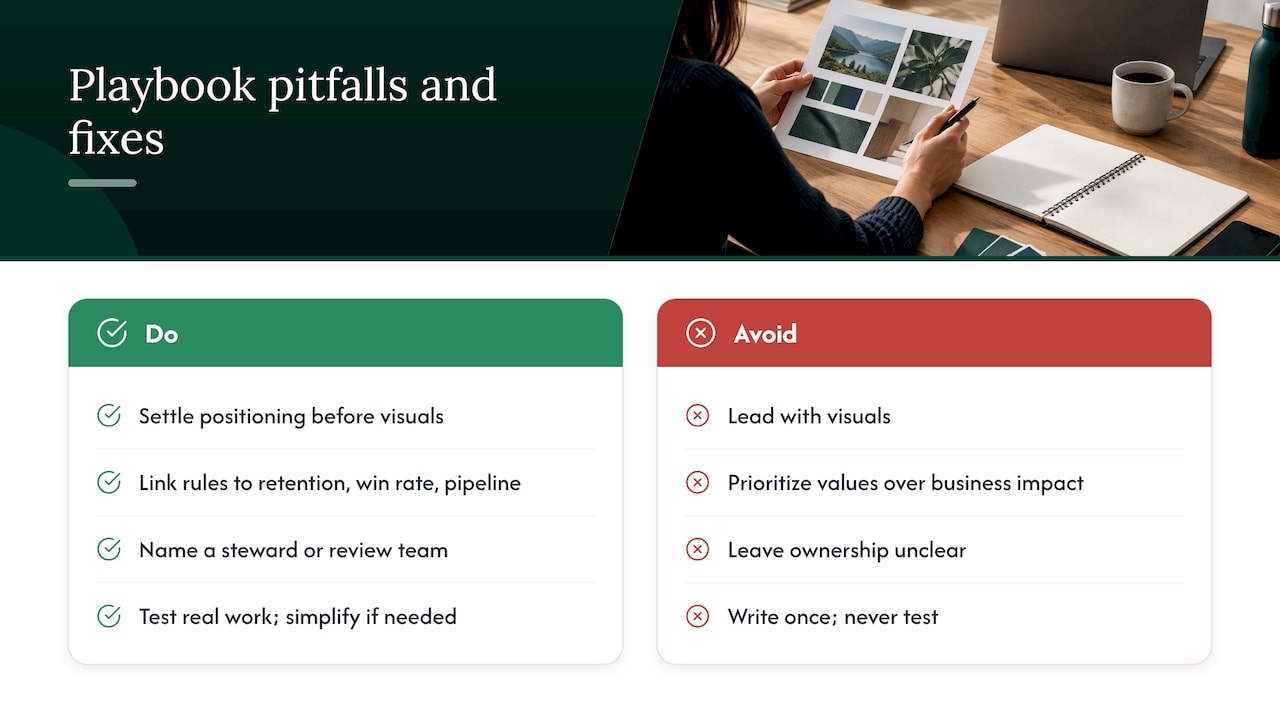
Visuals before positioning. A common failure point for startups is focusing on visual identity before positioning is settled. The logo gets redone twice because nobody agreed on who the brand is for.
Values over business impact. Experts commonly name over-emphasizing values at the expense of business impact as the usual pitfall for B2B consultancies. A playbook that cannot connect to retention, win rate or pipeline will lose budget fast.
No owner. Governance depends on clear ownership more than on the document. The ONS service manual and similar guidance describe a designated steward or review team that manages updates, typically quarterly, and the document should say who decides when the rules are ambiguous. Without that, brand decisions end up in scattered notes, email threads and expired slide decks. That is drift.
Written once, never tested. A playbook should be tried on real work: a sales email, a job post, a landing page. If people cannot apply it in ten minutes, simplify it.
A brand playbook template you can start with today
Open a blank document and make these headings. Fill each in with one paragraph or a short list before you add anything visual.
- Why we exist. Two sentences.
- Who we serve. One ideal customer, described by situation, not demographics. If this is fuzzy, our ideal customer profile framework walks through it.
- What we promise and how we prove it. Three proof points, each with a number or a named outcome.
- How we differ. Name the category alternatives by type. A competitive brand analysis will give you honest inputs.
- Personality. Three traits, each with “we are / we are not.”
- Voice and tone. One voice, three tone examples.
- Visual basics. Logo, color, type, imagery, with a do and a don’t each.
- Applications. Show five real examples: deck, website section, email, job post, sales one-pager.
- Governance. Owner, approver, review date, where the files live.
If you are testing your positioning with a team first, a 60 to 90 minute positioning workshop is a fast way to get section 3 and 4 agreed.
Building it in 90 days
A 90-day structure works well for startups and teams building a playbook from scratch, as laid out in one consulting guide from NMS: research, positioning and mapping in days 1 to 30; messaging tests and core brand codes in days 31 to 60; implementation, training and a governance rhythm in days 61 to 90.
In practice:
- Days 1 to 30: interview customers and lost deals, review competitors, draft positioning and proof.
- Days 31 to 60: test messages with real prospects, lock voice, then define color, shape and type.
- Days 61 to 90: apply to real assets, train every team, set the review date and name the owner.
The final step is the one that decides whether the playbook sticks. Our go-to-market framework shows how the same 90 days connects brand to launch and revenue work.
Our perspective: a playbook is a business tool
We see brand as a core business strategy, not a marketing accessory. That shapes how we think about playbooks.
First, a playbook should align product, marketing and sales around one story. When those three describe the company differently, customers compare you on price because nothing else is clear. The document is how you stop that.
Second, we come at this as operators. Our experience building brands, across more than 200 international retail locations, taught us that rules nobody can apply at a counter, in a sales call or in a product release are not rules. So we favor short, iterative playbooks over exhaustive ones, and we tie every section to something measurable: customer experience, conversion, retention.
Third, we ask for the proof before the paint. If a team cannot say what it promises and how it proves it, no color palette will help.
— Quincy
When to bring in an advisor
You can write a playbook internally if your team agrees on who the customer is and what you offer. Help is worth it when sales and marketing disagree, when you are about to launch or reposition, or when the founder is the only person who can explain the brand.
We work with founders, executive teams and marketing teams on brand strategy, positioning, growth and go-to-market work, and customer experience. If you want a playbook that connects to business results rather than sitting in a folder, talk to us about brand strategy and growth advisory. If you need a speaker for a leadership event, see our speaking page.
Not sure whether you need a full rebrand or a tune-up? Read rebrand vs. brand refresh first.
FAQ
What is the difference between a brand playbook and brand guidelines?
Brand guidelines mostly cover how the brand looks: logo, color, type and imagery. A playbook includes those but adds strategy, such as positioning, proof and voice, and operating rules like ownership and review cadence. If you only have guidelines, your team knows how to format a slide but not what the slide should say.
How long should a brand playbook be?
As long as people will read it. A startup can do well with two to six pages. A growth-stage company often needs 15 to 30. Past that, move to a searchable digital hub rather than a longer PDF.
Who should own the playbook?
One named person, often a head of marketing or brand, plus a small review group. Guidance on governance recommends a designated steward and a regular review, typically quarterly. Write down who decides when two people disagree.
Should we make our brand playbook public?
It can help. Public-first guides push teams toward higher quality and let agencies and partners find assets without asking for them. Keep internal-only content, such as unreleased positioning or pricing language, in a private section.
Where should a first-time team start?
Start with positioning: who you serve, what you promise and how you prove it. Add voice next. Leave visual rules for last, because they should express the strategy, not replace it.
Sources
- IBM Event Design: Brand expression
- Mailchimp Content Style Guide: Voice and Tone
- Brand guidelines, Office for National Statistics service manual
- Brand guidelines template: free outline (12 parts), Brandbooks
- Brand guidelines examples, Frontify
- The B2B CMO Imperative: 2026 Marketing Leadership Report
- Brand Strategy Consulting guide, NMS Consulting