Rebrand vs. Brand Refresh: How to Choose the Right Move
A brand refresh updates how your company looks and sounds while keeping its strategy intact. A rebrand changes the strategy itself: who you serve, what you stand for, and how you are positioned against the alternatives. Pick the refresh when your positioning still holds and your expression has gone stale. Pick the rebrand when the business has changed underneath the brand, or when the market no longer sees you the way you need to be seen.
The mistake we see most often is choosing by budget or by taste. A founder tired of an old logo asks for a rebrand. A leadership team with a real positioning problem asks for a “fresh look” because it feels safer. Both spend money and neither fixes the issue. This guide gives you a way to diagnose the problem first, then choose the scope.
TL;DR
- A refresh modernizes visuals and messaging around a strategy that still works. A rebrand rebuilds the strategy, and the identity follows from it.
- Decide by the problem, not the price: if your business model, audience, or positioning has shifted, a refresh will not be enough.
- Neither move can rescue a weak product. A brand change has to articulate a real competitive advantage.
- Most failures come from internal misalignment and poor rollout, not from the creative itself.
- Set measurable targets before you start, and tell employees before customers.
Table of Contents
- What each one actually changes
- Signs you need a refresh
- Signs you need a rebrand
- A five-question test before you choose
- The middle path: reposition without renaming
- Why a brand change cannot fix a weak product
- Rebranding risks to plan for
- How to measure whether it worked
- A rebranding process in six steps
- Our perspective
- Working with us on the decision
- Where your ideal customer fits
- FAQ
- Sources
What each one actually changes
The two terms get used loosely, so here is a working definition.
A brand refresh keeps your core intact. Typical changes include a modernized logo, an updated color palette and typography, a tighter tone of voice, and cleaner templates for sales and marketing. Your name, your promise, and your target customer stay the same. The goal is consistency and relevance.
A rebrand questions the foundation. It can involve a new positioning, a new value proposition, a new audience focus, and sometimes a new name. The visual identity is a consequence of those decisions, not the starting point. A rebrand touches product, pricing conversations, sales narrative, customer experience, and internal culture.
The GoodFirms guide to refresh versus rebrand puts the split in similar terms: refresh when the strategy is sound but the visuals or messaging look dated, and rebrand when the business model, audience, positioning, or purpose has changed significantly.
| Brand refresh | Rebrand | |
|---|---|---|
| Starting question | How do we express who we are better? | Are we still who we need to be? |
| Strategy | Unchanged | Revisited or rewritten |
| Typical scope | Logo, color, type, tone, templates | Positioning, messaging, name, identity, experience |
| Who is involved | Marketing, design | Executive team, product, sales, marketing, HR |
| Main risk | Cosmetic change that hides a real problem | Losing equity and confusing customers |
| Timeline | Weeks to a few months | Several months to more than a year |
The timelines are general ranges from our experience, not figures that apply to every company. A global enterprise and a twelve-person startup will move very differently.
Signs you need a refresh
A refresh is the right call when the following are true:
- Customers understand what you do and why you are different, but your materials look a generation behind.
- Your brand shows up inconsistently: three versions of the logo, different tones across the website, sales decks, and social posts.
- You have grown into a more premium or more sophisticated position, and the visual identity undersells it.
- Win rates and retention are healthy. The complaint is about polish, not about relevance.
- You have added a few products or features, but your audience and promise are unchanged.
In short, the strategy is working and the expression is lagging. This is a clarity and consistency problem, and a refresh fixes it at a fraction of the effort of a rebrand.
Signs you need a rebrand
A rebrand makes sense when the gap is strategic:
- Your business changed. You moved from selling to small teams to selling to enterprises, from a product to a platform, or from one category to another.
- A merger, acquisition, or divestiture has left two identities competing, or one identity that no longer describes the combined company.
- You are being compared to the wrong set. Buyers put you next to competitors you do not want to be measured against, and your sales team keeps discounting to win.
- Your name is a liability. It limits where you can grow, is hard to spell or say, or carries baggage.
- Reputation damage needs a real reset, not a new coat of paint.
- Your positioning has drifted. Product says one thing, marketing another, and sales a third. No visual update will reconcile that.
The common thread is that the brand’s central promise no longer matches market reality. When that happens, changing only the look gives customers a new surface over the same confusion.
A five-question test before you choose
Run your team through these questions. Write the answers down separately, then compare them. Disagreement among your own leaders is itself a finding.
- Can every executive state our positioning in one sentence, and do the sentences match? If not, you have a strategy problem, which points to a rebrand or at least a repositioning.
- Has our customer changed? If the buyers you win today differ from the ones you were built for, revisit positioning.
- Do customers choose us for reasons we would say out loud? If they buy for a reason you do not promote, your brand is missing its real advantage.
- Is the product delivering the promise? If not, stop. Fix the offering first.
- Does the problem show up in customer behavior or only in our opinion of the design? Lost deals, long sales cycles, and price pressure are strategic signals. A dated logo is a cosmetic one.
Mostly “no” on questions 1 to 3 points to a rebrand. Mostly “yes” with a visual complaint points to a refresh.
The middle path: reposition without renaming
The choice is not always binary. Many companies need a repositioning: a deliberate shift in the place you hold in the buyer’s mind, without a new name or a dramatic visual overhaul. You change the story, the proof points, the category you compete in, and the audience you lead with. The identity may get a modest refresh to support it.
How to reposition a brand, in practical terms:
- Audit how you are perceived today. Interview customers, lost prospects, and your own sales team. Compare what they say to what you say.
- Define the competitive set you want. Decide who you want buyers to compare you with, and why you win against them.
- Write the positioning. Audience, category, differentiated value, and proof, in language a salesperson can say without a script.
- Test it with real buyers before you commit design budget.
- Align product, marketing, and sales around it, then update the identity to match.
If you want worked examples of positioning statements and a way to pressure-test your own with your team, our brand positioning examples workshop walks through a 60 to 90 minute format.
Why a brand change cannot fix a weak product
A rebrand is not a repair job. Brand equity is fragile and takes years to build. The Harvard Business Review reading on brands and brand equity frames good branding as something that gives buyers confidence in their purchase decision. That confidence only lasts if the product earns it. If the offering does not deliver, any new identity, refresh or rebrand, stays superficial and will not produce sustainable performance.
So the primary objective of a brand change should be to articulate a genuine competitive advantage. If you cannot name one, that is the work to do first.
Rebranding risks to plan for
Change carries real downside, and the risks are different for each path.
Customer backlash and lost recognition
Customers build habits around familiar cues. Tropicana’s 2009 packaging redesign is the cautionary tale: dollar sales fell 19% after the change and the company went back to the original package soon afterward. Note that this was a visual change, not a full strategic rebrand. A “mere” refresh can hurt when it discards the cues that people use to find you.
The lesson for B2B is the same, only quieter. Keep what buyers rely on, such as a recognizable name, a color, a signature phrase, or a product naming system, unless you have a reason to remove it.
Internal misalignment
The most overlooked phase of a rebrand is internal activation. Recognition programs such as the IABC Gold Quill Awards reward transformations that tied leadership advocacy and cultural integration to the new brand, which is a reminder that the work does not end at the reveal. If leaders are not unified advocates, and if performance metrics and HR processes still reward the old behavior, the new promise rings hollow to customers. We cover the sequencing in detail in our piece on why a brand rollout plan starts with employees, not customers.
No measurement
If you cannot say what success looks like, you cannot defend the investment, and you cannot learn from it. This is the cheapest risk to remove.
SEO and discoverability
A new name or a restructured website can break the search visibility you have built. Redirects, updated profiles, consistent naming across directories, and a plan for branded search all need an owner. If search is a meaningful channel for you, it helps to understand how to prioritize SEO work that drives trials and pipeline, a Portuguese-language guide aimed at SaaS companies, before you change URLs or names.
Scope creep and fatigue
Rebrands drag when nobody owns the decision. Name one accountable executive, set a decision calendar, and say in advance what is out of scope.
How to measure whether it worked
Decide on indicators before kickoff and capture a baseline. Useful measures include:
- Awareness and search: branded search volume, direct traffic, share of voice.
- Pipeline quality: win rate, average deal size, sales cycle length, discounting.
- Customer signals: retention, net promoter score, and the words customers use to describe you.
- Internal alignment: can employees explain the positioning, and do sales materials use it?
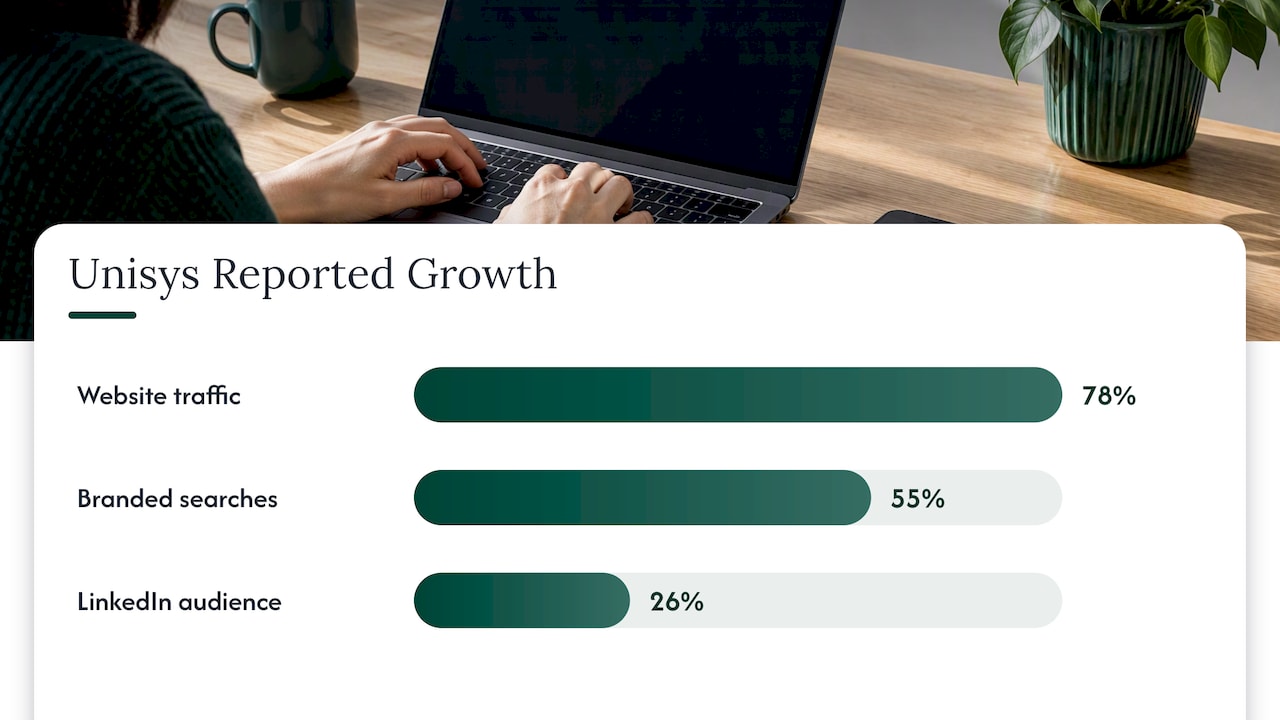
For a sense of what a tracked B2B rebrand can look like, Unisys reported that, 18 months after its rebrand, it saw a 78% increase in website traffic, a 55% jump in branded Google searches, and 26% growth in its LinkedIn audience. That is one company’s own reported result, tied to a multi-channel program, so use it as an example of what to measure, not as a benchmark you should expect.
Be skeptical of tidy statistics that claim refreshes always beat rebrands on cost and engagement. Scope, category, and starting point drive the outcome far more than the label.
A rebranding process in six steps
This is the framework we use as a starting point. Adapt the depth to the scale of your company.
- Diagnose. Gather customer, sales, and market evidence. Decide whether you have an expression problem or a strategy problem.
- Decide the scope. Refresh, reposition, or full rebrand, with explicit reasons and an executive owner.
- Build the strategy. Positioning, messaging hierarchy, proof points, and the customer experience you promise.
- Design the expression. Name, identity, voice, and templates, only after the strategy is settled.
- Activate internally. Brief leaders first, then employees, then update tools, training, incentives, and sales enablement.
- Launch and measure. Roll out externally, track the baseline indicators, and iterate for at least two quarters.
Notice that design is step four. When design comes first, teams end up debating taste instead of strategy.
Our perspective
We treat brand as a core business strategy, not a marketing accessory. That changes how we answer the rebrand versus refresh question.
First, we do not start with the logo. We start with drift and comparison: where product, marketing, and sales have stopped telling the same story, and where buyers are comparing you to the wrong set of alternatives. If those two are healthy, you probably need a refresh, and we will say so. If they are not, a prettier surface will not help.
Second, we have seen brand building from the operator’s side, including work across more than 200 international retail locations and exit experience. That has made us wary of brand exercises that cannot be tied to performance. Every engagement we run connects brand strategy to measurable outcomes through our Brand-Backed Performance™ approach, and uses frameworks such as The Golden Spiral™ to keep positioning, product, marketing, and sales iterating together rather than handing off a deck.
Third, the hardest and most valuable part is usually the internal one. A brand that employees cannot explain does not exist for customers either. So we push clients to align leaders and teams before they announce anything publicly.
If you are a startup, the same logic applies at a smaller scale. Our article on startup brand strategy for founders shows how to treat brand as a growth metric from the beginning, which often removes the need for an expensive rebrand later.
— Quincy
Working with us on the decision
If you are unsure which path fits, the cheapest first step is a positioning diagnosis, not a design brief. We help founders, executive teams, and marketing teams assess where the brand stands, decide the scope, and connect the work to growth. Our offerings include brand strategy, brand positioning, growth and go-to-market strategy, and founder and executive advisory. Pricing is scoped to each engagement. You can see the full range on our services page, or get in touch to talk through your situation.
If you want to align a leadership team around the question, we also run talks and sessions, described on our speaking page.
Where your ideal customer fits
Many rebrand debates are really audience debates. If you cannot describe who you are building for in terms your sales team can act on, positioning will stay fuzzy whichever path you choose. A clear ideal customer profile framework is often the missing input, and it is worth finishing before you commission any creative work.
FAQ
What is the difference between a brand refresh and a rebrand?
A refresh updates the look and voice of your existing brand, such as the logo, colors, typography, and tone, while the strategy stays the same. A rebrand changes the strategy underneath: positioning, audience, value proposition, and sometimes the name. The refresh changes how you express the brand. The rebrand changes what the brand is.
When should a company rebrand instead of refresh?
Rebrand when something fundamental has shifted: your business model, target audience, positioning, or purpose, or after a merger or acquisition. Also consider it when buyers keep comparing you with the wrong competitors. If the strategy is sound and only the visuals feel dated, a refresh is usually enough.
What are the biggest rebranding risks?
The main ones are losing recognition customers rely on, internal misalignment, no measurable goals, and damage to search visibility if names or URLs change. Public backlash can also be costly, as Tropicana’s 2009 packaging redesign showed. Most can be reduced by testing with real buyers, briefing employees first, and setting a baseline.
Can a rebrand fix a poor product?
No. A new brand can sharpen how you communicate an advantage, but it cannot create one. If the offering does not deliver on its promise, fix that first, then change the brand.
What are the 5 C’s of branding?
The commonly cited list is clarity, consistency, creativity, connection, and commitment. Refreshes tend to address clarity and consistency in how a brand is expressed, while a rebrand is warranted when the commitment to the original brand essence no longer matches the market.
Sources
- GoodFirms: Brand Refresh vs. Rebrand
- Core Reading: Brands and Brand Equity (HBR)
- Tropicana packaging redesign and sales impact (Yahoo Finance)
- ABM 2026 IABC Gold Quill Award announcement
- Unisys B2B rebrand award announcement