
Competitive Analysis Framework: A Practical Guide for Leaders
A competitive analysis framework is a repeatable way to answer one question: why would a customer choose us over the alternatives? The version that works has five moves. Define the market the way your customer sees it. Choose the handful of rivals that sit in a buyer’s real consideration set. Gather evidence from sources you can verify. Compare everyone on the same criteria. Then turn the gaps into a positioning decision and a go-to-market plan. Everything below walks through those moves with the models, template fields and tool types that support them.
TL;DR
- Start with the customer’s alternatives, not a list of every company in your industry. The closest rivals are the ones buyers actually weigh against you.
- Use one model per question: SWOT for internal and external factors, Five Forces for industry structure, strategic groups for who competes with whom, a positioning map for whitespace.
- Log evidence in one spreadsheet, with a source and a date on every row, and compare all competitors on the same criteria.
- The analysis only pays off when it ends in a decision: a sharper position, a pricing stance, a channel choice, or a message your sales team can use.
- Tools help with monitoring. They do not replace the judgment about what the findings mean.
Table of Contents
- What a competitive analysis framework does
- Step 1: Define the market the way your customer does
- Step 2: Choose the competitors worth analyzing
- Step 3: Gather evidence you can defend
- Step 4: Profile each competitor
- Step 5: Pick the model that answers your question
- What a competitive analysis template should include
- Where tools fit
- Turn findings into positioning and go-to-market choices
- A one-week schedule
- Mistakes that weaken the result
- Work through it with an advisor
- FAQ
- Sources
What a competitive analysis framework does
Competitive analysis is a structured process for identifying direct and indirect competitors, comparing their products, pricing, marketing and sales, and assessing strengths and weaknesses. Shopify’s guide names SWOT, Five Forces, strategic-group analysis and positioning maps as the models that organize that research. A framework is what keeps the work from turning into a pile of screenshots.
The U.S. Small Business Administration frames the purpose plainly: market research helps you find customers and competitive analysis helps you make your business unique, and together they can reveal a competitive advantage. That is the right bar. If the finished document does not change something you will say, sell, build or charge, it was a research exercise, not a strategy.
For leaders, the common failure is drift. Product describes the company one way, marketing another, and sales improvises a third when a buyer asks how you differ from the option they are also considering. A good framework gives all three teams one shared picture of the market and one shared answer. If you want the brand side of this in depth, our guide to competitive brand analysis picks up where this article ends.
Step 1: Define the market the way your customer does
Before you list a single competitor, decide what market you are analyzing. The SBA suggests assessing demand, market size, economic indicators, location, market saturation and the prices customers pay for alternatives when defining a U.S. market. Those inputs keep the boundary honest.
Cornell’s Dyson School adds a useful discipline: identify competitors with both an industry approach and a market approach. The industry approach looks at structure and products. The market approach looks at firms serving the same customer need. A project management app competes with other apps on the industry view, but on the market view it also competes with spreadsheets, an assistant hired to chase deadlines, and doing nothing.
Write the market definition as one sentence you could say to a buyer: “We help [who] solve [what problem] when [situation].” If you cannot write it, your competitor list will be a guess. Our guide to go-to-market research covers what to study before you commit to a market, and the ideal customer profile framework helps you sharpen who the “who” is.
Step 2: Choose the competitors worth analyzing
Most teams build the list too wide. Cornell separates brand, industry, product and generic competition, from similar products at similar prices to every provider competing for the same consumer dollar. Each layer teaches you something, but only the inner layers need a full profile.
Research from the University of Minnesota maps competitors by market commonality and resource similarity. That separates direct rivals from indirect substitutes, potential entrants and firms currently outside the set. The same study finds that the most significant direct competitors are often the alternatives inside the customer’s consideration set, not every firm on a broad market map.
A practical way to apply this:
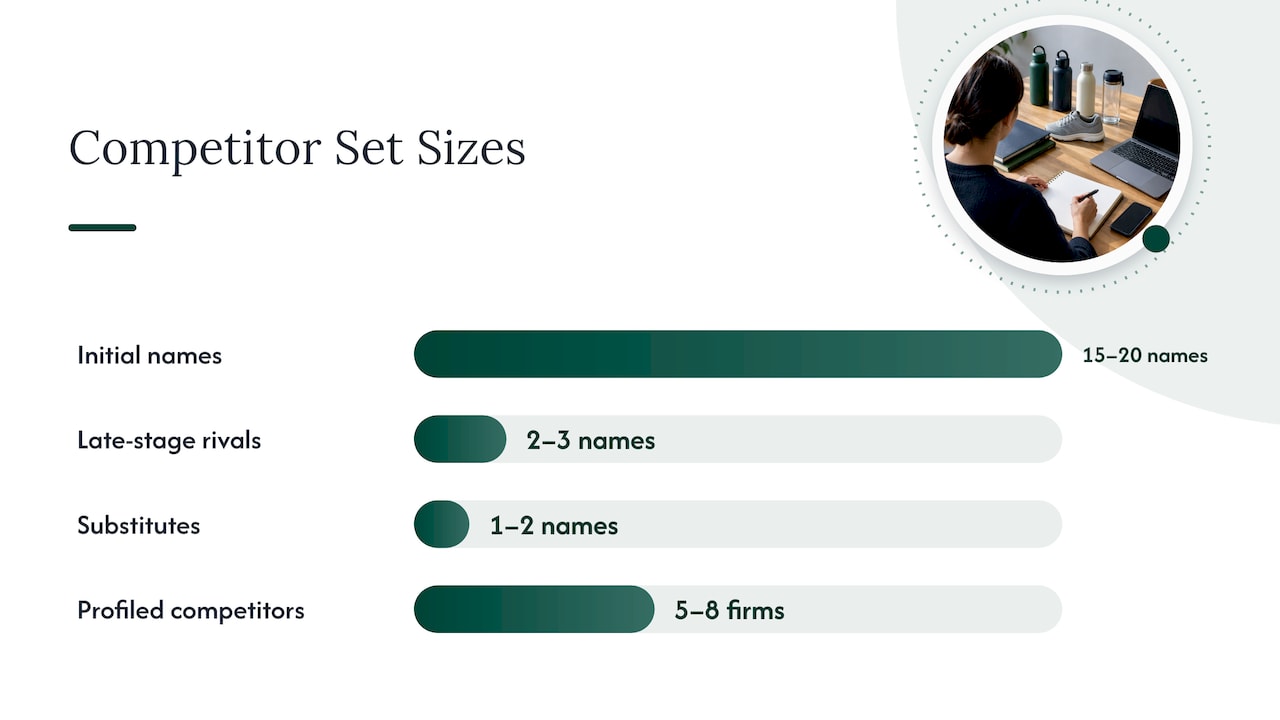
- List 15 to 20 names from search results, customer conversations, analyst coverage and your own lost deals.
- Ask your sales team which two or three names come up in late-stage deals. Those are your direct set.
- Group the rest by strategy. Darden at the University of Virginia recommends putting firms with similar strategies into strategic groups so you can prioritize the closest rivals while keeping watch on the more distant ones.
- Add one or two substitutes: the non-obvious way a buyer might solve the problem without buying from anyone in your category.
A final set of five to eight profiled competitors is plenty. More than that and the comparison stops being read.
Step 3: Gather evidence you can defend
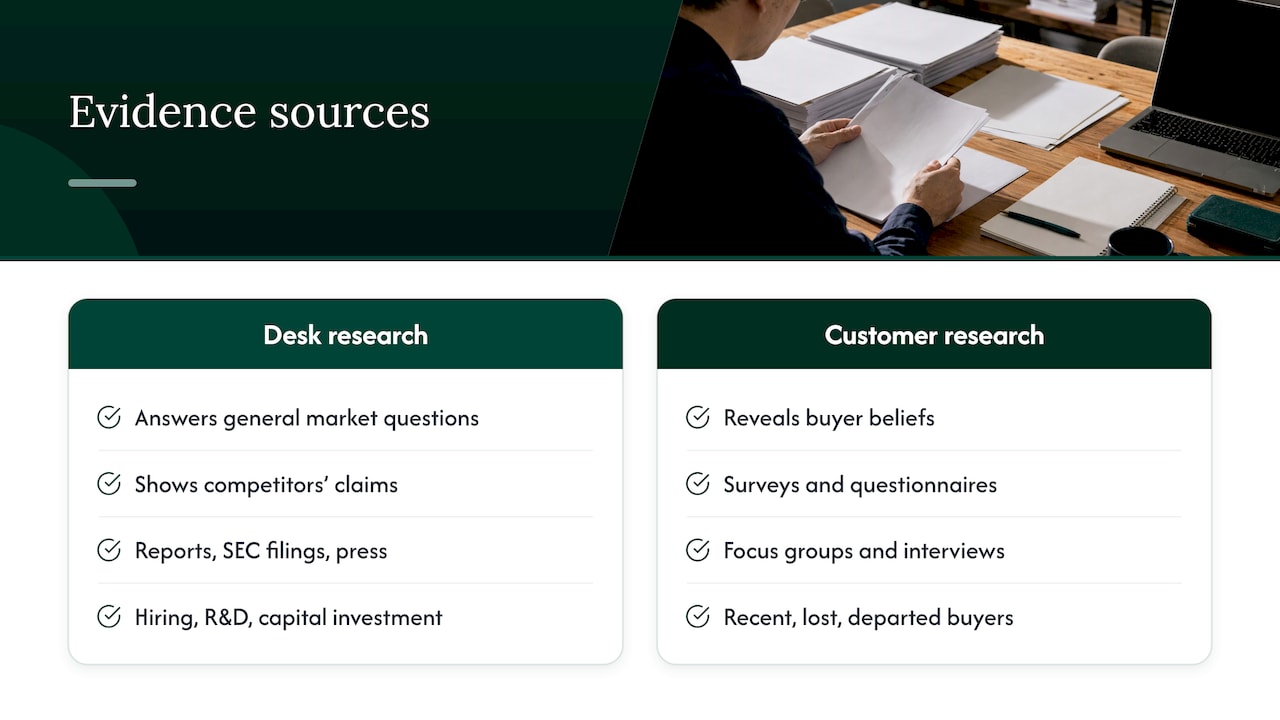
The SBA advises using existing sources for general and quantifiable market questions, and surveys, questionnaires, focus groups or in-depth interviews for direct research. Both matter. Desk research tells you what competitors say about themselves. Customer research tells you what buyers believe, and beliefs are what decide deals.
For desk research, Darden points to shareholder reports, SEC filings, press coverage, hiring patterns, R&D activity, capital investment and strategic partnerships, and recommends logging findings in a spreadsheet. Hiring is the underrated one. A competitor posting ten enterprise sales roles and a compliance lead is telling you where it is heading before any press release does.
For marketing-side evidence, Buffer’s framework organizes a review into company metrics, product, customer awareness and marketing, covering items such as funding, revenue, features, pricing, share of voice, sentiment, SEO, social, advertising, content, sales and customer service. Use it as a checklist of where to look, then keep only the fields that bear on your decision.
For customer-side evidence, interview recent buyers, lost prospects and customers who left. Ask who else they considered, what they believed each option was best at, and what nearly made them choose differently. Our overview of B2B customer research methods shows which methods change decisions rather than decorate slides.
If your competitors depend on local discovery, location-level evidence matters too. A map-based competitor benchmarking approach shows how to compare visibility across a service area, not just in a single search.
Evidence rules that save the project
- One row per claim, with source and date.
- Separate what a competitor says from what you verified.
- Use public, legal and ethical sources only. HubSpot defines competitive intelligence as legally and ethically monitoring, gathering and analyzing competitor and industry data to improve decisions.
- Mark gaps as unknown rather than filling them with assumptions.
Step 4: Profile each competitor
Cornell’s profiling approach asks you to identify key competitors, their objectives and strategies, strengths and weaknesses, threat level and likely reactions to your moves. Darden extends the questions to operating assumptions, capabilities, resources, and the longer-term sustainability of your own advantage.
The reaction question is the one most profiles skip. If you cut price, bundle a service or enter their best segment, what will they do? A competitor with deep cash and a stated growth target will respond differently from one that is thinly funded and narrowly focused. Write a one-line prediction for each rival. You will be right often enough to make the habit worthwhile.
A one-page profile is enough:
| Field | What to capture |
|---|---|
| Who they target | Segment, company size, buyer role |
| What they promise | The headline claim on their site and in sales material |
| Offer and pricing | Packages, price signals, discount patterns |
| Proof | Case studies, customers named, reviews, awards |
| Go-to-market | Channels, content, partnerships, sales motion |
| Strengths and gaps | What buyers praise and what they complain about |
| Likely reaction | What they will probably do if you move on them |
Step 5: Pick the model that answers your question
No single model does everything. Choose by the question you are trying to settle.
| Framework | Question it answers | Best used when |
|---|---|---|
| SWOT | What are our internal strengths and weaknesses, and which outside opportunities and threats matter? | You need a quick synthesis after research |
| Five Forces | How attractive is this industry and where does pressure come from? | You are choosing a market or setting long-term strategy |
| Strategic groups | Which rivals pursue similar strategies and who is our closest set? | Your competitor list is long and unfocused |
| Positioning map | Where does each player sit on the attributes buyers care about, and where is the open space? | You are deciding how to differentiate |
Shopify’s summary is that you use SWOT to sort internal strengths and weaknesses from external opportunities and threats, Five Forces to examine industry structure, strategic groups to find firms with similar strategies, and positioning maps to show relative positions and potential whitespace.
Five Forces for industry structure
Harvard Business School’s Institute for Strategy and Competitiveness says Porter’s model examines rivalry, new entrants, substitutes, supplier power and buyer power. It also notes the model helps you assess industry attractiveness, understand how trends affect competition, decide which industries to compete in, and position the company. Use it before you invest in a new segment, not after.
Positioning maps for whitespace
Shopify recommends choosing two customer-relevant attributes and plotting roughly five to ten competitors along with your company, then validating any apparent whitespace with customer and market research. That last step matters. An empty corner of the map is sometimes empty because nobody wants to buy there. Our collection of positioning map examples shows how to choose axes that reflect buyer decisions rather than internal preferences.
SWOT without the cliché
A SWOT works when every entry is specific and evidence-backed. “Strong brand” is noise. “Named first by six of ten recent buyers when asked who they considered” is a strength. Cut anything you cannot support with a source from your spreadsheet.
What a competitive analysis template should include
When readers search for a template, they usually want the skeleton. Pull it from the planning documents small businesses already use. The University of Houston SBDC’s marketing plan template places a situational analysis with core competencies, SWOT and competitive analysis ahead of promotion, pricing, distribution, conversion, channels and measurable marketing objectives. The order carries the lesson: analysis comes first, decisions follow, and objectives are measurable.
Nulab’s positioning guide suggests researching competitors across market size, market lifecycle, product features, effectiveness, price, service, market share, innovation, distribution, recognition and financial strength, then rating competitors and your own company to spot opportunities.
Combine those into a template with six tabs:
- Market definition: the one-sentence statement, segments, size and demand signals.
- Competitor set: direct, indirect, substitutes and potential entrants, with the reason each is on the list.
- Profiles: one row or page per competitor using the fields above.
- Scorecard: each criterion rated one to five for every competitor and for you, with a note on the evidence.
- Model outputs: the SWOT, positioning map or Five Forces notes.
- Decisions: what you will change in positioning, messaging, pricing, channels and product, with an owner and a review date.
The last tab is the one that makes the template worth using.
Where tools fit
People also search for competitive intelligence tools, market intelligence platforms and competitor analysis software. They fall into a few types, and the right choice depends on your question.
- SEO and traffic suites show search visibility, keywords and estimated traffic. HubSpot’s guide lists paid plans for one well-known SEO suite at $119 to $449 per month and a traffic-estimation tool at $20 to $135 per month for business use, figures that reflect its 2023 publication, so check current pricing.
- Competitive intelligence platforms centralize alerts, reports and sales battle cards. The same HubSpot guide describes one such platform as pulling from more than 300 million sources and over 100 data types.
- Review and sentiment monitoring reveals how customers talk about rivals in their own words.
- Spreadsheets and a shared folder remain the best starting point for a team of any size.
When you evaluate a platform, ask four things: which sources it covers, how often it refreshes, whether findings reach your sales team in the tools they already use, and who will own the output. A subscription with nobody assigned to read it is wasted money. If you are weighing outside help for the analytics side, this data analytics consulting firm selection guide lays out how to compare providers.
Turn findings into positioning and go-to-market choices
Here the framework earns its keep. Go through your scorecard and map, and look for three things:
- Parity points: what every credible option offers. You need these to be considered, but they will not win the deal.
- Contested points: where two or three rivals fight over the same claim. Avoid these unless you can prove you are better.
- Open points: a claim that matters to buyers, that you can prove, and that no one owns.
The open point becomes the core of your position. Test it with buyers before you commit. Our positioning frameworks workshop format gives you a way to pressure-test a position in 60 to 90 minutes, and the brand positioning examples show what a finished statement looks like.
Then carry the finding through the business. Pricing should reflect the value you can prove against the alternatives, which is the focus of our pricing and positioning playbook. Messaging should lead with the open point. Sales enablement should include a plain answer to “how are you different from X?” Channel and campaign choices should favor places where your rivals are weak or absent. And if your product is sold to a committee, check the position against each role, as we explain in why corporate positioning must win the buying committee.
A one-week schedule
| Day | Work | Output |
|---|---|---|
| 1 | Define the market and draft the competitor list | One-sentence market statement, long list |
| 2 | Interview sales and two or three recent buyers | Consideration set, decision criteria |
| 3 | Desk research on five to eight competitors | Evidence spreadsheet |
| 4 | Profiles and scorecard | Rated comparison |
| 5 | Positioning map, SWOT, decisions | Decision tab with owners |
Repeat the lightweight version every quarter, and the full version once a year or when the market shifts.
Mistakes that weaken the result
- Copying competitors. The point is to understand the field so you can choose where and how to compete, not to match features.
- Comparing on your own criteria. Use the criteria buyers use, which interviews reveal.
- Treating the document as finished. Competitors reposition, so give every row a date.
- Stopping at description. A list of what rivals do is not a strategy. End with decisions.
- Ignoring substitutes. The biggest competitor is often the status quo.
Perspective
In our work, the competitive analysis is rarely the hard part. The hard part is that product, marketing and sales each hold a different version of the answer, so the findings never become one position anyone acts on.
We treat brand as a core business strategy, not a marketing tool. That means the analysis has to connect to what the company builds, how it sells and what it can prove. A position that marketing likes but sales cannot defend is just drift with better copy.
Our approach comes from an operator’s view of real brand building and exit experience. We use frameworks such as The Golden Spiral™ and Brand-Backed Performance™ to tie positioning to measurable performance, and we iterate: test the position with customers, adjust, and carry it into product, marketing and sales.
If you take one thing from this guide, make it the decision tab. Name the claim you will own, the proof behind it, and the person responsible for putting it in front of buyers.
Quincy
Work through it with an advisor
If your team has the competitor data but not the alignment, we can help. Quincy Samycia advises founders and executive teams on brand strategy, positioning and go-to-market strategy, connecting the competitive picture to a position that product, marketing and sales can all use. Engagements are scoped to your situation, and our brand strategy frameworks show how we structure the work.
If you want these findings turned into an executive workshop or a keynote for your leadership team, see our speaking page.
FAQ
What is the simplest competitive analysis framework to start with?
Start with a scorecard of five to eight competitors rated on the criteria your buyers use, then plot them on a positioning map with two attributes. Add a short SWOT to summarize what the evidence says about you. This takes a week and produces a decision, which is more useful than a long report.
How many competitors should I analyze?
Profile the two or three that appear in your late-stage deals plus a few from adjacent strategic groups, usually five to eight in total. Research from the University of Minnesota suggests the most significant direct rivals are the alternatives inside customers’ consideration sets. Keep a lighter watch list for everyone else.
How often should I update a competitive analysis?
Refresh the evidence spreadsheet quarterly and redo the full analysis annually or after a major shift, such as a new entrant, a big funding round or a pricing change. Date every row so readers know how current each claim is.
Do I need paid competitive intelligence software?
Not to begin. A spreadsheet, public filings, competitor websites, review sites and buyer interviews cover most of what a first analysis needs. Software becomes worthwhile when you track many competitors or need alerts to reach sales quickly, and only if someone owns the output.
Sources
- Plan your business, U.S. Small Business Administration
- Marketing Module 4: Competitor Analysis, Cornell Dyson School
- Competitor identification and competitor analysis, University of Minnesota
- Future-Proof Your Strategy: Competitor Analysis, UVA Darden
- The Five Forces, Harvard Business School Institute for Strategy and Competitiveness
- Competitive Analysis: How to Do It, Shopify
- How to Perform a Competitor Analysis, Buffer
- A Marketer’s Guide To Competitive Intelligence, HubSpot
- Marketing Plan Template, University of Houston SBDC
- Competitive positioning strategy, Nulab
- Maps competitor benchmarking
- Data analytics consulting firm selection guide