
Moment of Truth in the Customer Journey: How to Find and Fix Yours
A moment of truth is any point in the customer journey where a buyer forms or changes their opinion of your brand, usually fast and often emotionally. Most journeys have dozens of touchpoints but only a handful of these moments, and those few decide whether someone buys, stays, complains or recommends you. The work is to find them, check whether your product, marketing and sales teams deliver the same promise at each one, and fix the gaps in order of impact.
This guide covers where the idea came from, the four moments most teams use, how they differ for B2B companies, a step-by-step way to map yours, and the mistakes we see founders and marketing teams repeat.
TL;DR
- A moment of truth is an interaction where a customer forms or revises their judgment of your brand. It is not every touchpoint, only the ones that carry weight.
- The common model has four moments: zero (research before contact), first (first encounter), second (using the product) and ultimate (feedback and advocacy).
- B2B buyers have these moments too, but they are spread across a buying committee and a longer timeline, so each stakeholder may have a different one.
- Map them with real customer stories first, then validate with operational data, and turn every finding into a change someone owns.
- Most failures come from drift: marketing promises one thing, sales says another, and the product delivers a third.
Table of Contents
- Where the idea comes from
- The four moments, and the one before them
- Moments of truth in B2B
- Examples of moments of truth you can recognize
- How to map your moments of truth
- Why moments of truth fail: drift
- Where AI fits
- Our perspective
- Putting it into a 90-day plan
- Working with us on this
- FAQ
- Sources
Where the idea comes from
The term entered marketing through Procter & Gamble. A.G. Lafley, then P&G’s chairman and CEO, described two moments of truth in 2005: the moment a shopper meets the product, and the moment they use it and judge it against the brand’s promise. Google later added a third moment that happens before either, and a fourth was suggested for what happens after use. Academic treatments of customer journey analytics still credit P&G with introducing the concept and describe moments of truth as interactions where customers invest a high amount of emotional energy in the outcome.
That last point is the useful one. A moment of truth is defined by its emotional stakes, not by its position on a diagram. A routine password reset is a touchpoint. A password reset that locks a new customer out the night before their launch is a moment of truth.
The four moments, and the one before them
The model you will see most often runs like this. The definitions below follow Liferay’s overview of the five moments of truth and the Wikipedia entry.
| Moment | What happens | Typical B2B version |
|---|---|---|
| Less than zero | Outside influence shapes opinion before the customer starts looking | A peer warns a founder about your onboarding in a private Slack group |
| Zero (ZMOT) | The customer researches online before acting | A buyer reads your site, reviews and case studies before booking a call |
| First (FMOT) | The customer first meets the product or service | The discovery call, the demo, the first proposal |
| Second (SMOT) | The customer uses it and compares it to the promise | Onboarding, the first deliverable, the first month of results |
| Ultimate (UMOT) | The customer shares feedback and recommends or warns others | A renewal decision, a review, a referral |
The less-than-zero moment is the least controlled. Liferay cites data that 44.4% of consumers share bad experiences with friends and family, which means some prospects arrive with a verdict already formed. It also reports that 88% of US customers research online before buying, so the zero moment is where most journeys effectively begin.
How this maps to the standard journey
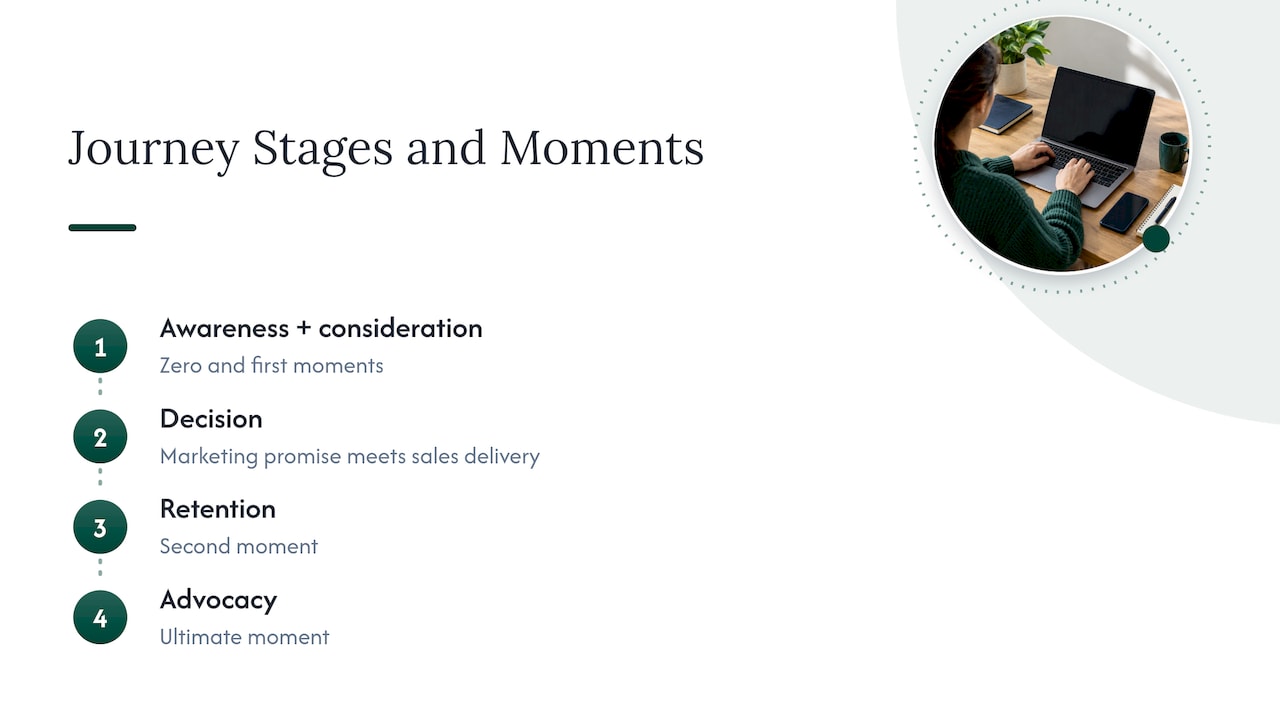
The usual journey runs through awareness, consideration, decision, retention and advocacy. Moments of truth do not replace those stages. They sit inside them, and each stage tends to have one or two. Awareness and consideration hold the zero and first moments. Decision holds the handoff between marketing’s promise and sales’ delivery. Retention holds the second moment. Advocacy is the ultimate one.
The practical difference: a stage tells you where the customer is. A moment of truth tells you where the outcome is decided.
Moments of truth in B2B
The examples most articles use come from consumer goods: a shelf, a package, a phone in your hand. If you sell consulting, software or any high-consideration service, the same logic applies with three differences.
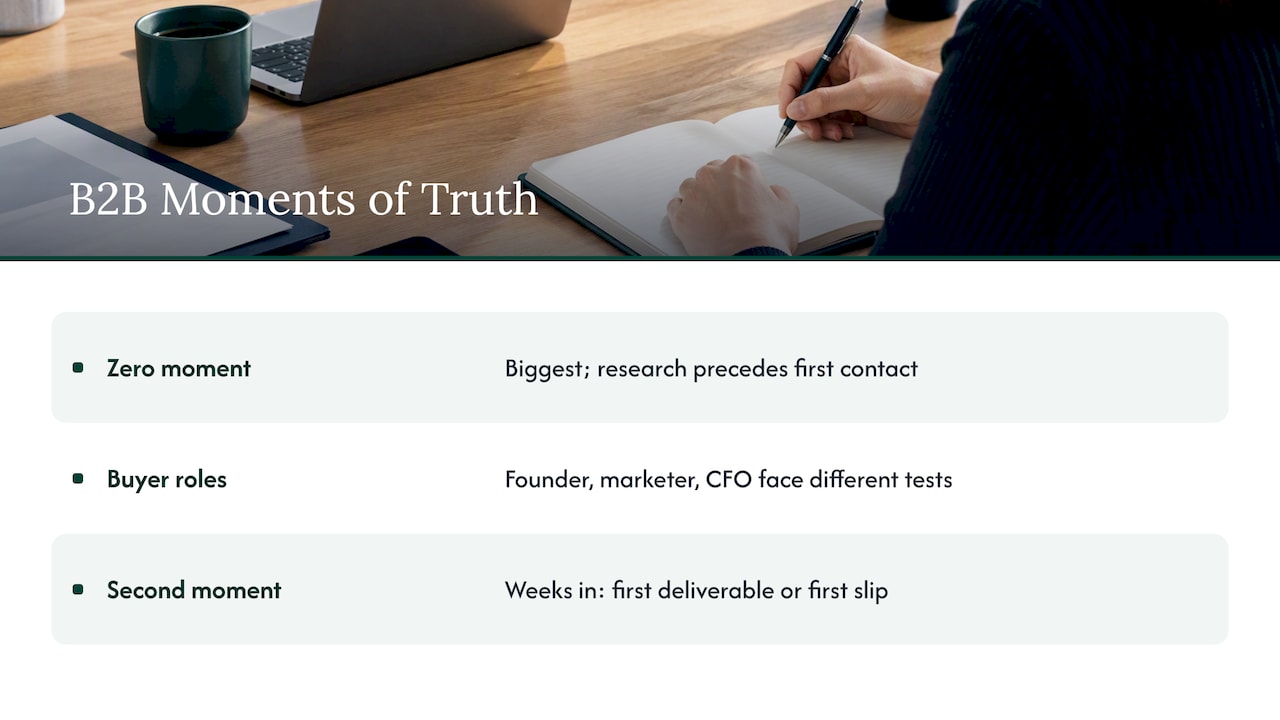
The zero moment is the biggest one. By the time a buyer talks to you, they have read your site, looked at your leadership, checked how you describe yourself against two or three alternatives, and probably asked someone they trust. If your positioning is vague, they compare you on price because nothing else is clear. That is a zero moment lost before you knew it existed.
There are several buyers. A founder, a head of marketing and a CFO each have a first moment, and they are not the same. The founder cares whether you understand the business. The marketer cares whether your work will survive contact with their team. The finance lead cares whether the spend ties to results. A single pitch has to pass all three tests.
The second moment is slow. In B2B the product is often a project or a relationship, so the second moment arrives weeks in, at the first deliverable or the first time something slips. How you handle the first miss tells the customer more than ten smooth meetings.
Examples of moments of truth you can recognize
The pages ranking for this topic list moments such as the first login, the first milestone and the first time something goes wrong. Here are concrete versions across business types, written as situations rather than universal rules.
- Software. A new admin signs up and has to invite their team. If the invite flow breaks, the second moment is lost in the first ten minutes.
- Professional services. The kickoff call. The client is checking whether the person who sold the work is the person doing it, and whether the plan matches what was promised.
- Ecommerce. The unboxing, and the first return. Many shoppers decide whether to buy again based on how painless the return was, not the product.
- Sales handoff. The moment a prospect is told something in a demo that the onboarding team has never heard of. This one is invisible on most maps and expensive.
- Support. The first time something goes wrong. TechTarget notes that a moment of truth can turn a positive experience into a negative one, and the reverse, which is why a well-handled failure can build more trust than a flawless run.
How to map your moments of truth
Mapping is where most teams either overspend or stall. Federal CX guidance is helpful here: journey maps are visual summaries of human stories, not statistically significant data sets. That should shape how you build one.
- Define the customer. Start with one segment, not everyone. If you cannot say who your best customer is, build an ideal customer profile first, because a map of a blurry customer is a blurry map.
- Talk to real customers. Interview eight to twelve people, including some who left. Ask them to walk you through how they found you, what almost stopped them, and the moment they decided. Qualitative research comes first; the federal human-centered design guidance recommends validating those stories with quantitative data afterward.
- List the touchpoints. Write every interaction from research to renewal, including the ones you do not own: review sites, peer conversations, a partner’s referral email.
- Mark the emotional peaks and valleys. Where did customers use words like relieved, worried, confused or surprised? Those are your candidates. A GSA guide describes a journey map as a visual tool to help you understand the customer’s experience and make better decisions, and emotion is the layer that turns a process diagram into a useful one.
- Check the data. For each candidate, look for a number that confirms it: drop-off in a funnel step, support ticket volume, time to first value, churn after month two. Keep what the data supports.
- Rank by impact and fixability. You will find more problems than you can fix. Pick the two or three where a customer’s decision is most affected and where you can act within a quarter.
- Assign an owner and a change. If the map does not lead to a design change, it is a superficial artifact rather than a strategic tool. Every moment on your short list gets one named owner and one specific change.
Avoid analysis paralysis
The same federal guidance warns about organizations stuck in endless research. Set a time box. Three weeks from first interview to ranked list is realistic for a company with a focused customer segment. You can refine later, and you should, because the map is a living document. Re-run it when you launch a new offer, change pricing or enter a new segment.
Why moments of truth fail: drift
When a moment of truth goes wrong, the cause is rarely the interaction itself. It is usually a gap between what was promised upstream and what is delivered downstream.
Three common patterns:
- Marketing overpromises. The website says white-glove, the onboarding is a self-serve video library.
- Sales improvises. To close, reps stretch the positioning. The customer’s first moment feels great and their second feels like a bait and switch.
- Product and brand diverge. The brand talks about simplicity while the product requires a configuration project.
This is a brand problem as much as a CX problem. If your team has never agreed on what you stand for, each department fills in the blanks differently. Strong positioning examples and a clear view of how competitors present themselves give everyone the same reference point before you start fixing individual touchpoints. And because employees deliver most of these moments, a brand rollout plan that starts with your own people matters as much as any customer-facing change.
Where AI fits
AI changes the economics of spotting and serving moments of truth. Analytics can surface patterns in support tickets, call transcripts and product usage that interviews would never reach, and one 2025 paper argues that AI-enabled touchpoints now account for a large share of advocacy outcomes by enabling personalized, proactive engagement at scale. Read that as a direction, not a guarantee: results depend on your data and your customers.
The useful shift is from reactive to predictive. Instead of waiting for the angry email, you notice that accounts with no logins after day ten tend to churn and you reach out on day eleven. For service businesses, the same thinking applies to capturing client details in the field and responding faster; this look at agentic AI in field service work shows how automation can cut repeat visits and paperwork, which is a second-moment improvement for the customer.
A caution: automation can erase the human moment that makes a customer feel seen. Automate the routine, and keep a person on the moments where the emotional stakes are highest, such as a first failure or a renewal conversation.
Our perspective
We see moments of truth as the place where brand strategy stops being a slide and becomes a business result. Most companies treat journey mapping as a one-time project and a deliverable for a shared drive. We have seen the opposite work: a short, living list of the moments that matter, each tied to a metric and an owner, reviewed the way a team reviews pipeline.
Our view, shaped by building brands across more than 200 international retail locations and by operating experience, is that a moment of truth is almost never lost in the moment itself. It is lost earlier, when positioning, product and sales were allowed to drift apart. A customer who hears one story from marketing, another from a rep and a third from onboarding does not file it as a communications problem. They file it as a trust problem.
So we start with alignment. What do we promise, to whom, and can every function deliver it? Only then do we map the moments and choose where to invest. That sequence, brand strategy connected to measurable performance, is what separates a brand that earns advantage from one that only looks polished. For founders, the same logic applies earlier: treat brand as a growth metric from the start, and the moments of truth become easier to design rather than repair.
— Quincy
Putting it into a 90-day plan
If you want a simple sequence, this one works for most teams:
- Weeks 1 to 3: Pick the segment, interview customers, draft the map, and shortlist five to eight candidate moments.
- Weeks 4 to 6: Validate with data, rank, and pick two or three. Align marketing, sales and product on what you promise at each.
- Weeks 7 to 12: Ship the changes, measure the before and after, and brief every customer-facing team. If you are launching or relaunching, a 90-day go-to-market framework can anchor this work in a broader plan.
Choose one metric per moment. For the zero moment, that might be the share of demo requests that cite a specific piece of content. For the second moment, time to first value. For the ultimate moment, referral rate or renewal rate. Without a number, you cannot tell whether the fix worked.
Working with us on this
If you want an outside operator to help find your moments of truth and connect them to positioning, go-to-market and customer experience, that is what our brand strategy, positioning, growth and customer experience work is built for. We run it as a structured engagement or an advisory relationship, depending on how much your team wants to own. If you are planning an offsite or a leadership event on this topic, we also do keynotes and workshops.
FAQ
What is a moment of truth in the customer journey?
It is an interaction where a customer forms or changes their impression of your brand, product or service. These moments are brief and emotionally charged, and they carry more weight than routine touchpoints. Most journeys contain only a few.
What are the four moments of truth?
The zero moment is online research before any contact. The first is the initial encounter with the product or service. The second is using it and comparing it to the promise. The ultimate moment is the feedback and advocacy that follow, which feeds other buyers’ zero moments.
How is the zero moment of truth different in B2B?
The research is deeper and spread across several people. A buying committee may read your site, ask peers and compare alternatives before you hear from anyone. Clear positioning, proof and consistent messaging matter most here, because you are rarely present while the decision forms.
How many moments of truth should I map?
Start with two or three that you can fix within a quarter. A long list produces a report and no change. Once those are improved and measured, return to the map and take the next ones.
Sources
- Moment of truth (marketing), Wikipedia
- What are the Five Moments of Truth in Marketing?, Liferay
- Customer Journey Stages: The Complete Guide, Qualtrics
- Customer Journey Analytics, Wiley
- How to find the customer journey moments of truth, TechTarget
- Human-Centered Design, Performance.gov
- What Is a Customer Journey Map?, GSA
- AI-driven customer journey analytics, TPMAP