JTBD Positioning: Turn Customer Jobs Into a Clear Market Position

JTBD positioning means defining your market position around the job customers hire you to do, not around your features or a demographic profile. You find the job, learn what progress looks like to the buyer, and name the alternatives they would otherwise hire. Then you build your claim, messaging and sales story on that. It also answers the common question about JTBD in marketing: the same research that sharpens your position gives you the language for your homepage, your pitch and your launch.
This guide shows how to do it in order, with a worked example, a job statement template and the mistakes that make teams drop the approach too early.
TL;DR
- A job is the progress a person or organization is trying to make in a specific circumstance. They “hire” a product or service when that job arises.
- JTBD positioning starts from the job, the trigger and the success criteria. It does not start from your feature list or a persona sketch.
- Your real competitive set is whatever else gets the job done, including spreadsheets, hires and doing nothing.
- Test the position with buyers, then align product, marketing and sales around one job-based story.
- Use the research to rewrite messaging. Treat any lift as a result to measure, not a promise.
Table of Contents
- What JTBD means, in plain terms
- Why JTBD sharpens positioning
- How to find the job customers hire you for
- A worked example: the milkshake
- JTBD in marketing: messaging that matches the job
- Connecting the position to go-to-market
- Common mistakes in JTBD positioning
- Our perspective
- Work with us on your position
- FAQ
- Sources
What JTBD means, in plain terms
The Christensen Institute describes Jobs to Be Done as a lens on the circumstances and forces that push people and organizations toward and away from decisions. It surfaces functional, social and emotional dimensions of a choice. A job is the progress someone is trying to make toward a goal within particular circumstances, and they hire a product or service when that job shows up.
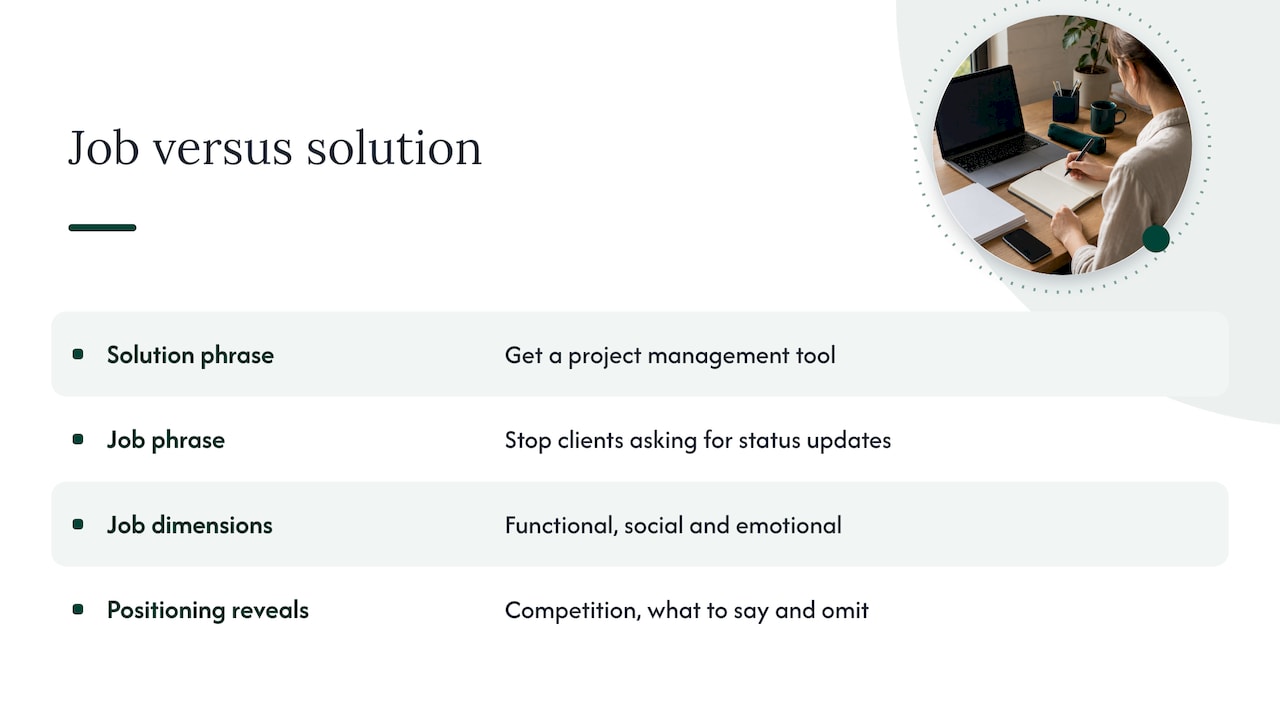
That last phrase matters for positioning. A job is not a task and not a product category. “Get a project management tool” is a solution. “Stop clients from asking me for status updates three times a week” is closer to a job. The second version tells you who the competition is, what to say and what to leave out.
The idea is not new, but it keeps resurfacing because most positioning still starts in the wrong place. Christensen and his colleagues wrote in MIT Sloan Management Review that most companies segment by customer demographics or product characteristics and differentiate by adding features. The customer sees it differently: they have a job to be done and want to hire the best option to do it.
Why JTBD sharpens positioning
Positioning is a choice about who you are for, what you do better than the alternatives, and why that matters. Most weak positions fail on the second and third parts. They describe the product (“an all-in-one platform”) but not the situation that makes someone buy.
JTBD fixes that in three ways:
- It gives you a reason that holds across segments. The job stays stable even when buyer titles, company sizes and industries change.
- It widens the view of competition. Buyers compare you to every way of making the job happen, not just to look-alike vendors.
- It gives you words buyers already use. Interviews about a recent decision produce the phrases that belong in your headline.
The stakes are real. In an HBS Online piece, Clayton Christensen is quoted saying that 75 to 85 percent of new products fail financially because they do not target a job people are trying to get done. Treat that as a reason to validate the job before you invest, not as a forecast for your company.
JTBD vs. personas and demographics
Teams often ask whether JTBD replaces personas. It does not. The Nielsen Norman Group compares the two and notes that good personas go beyond demographics to include goals, behaviors, attitudes and context, and that the two can be used together.
A simple division of labor works well:
| Question | JTBD answers it | Persona answers it |
|---|---|---|
| What progress is the buyer trying to make? | Yes, it is the core | Partly |
| What triggered the search? | Yes | Sometimes |
| What do we say, and in what tone? | Informs the claim | Shapes tone and channel |
| Who inside the account decides? | Not its purpose | Yes |
| How long does the insight last? | Typically years | Changes as the segment changes |
SurveyMonkey’s JTBD overview draws a similar line: JTBD for strategy, roadmap and positioning, personas for tone, messaging and sales enablement. If you already have an ICP, our ideal customer profile framework shows how to connect it to the job so reps act on it.
How to find the job customers hire you for
The method is simple. It takes discipline to run well.
Step 1: Interview recent buyers about a moment of change
Talk to people who bought, switched or declined in the last few months. Salesforce’s Trailhead module on discovering customer jobs recommends in-depth interviews that cover both functional and social or emotional goals, using how and why questions rather than yes/no or rating questions.
Start with the trigger. What happened that made the old way stop working? Then walk through:
- What they tried first, including non-products like a spreadsheet or an internal hire
- What they worried about before choosing
- What they expected to be different afterward
- Who else weighed in
If you want a deeper guide to interview design and sample sizes for B2B, our piece on B2B customer research methods covers it. Any research that records what buyers said in their own words also gives you a record to go back to. A tool that turns client conversations into structured records can help you keep decisions and open questions traceable to the original call.
Step 2: Write the job in a form you can test
Three formats are in common use, and the choice depends on what you need:
- Job statement: a verb plus the object plus context. “Help a founder explain what the company does so a buyer repeats it correctly.”
- Job story: “When [situation], I want to [motivation], so I can [outcome].”
- Desired outcome statements: measurable success criteria, such as minimizing the time it takes to get a buyer to understand the offer.
For positioning, the job story is usually the fastest to use. For prioritization, outcome statements are stronger. A JTBD overview from Tempo describes building a job map, deriving solution-independent outcome statements from it, and then surveying users on how important each outcome is and how satisfied they are today. Underserved outcomes are where a position can win.
Step 3: Capture trigger, alternatives and success criteria
UserCall’s practical JTBD frame organizes this around the desired progress (functional, emotional and social), the trigger that created demand, and success criteria such as hiring criteria and success signals. Those map directly to a position:
| JTBD element | What it becomes in your positioning |
|---|---|
| Trigger | Who you target and when you show up |
| Desired progress | The core promise |
| Alternatives | Your competitive frame of reference |
| Anxieties | Objections your messaging and sales must answer |
| Success criteria | The proof points you lead with |
Step 4: Turn the findings into a position
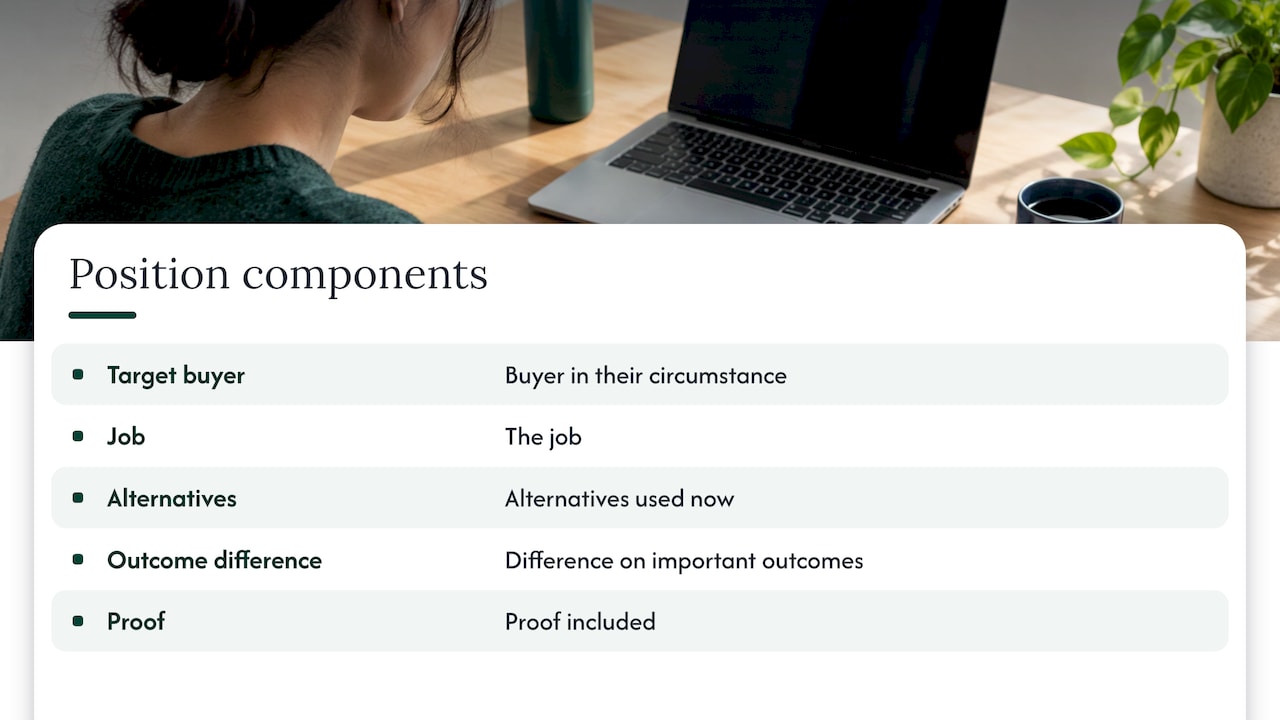
A position built on a job has five parts: the target buyer in their circumstance, the job, the alternatives they use now, the difference you deliver on the outcomes that matter, and the proof. Write it in one paragraph. If a sales rep cannot say it aloud in 15 seconds, it is not finished.
We lay out a way to pressure-test the draft in our guide to positioning frameworks and the 60 to 90 minute workshop. A positioning audit is a good first move when you already have messaging out in the market and want to see where it drifts from the job.
A worked example: the milkshake
The best-known JTBD case is the fast-food milkshake. According to a summary of JTBD examples, research into why people bought milkshakes in the morning revealed a commuter job, and showed that competitors included things like bananas and bagels rather than other milkshakes.
The positioning lesson is the one that applies to B2B:
- The product was not being compared with its category. It was being compared with whatever else could make a boring commute better.
- Improving the product against the wrong competitors (more flavor, lower price) would have missed the job.
- The position changed the offer: thicker, longer-lasting and easier to drink in a car.
Now translate it to a B2B setting. A software company thinks it competes with other tools. Interviews reveal that the real alternative is an ops manager building a spreadsheet and chasing people on Slack. The job is “get everyone to follow the same process without me policing it.” The position shifts from “workflow platform” to “process that runs without the chasing.” Same product, different frame, different proof points.
That example is illustrative, not a client case. The structure is what you should copy.
JTBD in marketing: messaging that matches the job
Once the position is set, JTBD does its second job: it writes your messaging. Claire Suellentrop’s talk at Business of Software reports on a personal finance software homepage whose generic header was rewritten based on customer survey results. She says conversion from homepage to pricing page rose 200 percent. That is one reported case, so measure your own change rather than expecting the same number.
Use the research this way:
- Headlines: state the progress, not the product. Use the buyer’s own words from interviews.
- Sales conversations: open with the trigger. “What changed that made this a priority now?” is a better first question than a feature demo.
- Content: build pages around the situations that trigger the search, plus the alternatives buyers considered.
- Proof: lead with the success criteria buyers named, such as speed to clarity or fewer handoffs.
Personas still earn their place here for tone and channel choice, as the comparison above shows.
Connecting the position to go-to-market
A job-based position only works if product, marketing and sales all tell the same story. Cisco’s blog on JTBD in go-to-market argues that personas answer “who” and use cases answer “what” and “how,” while JTBD gets at “why,” and that recognizing the jobs your product is hired for informs the whole go-to-market approach.
In practice that means:
- Product prioritizes the outcomes buyers rate as important and underserved.
- Marketing builds campaigns around the trigger and the job.
- Sales qualifies on whether the job is present, not just on firmographics.
- Customer success measures whether the progress happened.
The handoffs are where it usually breaks. Our guide to marketing and sales alignment with an SLA covers how to make the shared definition stick. For the pipeline mechanics that follow a clear position, this practical guide to sales pipeline automation covers lead management for service businesses. Before launch, use go-to-market research to check the job exists in the segment you are entering.
In larger accounts, the job often differs by role. A buying committee has several people with different jobs, so see how corporate positioning wins the buying committee.
Common mistakes in JTBD positioning
- Writing a job that is really a feature. “Use dashboards” is a solution. Ask what progress the dashboard enables.
- Making the job too broad. “Grow my business” excludes nothing. A good job statement rules out products that do not do it.
- Interviewing only happy customers. Include people who chose another path or did nothing. They show you the real alternatives.
- Asking what buyers want. Ask what they did, when and why. Feature wishlists are not jobs.
- Stopping at the research. A job map that never reaches the homepage, the sales deck and the roadmap is a slide, not a position.
- Treating it as a one-time exercise. Revisit when a new trigger, competitor type or segment appears.
If you want to see how the finished position can look in a visual form, our positioning map examples and brand positioning examples show how teams present the choice.
Our perspective
We treat brand as a core business strategy, not a layer of messaging on top of the product. That is why we like JTBD as a starting point for positioning: it forces the conversation back to why a customer shows up at all.
Most of the drift we see comes from teams describing themselves in the language of their own org chart. Product talks about features, marketing talks about audiences, and sales talks about whatever closes. A shared job gives all three one thing to point to.
Our approach is built from an operator’s seat, informed by real brand building and exit experience. We connect positioning to customer experience and to measurable performance, and we iterate on it with the team rather than hand over a deck. A position is only good if sales can sell it and customers recognize themselves in it.
If you take one thing from this article, take this: interview ten recent buyers about the moment they decided, and write the position from what they say.
Quincy
Work with us on your position
If your team has the interviews but not the alignment, or the messaging but not the proof, that is the gap we work on. Our brand strategy, brand positioning and growth and go-to-market work is built to connect positioning with measurable business outcomes across product, marketing and sales.
See how we work on brand strategy and positioning or review our brand strategy frameworks. For more on this topic, browse the journal.
FAQ
What is JTBD positioning in one sentence?
It is a way of positioning your offer around the progress a customer is trying to make in a specific circumstance, rather than around your features or a demographic. You identify the job, the alternatives, and the outcomes that matter, then build your claim and proof on those.
How is JTBD used in marketing?
Marketers use it to find the trigger and desired progress behind a purchase, then write headlines, sales questions and content around them. It informs what you say, while personas and channel research inform how and where you say it.
How many interviews do I need?
There is no fixed number. Start with a handful of recent buyers and keep going until the triggers and alternatives repeat. Include people who chose a different option or did nothing, because they reveal the true competitive set.
Does JTBD replace personas or an ICP?
No. The job explains why people buy, and the persona or ICP explains who to reach and how to speak to them. Used together, they keep messaging specific and keep targeting practical.
Sources
- Jobs to Be Done Theory, Christensen Institute
- Finding the Right Job For Your Product, MIT Sloan Management Review
- The Jobs to Be Done Framework and Real-World Examples, HBS Online
- Personas vs. Jobs-to-Be-Done, Nielsen Norman Group
- Jobs to Be Done: The JTBD Framework and How to Apply It, SurveyMonkey
- Understanding User Jobs and Needs, Salesforce Trailhead
- Product innovation strategy using Jobs-To-Be-Done, Tempo
- Jobs to Be Done Framework: A Practical Guide, UserCall
- Jobs to Be Done Examples
- Claire Suellentrop: Getting Out of the Echo Chamber, Business of Software
- Accelerate GTM Transformation Using the Jobs to be Done Framework, Cisco Blogs
- Client Feedback Tracking for Design Teams
- Sales Pipeline Automation for Service Businesses