
Product Marketing vs Brand Marketing: How They Differ
Product marketing makes a specific product succeed: who it is for, how it is positioned, how it launches and how it gets adopted. Brand marketing builds the company behind the product: what it stands for, how well it is known and why buyers prefer it. One works at the level of the offering. The other works at the level of the whole business. Growth stalls when a company treats them as the same job, or as rivals.
This guide separates the two, shows who owns what, clears up the neighboring terms that confuse teams (positioning, messaging, value proposition, brand strategy, marketing strategy) and ends with a practical way to align them.
TL;DR
- Product marketing is offering-level: segments, competitors, positioning, messaging, launches, sales enablement and adoption for one product or product family.
- Brand marketing is company-level: identity, awareness, emotional connection, reputation and long-term equity.
- Positioning says why you are different from alternatives. Messaging says how you will deliver on that. A value proposition is the promise of benefits.
- Brand strategy sets the foundation and marketing strategy turns it into plans. Product marketing then carries both to market.
- Misalignment shows up as contradictory content, confused sales reps and launches that sound like a different company. Shared goals and clear decision rights fix it.
Table of Contents
- The core difference in one view
- What product marketing actually does
- What brand marketing actually does
- Where the confusion starts: five neighboring terms
- How the two work together
- What goes wrong when they drift apart
- A practical way to align the two
- Which one do you need first?
- Perspective: brand is a business strategy, not a marketing department
- Where we can help
- FAQ
- Sources
The core difference in one view
The cleanest way to hold the distinction: product marketing answers “why should this buyer choose this product?” Brand marketing answers “why should anyone choose this company, and remember it when they are ready to buy?”
Forbes frames it this way: product marketing concentrates on the features and benefits of specific offerings, while brand marketing seeks to influence how customers and stakeholders perceive the company as a whole. Qualtrics puts brand marketing in terms of higher-level ideas such as values, image, purpose and ethics, and product marketing in terms of building awareness of specific customer offerings.
| Product marketing | Brand marketing | |
|---|---|---|
| Scope | One product, feature or product family | The whole company or brand |
| Core question | Why this product, for this buyer, now? | Why this company, and why remember it? |
| Main outputs | Positioning, messaging, launch plans, sales enablement, adoption programs | Identity, narrative, awareness campaigns, reputation, brand equity |
| Appeals to | Rational evaluation of benefits and fit | Emotion, familiarity, trust, preference |
| Time horizon | Launch cycles and the product lifecycle | Years, compounding |
| Closest partners | Product, sales, customer success | Executive team, creative, communications, HR |
| Typical measures | Adoption, pipeline influence, win rate, launch results | Awareness, preference, consideration, equity |
Treat the table as a tendency, not a wall. Both disciplines care about the customer, and the best teams borrow from each other constantly.
What product marketing actually does
Product marketing sits between the people who build the product, the people who sell it and the buyers who need it. Product Marketing Alliance describes it as bringing a product or feature to market and translating between the teams that build and service the product.
In practice, CXL’s guide lists the typical scope: research on target segments, competitor analysis, product value propositions, messaging, go-to-market strategy, launches, sales enablement and post-launch adoption. Coursera adds collaboration with product teams and iteration after launch based on customer insight.
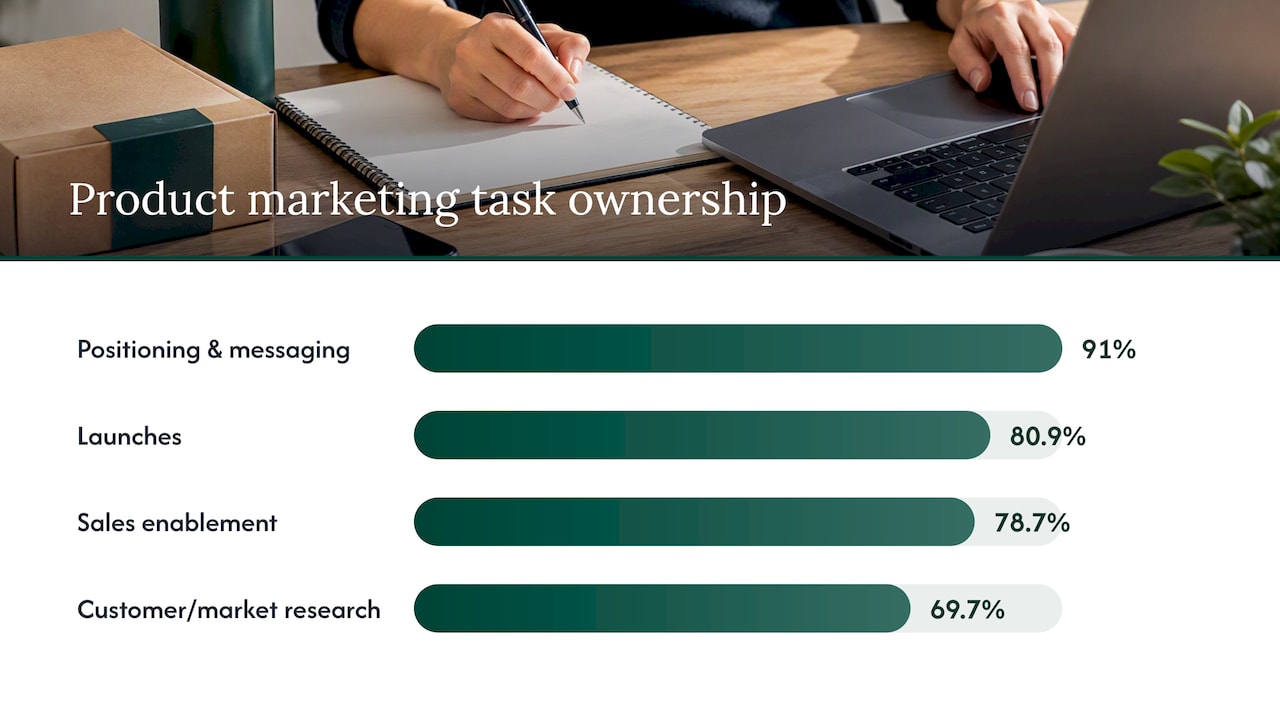
How common are these tasks? In figures from a Product Marketing Alliance survey, as reported by Ampere, 91% of surveyed product marketers own positioning and messaging, 80.9% own launches, 78.7% own sales enablement and 69.7% own customer and market research. Positioning and messaging sit at the center of the job.
A few concrete examples of product marketing work:
- Interviewing recent buyers to learn which problem they hired the product to solve, then rewriting the product page around it.
- Building a battlecard so sales reps can answer “how are you different from the other option we are evaluating?” in two sentences.
- Planning a launch: audience, timing, channels, internal readiness and the first 30 days of follow-up.
- Reviewing adoption data after launch and adjusting onboarding messages for the features people ignore.
Notice that none of this requires the company to be famous. A lesser-known company with excellent product marketing can win a deal. What it cannot easily do is win the deals that never reach a shortlist.
What brand marketing actually does
Brand marketing works on the meaning of the company in the buyer’s mind. Product Marketing Alliance characterizes it as communicating why an organization exists and creating a meaningful emotional connection. CXL describes the focus as identity, recognition, awareness, equity and consumer perceptions, with the goal of making the brand the first and most obvious choice.
The American Marketing Association says brand marketing typically drives awareness and builds brand equity, while demand marketing aims to get audiences to take immediate action or convert. That is a useful way to see where brand sits: it widens and warms the pool of buyers who will respond when someone asks them to act.
Brand work also protects what it builds. A company’s reputation is an asset that can be damaged faster than it was made, and leaders who think ahead treat reputation risk mitigation as part of looking after the brand, not as a separate emergency function.
Typical brand marketing work includes:
- Defining the brand’s purpose, personality and visual and verbal identity.
- Running campaigns that make the company easy to recall in buying situations. We go deeper on that in our piece on mental availability.
- Deciding when a company has outgrown its identity, which we cover in rebrand vs. brand refresh.
- Making sure employees understand and live the brand before customers see it. Our brand rollout plan starts there.
Where the confusion starts: five neighboring terms
Most searches around this topic are really about the vocabulary. Here is how the pieces fit.
Positioning vs messaging
Positioning is the decision. Messaging is the delivery. Product Marketing Alliance’s positioning guide says positioning outlines why a product is unique compared with the alternatives in the market, and messaging tells target segments how it will deliver on the promises made in that positioning.
A practical test: positioning can be stated once, internally, in plain language that nobody would ever print on a billboard. Messaging is what you then say differently to a CFO, a developer and a first-time founder. If your messaging changes by audience but your positioning changes by quarter, you have a positioning problem.
Positioning vs value proposition
The same guide distinguishes the two this way: positioning explains why a product is unique relative to alternatives, while a value proposition promises customers the benefits the offering will bring. The American Marketing Association describes a value proposition as the brand’s promise about why customers should choose it, and positioning as communicating that value in a way that resonates.
So a value proposition looks at the customer’s gain. Positioning looks at the competitive frame: against what, and for whom, are you the better choice? You need both. A strong benefit promise with no competitive frame sounds like everyone else. A sharp frame with no benefit gives buyers nothing to act on. For examples, see our brand positioning examples and the workshop format that goes with them.
Brand strategy vs marketing strategy
The AMA’s guide defines marketing strategy as a long-term blueprint for creating and delivering customer value, including the value proposition, goals and market positioning. It also defines strategic marketing as aligning marketing activity with business goals to create lasting competitive advantage rather than chasing short-term promotions.
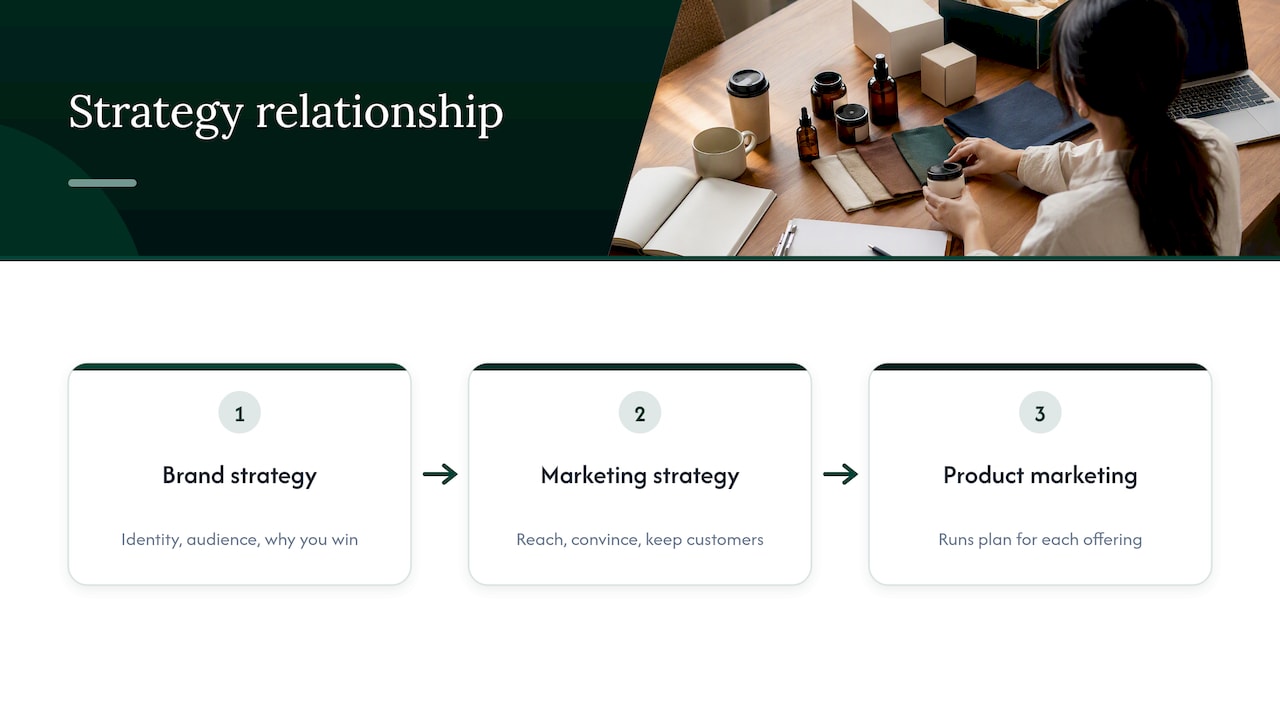
Our working view: brand strategy decides who you are, who you are for and why you win. Marketing strategy decides how you reach, convince and keep those customers. Brand strategy is the input and marketing strategy is the plan built on it. Product marketing then runs the plan at the level of each offering. If you skip the first step, the second becomes a list of tactics.
Brand marketing vs demand marketing
Some teams use “demand” for the work product marketing and performance channels do. The AMA’s view is that brand and demand work should be integrated around shared objectives, customer journeys, experimentation and unified measurement, not treated as competing silos. That advice applies equally to brand and product marketing.
Brand architecture
If you sell several products, the relationship between company brand and product names matters. The AMA’s analysis of brand architecture says a coherent architecture organizes brands, products, benefits and consumer targets so that communications and offerings occupy differentiated, understandable spaces. That is the structural bridge between the two disciplines.
How the two work together
The disciplines are complementary. Forbes contributor Jessica Wong notes that product marketing has a narrower focus but extends into ongoing sales after launch, while brand marketing shapes perception of the entire company.
Product Marketing Alliance’s view is that brand strategy provides the foundation for product positioning, customer experience and differentiation, and product marketing turns that foundation into market-facing launches and adoption. CXL makes the reverse point: product marketing informs strategic positioning and value propositions, and brand marketing uses those insights to build customer relationships.
The flow runs both ways:
- Brand to product: the brand supplies the promise, tone and credibility. A buyer who already trusts you needs fewer proof points in a launch.
- Product to brand: every product experience either proves the brand promise or breaks it. Launch messaging that overpromises damages the brand, whatever the campaign deck says.
- Customer insight, shared: product marketers hear buyers’ real words in interviews and sales calls. Brand teams should be using those words.
Launches
A launch is where the two meet in public. The product team wants feature clarity and a clean call to action. The brand team wants the launch to sound like the company. A good launch brief states the single product claim, the brand idea it supports and who signs off on each.
Customer experience
Buyers do not experience departments. They experience a website, a sales call, an onboarding email and a support reply, and judge the company on the sum. Mapping those moments, especially the one where trust is won or lost, is shared work. We explain how to find yours in moment of truth in the customer journey.
What goes wrong when they drift apart
The Content Marketing Institute calls this the split personality problem: brand and product marketing producing contradictory content. Its recommended fixes are to integrate goals and incentives, define responsibility and authority, and communicate early and often.
In our experience the symptoms are easy to spot:
- The homepage describes one company and the sales deck describes another.
- Sales reps rewrite messaging because the official version “doesn’t sound like how customers talk.”
- Each product launch uses a new tagline, so the brand never accumulates meaning.
- Brand budget is judged on clicks and product budget on awareness, so neither team wins by cooperating.
- Nobody can say who has the final word when a launch headline conflicts with the brand voice.
The Content Marketing Institute’s argument that shared accountability, explicit decision rights and frequent communication are organizational prerequisites is worth taking literally. Most alignment failures are org design failures, not creative ones.
A practical way to align the two
Here is a sequence that works for startups and mid-sized teams alike.
1. Write one positioning statement and lock it
Define the target customer, the competitive frame, the key differentiator and the proof. Product marketing usually drafts it from buyer research. Brand and leadership pressure-test it. Then it becomes the reference for everything.
2. Separate what is fixed from what flexes
Fixed: positioning, brand voice, core narrative. Flexible: product-level messaging, audience-specific proof points, channel tactics. Write both lists down. Disputes get shorter when everyone knows which list a question belongs to.
3. Name decision rights
For each asset type (homepage, launch announcement, sales deck, pricing page), state who owns it, who must be consulted and who approves. A one-page table is enough.
4. Share goals and a scorecard
Give both teams at least one common metric, such as pipeline from target accounts, win rate or branded search demand, alongside their own. This follows the AMA’s call for unified measurement.
5. Put customer language in the middle
Use the same buyer research for brand campaigns and product messaging. If you need a structured way to define who you are targeting, our ideal customer profile framework moves from data to actions reps can take. A competitive brand analysis shows where your frame is crowded and where it is open.
6. Document it in a playbook
A brand playbook that product marketers actually open beats a beautiful PDF nobody reads. See what the best ones include in brand playbook examples.
Which one do you need first?
It depends on where the constraint is.
- Buyers don’t know you, or confuse you with others: start with brand. Clarify positioning at company level and build recall. Our guide to startup brand strategy treats brand as a growth metric from day one.
- Buyers know you but don’t understand the product, or reps struggle to win: start with product marketing. Fix segmentation, messaging and enablement.
- A new product is about to launch: do product marketing first, but check it against the brand promise before anything ships. The decisions behind a launch (who to target, what to claim, where to sell) are go-to-market choices. Teams entering a demanding new market face the same questions, as in this piece on selling cybersecurity to US enterprises, and our go-to-market framework for founders shows how to put brand to work in 90 days.
Small companies often have one person doing both jobs. That is fine. The risk is not the headcount but unclear thinking: writing a launch email without knowing whether it is meant to build the brand or move a product.
Perspective: brand is a business strategy, not a marketing department
We see the product versus brand debate as a symptom. When companies argue over which team owns what, the underlying problem is usually that the business has not decided what it is for, whom it serves and why it wins. Until that is settled, product marketing sharpens a claim nobody has agreed on, and brand marketing builds awareness of an idea the product doesn’t deliver.
Our approach comes from operating, not just advising: real brand building and exit experience, and work across more than 200 international retail locations. That experience taught us that brand has to connect to measurable performance. If positioning doesn’t change how product, marketing and sales behave, it is decoration.
So we start with clarity and alignment. One positioning decision. One customer promise. Then product, marketing and sales each carry it in their own language, and you measure whether buyers respond. Brand and product marketing stop competing for credit because both are accountable to the same business outcome.
— Quincy
Where we can help
If your brand and product messages pull in different directions, we work with founders, executive teams and marketing teams on brand strategy, positioning, and growth and go-to-market strategy, tying them to measurable performance. You can see the full range of services on our main site, or look at speaking engagements for leadership events and team sessions.
FAQ
Is product marketing part of brand marketing?
No, though they overlap. Product marketing is scoped to a specific product or product family and its launch, adoption and sales support. Brand marketing is scoped to the company and how it is perceived. Most organizations run them as separate functions that share positioning, customer insight and goals.
Which should a startup invest in first?
A startup needs a clear positioning decision before either. After that, early-stage teams usually lean on product marketing because it supports the first sales, then add brand investment as the market widens. The point is not to postpone brand but to keep it simple: a clear promise, a consistent voice and a message the founders and the first reps all repeat.
What is the difference between a value proposition and positioning?
A value proposition promises the benefits a customer will get. Positioning explains why your offering is unique compared with the alternatives. The first is about customer gain and the second about competitive context. Strong companies write both and keep them consistent.
How do brand strategy and marketing strategy differ?
Brand strategy defines who you are, who you serve and why you win. Marketing strategy is the long-term plan for creating and delivering customer value, including the value proposition, goals and market positioning. Brand strategy informs the plan, and the plan guides tactics such as campaigns and product launches.
Who should own messaging?
Product marketing typically drafts messaging because it is closest to the buyer and the product. Brand marketing reviews it for voice and consistency with the positioning. Name a final approver in advance so launches don’t stall.
Sources
- Brand Marketing vs. Product Marketing (CXL)
- Branding Versus Product Marketing, And How To Sync The Two (Forbes)
- Brand Marketing: Definition, Examples & Strategy (Qualtrics)
- The interconnectedness of brand and product marketing (Product Marketing Alliance)
- What is product marketing? (Ampere)
- What Is Product Marketing? (Coursera)
- What is positioning? (Product Marketing Alliance)
- What is Strategic Marketing? (American Marketing Association)
- Develop a Winning Marketing Strategy (American Marketing Association)
- Brand and Demand Marketing (American Marketing Association)
- The Science and Magic of Brand Architecture (American Marketing Association)
- Brand and Product Marketing: How to Solve the Split Personality Problem (Content Marketing Institute)