SaaS Go-to-Market: How to Build a Plan That Wins Buyers

A SaaS go-to-market (GTM) plan is the finite, product-specific plan for how one product reaches one defined set of buyers, wins them and keeps them. It works when positioning, product, marketing and sales all say and do the same thing. Most plans fail at that alignment, not at the channel list. Pick a sharp customer, state a position that customer can repeat, choose one primary motion, and measure retention, not just signups.
This guide is for founders, marketing leaders and executives who need to bring a SaaS product to market, or reset a launch that stalled. It covers the parts that decide the outcome and leaves out the templates.
TL;DR
- A GTM strategy is time-bound and tied to one product and segment. A marketing strategy is ongoing and covers the whole business.
- Start with an ideal customer profile (ICP) and a position that sets you apart from the alternatives your buyer is already comparing.
- Choose one primary motion (sales-led, product-led or hybrid) based on deal size and how the buyer evaluates, then add others only when the first works.
- Run the first 90 days with named owners, shared messaging across product, marketing, sales and customer success, and a review after launch.
- Judge success by activation, retention and payback, not by launch-week attention.
Table of Contents
- What a SaaS go-to-market strategy is, and what it is not
- Step 1: Define the customer you will win first
- Step 2: Make the position clear enough to repeat
- Step 3: Choose a primary motion
- Step 4: Align product, marketing, sales and customer success
- Step 5: Run the first 90 days
- Measure what the business actually needs
- Where SaaS go-to-market plans go wrong
- Our perspective
- Where we come in
- FAQ
- Sources
What a SaaS go-to-market strategy is, and what it is not
A go-to-market strategy answers who will buy, why, how you reach them and how you sell to them. One guide to SaaS GTM draws the line this way: a broad B2B marketing strategy is ongoing and brand-centric, while a GTM strategy is finite, product-specific and focused on reaching and winning customers in a defined segment.
That gives you two practical tests.
- Scope. If the plan covers the whole company’s demand, it is a marketing strategy. If it covers one product, or one product entering one new market, it is a GTM plan.
- Owner and end date. A GTM plan has one accountable owner, usually the founder or the product marketing lead, and a horizon of weeks to a few quarters. After that it hands off to ongoing marketing and sales.
A launch plan is smaller still. It generates first attention: the announcement, the press, the first wave of outreach. The GTM strategy is the system behind it that decides whether you find the right buyers repeatedly, convert them at a cost the business can sustain and keep them long enough for the economics to work. A great launch week on top of a weak GTM strategy produces a spike and then silence.
SaaS adds one more difference. Revenue is recurring, so the work does not end at the signature. HubSpot’s B2B SaaS marketing guide notes that marketing in SaaS has to drive recurring subscription revenue, which pushes it into activation, retention and expansion after the first sale. Your plan has to cover the customer’s first 90 days with the product, not only the path to the contract.
Step 1: Define the customer you will win first
The most common GTM mistake is a market definition so broad that nobody on your team can tell a good lead from a bad one. An ICP fixes that. It describes the kind of company, and the people inside it, that get the most value from your product and are easiest to reach.
A workable ICP covers:
- Company profile: size or revenue range, type of business, geography and industry.
- Roles: the buyer who signs, the users who live in the product and the influencers who can block the deal.
- A defined problem: one you can solve, with the specifics that make it urgent for this company.
- Context: the technologies they already use and how they typically buy.
That list follows a16z’s framework for defining and refining an ICP, which also gives the test worth borrowing: can you answer each prompt with high-fidelity detail, drawn from real customers rather than guesses? If you cannot, you have a hypothesis, and your first 90 days should be spent testing it.
Two habits keep the ICP honest. Quantify the value: how much time, money or risk does the product remove for this buyer? And rank segments by the value actually delivered, not by how many companies fit the description. A smaller segment that gets results quickly will teach you more than a large one that stalls in evaluation. For a step-by-step build from data to rep actions, see our ideal customer profile framework.
Step 2: Make the position clear enough to repeat
Buyers rarely compare you with nothing. They compare you with the incumbent, a competitor and doing nothing. Positioning is the answer to “why you, for this problem, instead of those?” and it has to be the same answer in the pitch deck, the homepage, the demo and the renewal conversation.
A position holds up when it has four parts:
- A named alternative. Who or what does the buyer use today?
- A difference that matters. What can you do that the alternative cannot, in the buyer’s words?
- Proof. A result, a customer story or a number that makes the difference believable.
- A fit statement. Which customers it is best for, which is the ICP stated plainly.
The frequent failure is drift: the founder pitches one story, the website tells another and sales improvises a third. Drift is why buyers fall back to comparing price and feature checklists. When your position is clear, the comparison happens on your terms. Our guide to brand differentiation strategy shows how to find and test the difference.
Step 3: Choose a primary motion
The motion is how customers move from stranger to paying account. The main options:
| Motion | How it works | Typically fits |
|---|---|---|
| Sales-led | Reps qualify, demo and close; the buyer talks to a person before paying | Higher contract values, multiple stakeholders, complex setup |
| Product-led | The product itself drives trial, activation and upgrade | Low-friction products a single user can try and value alone |
| Hybrid | Self-serve entry, with sales joining when accounts grow or show intent | Products that start with individuals and expand into teams |
| Partners and marketplaces | Resellers, integrations or app marketplaces bring the buyer to you | Products that sit inside another platform or workflow |
Sales-led is still the mainstream choice at scale. In the 2021 KBCM SaaS Survey, field sales was the primary GTM motion for 55% of smaller and 60% of larger SaaS respondents. It is a few years old, so treat it as evidence that direct sales stays common, not as a current market share.
How to choose:
- Look at how your buyer evaluates. If a single person can try the product and see value in a day, product-led is natural. If a committee must be convinced, you need a person in the conversation.
- Look at deal size. Sales headcount has to pay back through contract value and retention.
- Pick one primary motion first. Teams that launch three motions at once cannot tell which one is working.
The motion also has to match the position. A premium, high-trust promise delivered through a self-serve flow with no human contact creates a mismatch the buyer feels immediately.
Step 4: Align product, marketing, sales and customer success
This is the step most GTM guides compress into a line, and it is where plans break. The sales team promises what the product does not do yet. Marketing generates leads the ICP would reject. Customer success inherits accounts sold on a story it has never heard.
The fix is shared artifacts, reviewed together:
- the ICP and the position
- the core messages and proof points
- the enablement kit sales will use
- the launch date and what is genuinely ready by then
One 90-day GTM framework has sales, marketing, product and customer success review exactly these items together before launch. It is a simple habit, and it removes most of the contradictions before a buyer sees them.
Alignment continues after the sale. Martech.org describes post-sale experience as a shared commercial system: sales holds the original business case, customer success watches adoption, support sees recurring friction, product understands usage patterns, and finance tracks renewal and expansion. The practical rule is that the promise made in the sales cycle travels with the account. For the customer-side view, read our piece on B2B customer experience as a revenue discipline.
Step 5: Run the first 90 days
A ninety-day structure keeps the plan finite. The phases below follow the foundation, build-and-align, then launch-and-execute pattern of a published 90-day GTM framework.
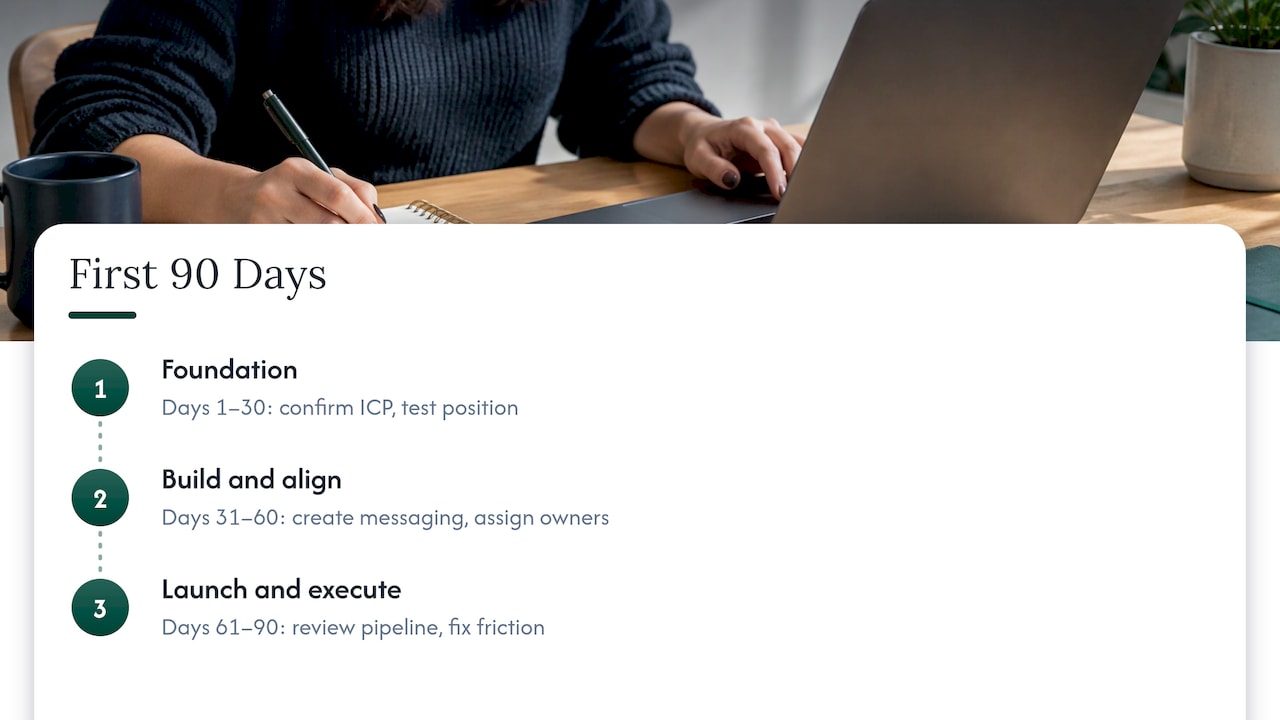
Days 1 to 30: foundation. Confirm the ICP with customer conversations. Write the position and test it with five to ten buyers in the segment. Choose the primary motion and the single number that will tell you it is working.
Days 31 to 60: build and align. Produce the messaging, the demo flow, the onboarding path and the sales enablement kit. Hold the cross-team review. Name owners for every launch task.
Days 61 to 90: launch and execute. Go to the chosen segment. Review pipeline weekly. Listen to sales calls and onboarding sessions, and fix the biggest friction first.
Accountability matters as much as the calendar. The Product Marketing Alliance points out that a successful launch framework defines success metrics, ownership and accountability, and includes a retrospective after each launch. Write the metric and the owner next to every task, and hold the retrospective even when the launch went well.
For deeper versions of this sequence, see our go-to-market framework for founders, the product launch strategy guide and the go-to-market checklist, which tests readiness through five lenses.
Measure what the business actually needs
Launch-week traffic is easy to count and says little. SaaS economics reward retention, so the scorecard should reach past the first sale.
- Acquisition: pipeline created, win rate, sales cycle length and customer acquisition cost (CAC).
- Activation: the share of new accounts that reach the first moment of real value.
- Retention and expansion: churn, net revenue retention (NRR) and CAC payback.
- Efficiency: the Rule of 40, a rule of thumb that revenue growth rate plus profit margin should exceed 40% for a healthy SaaS company at scale.
HubSpot’s list of SaaS success measures, covering pipeline, activation, monthly recurring revenue, churn, NRR and CAC payback, is a useful frame. Post-launch monitoring also benefits from win/loss analysis, pipeline reviews and feedback loops. Win/loss in particular tells you why buyers chose or rejected you in their own words. Our guide to B2B win-loss analysis shows how to turn it into one shipped change in 90 days.
Set targets from your own history and your own cost structure. Published benchmarks differ by company size, price point and year, so use them as reference points while you build your baseline.
Where SaaS go-to-market plans go wrong
- The ICP is a wish list. Everyone with a credit card is not a segment.
- Positioning is a feature list. Buyers compare features line by line and pick the cheapest.
- The motion fights the promise. A high-touch story sold through a no-touch flow, or the reverse.
- Launch ends at announcement. Nobody owns activation, so early accounts churn quietly.
- Teams work from different stories. Product, marketing and sales each describe a different company.
- Expansion comes too early. A second segment or a second motion arrives before the first one works. If you are weighing it, our market expansion strategy guide scores markets you can win.
Every item on this list is a clarity and alignment problem before it is a channel problem. That is why the strongest GTM work starts with brand and positioning, not with a media plan.
Our perspective
Brand is not a marketing tool. It is a core business strategy, and a SaaS go-to-market plan is where that becomes obvious.
We work from an operator’s point of view, shaped by building brands and by exit experience. From that seat the pattern is consistent: companies do not stall for lack of tactics. They stall because product, marketing and sales have drifted into three versions of the company, and buyers are left to compare them on price.
Our approach, The Branded Agency method, connects brand strategy to measurable performance. Frameworks like The Golden Spiral™ and Brand-Backed Performance™ tie positioning, product, marketing and sales together through iteration, so the position a founder writes in week one is the one a customer success manager defends at renewal.
If your plan is a list of channels, start one level up: who exactly are we for, why us, and who in the company is accountable for keeping that promise?
Quincy
Where we come in
If you are a founder or an executive team bringing a SaaS product to market, the hard part is usually the clarity and alignment in steps 1 to 4, not the launch calendar. We help organizations turn brand positioning and strategy into a competitive advantage, with services covering growth and go-to-market strategy, brand positioning, customer experience and founder and executive advisory. Our work connects brand strategy to measurable performance, with alignment across product, marketing and sales.
If you want a second set of operator eyes on your ICP, position and launch plan, start with the Brand Strategy Frameworks page or reach out through our site.
FAQ
What is a go-to-market strategy for SaaS?
It is the plan for how a SaaS product reaches a defined customer segment, wins them and keeps them. It covers the ICP, positioning, pricing, the sales and marketing motion and the post-sale experience. It is specific to one product or market and has a defined horizon, then hands off to ongoing marketing and sales.
How is a SaaS GTM strategy different from a launch plan?
A launch plan creates initial attention around a release date. A GTM strategy is the larger system that decides whether you keep finding the right buyers, convert them at a sustainable cost and retain them. The launch plan is one component inside it.
What is the Rule of 40 in SaaS?
It is a rule of thumb that a healthy SaaS company’s revenue growth rate plus its profit margin should add up to at least 40%, as explained here. It is meant for companies at scale and is a reference point, not a target for an early-stage launch.
How long should a SaaS GTM plan take to run?
A focused plan usually runs from several weeks to a few quarters. A 90-day structure with foundation, build-and-align and launch-and-execute phases is a practical shape for most startups, followed by a retrospective that decides what to change next.
Should a SaaS startup go product-led or sales-led?
Choose by how your buyer evaluates and by deal size. A product one person can try alone suits product-led. A product that needs a committee and careful setup suits sales-led. Many companies end up hybrid, but start with one primary motion so you can see what is working.
Sources
- Ultimate Guide to SaaS Go-To-Market Strategy
- The most effective B2B SaaS marketing tactics
- A Framework for Defining and Refining Your ICP
- 2021 KBCM SaaS Survey
- A Detailed GTM Framework From Day 1 to Day 90
- B2B growth doesn’t end at closed-won
- How PMM leaders are owning commercial outcomes in 2026
- Product launch sales readiness checklist
- The Rule of 40