
Brand Differentiation Strategy: A Practical Guide for 2026
A brand differentiation strategy is a deliberate choice about how buyers should see you as different from the alternatives, and a way of running the business so that difference is true every day. It is not a tagline or a logo. It is the answer to one question: why would a buyer who knows your category pick you? This guide shows how to build that answer, with examples, a step-by-step process, and ways to test whether it holds.
TL;DR
- Differentiation starts with a frame of reference: who buyers compare you with. Change the frame and the difference changes.
- A useful difference matters to a defined customer, is believable, and is hard to copy. Trivial features and gimmicks fail all three.
- You also need points of parity, the basics buyers expect, or you will not be considered at all.
- The difference must show up in product, marketing, sales and customer experience. A claim only marketing makes is drift.
- Test it with buyer perception, not internal opinion, and revisit it when competitors catch up.
Table of Contents
- What brand differentiation strategy actually means
- Why most differentiation fails
- The types of value you can differentiate on
- Brand differentiation examples that hold up
- How to build your differentiation, step by step
- Make it real across product, marketing and sales
- Perspective: differentiation is a business decision
- How to tell if your differentiation is working
- When your difference needs to change
- Work with us on your positioning
- FAQ
- Sources
What brand differentiation strategy actually means
Marketing scholar Kevin Lane Keller frames positioning as choosing a competitive frame of reference and then the points of difference that set a brand apart within it. The frame tells buyers what you are and what you should be compared with. The points of difference tell them why you win that comparison.
That is also the difference between brand differentiation and the looser idea of competitive differentiation. Competitive differentiation can mean any advantage over a rival: a lower price, a faster shipment, a bigger catalog. Brand differentiation is narrower and more durable. It ties one or two advantages to a clear category, a clear customer and a reason to believe, then holds them steady over years.
Keller adds a point most guides skip. Every brand needs points of parity too: the category expectations that make you a legitimate option. A bank can be different in how it serves small businesses, but it still has to be safe and insured. A difference built on top of missing basics does not land.
Why most differentiation fails
The usual failure is not a lack of effort. It is differentiating on the wrong thing. The Marketing Society makes the case that real differentiation is about meeting customer needs better than the competition, not about obsessing over trivial features or gimmicks.
We see three patterns in teams that come to us stuck:
- Differentiating on what you do, not what the buyer gets. “AI-powered” or “full-service” describes your inputs. Buyers care about outcomes.
- Claims every competitor makes. If five rivals say “customer-first,” nobody remembers any of them.
- A promise only one department keeps. Marketing says “fastest onboarding,” sales discounts to close, and product takes 90 days to implement. Buyers feel the gap, and the claim becomes a liability.
If you want to see where your category already crowds together, start with a competitive brand analysis before you pick a direction.
The types of value you can differentiate on
Customer value comes in three forms, according to the marketing management literature: functional, psychological and monetary. It helps to know which one you are really selling, and to read about the value a brand can deliver in a specialized market to see how sharply a niche can define it.
| Type of value | What the buyer gets | Typical point of difference | Risk |
|---|---|---|---|
| Functional | Better performance, speed, reliability | Faster, safer, easier, more accurate | Easiest for rivals to copy |
| Psychological | Identity, confidence, belonging, status | A stance, a community, a feeling of being understood | Needs consistency over years |
| Monetary | Lower cost or better return | Lower total cost, clear ROI | Starts price wars you may not win |
Most durable brands lead with one type and support it with a second. Competing on price alone is the weakest option for a young company, because someone with deeper pockets can always go lower.
Brand differentiation examples that hold up
The best examples share one trait: the brand changed what buyers compared it with, or it kept proving a difference that mattered.
FedEx: a difference that had to move
FedEx first stood apart from the U.S. Postal Service by offering overnight delivery. As other overnight providers appeared, that difference stopped being unique, so the brand repositioned around speed and dependability. The lesson: a point of difference has a shelf life, and the frame of reference moves when competitors arrive.
Panera Bread: choose your category
Panera defined itself as a “fast-casual bakery cafe” instead of competing head-on with entrenched fast-food chains, a move TechCrunch’s positioning guide uses as an example. Naming a different category changed what customers expected, including what they were willing to pay.
White Claw: lead a new category
The same guide notes that White Claw led the “hard seltzer” category rather than trying to beat beer and malt beverages at their own game. When you name and own a category, you set the terms of comparison.
PalmPilot: win parity first
Keller points to the PalmPilot, which succeeded in part because it limited its functions to those buyers associated with electronic organizers. That earned category legitimacy before it tried to be different. Simplicity became the difference.
Nike: a stance plus constant proof
Nike’s difference is less about any single shoe and more about a consistent idea: inspiring athletes at every level to push past limits, expressed through “Just Do It,” athlete partnerships and product innovation, as one marketing case study of the brand describes it. The psychological value is what buyers remember, and the functional innovation gives it credibility.
For more examples built for team discussion, see our brand positioning examples workshop.
How to build your differentiation, step by step
1. Define the frame of reference
Write down who your buyer compares you with today, including non-obvious alternatives like a spreadsheet, an in-house hire or doing nothing. Then decide the frame you want. Panera did not accept the one it was given.
2. Get specific about the customer
You cannot be different for everyone. Pick the segment where your strengths matter most. If your customer definition is vague, build it first with an ideal customer profile framework that moves from data to concrete actions.
3. Find the unmet need and the friction
Interview recent buyers, lost deals and churned customers. Ask what almost stopped them from buying, what they compared you with, and what they would tell a peer. Look for friction competitors accept as normal. The strongest differences come from fixing something the category has tolerated.
4. Choose one or two points of difference
Test each candidate against four questions:
- Does the target customer care about it?
- Can we deliver it better than anyone else, consistently?
- Can we prove it?
- Will it be hard for a rival to copy within two years?
If any answer is no, keep looking.
5. Write the positioning statement
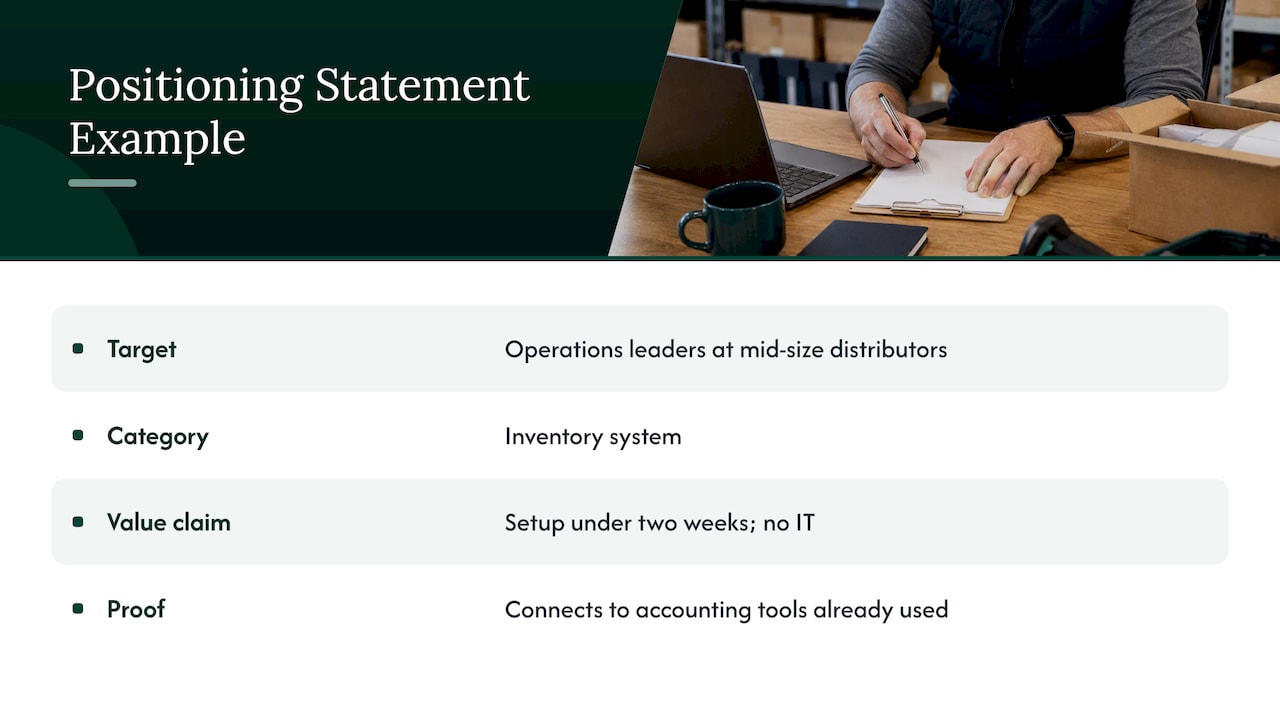
A simple structure from Harvard Business School Online: for a target market, our brand is the only one among a competitive set that delivers a unique value claim, because of specific reasons to believe. The “because” is where most drafts fall apart. If your reasons to believe are vague, the claim is too.
Here is a worked example for a fictional B2B software company:
For operations leaders at mid-size distributors, our platform is the only inventory system that sets up in under two weeks without IT involvement, because it connects directly to the accounting tools they already use.
The target, set, claim and proof are all there. Each part can be checked.
6. Brand the differentiator
When the difference is a feature, service or ingredient, giving it a name can help buyers remember it. The Marketing Society notes that a branded differentiator adds credibility and visibility, and cites Oral-B’s Action Cup as a name that summarizes complex product characteristics. It also warns that a branded differentiator needs active management and funding. A name with no investment behind it is decoration.
Make it real across product, marketing and sales
A difference that lives in a slide deck is not a difference. Buyers meet your brand in the demo, the onboarding call, the invoice and the support ticket. Run this check across each function:
| Function | Question to ask |
|---|---|
| Product | Does the roadmap deepen the point of difference or dilute it? |
| Marketing | Does every message lead with the same claim and proof? |
| Sales | Can reps explain the difference in one sentence without discounting? |
| Customer experience | Is there a moment where we visibly deliver the promise? |
That last row matters more than most teams assume. Find the moments that shape whether a customer believes you, using our guide to the moment of truth in the customer journey. To make the difference easy to recall at the moment of purchase, read about building mental availability. And once the choices are made, capture them in a brand playbook so new hires and agencies do not drift from them.
Perspective: differentiation is a business decision
We do not treat brand as a marketing exercise. In our work, differentiation is a strategic choice about where the business will win, and it has to be backed by the operating decisions that make it true.
That view comes from building brands as an operator, including through an exit, and from work across more than 200 international retail locations. The pattern repeats. Companies rarely lose because they lack a brand identity. They lose because product, marketing and sales each tell a slightly different story, and buyers fall back to comparing price.
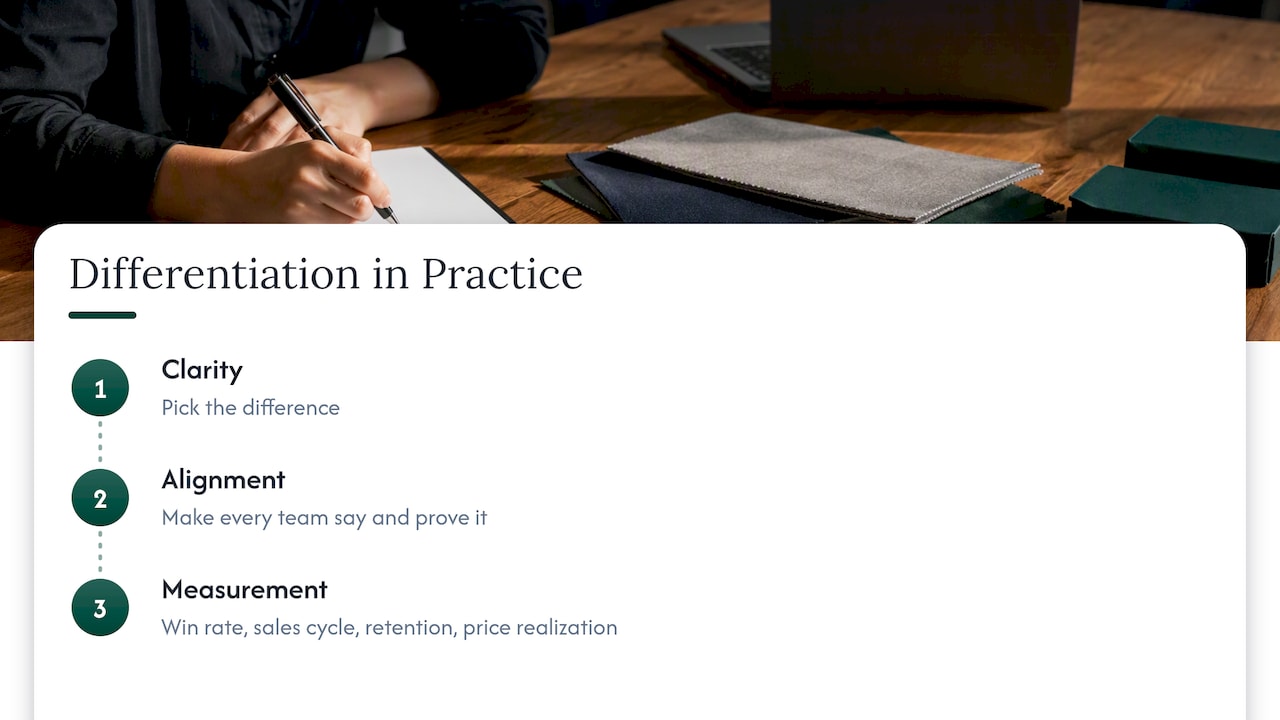
So we start with clarity, then alignment, then measurement. Pick the difference. Make every team able to say it and prove it. Then connect it to numbers: win rate, sales cycle, retention, price realization. If the brand work does not move one of those, it is not finished.
— Quincy
How to tell if your differentiation is working
By asking buyers, not the team. Four checks work well:
- Perceptual map. A perceptual map plots how customers see your brand against competitors on attributes such as price, quality or innovation. Survey 30 to 50 target buyers and look for open space you own.
- Win/loss language. Do buyers who choose you repeat your claim in their own words? If they cite price or “you were recommended,” the difference has not landed.
- Sales cycle and discounting. Clear differentiation shortens comparison. If reps discount more over time, the difference is weakening.
- Consistency audit. Collect your homepage, sales deck, onboarding emails and support scripts. Count how many carry the same claim.
Repeat quarterly at first. When a rival copies your difference, as happened to FedEx, you need to know before buyers do.
When your difference needs to change
Sometimes the answer is a sharper claim; sometimes it is a broader shift. If the market has moved, a new category or customer is the better bet. For help choosing the scale of change, read rebrand vs. brand refresh. Early-stage companies should connect the work to growth from the start, as laid out in our startup brand strategy guide, and turn the choice into launch actions with a go-to-market framework.
Work with us on your positioning
If you have read this far and your team still cannot agree on what makes you different, that is the problem we solve. Our brand strategy and positioning work covers positioning, growth and go-to-market strategy, customer experience and founder and executive advisory, and connects them to measurable performance. If you want your leadership team aligned in a single session, our speaking and workshop options are a good place to start.
FAQ
What is an example of a brand differentiation strategy?
Panera Bread is a clear one. It defined itself as a “fast-casual bakery cafe” instead of fighting fast-food chains on their terms, as TechCrunch’s positioning guide explains. The category choice changed how customers judged it.
How do you differentiate a brand in a crowded market?
Change the comparison. Choose a specific customer, find friction competitors ignore, and build one proof-backed difference around it. Avoid trivial features, since meeting customer needs better is what lasts. Then make product, marketing and sales deliver it consistently.
What is Nike’s brand differentiation?
Nike pairs an emotional idea, encouraging athletes at every level to go beyond their limits, with athlete partnerships and product innovation, according to a Nike marketing case study. The message gives psychological value, and the innovation makes it believable.
What is the difference between brand differentiation and competitive differentiation?
Competitive differentiation can be any edge over a rival, such as price or speed. Brand differentiation ties a chosen frame of reference, a defined customer and points of difference balanced with points of parity into a position buyers remember and trust over time.
Sources
- Three Questions You Need to Ask About Your Brand, Harvard Business Review
- How to Craft the Perfect Brand Positioning Statement, Harvard Business School Online
- Differentiation that matters, The Marketing Society
- Innovation: brand it or lose it, The Marketing Society
- Carve out a place for your brand with a positioning statement, TechCrunch
- Crafting a Customer Value Proposition and Positioning, Marketing Management (2022)
- Nike Branding Strategy and Marketing Case Study