
Brand Audit Checklist: 7 Areas to Review and Score
A good brand audit checks seven areas: strategy and positioning, visual identity, messaging, digital presence, customer perception, competitive standing and internal alignment. For each area you ask a handful of direct questions, collect evidence, score what you find, and turn the gaps into a short, ranked action list. The checklist below gives you the questions, the evidence to pull, a scoring method and the order to fix things in.
TL;DR
- Audit seven areas: strategy, identity, messaging, digital presence, customer perception, competitors and internal alignment.
- Collect evidence for every question (screenshots, reviews, survey answers, sales calls). Opinions are not evidence.
- Score each area from 1 to 5, write the finding, and attach one recommended action with an owner.
- Compare against three to five direct competitors, not the whole market.
- Fix the positioning and alignment gaps first. Visual polish comes after the brand is clear.
Table of Contents
- What a brand audit is, and what it should tell you
- When to run one
- Before you start: set scope and gather your inputs
- The brand audit checklist: seven areas
- Add performance: close the loop with metrics
- Brand audit template: how to score and report
- Brand audit questions that expose the biggest gaps
- What to fix first
- How much does a brand audit cost?
- Work with us on your audit
- FAQ
- Sources
What a brand audit is, and what it should tell you
A brand audit is a structured look at how your brand actually performs against what you intend it to do. One published guide describes it as an exam that replaces assumptions with data and reveals gaps between brand intent and brand reality. That gap is the whole point. Most companies know what they hope customers think. Few know what customers say, what the sales team says, and what the website says, side by side.
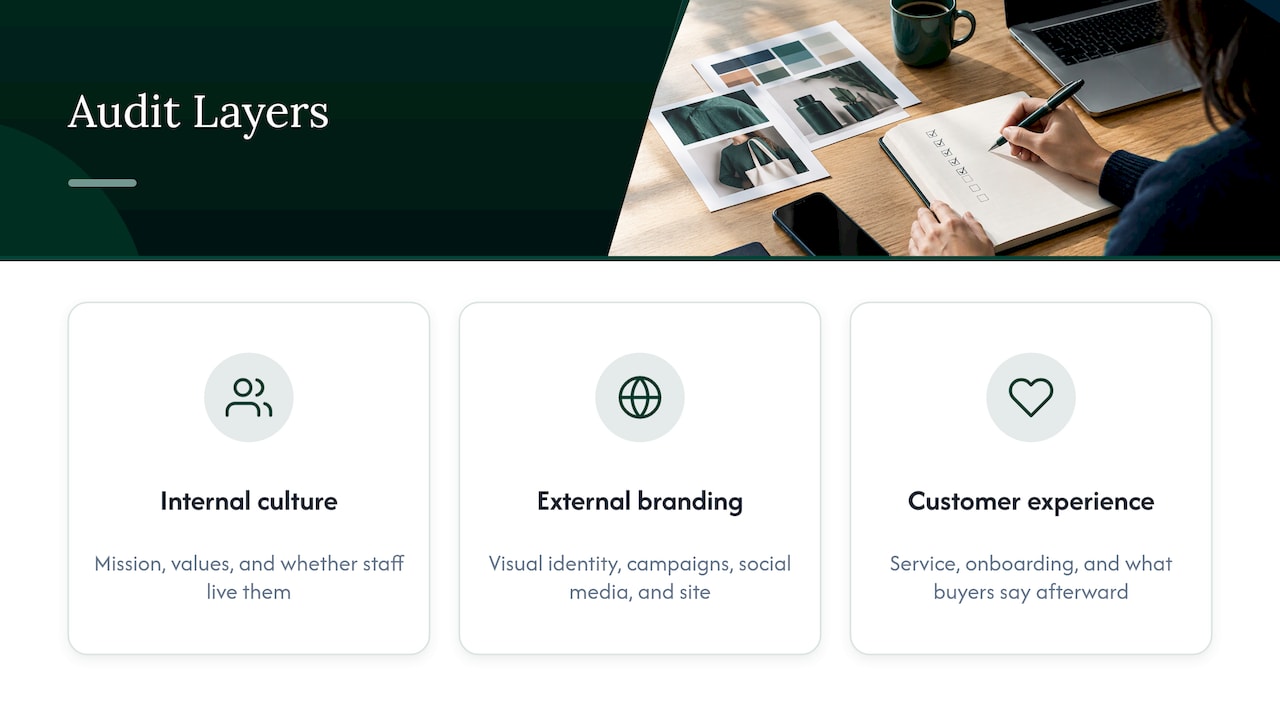
A complete audit has three layers, which match how Shopify suggests grouping a checklist: internal culture, external branding, and customer experience. Internal covers your mission, values and whether staff live them. External covers visual identity, campaigns, social media and your site. Customer experience covers service, onboarding and what buyers say afterward.
When it is done well, an audit answers three questions: is the brand being executed consistently, are internal stakeholders aligned, and how well does the brand exist in customers’ minds at the point of purchase, as Behavio’s guide frames it.
When to run one
Run a brand audit when something feels off and you cannot name it. Common triggers we see with founders and leadership teams:
- Sales has to explain the company differently on every call.
- Marketing, product and sales describe different customers.
- You are about to raise money, rebrand, enter a new segment or launch a major product.
- Prospects compare you on price because they cannot see what makes you different.
- Growth has stalled and nobody agrees why.
If none of these apply, an annual light audit is still a sound habit. A full audit every two or three years, or at any major strategic shift, keeps drift from building up.
Before you start: set scope and gather your inputs
Skipping preparation is the most common reason audits produce a pretty deck and no change. Do four things first.
- Define the goal. “Understand why win rates dropped” is a goal. “Review our brand” is not.
- Name an owner and a small team. One person from marketing, one from sales, one from product or customer success, and an executive sponsor.
- Collect the existing assets. Brand guidelines (if they exist), pitch decks, website pages, ad creative, email templates, proposals, social profiles, packaging, signage and onboarding materials.
- Pull the data you already have. Web analytics, win/loss notes, review sites, support tickets, NPS or survey results and recent customer interview recordings.
The Frontify guide lays out a 10-step process that runs from preparation through gathering internal data, reviewing collateral, competitive analysis, surveys, consistency, visibility and reputation, then reporting and an action plan. The checklist below folds those steps into seven areas so you can work through them in one pass.
The brand audit checklist: seven areas
Effective audits typically cover seven areas: visual identity, messaging consistency, digital presence, customer perception, competitive positioning, internal alignment and market performance. We start with strategy, because everything else is judged against it, and treat market performance as the outcome measure that closes the audit.
1. Strategy and positioning
This is the foundation. If it is vague, every other area will look inconsistent no matter how well it is designed.
- Are your mission, vision and values written down, and do they appear in how you actually brand and sell? Brandwatch’s checklist opens with exactly this question.
- Can you state who you serve, the problem you solve and why you are the better choice, in two sentences?
- Would your CEO, head of sales and head of product give the same two sentences?
- Does your positioning name a specific customer and a specific alternative, or could any competitor claim it?
- Is the brand promise something you can deliver every time?
Evidence to pull: your positioning statement, the homepage headline, the first slide of the sales deck, and three recent sales call recordings.
If your answers differ across the team, that is itself the finding. Our walkthrough of brand positioning examples shows how to settle it in a 60 to 90 minute working session.
2. Visual identity
Look at consistency, not taste.
- Is the logo used correctly everywhere: sizing, clear space, versions, file quality?
- Do colors and typography match the guidelines on the website, decks, social profiles, invoices and email signatures?
- Does imagery look like it comes from one company?
- Are the guidelines current, easy to find and actually used?
A common method is to review logo usage, color palette, typography and tone of voice across digital and physical touchpoints, and score each against your guidelines. Print every touchpoint, pin them to a wall or a shared board, and look for the ones that do not belong.
3. Messaging and voice
- Is tone consistent across the website, social, sales emails, support replies and proposals?
- Does the language match your stated values?
- Do you lead with customer outcomes or with internal jargon? Internal vocabulary is a quiet cause of weak positioning, which we cover in why internal language weakens corporate positioning.
- Are the three or four core messages the same in every channel?
A quick test: copy five sentences from your site and five from sales emails, remove the logo, and ask someone outside the company if they come from the same business.
4. Digital presence and website experience
Your site is usually the first touchpoint for a B2B buyer. Review it as a prospect would.
- Does the homepage say what you do, for whom, within the first screen?
- Is it responsive and mobile friendly, with clear navigation? Brandfolder’s primer quotes a branding expert who suggests asking whether the site is responsive, mobile-first, well laid out and easy to use.
- Does a visitor know the next step on every key page?
- Are your social profiles, directory listings and Google Business Profile accurate and on-brand?
- Which content gets traffic, and does it reinforce the positioning or dilute it?
For a deeper technical view of search listings, reviews and website experience, specialists in reputation management and local SEO cover the same ground from the visibility side.
5. Customer perception
This is the area teams most often guess at. Replace guessing with listening.
- What do customers say you do, and is it what you say you do?
- Why did your best customers choose you, and what almost stopped them?
- What themes appear in reviews and support tickets?
- Do customer sentiments match your promises?
Perception data can come from surveys, social listening, online review analysis and support ticket themes. Add five to ten short customer interviews if you can. Ask what they were using before, what made them switch, and how they would describe you to a peer. Use their exact words. Those phrases often make better positioning than anything written in a conference room.
Do not forget the experience itself. Map the journey from first contact to renewal and mark where the brand promise is kept and where it breaks.
6. Competitive standing
Pick three to five direct competitors. Compare visual identity, messaging, digital presence, content quality, social engagement and brand perception in a simple matrix, then look for open space.
| Dimension | Your brand | Competitor A | Competitor B | Competitor C |
|---|---|---|---|---|
| Core claim | ||||
| Target customer | ||||
| Visual style | ||||
| Tone of voice | ||||
| Proof used (case studies, numbers) | ||||
| Content focus |
Two extra techniques help. Measure share of voice, meaning your share of the relevant online conversation versus competitors over about 90 days, and build a two-by-two positioning map based on how the market perceives each brand, both of which BrandQuarterly describes. Then note which claims competitors own strongly and which they leave unaddressed. We go deeper in our practical guide to competitive brand analysis and in positioning map examples.
7. Internal alignment
A brand lives or dies in how employees behave, not in the guidelines PDF.
- Are teams and stakeholders aligned with the brand and following its guidelines?
- Can a new hire explain the positioning after their first week?
- Do product, marketing and sales share one definition of the ideal customer?
- Do leaders make decisions (pricing, hiring, roadmap) with the brand in mind?
- Is there a shared handoff between marketing and sales, such as a service level agreement on lead quality and follow-up? We cover this in aligning sales and marketing.
Alignment also shows up in the physical environment. Offices, reception areas and shared spaces tell visitors something about your standards, and the way a workplace is kept can reinforce or undercut what you say, as this piece on office cleaning and branding explains. If clients visit you, include the space in your touchpoint review.
Add performance: close the loop with metrics
An audit that only describes appearance misses the business question: is the brand helping you grow? Pair each area with a number you already track, such as win rate, sales cycle length, branded search volume, referral share, retention or net promoter score. Our list of 11 metrics brand teams use is a good place to choose a few. Record the baseline now so you can see movement after changes.
Brand audit template: how to score and report
You do not need special software. A spreadsheet works. One tab per area, and a summary tab.
| Column | What goes in it |
|---|---|
| Question | The checklist item |
| Evidence | Link, screenshot or quote |
| Score (1 to 5) | 1 = missing or contradictory, 5 = clear and consistent everywhere |
| Finding | One sentence on what you saw |
| Recommended action | One specific change |
| Owner and timing | A named person and a target month |
For the final report, one published guide recommends organizing it by dimension, with a score, key findings and recommended actions, and including an executive summary, methodology, evidence, competitive benchmarking, customer perception data and an implementation timeline. Another template outline uses sections for brand identity, visual identity, audience, competitors and reflection.
Keep the executive summary to one page: the three biggest gaps, the evidence behind each, and the first three actions.
Brand audit questions that expose the biggest gaps
If you only have an afternoon, ask these ten questions of your leadership team, your sales team and five customers, then compare the answers.
- Who is our ideal customer, in one sentence?
- What problem do we solve better than anyone?
- Who do customers compare us with?
- Why do we win?
- Why do we lose?
- What three words should customers use to describe us?
- What three words do they actually use?
- Where does our experience fall short of what we promise?
- Which of our materials would we be embarrassed to show a new prospect today?
- What would we have to stop saying or doing to be believable?
Disagreement between groups is the signal. It tells you where drift has set in.
Our perspective: audit for clarity before design
Most audits we see start with the logo and end with a refreshed color palette. That is the least valuable place to start. In our experience, brand is a core business strategy, not a marketing tool, and the audit should reflect that. The question is not whether your materials look consistent. It is whether product, marketing and sales are telling one story that customers believe and pay for.
That is why our method ties positioning to the work of each team and to measurable performance. We bring an operator’s perspective, shaped by real-world brand building and exit experience, to ask where the brand helps revenue and where it creates friction. When a founder says “people don’t get what we do,” the cause is usually drift between what the company says, what it ships and how it sells, and a prettier logo will not close that gap.
Use the checklist above honestly, score what you find, and fix alignment and positioning first. If you want a partner to run it with you, that is the work we do through The Branded Agency.
Quincy
What to fix first
An audit usually produces thirty to fifty findings. Do not try to fix them all. Rank them with two questions: how much does it affect revenue or customer trust, and how hard is it to change?
- Positioning and message gaps. These affect everything downstream and cost little to fix beyond time.
- Alignment gaps. Update sales decks, onboarding and internal training so every team uses the same story.
- Customer experience breaks. Fix the places where the promise fails, such as slow onboarding or inconsistent support.
- Digital presence. Rewrite key pages, correct listings and tighten navigation.
- Visual consistency. Retire off-brand materials and update templates.
The Frontify process ends with a report and an action plan with prioritized improvements, assigned ownership and a roadmap. Assign each action a single owner and review progress monthly. If the work needs a strategy deliverable, our guide to brand strategy deliverables and a phased plan shows what to produce and in what order.
How much does a brand audit cost?
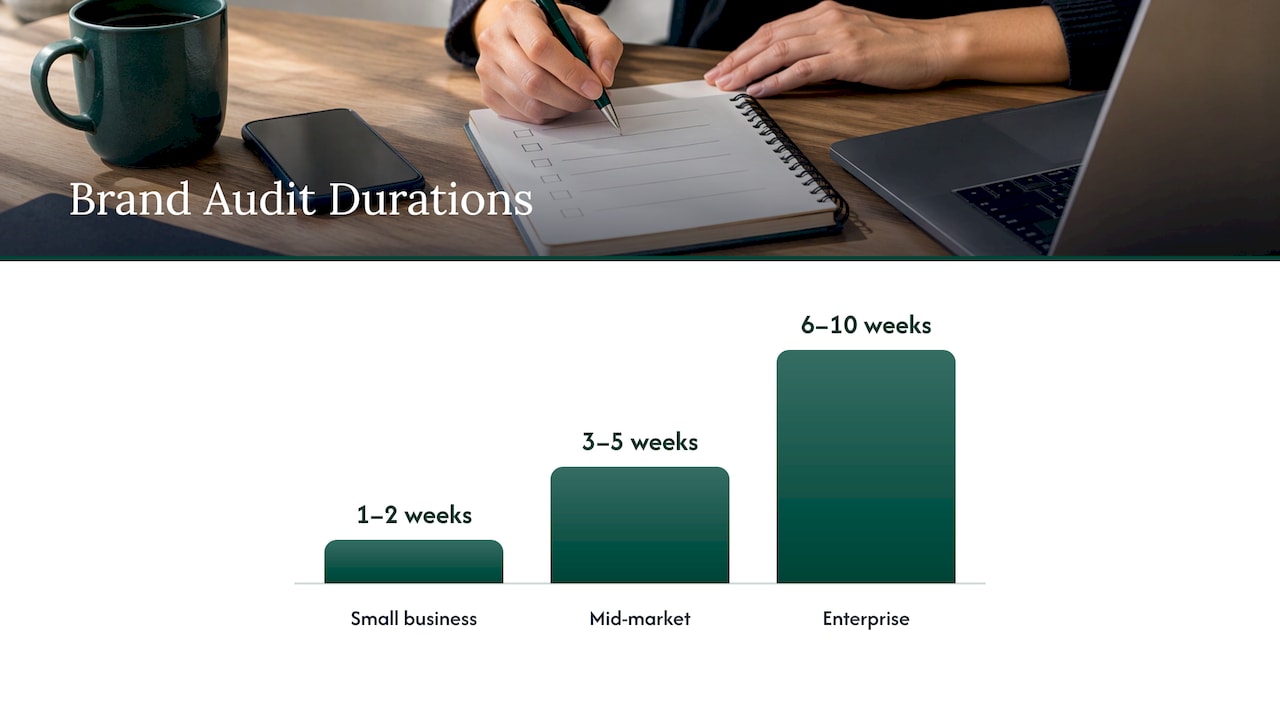
The price depends on scope. Published estimates point to factors such as number of channels, business complexity, data preparation, provider experience, deliverables, timeline and post-audit consulting. One freelance rate guide published in 2026 reports that freelance brand strategists in the US charge $2,000 to $10,000 for an audit, with a typical project fee of $5,500. It lists the same kinds of cost drivers: organization size, touchpoints reviewed, competitive analysis, customer research, stakeholder interviews and the depth of digital versus offline review. It also gives rough durations: one to two weeks for a small business, three to five for mid-market and six to ten for enterprise.
Treat these as ballpark figures, not quotes. Doing it yourself costs time rather than fees, and the checklist above is built for that. If you want an outside view, an advisor brings objectivity, because internal teams find it hard to judge their own story.
Work with us on your audit
We help startup founders, executive teams and marketing teams turn a brand audit into a positioning and growth plan. Our services cover brand strategy, brand positioning, growth and go-to-market strategy, customer experience, and founder and executive advisory. Each is designed to connect the brand to measurable business performance rather than to cosmetic change.
If you have run the checklist and want help closing the gaps, see how we work on the Quincy Samycia site or browse our brand strategy frameworks. For founders, our piece on startup brand strategy is a useful first read, and the journal has more.
FAQ
What should a brand audit include?
It should include an internal review of foundations and culture, an external review of customer perception and competitive position, and a review of every brand touchpoint. In practice that means strategy, visual identity, messaging, digital presence, customer perception, competitors and internal alignment, as Behavio’s guide outlines.
How long does a brand audit take?
A lighter, self-run audit can be done in a few days to two weeks if the data is at hand. Published freelance estimates put a small-business audit at one to two weeks, mid-market at three to five weeks and enterprise at six to ten weeks. Customer interviews and survey time are what stretch the schedule.
How many competitors should I include?
Three to five direct competitors is enough. Fewer gives you no pattern, and more makes the matrix hard to read. Choose the companies your customers actually compare you with, which your sales team can tell you.
How often should I audit my brand?
Run a full audit every two or three years and at any major change, such as a funding round, new market or rebrand. A short check of the ten questions above each year helps catch drift early. This is our practical recommendation rather than a fixed rule.
Sources
- Brand Audit Checklist, 7-Area Framework (AMW)
- What is a brand audit? A complete guide (Behavio)
- How To Do a Brand Audit: 8-Step Framework (Shopify)
- Brand Audit: The 7-Step Process (Brandwatch)
- How to perform a brand audit (Frontify)
- Brand Audits: A Comprehensive Primer (Brandfolder)
- Digital Brand Audit Template (BrandQuarterly)
- Creating a Comprehensive Brand Audit Template (Aprimo)
- How Much Does a Marketing Audit Cost? (LegalClarity)
- Brand Audit Pricing, Freelance Rates (WhatShouldICharge)
- Reputation management and local SEO (Bright Forge Digital Solutions)
- The Role of Cleaning in Office Branding