Brand Messaging Framework: How to Build One That Teams Use

A brand messaging framework is a short, written structure that turns your positioning into language: one core message, a few supporting pillars, and proof for each, adapted by audience and channel. Build it in that order, test it with sales and product, and keep it to a page or two. If your team cannot recite the top line from memory, the framework is too long or too vague.
This guide covers what the framework contains, how it differs from positioning, how to build the hierarchy step by step, a template you can copy, and how to keep product, marketing and sales saying the same thing.
TL;DR
- A messaging framework is the written bridge between positioning (where you sit in the market) and the words every team uses (web copy, sales decks, launch emails).
- The most common structure is a pyramid: one core message on top, two or three supporting pillars beneath it, and proof points at the base.
- Build it in order: audience, value proposition, core message, pillars, proof, then audience and channel variants.
- It only works if sales, product and marketing all use it, so run a workshop and publish a one-page playbook.
- Review it when the market, product or buyer changes, not on a fixed calendar alone.
Table of Contents
- What a brand messaging framework is (and how it differs from positioning)
- What goes inside the framework
- The messaging hierarchy, explained
- How to build a brand messaging framework, step by step
- A brand messaging template you can copy
- Product messaging and brand messaging: how they connect
- B2B messaging: what changes
- Three C’s of brand messaging
- Getting teams to use it
- Common mistakes
- Our perspective
- Need help turning positioning into messaging?
- FAQ
- Sources
What a brand messaging framework is (and how it differs from positioning)
The terms get blurred, so separate them first. Hootsuite frames it this way: positioning defines where you sit in the market, messaging turns that strategy into words, and brand voice shapes how those words sound. Atlassian puts the relationship as parent and child: positioning is the concise statement of why you are different, and messaging is the detailed description of what you do to make that statement true.
In practice that gives you three documents with three jobs:
| Document | Question it answers | Who uses it |
|---|---|---|
| Positioning | What do we believe about the market and our place in it? | Leadership, strategy |
| Messaging framework | How do we put that into language for specific audiences and channels? | Marketing, sales, product, customer success |
| Voice and brand guidelines | How should everything we publish sound and look? | Writers, designers, agencies |
If your positioning is still fuzzy, fix that first. Messaging written on top of an unclear position produces polished copy that says nothing distinct. Our positioning frameworks guide shows how to test a position in a 60 to 90 minute workshop, and the brand positioning examples article shows what a finished one looks like.
What goes inside the framework
Hootsuite says most frameworks cover seven components: mission and purpose, value proposition, positioning statement, target audience, key message pillars, voice and tone guidelines, and proof points. That is a useful checklist, but a working team does not need seven separate documents. Here is how we would group them.
1. The foundation. Audience, positioning statement and value proposition. These are decisions, not copy. They sit behind the framework and rarely change.
2. The hierarchy. The core message, the pillars and the proof points. This is the part people actually use every day.
3. The variants. How the same pillar is phrased for a CFO versus a practitioner, and how it fits a homepage versus a sales deck. Teams often skip this layer and then wonder why sales ignores the framework.
4. The voice rules. Tone and word choices. Keep these in a separate, short document. Our piece on brand voice guidelines covers how to write them so people use them.
The messaging hierarchy, explained
The hierarchy (also called a messaging pyramid or message house) is the heart of the framework. Copy.ai describes it as a pyramid with the core message at the top, supporting messages in the middle and proof points at the bottom. Crayon adds that the purpose is two-fold: a layered system of language that distills your value to essential points, and a way to adapt that system to different audience segments or buyer personas.
The core message
This is the one idea you want every buyer to take away. It answers “why should I care?” It should be a sentence a buyer would repeat to a colleague, not a tagline that only works with a logo beside it. Test it: remove your company name and see whether a competitor could say the same thing. If they could, it is not yet a position.
The pillars
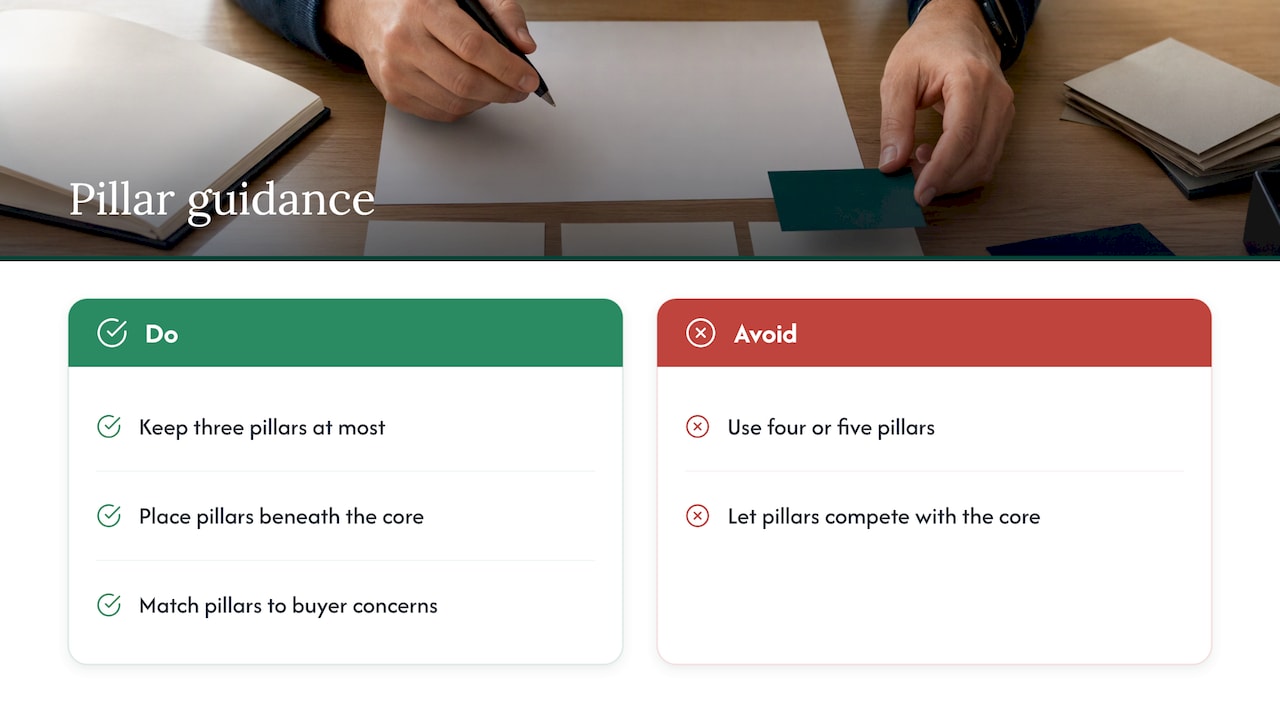
Pillars are the two or three supporting messages beneath the core. They answer “why should I believe you?” Keep them to three at most. Four or five pillars means nobody remembers any of them.
The mistake we see most often is pillars that compete with the core message instead of supporting it: three good ideas all fighting for the same headline slot. The difference between the core message and a pillar is sequence, not importance. Buyers hear the core first, then the pillar that matches their concern. (This echoes the point made by Articos that confusing primary and secondary messages is the hierarchy’s usual failure; we have seen the same pattern in our own work.)
Proof points
Each pillar needs evidence that makes the claim believable: a metric, a customer result, a process, a certification, a piece of research. Hootsuite recommends that for every pillar a team writes the core message, why it matters to the audience, the supporting benefits and the proof points. A pillar without proof is an opinion.
Audience and channel variants
The same pillar lands differently depending on who reads it. A finance leader wants risk and payback; a practitioner wants time saved and fewer workarounds. The framework should show both phrasings, plus how the pillar shortens for a homepage headline and expands for a sales deck. Our customer segmentation framework article helps decide which audiences deserve their own variants.
How to build a brand messaging framework, step by step
You can finish a solid first version in two working sessions plus some homework. Here is the order that works.
- Name the audience. Pick the one to three buyer groups that matter most, including the buying committee, not just the champion. For B2B, this often means a user, an economic buyer and a technical evaluator.
- Gather what buyers actually say. Pull phrases from sales calls, win and loss notes, support tickets and reviews. Use their words for the problem, not yours.
- Write the value proposition. One or two sentences: who it is for, the problem, the outcome, and why you rather than the alternatives. If you sell on price or packaging, align this with your pricing and positioning so the number and the story agree.
- Draft the core message. Write ten versions. Cut to one. Read it aloud to someone outside the company.
- Choose three pillars. Each should be a reason the core message is true, and each should be something you can prove.
- Attach proof. Two or three proof points per pillar. If you cannot find any, either the pillar is wrong or you have a product or evidence gap to close.
- Write the variants. For each audience, a one-line phrasing of each pillar. For each channel, a short and a long version.
- Pressure-test with the teams who will use it. Hand it to sales, product and customer success and ask where it breaks in real conversations.
A brand messaging template you can copy
Paste this into a document and fill in each line. Keep the finished page to one side of paper.
| Element | What to write |
|---|---|
| Audience | Who this is for, and the one problem they would pay to solve |
| Positioning statement | For [audience] who [need], we are the [category] that [key benefit], unlike [alternative] |
| Core message | One sentence, under 20 words, that answers “why should I care?” |
| Pillar 1 / 2 / 3 | A short reason the core message is true, in plain words |
| Proof for each pillar | Two or three facts, results or processes |
| Audience variants | How each pillar is phrased for each buyer role |
| Channel variants | Homepage line, email subject line, sales deck slide, keynote opener |
| Words we use / avoid | Five terms to own, five to retire |
A worked example (hypothetical)
The example below is invented to show the structure. It is not a real company.
Say a B2B software company sells scheduling tools to home-services businesses.
- Core message: Fill your calendar without hiring more office staff.
- Pillar 1, Booking happens by itself: customers choose a slot online at any hour. Proof: share of jobs booked outside office hours; a customer story.
- Pillar 2, Crews stay on route: schedules adjust to travel time and job length. Proof: average drive time before and after; a documented setup process.
- Pillar 3, Setup takes days, not months: a guided onboarding. Proof: median time to first booking; a named onboarding owner.
- Owner variant: “Stop losing jobs to voicemail.” Operations manager variant: “One calendar your dispatchers trust.”
Notice that every pillar is something the company can measure. That is what lets sales say it with confidence.
Product messaging and brand messaging: how they connect
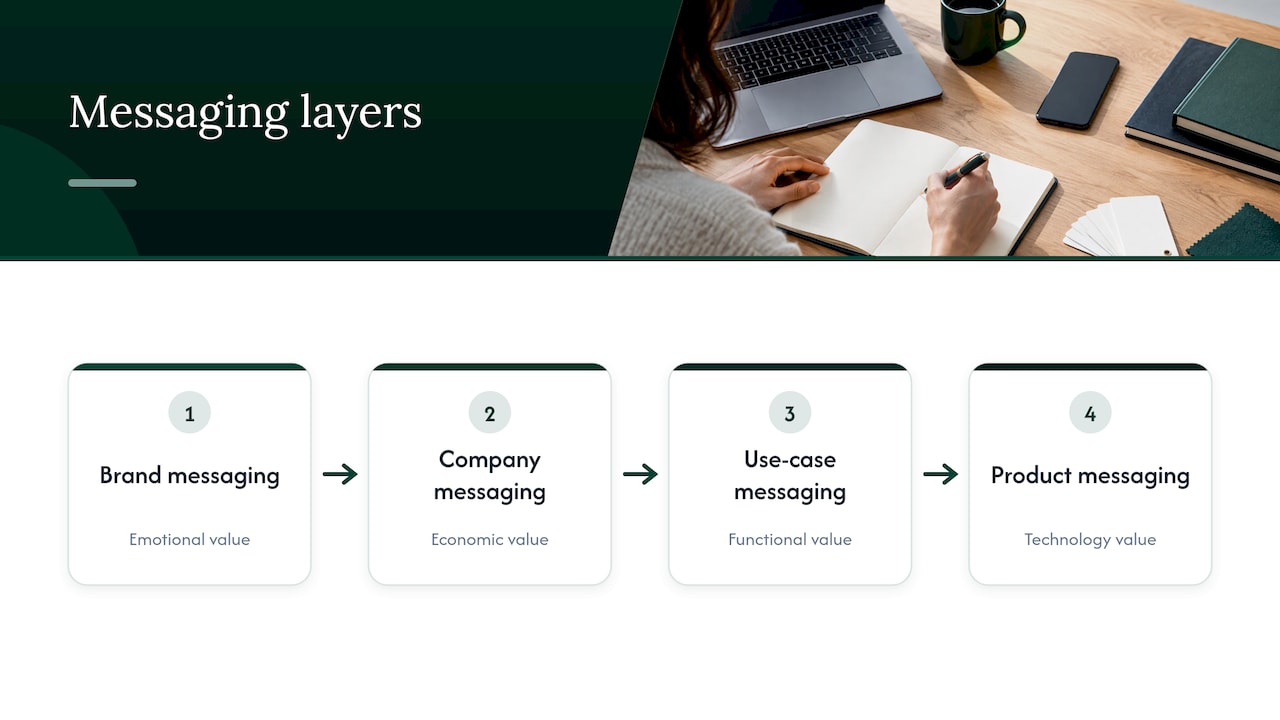
Most growing companies need messaging at more than one level. One way to see it is the GitLab Handbook, which describes a messaging pyramid made of brand messaging (emotional value), company messaging (economic value), use-case messaging (functional value) and product messaging (technology value). You do not need four layers on day one, but the principle holds: each lower layer inherits the layer above and adds detail.
A practical rule: the product framework may add features and specifics, but it should never contradict the brand-level core message. When a launch team writes a new product pillar, ask which brand pillar it supports. If it supports none, either the brand framework is incomplete or the product line is drifting from the position. That drift is the pattern we see most often when companies grow into new categories.
B2B messaging: what changes
B2B messaging frameworks follow the same pyramid, but three things need extra care.
- Multiple buyers. A deal involves several people with different fears. Your pillars stay constant while the phrasing changes by role. See why positioning has to win the buying committee.
- Longer proof. Buyers expect evidence: references, implementation detail, security and compliance answers, and numbers tied to their outcome.
- Sales enablement. The framework must show up in discovery questions, demo scripts and proposals, not only on the website.
Three C’s of brand messaging
Readers often ask about the “three C’s,” and sources differ. One customer experience publication lists consistency, clarity and character. Shopify lists clarity, consistency and constancy: easy to understand, the same across channels and campaigns, and steady over time. Clarity and consistency appear in both, and they are the two to protect. Character is where your voice and point of view come in.
Getting teams to use it
A framework no one uses is a slide deck. The usual failure is not the writing; it is adoption. A few habits help:
- Run a live workshop. Walk sales, product, marketing and customer success through the pyramid and let them challenge it. People defend what they helped build.
- Publish a one-page playbook. Core message, pillars, proof, and sample copy for the three most common situations: an outbound email, a demo opening and a homepage headline.
- Bring product and engineering in. Teams that understand go-to-market and positioning tend to be more empathetic toward customers, and their view on which capabilities best back up a value proposition is worth taking seriously, as one product marketer advises.
- Give it an owner. One person approves changes. Otherwise every team makes small edits until the message drifts.
- Tie it to a service-level agreement. When sales and marketing agree on what each owes the other, the message holds up under deal pressure. See our guide to marketing and sales alignment.
Review the framework when something real changes: a new segment, a new competitor move, a pricing change, or repeated lost deals that trace to the same objection.
Common mistakes
- Writing for the company, not the buyer. If every pillar starts with “we,” rewrite it around the buyer’s problem.
- Too many pillars. Three is a ceiling.
- Adjectives instead of proof. “Innovative” and “world-class” prove nothing.
- One version for all audiences. Add role variants.
- Treating it as a launch artifact. It is an operating document.
Our perspective
We treat brand as a core business strategy, not a marketing layer. A messaging framework is where that either becomes real or falls apart, because it is the point where strategy meets what a salesperson says on a Tuesday afternoon.
Our approach comes from an operator’s view of brand building, including exit experience, and from work across more than 200 international retail locations. What we have learned is that messaging fails when product, marketing and sales each hold a slightly different story. The fix is not cleverer copy. It is clarity and alignment, built through iterative frameworks that connect positioning to what customers experience and to measurable performance.
That is why we build messaging as part of a wider system, through The Branded Agency method and frameworks such as The Golden Spiral™ and Brand-Backed Performance™. Messaging comes after a clear position and before the work that tests it in market. Done in that order, the framework stops being a document and becomes a way the team makes decisions.
Quincy
Need help turning positioning into messaging?
If your team has a position but not a shared way to say it, we can help. We work with founders, executive teams and marketing teams on brand strategy, positioning, and growth and go-to-market strategy, including workshops that align product, marketing and sales around one message. See our brand strategy and advisory services or explore our brand strategy frameworks.
For a team event or conference, we also speak on brand strategy and growth: details are on the speaking page.
FAQ
What is the difference between a messaging framework and a messaging hierarchy?
The hierarchy is the core of the framework: core message, pillars and proof points in ranked order. The framework is broader. It also holds the audience, value proposition and positioning statement behind the hierarchy, plus audience and channel variants that show how each pillar is phrased in practice.
How many pillars should a messaging framework have?
Two or three. Three is the typical number, and it is the most a team can remember and repeat in a live conversation. If you have more candidates, merge them or demote the extras to proof points.
How long should it take to build one?
A focused first version can come together in two working sessions plus the research beforehand, such as reviewing sales calls and customer language. Time depends on how clear your positioning already is. If the team disagrees on who the customer is, settle that first.
Can a startup use the same framework as a larger company?
Yes, in a lighter form. A startup can work with one audience, one core message, three pillars and a handful of proof points. Add role variants and a product layer as the sales team and the product line grow.
Sources
- Hootsuite: What is brand messaging? A framework for teams of any size
- Atlassian: Nail Your Brand Positioning and Messaging
- Copy.ai: Messaging Hierarchy, Your GTM Success Guide
- Crayon: Why You Need a Messaging Hierarchy
- Articos: Messaging Hierarchy, How to Prioritize Your Words
- GitLab Handbook: Product Marketing
- CX Network: The 3 Cs of brand messaging
- Shopify: How To Craft Brand Messaging That’s Effective and Memorable
- Julian Dunn: How to Use Message Houses in Product Marketing