Brand Purpose vs. Positioning: How They Differ and Work Together
Brand purpose is the reason your company exists beyond profit. Brand positioning is the place you want to hold in your customer’s mind compared with the alternatives. Purpose faces inward first: it guides decisions and motivates your team. Positioning faces outward: it helps a buyer choose you. Confusing the two is how companies end up with a lofty mission statement that no buyer can use, or a sharp tagline that no employee believes.
This guide explains the difference in plain terms, shows where each one belongs, and gives you a working order of operations. It’s written for founders, executives and marketing teams who need to decide what to define first and how to keep the pieces aligned.
TL;DR
- Purpose is your why; positioning is your where. Purpose explains why the company exists beyond profit. Positioning defines the space you own versus competitors in a specific customer’s mind.
- Purpose is for you first, positioning is for them first. Purpose steers internal decisions. Positioning is a customer-facing choice about who you serve, against whom, and why you win.
- You usually need both, in a sequence. Get positioning clear enough to sell, then use purpose as the guardrail for decisions. Purpose isn’t right for every brand, and it must be backed by behavior.
- Credibility comes from action. Purpose that shows up only in messaging reads as performative. Product, pricing, hiring and service decisions are what make it real.
Table of Contents
- What is brand positioning?
- What is brand purpose?
- Brand purpose vs. positioning: the core differences
- Do you need both?
- A practical order of operations
- Common mistakes
- How the two work together in practice
- Our perspective
- Where we can help
- A note on books
- FAQ
- Sources
What is brand positioning?
Positioning is what a brand wants to stand for in people’s minds. Kellogg School of Management frames it as the traditional way brands separate themselves from competition. It’s a strategic decision first, and a sentence second.
Good positioning answers five questions:
- Who exactly is this for?
- What category or frame of reference are we competing in?
- What is the one difference that matters most to that buyer?
- Why should they believe us?
- Which alternatives are we deliberately being compared with?
A common template, taught in marketing courses, runs like this: to [target audience], [brand] is the only [category] that [point of difference] because [reason to believe]. A SUNY marketing course reading lays out those same five ingredients: target segment, brand name, frame of reference, differentiation and reasons to believe.
One caution: a positioning statement is not a tagline and it isn’t usually published word for word. It’s an internal decision that product, marketing and sales all work from. If you want to see what the output looks like in practice, our walkthrough of brand positioning examples shows how teams get there in a 60 to 90 minute workshop.
What is brand purpose?
Brand purpose is the reason a company exists beyond making money. Adobe’s explainer puts purpose, mission, vision and values in a clear order: purpose is why you exist, mission is how you operate today, vision is the future you want, and values are the principles that guide behavior.
That gives you a useful ladder:
- Purpose: the impact you exist to create.
- Vision: the future state you’re working toward.
- Mission: what you do, every day, to move toward it. Shopify’s overview describes mission as the specific goal pursued daily to achieve the vision.
- Values: the standards for how you pursue purpose and mission.
Notice what’s missing: a competitor. Purpose doesn’t say who you beat. That’s exactly why it can’t do the job of positioning.
Purpose also differs from a value proposition. A value proposition is a concrete product- or service-level statement of the customer benefit and why the offer beats alternatives, as Semrush explains. It sits closer to positioning than to purpose.
Brand purpose vs. positioning: the core differences
| Brand purpose | Brand positioning | |
|---|---|---|
| Core question | Why do we exist beyond profit? | Where do we sit versus alternatives, for whom? |
| Primary audience | Employees, leadership, partners first | A defined customer segment |
| Competitor reference | None required | Central |
| Time horizon | Long-lived, changes rarely | Revisited as markets, competitors and products shift |
| What it drives | Decisions, culture, guardrails | Messaging, product emphasis, sales narrative, pricing signals |
| Failure mode | Empty rhetoric | Generic claims everyone makes |
A useful shorthand: purpose is for you, not for them, and positioning is for them, not for you. Purpose gives your team a reason to care and a rule for hard choices. Positioning gives a buyer a reason to pick you this quarter.
Where they overlap
The lines blur because purpose can become part of the positioning. Alice Tybout of Kellogg argues purpose can work at a higher order than traditional positioning by connecting functional benefits to emotional or societal meaning. A running-shoe brand that positions on performance for serious amateurs can add a purpose about getting more people moving, and the second idea makes the first one richer.
But it only works when it’s authentic. The same Kellogg analysis stresses that purpose must be genuine rather than empty rhetoric.
Where they don’t
Many brands win with positioning alone. Tybout cautions that a public purpose isn’t automatically right for every brand. It can motivate employees and differentiate, but an authentic purpose may require taking positions with downsides, and some customers mainly want a product to do a job. A payroll tool for small contractors may be better served by a razor-sharp position than by a campaign about changing the world.
Do you need both?
For most growing companies, yes, but not at the same moment and not with the same weight.
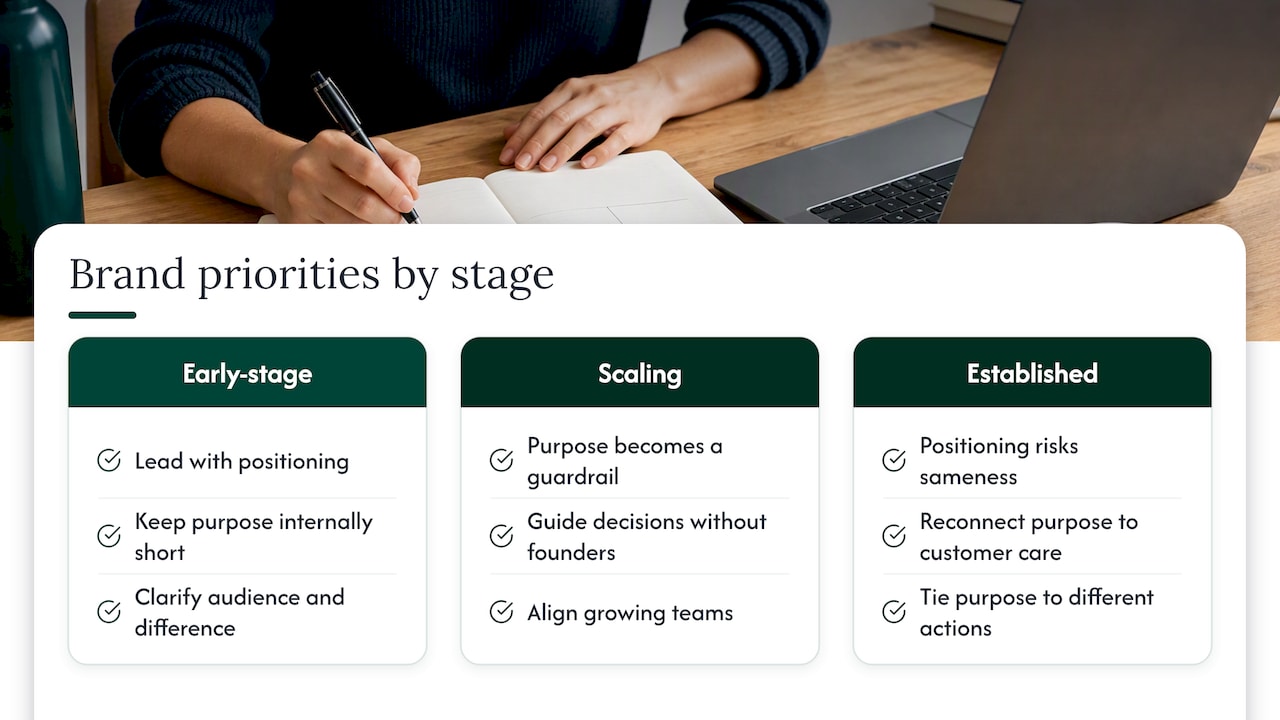
Early-stage startups should lead with positioning. If buyers can’t tell what you are, who you’re for and why you’re different, a purpose statement won’t rescue the pipeline. Purpose can stay a short internal sentence until the team grows. Our guide to startup brand strategy for founders covers how to treat brand as a growth metric from the start.
Scaling companies feel the gap differently. As teams multiply, people make thousands of small decisions without the founder in the room. Purpose becomes the guardrail. Kimberly Whitler of UVA Darden describes brand purpose as a North Star that aligns and focuses an organization and gives guidance and guardrails for brand decisions and activation.
Established brands in crowded categories often discover that their positioning has drifted into sameness. Purpose can help them rediscover why customers should care, but only if the purpose is tied to something the company does differently.
Does purpose actually pay?
The evidence is encouraging but should be read carefully. A Bain study of insurgent brands in the United States found that brands scoring highest on life-changing and global-impact elements grew at nearly five times the rate of those scoring lowest. A 2018 study reported by Marketing Dive found brands consumers see as having a positive impact grew at twice the rate of other brands.
These are correlations, not guarantees. Fast-growing brands may be the ones with the resources and clarity to build a purpose, not the other way around. Treat the numbers as a reason to take purpose seriously, not as a promise that adding a purpose statement will lift revenue.
A practical order of operations
Here is the sequence we’d use with a leadership team that hasn’t defined either.
Step 1: Start with the customer and the competitive frame
Before you write a word, get specific on who your best customers are and what they compare you to. If your ideal customer is fuzzy, work through an ideal customer profile framework first. Then test your assumptions against real buyers using B2B customer research methods that change decisions, rather than collecting opinions that confirm what you already think.
Next, map the alternatives honestly. A competitive brand analysis will show you where competitors cluster and where there’s open space.
Step 2: Draft the positioning
Use the five-part structure above: target, category, difference, reason to believe, and the alternatives you’re being compared with. Keep it to a few sentences. Then pressure-test it:
- Could a competitor say the same thing without lying?
- Can sales prove the claim in a first call?
- Does the product actually deliver the difference today?
If the answer to the last question is no, you have an aspiration, not a position. That’s fine as a roadmap item, but it’s not something to market yet.
Step 3: Define purpose from what is already true
The best purposes are discovered, not invented. Look for the thing the founders keep returning to when they explain why they started, the customer outcomes that make the team proud, and the decisions the company has made at a cost. Then write one sentence that describes the impact you exist to create.
Test it with the decision rule from Darden: does it provide a guardrail? If you can’t name a project you’d decline because of it, it’s probably a slogan.
Step 4: Connect them through mission and values
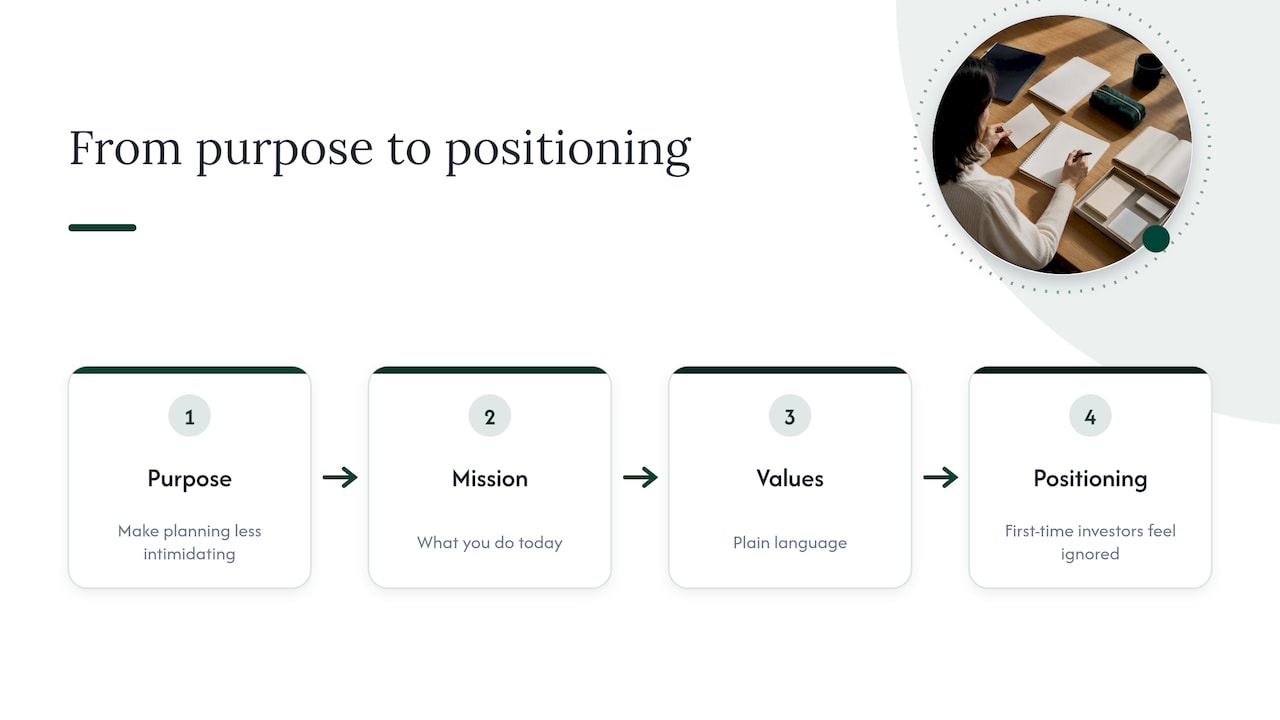
Mission and values are the bridge. Mission describes what you do today; values describe how. Together they translate a broad purpose into rules a product manager or an account executive can use. A purpose of making financial planning less intimidating, for instance, might yield a value of plain language and a positioning for first-time investors who feel ignored by big institutions.
Step 5: Build the system around it
Alignment is an execution problem as much as a strategy problem. A strategy execution framework can help leaders turn agreed priorities into accountable actions, and the same logic applies to brand: name owners, set measures and review them on a schedule. A brand playbook is the usual vehicle, and our piece on brand playbook examples shows what the best ones include.
Common mistakes
Treating purpose as a campaign
A purpose launched in an ad but absent from the business gets noticed. Fast Company’s 2026 analysis notes that purpose can seem performative if it isn’t demonstrated through consistent behavior, including product decisions, hiring and pricing, rather than only marketing messages. Credibility is built where the brand’s stance shows up in product decisions, customer service, hiring, partnerships, pricing and leadership communications.
Letting actions contradict the purpose
Darden’s 2021 guidance says company purpose, brand purpose, brand activation, and consumer needs and perceptions must fit together. Brand actions that don’t align with purpose make it ineffective. If your purpose is about simplicity and your onboarding takes six weeks and three logins, buyers will notice before your copywriter does.
Writing positioning that tries to please everyone
Positioning that names no alternative and no specific buyer is a description, not a position. Narrow the audience until it feels slightly uncomfortable. Then check whether the people left are enough to build a business on. Usually they are.
Assuming you control perception
A positioning statement states how you want to be perceived, but customers decide. That’s why you test it in sales conversations and customer research rather than relying on a workshop alone.
Using purpose where a value proposition would do
If your buyer is comparing three vendors on features and price, a purpose headline won’t help them choose. Lead with the value proposition and let purpose reinforce it deeper in the story, in recruiting and on your about page.
Mixing up brand and product messaging
Positioning often gets pulled into a turf war between brand and product teams. It helps to be clear about who owns what, and our comparison of product marketing vs. brand marketing maps the boundaries.
How the two work together in practice
Imagine a B2B software company that sells scheduling tools to home-service businesses.
- Purpose: to give small trades businesses back the evenings they lose to paperwork.
- Positioning: for owner-operated plumbing and HVAC companies with five to twenty technicians, the scheduling tool that dispatches and invoices from one screen, so owners stop doing admin at night. Compared with generic calendar apps and heavy field-service suites.
- How they connect: the purpose explains why the team keeps simplifying the product, and the positioning tells sales who to call and what to say. Pricing stays flat and predictable because the purpose rules out surprises that eat an owner’s evening.
This is an illustrative example, not a client case. The point is the division of labor: purpose is the reason and the guardrail, positioning is the choice and the claim.
Our perspective
We see the same pattern across companies of every size: brand is treated as a marketing layer when it’s really a business strategy. The trouble starts when product says one thing, marketing says another and sales improvises a third. Purpose and positioning get blamed, but the real issue is drift, and the fix is alignment.
Our view, shaped by building brands and by exit experience as an operator, is that you should earn the right to a purpose. Get positioning clear and provable first. Make sure product, marketing and sales tell the same story. Then let purpose become the guardrail that keeps the company honest as it grows. A purpose that costs you nothing is not a purpose.
We also insist on measurement. If a brand decision can’t be connected to customer experience and business performance, it’s decoration. That’s the idea behind the iterative frameworks we use with clients: positioning, marketing, product and sales are tied together, tested and adjusted.
— Quincy
Where we can help
If your team is stuck between a purpose statement nobody uses and a positioning line nobody believes, we can help you sort it out. Our work covers brand strategy, positioning, and growth and go-to-market advisory, with customer experience mapping and executive workshops to get product, marketing and sales working from the same story. If you’d rather start with a conversation on a stage, we also do keynote speaking. For a self-guided starting point, see our go-to-market framework for founders.
A note on books
Readers often ask which books to read on this. Classics like Al Ries and Jack Trout’s Positioning: The Battle for Your Mind remain the standard starting point on competitive positioning, and David Aaker’s work covers broader brand-building topics such as equity and relevance. Read them for the thinking, then test the ideas against your own customers rather than copying the frameworks wholesale.
FAQ
What is the difference between branding and positioning?
Branding is the whole system of how a company is recognized and experienced: name, identity, voice, reputation and customer experience. Positioning is one strategic decision inside it: the place you want to hold in a specific customer’s mind relative to alternatives. Positioning guides branding, and branding makes the position visible.
Should I define brand purpose or positioning first?
For most startups and growth-stage companies, start with positioning, because it directly affects whether buyers understand and choose you. Add purpose once you have a team making decisions without you, or when you need a guardrail for choices. If purpose is already deeply true to the founders, it can inform the first draft of positioning, but it shouldn’t replace it.
Can a brand have a purpose without public purpose marketing?
Yes. A purpose can guide hiring, product trade-offs and culture without ever appearing in an ad. Kellogg’s Tybout notes that a public purpose isn’t right for every brand, since an authentic one may mean taking positions with downsides. Many strong brands keep purpose internal and let behavior speak.
How do I know if my positioning is working?
Look for evidence in sales conversations and customer language. Prospects should describe you in terms close to your intended position, deals against your named alternatives should be easier to explain, and your team should give consistent answers when asked what makes you different. If different people give different answers, you have a drift problem, not a copy problem.
Sources
- Brand Purpose: The New and Higher Order of Branding, Kellogg School of Management
- Brand purpose 101, Adobe
- What Is Brand Purpose?, Shopify
- Unique Value Proposition: What It Is & How to Create One, Semrush
- Developing Positioning Statements, SUNY Marketing
- 5 Steps to Effectively Design and Execute Brand Purpose, UVA Darden
- Insurgent Brands Deliver More Value to Consumers, Bain
- Study: Brands with a purpose grow 2x faster than others, Marketing Dive
- Your brand purpose isn’t what consumers remember, Fast Company
- Strategy Execution Framework: A Practical Leader’s Guide