
Executive Offsite Agenda: A Two-Day Template That Ends in Decisions
A good executive offsite agenda is built backward from decisions. Pick two or three choices your leadership team must make, give each a long protected block, keep status updates out of the room, and finish with a written log of who owns what by when. Everything below shows how to build that agenda, hour by hour, and where teams usually lose the thread.
This guide is written for founders, CEOs and functional leaders who run the room, or who need to hire someone who can. If your offsite touches brand positioning, go-to-market or sales and marketing alignment, the sample agenda includes those blocks.
TL;DR
- Start with decisions, not topics. Choose two or three big questions the team must answer, and write each as a question with a named owner.
- Protect long blocks. Two to three deep discussions per day beat a dozen short presentations.
- Put the hardest decision in the morning, and leave real time near the end for commitments, owners and dates.
- Send a short pre-read ahead of time so the meeting starts at discussion, not at slide one.
- Close with a one-page decision log, then publish a recap and hold a checkpoint within 30 days.
Table of Contents
- Why most executive offsites fail before they start
- Start with the decisions, not the topics
- A sample two-day executive offsite agenda
- Agenda topics that work for strategy, brand and growth
- Prepare before the room: the pre-read
- Run the room: formats that produce decisions
- Close: documentation, owners and follow-up
- Common agenda mistakes to avoid
- Bring us into your offsite
- FAQ
- Sources
Why most executive offsites fail before they start
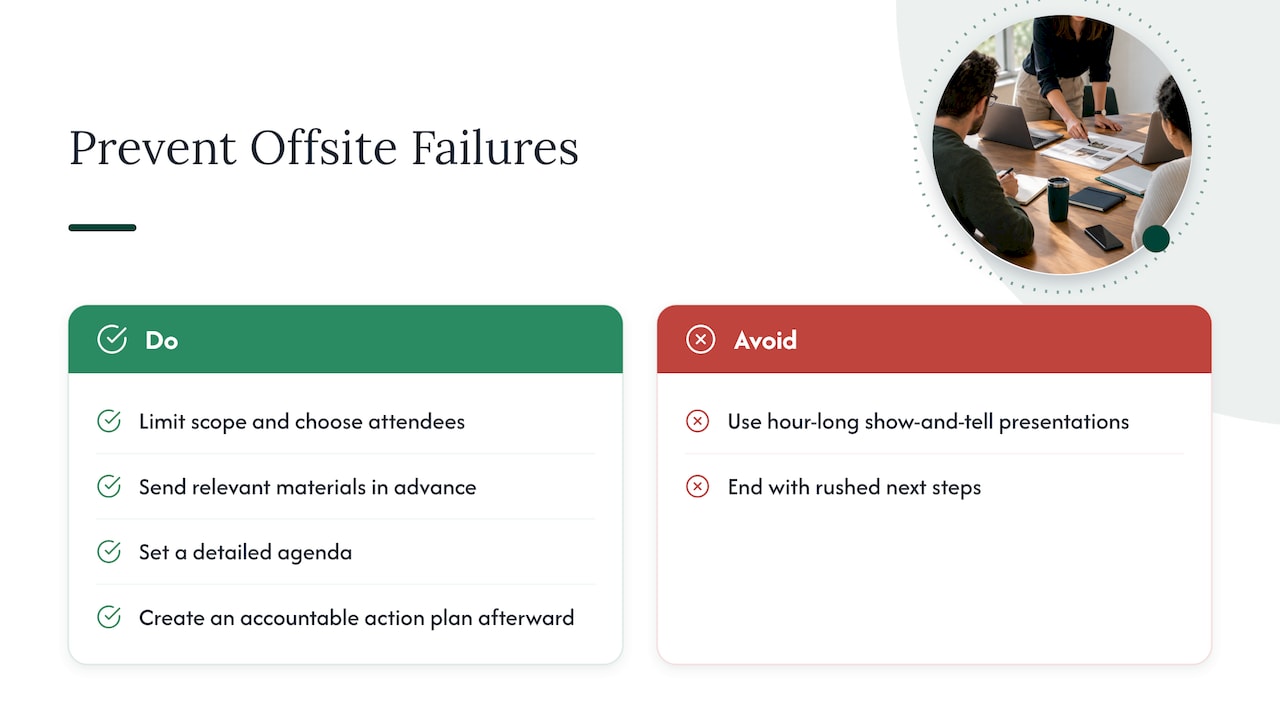
The most common failure is a lack of structure, not a lack of ideas. In Off-Sites that Work, Bob Frisch, Logan Chandler and Ruth Malloy argue that most strategy off-sites fail because they are insufficiently structured. Rigor, they say, has to begin before the meeting: limit the scope, decide who attends, send only relevant materials in advance, and set a detailed agenda. An action plan afterward carries accountability.
The second failure is the show-and-tell agenda. Each function takes an hour to present its numbers, everyone nods, and the real disagreements never surface. Presentations are information transfer. That can happen in a document read the week before. The room is expensive: it holds your most costly people for a day or two, so use it for the work that only a room can do, which is debate, trade-offs and commitment.
The third failure is vague endings. If the last session is a rushed fifteen-minute “next steps” slide, the offsite becomes a pleasant retreat with no consequences.
Start with the decisions, not the topics
Before you draft a single time slot, answer three questions for every session you are considering:
- What are we trying to decide, align on, or create?
- What will exist at the end that did not exist at the start?
- Who is facilitating, and who prepares the pre-read?
If a session cannot answer those, it does not earn a place. A topic like “marketing update” fails. A question like “Which customer segment do we stop serving next year?” passes, because it has an answer, an owner and an output.
How many decisions fit? For a two-day offsite, plan for two or three big topics per day at most. One framework for a decision-focused executive offsite, published by Rework, builds the agenda around three pre-defined decisions. Each gets a structured debate of 45 to 60 minutes. A useful variation is to name one executive in advance as devil’s advocate, so someone is assigned to argue against the leading option.
What belongs in the room, and what does not
Topics that earn offsite time share a few traits: the answer is not obvious, the choice affects more than one function, and the team will have to live with it for a year or more. Topics to leave out:
- Status updates and budget line items that can be read in advance.
- Anything one person could decide alone.
- Questions already decided, which only create the feeling of a debate.
- Operational detail. A strategy offsite planning guide from LaunchWeek lists operational details, already-decided topics and topics with one obvious answer as patterns to avoid, and recommends three deep topics of roughly two to two and a half hours each over ten shallow ones.
A sample two-day executive offsite agenda
This template assumes eight to twelve people, a two-day format and three major decisions. Adjust the topics, keep the rhythm. Finish each day by mid-afternoon: energy and candor fall off late in the day, and the best conversations rarely happen in the last hour of a long session.
Day 1: Context, then the hard choices
| Time | Block | Purpose and output |
|---|---|---|
| 8:30 to 9:00 | Arrival and personal opener | Each leader answers one non-work question. Sets a candid tone. |
| 9:00 to 10:00 | State of the business | One leader frames the facts everyone has already read. Output: shared view of where we are, and what is not working. |
| 10:15 to 12:30 | Decision 1 (the highest stakes) | Structured debate, devil’s advocate, decision or named missing information. |
| 12:30 to 1:30 | Lunch | Real break, no laptops. |
| 1:30 to 3:30 | Decision 2 | Same format as Decision 1. |
| 3:30 to 4:15 | Synthesis | Capture what was decided, what is open, and what is parked. |
| Evening | Dinner (optional) | Unstructured time to build trust. |
The highest-stakes decision goes in the morning slot because that is when most people think best. The “state of the business” block should be short and framed around what changed since the last time you met, not a tour of every dashboard.
Day 2: Remaining decisions, then commitments
| Time | Block | Purpose and output |
|---|---|---|
| 8:30 to 9:00 | Recap and overnight reactions | What stuck, what changed after sleeping on it. |
| 9:00 to 11:00 | Decision 3 or cross-functional dependencies | Where do functions block each other, and who resolves it? |
| 11:00 to 12:00 | How we work together | Team agreements: meeting cadence, escalation, how disagreement is handled. |
| 12:00 to 1:00 | Lunch | |
| 1:00 to 2:30 | Decision log and owners | Convert each decision into a written, owned commitment. |
| 2:30 to 3:00 | Close | Takeaways, appreciation, next steps in each leader’s own words. |
Note where the commitments session sits: early afternoon, not squeezed into the final minutes. Rushed action planning is one of the most common reasons implementation stalls, because the owner, deadline and measure are the parts that get skipped when people are tired and want to catch flights.
For a single-day offsite, keep the opener, the state-of-business framing, two decisions and a shortened commitments session, and cut everything else.
Agenda topics that work for strategy, brand and growth
For founders and executive teams, the best topics are the ones that connect directly to revenue and to how the market sees you. Phrase each as a question:
- Where to play. Which customers and markets will we focus on next year, and which will we stop serving?
- How we win. Why do customers choose us over alternatives, and is that still true?
- Big bets. Which one or two bets would change our trajectory?
- Pricing and packaging. Are we charging in the way that reflects the value we deliver?
- Alignment. Do product, marketing and sales describe the company the same way to buyers?
Those first four questions come from a leadership topic bank that suggests choosing three or four topics for a two-day offsite, and two for a single day.
If the offsite is about go-to-market
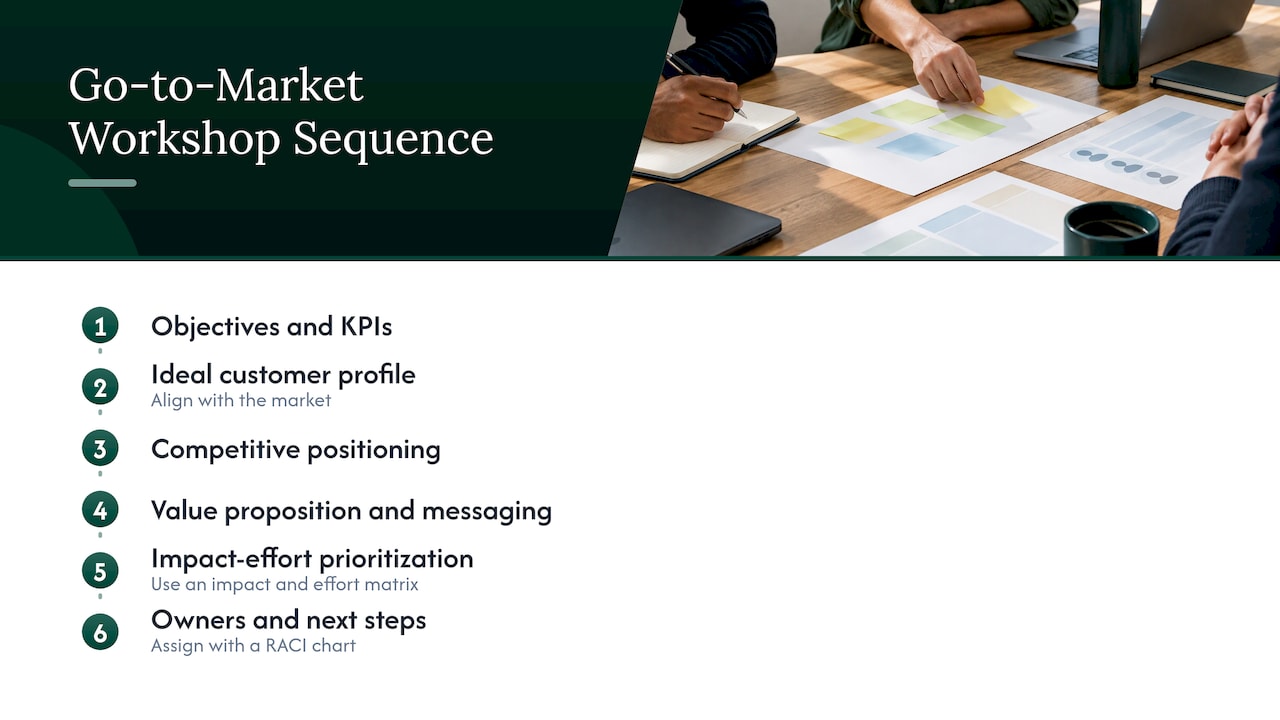
A go-to-market session needs a different run of blocks than a general strategy session. One 2026 go-to-market workshop playbook from Prospeo sequences the agenda as objectives and KPIs, ideal customer profile and market alignment, competitive positioning, value proposition and messaging, prioritization on an impact and effort matrix, and finally owners and next steps assigned with a RACI chart (a grid showing who is responsible, accountable, consulted and informed for each task). Its listed outputs include a validated ideal customer profile, a positioning framework, a launch plan, a KPI scoreboard and named owners.
If positioning is the question on your agenda, resist the urge to wordsmith a tagline in the room. Spend the session testing the position: who it is for, what it replaces, and what evidence supports it. Our walkthrough on testing a position in a 60 to 90 minute workshop shows a format that fits inside one block. For teams where marketing and sales describe the company differently, the work on sales and marketing alignment gives you the questions to put on the table.
If the topic is how customers experience the company from first contact to renewal, a half-day customer experience mapping session ends with named owners for each stage, which is precisely the kind of output an offsite agenda should demand.
If the offsite is about choosing between growth moves
Some teams arrive with two credible paths: compete harder in the existing market, or move toward a space with less competition. That is a good offsite decision because it is expensive to reverse. Frame it with a time horizon and a test. We cover how executives set 12 to 24 month tests for blue and red ocean moves, which turns a philosophical debate into a choice with a measurable checkpoint.
Prepare before the room: the pre-read
The agenda works only if people arrive informed. Keep pre-work light and specific:
- One short document per decision. Each owner writes a page or two: the question, the options, the data that matters, and their current lean.
- Two hours of reading in total, at most. If it takes longer, people skim, and the first hour of the offsite becomes a catch-up session.
- Two to five framing questions per session, printed in the agenda, so people can think before they arrive.
- Send it about two weeks ahead and make it clear that reading is an expectation, not a courtesy.
Choose attendees as carefully. Every member of the executive team belongs, and a chief of staff or a rising leader can join as an observer or note-taker if the team agrees. Adding more people makes candid debate harder.
Run the room: formats that produce decisions
The decision debate
Use a repeatable format so each decision gets equal rigor. The Rework guide describes one version: the CEO frames the decision, a pre-assigned devil’s advocate argues against the CEO’s initial lean, the group debates openly for about 30 minutes, and then the CEO decides or states exactly which information is missing. Naming the missing information matters. It turns “we need to think more” into an assignment with a date.
Do not force consensus where none exists. The goal is a clear decision that everyone understands and will support, not unanimous enthusiasm.
Prioritization methods
When you have more good ideas than capacity, use a method that forces trade-offs: dot voting, an impact and effort matrix, forced ranking, or a simple Now, Next, Later board. The method matters less than the rule that something must go in the “not now” column.
Mix the modes
Alternate whole-group discussion with small-group work and report-outs, and give people a few quiet minutes to write ideas down before anyone speaks. Quieter executives contribute more, and the loudest voice anchors the room less.
Facilitation
If the CEO both runs the discussion and holds the strongest opinion, the team learns quickly to wait for that opinion. A neutral facilitator, or at least a different leader running each block, protects the debate. Ask the facilitator to enforce time boxes and to call out when the group is circling a decision it has already made.
Close: documentation, owners and follow-up
The last working session decides whether the offsite mattered. Convert every decision into a one-page log, signed by the team. Each log entry should contain:
- The decision, in one sentence.
- One named owner: a person, not “the marketing team”.
- A specific, measurable outcome at 90 days.
- The first action, due in week one.
- What each other leader commits to in support.
That structure follows Rework’s Day 2 decision-log approach, and it is deliberately small. A page gets read. A forty-slide recap does not.
After the offsite:
- Within 72 hours, send a short written recap covering priorities, decisions, projects now paused and next steps. Prose beats a slide deck because it forces clear statements.
- Before the offsite ends, put a 30-day checkpoint on calendars. It is much harder to schedule once everyone is back in their inboxes.
- Fold decisions into your operating rhythm. Monthly reviews and quarterly resets keep the commitments alive. If one of your decisions requires steady content or campaign output, it helps to plan it around a single target, like a content calendar built around a 90-day goal, rather than filling empty slots.
If your decision involves changing how the company presents itself, the people inside need to hear it first. Our piece on why a brand rollout plan starts with employees explains how to sequence that internal launch.
Common agenda mistakes to avoid
- Too many topics. Ten shallow sessions produce ten polite conversations and no decisions.
- Presentation-heavy mornings. Departmental show-and-tell crowds out forward-looking discussion.
- Soft endings. A closing circle without owners and dates is a team-building exercise, not an executive offsite.
- Hidden agendas. If incentives are pulling executives in different directions, the debate will be about positioning, not substance. We wrote about how executive incentives quietly undermine strategy and why it deserves a place in your pre-read thinking.
- No challenge to assumptions. If every plan is accepted as given, the offsite just ratifies the last one. Strategy reviews that challenge assumptions are more useful than polished ones.
- Skipping the trust block. A short personal opener and a conversation about how the team works together make the candid sessions possible.
Our perspective
We build offsite agendas around one belief: brand is a core business strategy, not a marketing tool. That changes which questions earn a place in the room. When we help leadership teams, we look for the gap between how product, marketing and sales each describe the company, because that drift shows up in lost deals, muddled pricing and teams pulling in different directions.
Our approach comes from an operator’s seat, shaped by real-world brand building, an exit, and work behind more than 200 international retail locations. So we push for agendas that tie positioning to measurable performance. A session on “how we win” should end with a position the team can test, an owner for each action and a number to check in 90 days.
That is the idea behind frameworks like The Golden Spiral™ and Brand-Backed Performance™: iterate, connect the functions, and measure. If your offsite is going to touch positioning, go-to-market or customer experience, make those decisions the center of the agenda and do not treat them as a side conversation.
Quincy
Bring us into your offsite
If your next offsite needs to settle positioning, a go-to-market plan or alignment between product, marketing and sales, we can help you decide which questions belong on the agenda and design the sessions that answer them. Our work covers brand strategy, positioning, growth and go-to-market strategy, and founder and executive advisory, and we also run executive workshops and keynote talks for leadership teams.
To discuss a leadership team session or a keynote, start at quincysamycia.com or see our speaking page.
FAQ
What are typical items on an executive offsite agenda?
A typical agenda opens with a personal check-in and a short state-of-the-business review. It then moves to one to three major decisions, a block on how the team will work together, and a closing session of commitments with owners and dates. Status updates and budget details are usually better handled in a pre-read.
How long should an executive offsite be?
Two days suits most leadership teams with two to three major decisions. A single day works if you limit it to two topics and keep the commitments session. Finish each day by mid-afternoon so the team is still thinking clearly in the last session.
What should we avoid during an offsite?
Avoid crowding the agenda with updates, operational details, topics already decided, and questions with one obvious answer. Avoid ending with a rushed wrap-up too. Each of those turns a decision meeting into a presentation.
How do we keep the decisions from fading afterward?
Write a one-page decision log with a named owner, a measurable 90-day outcome and a first action for each decision. Send a written recap within 72 hours and schedule a 30-day checkpoint before the offsite ends.
Sources
- Off-Sites that Work, Harvard Business School Publishing
- How to Run an Executive Offsite That Produces Decisions, Rework
- Annual Strategy Offsite Planning, LaunchWeek.ai
- Leadership Offsite Agenda Topics and Questions, Offsiteio
- Go-to-Market Strategy Workshop: 2026 Playbook, Prospeo