Brand OKR Examples: Objectives and Key Results That Work
A good brand OKR names one change you want in the market and measures it with two to five key results you can check every week. The examples below cover awareness, positioning, consistency, loyalty and sales alignment, each tied to a business outcome. Brand OKRs fail when they count activity (posts, followers, press hits) instead of what customers think, choose and pay for.
TL;DR
- A brand OKR has one objective (the change) and two to five key results (the proof), reviewed on a 90-day cycle.
- Measure customer outcomes such as unaided recall, brand preference, branded search and win rate, not output such as posts published.
- Pair every brand OKR with a revenue or pipeline result so brand does not sit apart from growth.
- Set stretch targets, check in weekly, and recalibrate once mid-quarter.
- Use the examples below as shapes to adapt, not numbers to copy: your baseline decides the target.
Table of Contents
- What a brand OKR is, and how it differs from a KPI
- How to write a brand OKR in four steps
- Brand awareness OKR examples
- Brand positioning and differentiation OKR examples
- Brand identity and consistency OKR examples
- Brand and sales alignment OKR examples
- Brand loyalty and reputation OKR examples
- Weak and strong key results side by side
- Setting targets, cadence and review
- Common mistakes
- Our point of view
- Get the position right before you set the numbers
- FAQ
- Sources
What a brand OKR is, and how it differs from a KPI
OKR stands for objectives and key results. Amazon Ads defines the objective as the end goal and the key results as the measurable milestones that show you are getting there. Its brand example is an objective to increase brand loyalty, with key results of 30% more return customers and a 20% higher customer engagement score.
A KPI, by contrast, is a number you track continuously, such as monthly branded search volume. The Product Marketing Alliance notes that OKRs are meant to be more ambitious, while KPIs are tied to existing processes and are generally obtainable. In practice, KPIs are your dashboard and OKRs are the quarter’s bet. A KPI tells you where you are. A brand OKR says where you intend to move the needle this quarter and why it matters to the business.
If you want a fuller menu of what to track, our guide to metrics brand teams use to measure brand performance is a good companion.
How to write a brand OKR in four steps
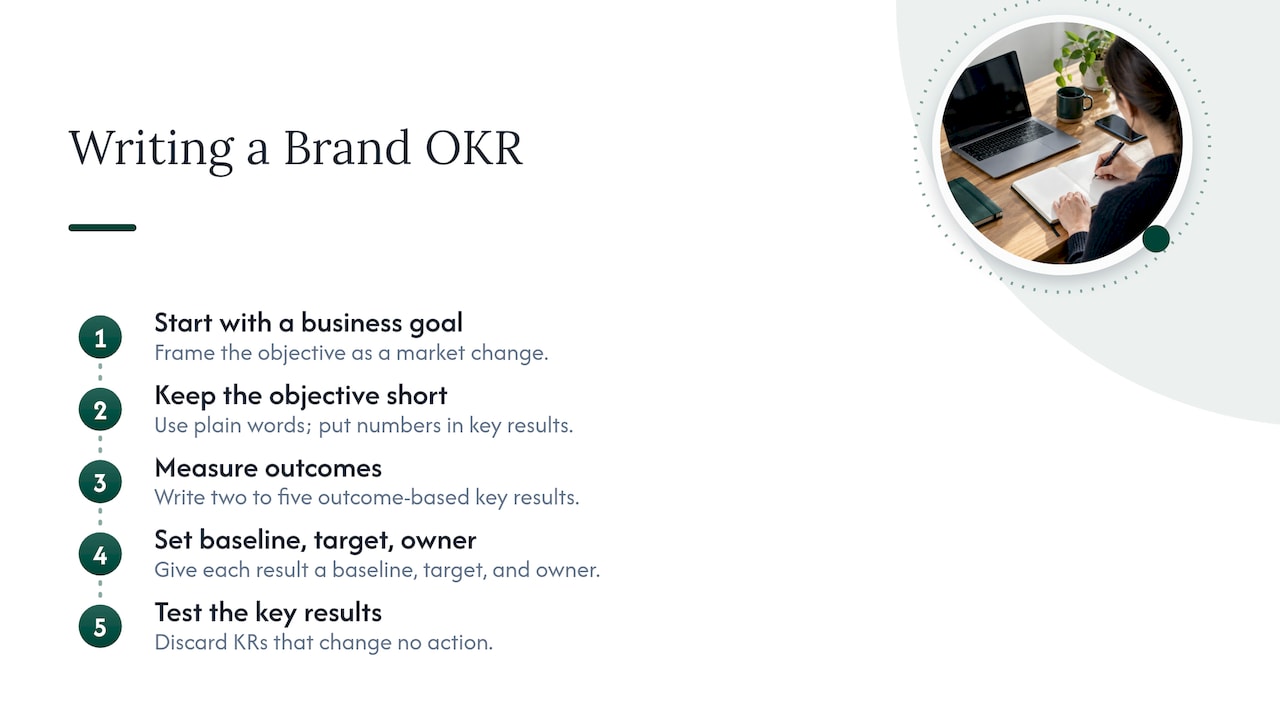
1. Start from a business goal, not a brand wish. “Be more recognizable” is a wish. “Win more deals in the mid-market segment where buyers shortlist three vendors” is a business problem a brand can address. Write the objective as the change in the market that would help solve it.
2. Keep the objective qualitative and short. One sentence, plain words, something a salesperson and a designer would read the same way. Numbers belong in the key results.
3. Write two to five key results that measure outcomes. The Product Marketing Alliance recommends a minimum of two and a maximum of five per objective. Prooflytics’ 2026 template suggests three to five objectives per quarter at most, and reports that revenue-tied OKRs such as marketing-sourced pipeline or LTV:CAC correlate two to three times better with business results than activity-tied ones. Treat that as one vendor’s finding, but the direction is sound: a key result you can connect to revenue is easier to defend in a budget meeting.
3a. Give each key result a baseline, a target and an owner. “Raise unaided recall from 12% to 22%” can be scored. “Improve recall” cannot. One named person per key result prevents the diffusion that kills most quarterly goals.
4. Run the test. Ask: if this key result were off track in week six, would we do something different? Tability’s writing guide recommends discarding any key result where the answer is no.
Brand awareness OKR examples
Awareness is the most common brand objective and the easiest to weaken with vanity metrics. Follower counts move, but they rarely tell you whether buyers in your category know you exist.
A stronger example, adapted from the Perdoo marketing OKR guide:
Objective: Move from familiar to first choice in our target market.
- Lift unaided brand recall in our ideal customer profile from 12% to 22%.
- Increase brand preference from 18% to 30%.
- Grow direct and branded traffic by 35% quarter over quarter.
Notice the mix. Two key results come from a survey of your target buyers, and one comes from behavior you can see in analytics. That pairing matters because surveys tell you what people think and traffic tells you what they do.
A startup-sized version, adapted from Brev’s marketing OKR examples:
Objective: Become a recognized name among operations leaders at mid-size companies.
- Reach 40% or higher unaided awareness in the target segment, measured by a quarterly survey of 200 respondents.
- Earn five mentions from founders or practitioners in newsletters or podcasts with audiences of 10,000 or more.
- Grow direct traffic 60% over the prior quarter.
The survey sample is stated, which keeps the measurement honest. The mentions are specific about audience size, which keeps “press” from becoming a count of any mention anywhere.
For a simpler reach-and-engagement version, DashThis offers an objective to increase brand awareness in target markets with key results to grow social followers 20%, increase branded keyword searches 11% and raise social share of voice 6%. Share of voice is your share of all the category conversation, so it is a useful relative measure when you compete with larger brands. If you need a primer on recognition versus recall, this brand recognition explainer lays out the difference.
A note on measuring awareness
Separate brand search from performance search. Google’s brand marketer guide advises judging brand campaigns on impressions, share of voice and cost per engagement rather than cost per acquisition. If you judge a brand effort on cost per acquisition, it will look worse than it is, and the work gets cut. For lift studies and how to run them, see our piece on brand lift measurement.
Brand positioning and differentiation OKR examples
Positioning OKRs are different. You are not trying to be known more. You are trying to be known for one specific thing, in the mind of one specific buyer, against named alternatives.
From the Perdoo guide:
Objective: Make our brand the default consideration in our category.
- Increase share of branded search 40% quarter over quarter.
- Reach top-three placement on the five highest-intent comparison or review pages.
- Lift unaided recall in the target profile from 12% to 22%.
A lower-cost version for an early team, drawn from the brand strategist goals at Spinach:
Objective: Land a positioning customers repeat back to us.
- Write a one-line positioning after speaking with at least 15 customers.
- Inform the tone-of-voice guide with 30 customer calls in the quarter.
- Hold at least five productive conversations a week with target buyers and share the takeaways company-wide.
This one is mostly inputs, which is acceptable at the very start when you do not yet have a baseline to measure. The moment the positioning exists, the next quarter’s key results should shift to outcomes: do buyers describe you the way you intended?
If you need to define the position before you can measure it, our brand positioning examples and positioning frameworks pieces each walk through a 60 to 90 minute workshop.
Brand identity and consistency OKR examples
Consistency is where brand quality shows up in daily work. Tability’s brand template has an objective to build a strong, consistent brand with these key results:
- 80% of people correctly identify the brand against competitors in blind tests.
- Brand guidelines cover 100% of public-facing assets.
- Websites, emails and keynotes all use the new guidelines.
The blind-test result is the one worth keeping. It checks whether the identity works, not just whether the files were updated.
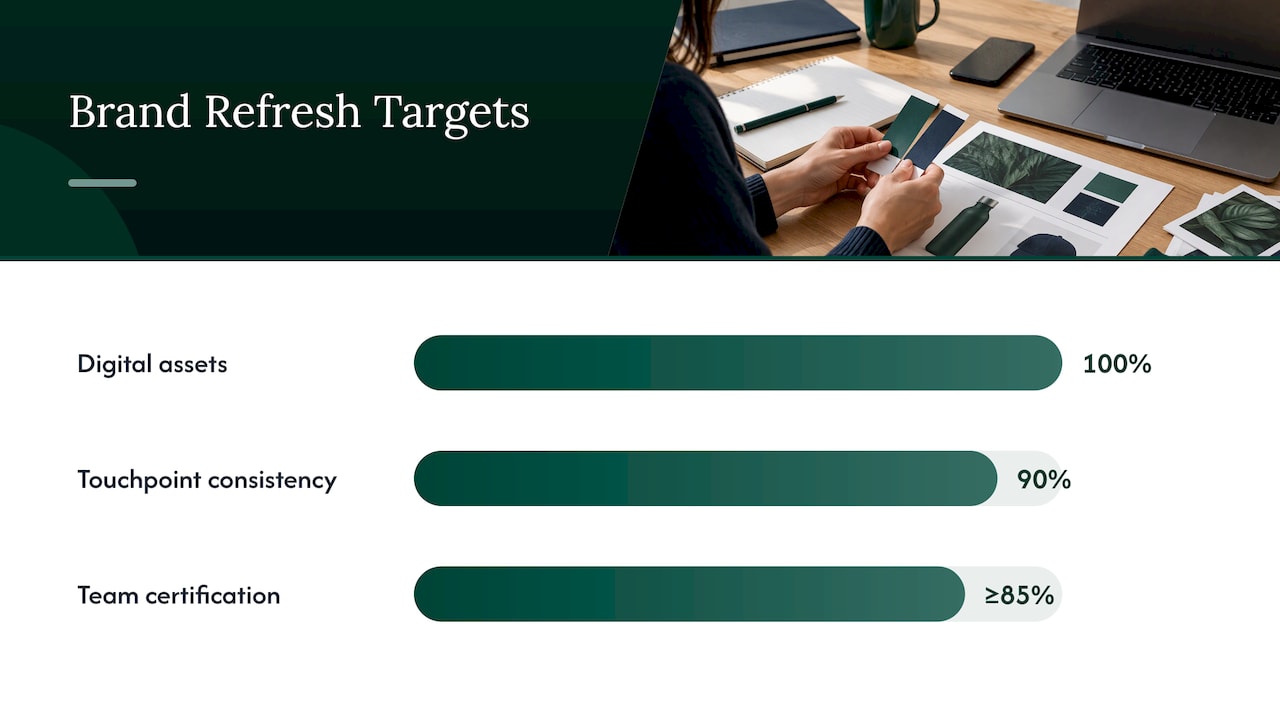
When the work is a larger refresh, Springhire’s examples show how far a consistency objective can go: update 100% of digital assets by the end of month two, hit a 90% consistency score in an audit of more than 200 touchpoints, and train every customer-facing team to an 85% or better certification pass rate. The training key result is what separates a refresh that lives in a PDF from one that shows up in sales calls and support replies.
Brand and sales alignment OKR examples
This is the category most brand OKR lists skip, and the one executives care about most. Brand clarity is supposed to make revenue work easier. Say so in the OKR.
Adapted from the Prooflytics template, a shared marketing and sales objective:
Objective: Hit the new-customer target with healthy unit economics.
- Marketing-sourced pipeline reaches the agreed dollar target.
- SQL-to-closed-won conversion reaches 25%.
- Time from marketing-qualified lead to closed-won falls from 45 to 30 days.
And from Springhire, an objective to build an integrated brand measurement system, with a multi-touch attribution model covering 90% of marketing-influenced deals. Attribution is imperfect, so treat these as directional evidence rather than proof. A cleaner test is the holdout: run a campaign in some markets and not others, then compare. Our piece on turning brand clarity into revenue with a sales and marketing agreement covers how to set the shared definitions these key results depend on.
Brand loyalty and reputation OKR examples
Loyalty objectives work well for companies with repeat customers. Amazon Ads’ example above is the shape: return customers up 30%, engagement score up 20%. For reputation, OKRify’s examples set measurable targets: at least 500 positive mentions in the first quarter, 50% of negative mentions addressed in the second, and a loyalty program enrolling at least 1,000 customers with repeat purchases up 5% by the third.
One caution: mention counts reward volume. If you use them, add a quality key result, such as a sentiment score or the share of mentions from your target buyers. For the bigger question of what actually earns repeat business, read our take on why recognition beats points in brand loyalty.
Weak and strong key results side by side
| Weak (activity) | Stronger (outcome) |
|---|---|
| Publish 12 thought leadership posts | Earn five mentions from audiences of 10,000 or more |
| Grow followers 25% | Grow branded search share 40% quarter over quarter |
| Launch new brand guidelines | 100% of public-facing assets compliant, 80% correct identification in a blind test |
| Run an awareness campaign | Lift unaided recall in the target segment from 12% to 22% |
| Hire an agency by Q2 | Raise brand preference from 18% to 30% |
| Hold weekly positioning meetings | Buyers repeat the one-line positioning in customer calls |
Some published lists contain items from the left column, for example hiring an agency or holding review meetings. They are tasks, not results. Keep them in the project plan, not in the key results.
Setting targets, cadence and review
Brand moves slower than demand, so give it a longer view without losing the quarterly rhythm. A workable cadence, assembled from the Orbitdeck 2026 framework:
- A 12-month north star objective for the brand, broken into three or four quarterly objectives.
- Three to five key results per objective, each mapped to a metric on a weekly scorecard.
- A short check-in each Monday with a red, amber or green status.
- A mid-quarter recalibration around week seven to drop, add or rewrite key results that have gone stale.
- A retro at week 13 to score the quarter and reset.
On target-setting, Prooflytics suggests setting targets at about 70% confidence, which means you expect to land near the target and a stretch lands you slightly short of it. Keep in mind that brand survey metrics move only when you have enough responses, so if you cannot field a survey of a few hundred target buyers each quarter, run it twice a year and use branded search and direct traffic as the in-between signals.
If your brand work depends on a go-to-market launch, sequencing matters as much as targets. This 90-day go-to-market plan shows how a quarter-long runway can be organized around a launch.
Common mistakes
- Too many objectives. Past five, nobody can remember them. Pick the one or two that matter to growth this quarter.
- No baseline. Without a starting number, a key result is a guess. Run the first survey or pull the first analytics number before you set the target.
- Brand OKRs owned by no one. Brand spans product, marketing and sales. Assign one executive owner and name the contributors.
- Brand and demand set against each other. Perdoo argues that brand work compounds over time and makes other channels cheaper, and it recommends pairing brand OKRs with demand OKRs. Do that, and measure outcomes instead of output.
- Changing targets mid-quarter. Recalibrate once, deliberately, in week seven, not every time a number looks bad.
Our point of view
Most brand OKRs we see are a list of marketing tasks with percentages attached. The problem is upstream. If the team has not agreed on who the brand is for and what it stands for against the alternatives, any metric you pick will measure motion, not progress.
We treat brand as a business strategy, not a marketing tool. That means the OKR conversation begins with product, marketing and sales in the same room, agreeing on the position, and only then picking the few numbers that prove it is working. Our Brand-Backed Performance™ approach is built to connect brand strategy to measurable business results, and The Golden Spiral™ is one of the frameworks we use to keep that alignment iterating instead of drifting.
My advice is simple. Choose one position. Write one objective around it. Give it key results that a customer, not a calendar, can verify. Then review it every week.
Quincy
Get the position right before you set the numbers
Brand OKRs only work when the position underneath them is clear and shared across product, marketing and sales. That is the work we do: brand strategy, brand positioning, and growth and go-to-market strategy, built on an operator’s perspective and designed to tie brand directly to business performance. If your team is writing OKRs around a position it has not yet agreed on, start with the position.
See our brand strategy and growth advisory services, or look at our brand strategy frameworks to see how we structure the work.
FAQ
How many OKRs should a brand team have?
One to three objectives per quarter, each with two to five key results. The Product Marketing Alliance gives the two-to-five range for key results, and Prooflytics suggests three to five objectives as a ceiling for a whole marketing team. A brand-specific set should sit well below that ceiling so the work stays focused.
Are OKRs better than KPIs for brand?
They do different jobs. KPIs are the steady metrics you watch all the time, and OKRs are the specific changes you are chasing this quarter. Most teams pick two or three KPIs as the source of their key results, so the two systems feed each other.
What is a good brand awareness key result?
A good one is measured among your target buyers and has a baseline and a deadline, such as lifting unaided recall in the ideal customer profile from 12% to 22% by quarter end. Pair it with a behavioral signal such as branded search share or direct traffic.
How often should we measure brand OKRs?
Track behavioral metrics weekly, run surveys quarterly or twice a year, and grade the whole set at the end of the 90 days. Make one recalibration around week seven if a key result has gone stale.
Sources
- Amazon Ads: What is an OKR?
- Product Marketing Alliance: What are OKRs in product marketing?
- Prooflytics: Marketing OKRs Template 2026
- Tability: How to write OKRs
- Perdoo: 20 OKR examples for marketing teams
- Brev: OKR examples for marketing teams
- DashThis: Guide to marketing OKRs
- Think with Google: Search for Brands
- Spinach: Brand strategist OKR examples
- Tability: Brand OKR templates
- Springhire: Marketing OKR examples
- OKRify: Brand marketing OKR example
- Orbitdeck: Marketing OKRs 2026 framework