Brand Workshop Cost: What US Teams Pay in 2026
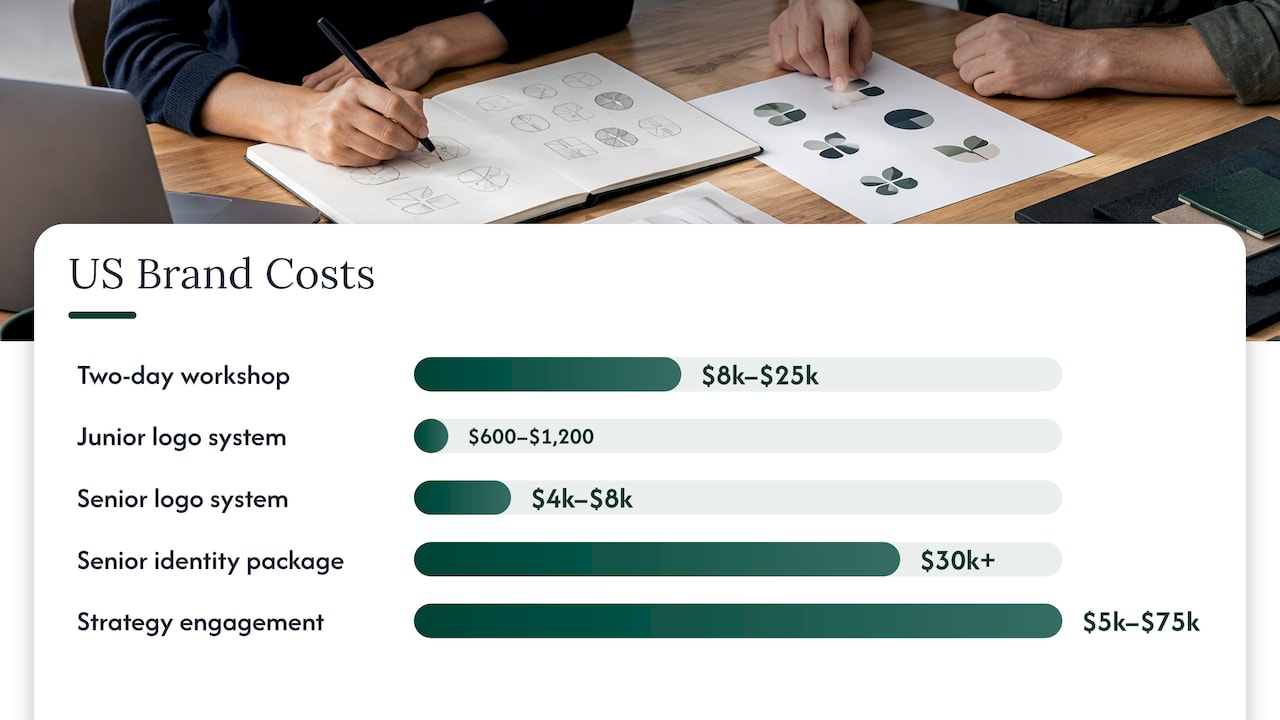
A brand workshop led by a senior strategist is usually priced as a fixed-fee project, and a two-day executive positioning workshop commonly lands between $8,000 and $25,000 once pre-reads, interviews, facilitation and synthesis are counted. The number matters less than what it buys. A workshop that ends with a shared position your product, marketing and sales teams will act on is cheap. One that ends with a photographed whiteboard is expensive at any price. This guide shows what drives the fee, how to read a quote, and how to budget so the workshop pays back.
TL;DR
- A two-day executive positioning workshop from a senior consultant is typically scoped at $8,000 to $25,000 as a fixed fee, separate from any retainer.
- Most of the fee is work you never see in the room: stakeholder interviews, prep and synthesis. Twenty interviews can take 50 to 70 hours before strategy work starts.
- Duration, number of participants, interview depth and deliverables move the price more than the facilitator’s hourly rate.
- Before comparing quotes, fix the decision the workshop must produce, who must be in the room and what you will have in hand a week later.
- Pay for the outcome (a position the whole company uses), not for exercises.
Table of Contents
- What a brand workshop is, and what you are really buying
- What brand workshops cost in the US
- What drives the price
- What a fair quote should list
- A budgeting approach for founders and leadership teams
- Where workshop money gets wasted
- Promo: workshops at Quincy Samycia
- FAQ
- Sources
What a brand workshop is, and what you are really buying
A brand workshop is a facilitated working session in which a leadership team decides who the company is for, what it stands for, why it wins and how that gets said consistently. For a founder or executive, the useful version is a decision-making session. You walk in with disagreements between product, marketing and sales, and you walk out with one position everyone can defend.
That is why the fee does not track time in the room. The room is the visible 10 to 20 percent. The rest is preparation that makes the room productive: reading the existing materials, hearing from customers and the sales team, and turning two days of discussion into a document people will use on Monday.
If you want to see what a short, tightly run session looks like, our notes on 90 minute brand workshop exercises and testing a position in a 60 to 90 minute workshop show how much can be decided in a compact format when the groundwork is done.
What brand workshops cost in the US
Published figures vary because “brand workshop” covers very different products. The most useful way to read them is by scope.
| Format | What it typically covers | Where the fee sits |
|---|---|---|
| 60 to 120 minute session | One decision: a positioning statement, a message hierarchy or a competitive frame | Lowest tier, often scoped as a add-on to an existing engagement |
| Half-day or one-day workshop | Positioning, audience and messaging for one leadership team | Mid tier, with the fee driven by prep and documentation |
| Two-day executive positioning workshop | Pre-reads, interviews, facilitation across functions and a written synthesis | $8,000 to $25,000 as a fixed fee |
| Workshop as part of a strategy engagement | Workshop plus research, strategy, rollout and measurement | Priced as the engagement, often with an ongoing advisory option |
Two cautions on reading any range. First, a figure is a snapshot of one pricing period, and consultant rates move with demand and seniority. Second, ranges describe a workshop as a stand-alone deliverable. Once research, a full strategy and rollout support are folded in, you are no longer buying a workshop. You are buying a strategy project, and our guide to budgeting brand strategy from $5,000 to $75,000 covers that wider picture.
It also helps to separate a workshop from design work. A logo system or visual identity is a different purchase with its own price scale. Rate data for US designers puts a logo system at $600 to $1,200 for junior designers and $4,000 to $8,000 for senior designers, with full identity packages running to $30,000 or more at the senior end. A workshop decides what the identity must say. Buying the design first and the position later is the most common way teams pay twice.
What drives the price
Five things move a workshop fee. Knowing them lets you ask better questions and compare quotes honestly.
Seniority and the kind of experience
You are paying for judgment under pressure: noticing when a room has agreed on a vague phrase to avoid an argument, and pushing until the real choice is on the table. An operator who has built and exited brands brings a view of what survives contact with sales and finance. That difference shows up in the outcome more than in the hourly rate.
Stakeholder interviews
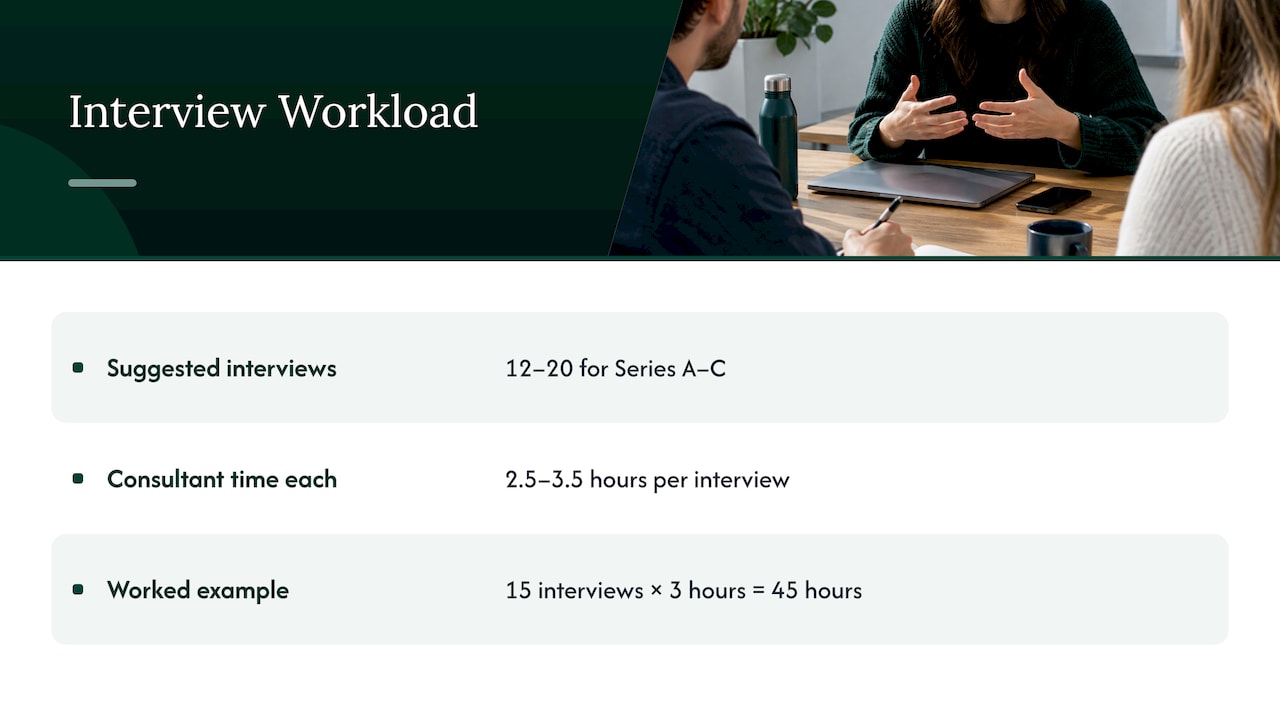
Interviews are the biggest hidden cost. Rate data indicates each 60-minute stakeholder interview consumes 2.5 to 3.5 hours of consultant time once scheduling, preparation, transcript review and synthesis are included. For a Series A to C company, the same source suggests 12 to 20 interviews: founders and executives, top sales reps, customer success leaders, six to ten current customers and three to five lost deals or churned prospects.
A worked example: 15 interviews at three hours each is 45 hours of work before anyone enters the workshop room. That is more than five full working days. A quote with no interviews is cheaper because it replaces evidence with opinion, and opinion is exactly what a workshop exists to move past.
Participants and functions
A workshop with the founders alone is simpler than one that must align product, marketing, sales and customer success. More functions mean more pre-work, more tension to resolve and a longer synthesis. They also produce the outcome most teams actually want, which is alignment that holds after the session.
Duration and format
Two days cost more than one, but a second day is not simply double. Day one usually diagnoses and debates. Day two decides and tests. Shortening the format works when the team already has research and a clear brief, and it fails when the team is hoping the room will generate the facts.
Deliverables
What do you hold at the end? A good workshop leaves a written position, the proof points behind it, messaging guardrails and a plan for who changes what. Our breakdown of five brand strategy deliverables with templates shows what a complete handoff includes. A fee that covers only facilitation leaves your team to write all of that.
What a fair quote should list
When quotes arrive, line them up on the same items. A workshop quote worth accepting names:
- The decision it will produce. For example: a single positioning statement and the three claims that support it.
- Pre-work. How many interviews, with whom, and who reviews customer and sales data.
- Participants. Who must be in the room and who is optional.
- Format and length. Days, hours per day, in person or remote.
- Deliverables. What you receive and how soon after the session.
- Follow-through. Whether anything happens in the 30 days after, such as a review of how teams used the position.
- What is not included. Design, copywriting and research are separate purchases and should be priced as such.
Two quotes that differ by $10,000 usually differ on items two and five. Ask the lower one to price the same interviews and the same written output before you call it a saving.
A budgeting approach for founders and leadership teams
Start from the decision, not the day rate.
Early-stage founders. If you are pre-revenue or just past it, a full two-day executive format is rarely the right size. One consultant view for early startups is that a lean starter package at a standard day rate is better than a steep discount, because discounting tends to cut the preparation that makes the work useful. A shorter, tightly scoped session aimed at one decision, such as who your first buyer is and why they choose you, gets you a usable position at a founder-friendly scale. Our piece on startup brand strategy as a growth metric explains how to make that position measurable.
Growth-stage companies. Here the cost of misalignment is higher than the cost of the workshop. If sales pitches one story, the website tells another and product ships to a third, the fee is small next to the pipeline lost to confused buyers. A cross-functional format with interviews earns its price.
Established teams. If the position exists but has drifted, begin with a positioning audit. It shows where the gap is before you commit to a full workshop, and it often narrows the workshop to a single day.
A simple test for any budget: write down the commercial result you expect, such as shorter sales cycles, fewer discount requests or a clearer pitch for new hires. If the workshop fee is a small fraction of what that result is worth, the budget is reasonable. If you cannot name the result, fix that first. Pricing is often the first place a weak position shows up, and our pricing and positioning playbook for leaders walks through how to quantify it.
Where workshop money gets wasted
- No evidence going in. Teams debate adjectives instead of customer reasons. Interviews and win-loss data fix this.
- The wrong people in the room. If the person who signs off on messaging is absent, the workshop produces a recommendation, not a decision.
- Design before direction. Commissioning a new identity before agreeing the position leads to a rebuild.
- No owner after. A position nobody governs drifts back to old habits within a quarter.
- Generic frameworks. Exercises that could be run for any company produce statements that could belong to any company.
Promo: workshops at Quincy Samycia
We run executive workshops as part of a structured method, The Branded Agency, that ties brand strategy to measurable performance and connects positioning with product, marketing and sales through frameworks such as The Golden Spiral™ and Brand-Backed Performance™. Our offers include Brand Strategy, Brand Positioning, Growth and Go-to-Market Strategy, Customer Experience, AI and Marketing Strategy and Founder and Executive Advisory. We do not publish a price list, because scope depends on your team, your stage and the decision you need to make.
If you want a workshop scoped around a specific decision, start with our services and tell us what your team needs to align on.
Our view: pay for alignment, not for a day
We have spent our careers building brands and taking them through exits, including work that reaches over 200 international retail locations. The pattern we see in how teams think about brand is consistent: they treat it as a marketing expense, so they buy a workshop the way they buy a campaign, as an event.
We treat brand as a core business strategy. That changes what a workshop is for. It exists to remove drift between what product builds, what marketing says and what sales promises, and to give buyers a clear reason to choose you over the comparison set they are already running.
So we scope by outcome. What decision must the team leave with? Who has to be in the room for it to stick? How will we know in 90 days that the position is working in the pipeline, in the pitch and in the customer experience? When those answers are clear, the fee is easy to justify and the workshop is rarely wasted.
Our approach is iterative on purpose. A position is tested, used by sales and refined, rather than handed over as a document. That is the difference we aim for between clarity that holds and a pleasant two days.
Quincy
FAQ
How much does a brand strategy workshop cost in the US?
For a senior consultant, a two-day executive positioning workshop is typically scoped at $8,000 to $25,000 as a fixed fee. Shorter, single-decision sessions cost less, and workshops folded into a wider strategy engagement are priced as part of that engagement.
What does a brand workshop fee typically include?
A complete fee covers pre-reads, stakeholder interviews, facilitation and a written synthesis of what was decided. Interviews alone can account for dozens of hours, which is why a quote that omits them looks cheaper but delivers less evidence.
Is a workshop the same as a branding package?
No. A workshop decides your position and messaging. A branding package usually means visual identity, such as a logo system, which is priced on a separate scale. Decide the position first so the design has something to express.
Should a startup buy a full executive workshop?
Most early startups are better served by a lean, tightly scoped session aimed at one decision, such as target buyer and core claim. As the team and the number of functions grow, the case for a longer cross-functional workshop gets stronger.
Sources
- Brand Positioning Consultant Rate Calculator 2026
- Freelance Graphic Designer Rates in 2026
- Brand Strategy Pricing for Startups, 2026 Rates