
Founder Brand Strategy: A Practical Guide to Building One
A founder brand strategy is a deliberate plan for how you, as the person behind the company, show up so that the right buyers, hires and partners understand what the business stands for and trust it. It works when it is tied to a specific audience, a clear position and a business outcome. It fails when it becomes a posting habit with no job to do. This guide walks through the steps, the structure that keeps the brand from depending on you alone, and how to tell whether it is working.
TL;DR
- Start with the decision you want a specific audience to make, not with the platform you want to post on.
- Build on three things: authenticity, a clear point of view and consistency, then back them with proof.
- Own one narrow subject. Depth beats breadth when people decide whom to remember.
- Make the founder story a system the company can use in product, marketing and sales, so it does not rest on one person.
- Measure trust, differentiation and revenue signals separately, and review them on a fixed rhythm.
Table of Contents
- What founder brand strategy actually means
- The three pillars to build on
- Step 1: Define the audience and the decision
- Step 2: Choose the space you intend to own
- Step 3: Turn lived experience into a credible story
- Step 4: Build content pillars and a distribution plan
- Step 5: Design the brand so it does not depend only on you
- Aligning the founder story across product, marketing and sales
- How to measure whether it is working
- A founder’s perspective
- Work with us on your founder brand
- FAQ
- Sources
What founder brand strategy actually means
There are two layers, and founders often blur them.
The first is the company brand: what the business promises, to whom, and why it is different. The second is the founder’s public presence: the stories, opinions and proof that make you a credible voice on the problem your company solves. A founder brand strategy connects the two so that your visibility makes the company easier to choose.
The US Chamber of Commerce makes the same point in its April 2026 guidance: founders who position themselves as the face behind the brand can build stronger connections and trust. It adds that visibility alone is not enough, because people need to trust the founder before they work with them.
That is the practical test. If a prospect has read your posts, heard you speak, or watched your demo, are they closer to a decision? If not, the strategy is producing activity and not growth.
This is also why we treat brand as a business strategy and not a marketing accessory. The founder’s story only compounds when product, marketing and sales all tell the same one.
The three pillars to build on
The same US Chamber guide describes a strong personal brand as resting on three pillars:
- Authenticity. You define your message, your audience and what you want to be known for.
- A clear and engaging point of view. You share what you believe and how you think differently.
- Consistency. You show up reliably, so the brand feels familiar and trustworthy across platforms.
For a founder, each pillar maps to a concrete piece of work. Authenticity becomes your story and your boundaries. Point of view becomes your positioning and the opinions you will defend. Consistency becomes your content system and your operating rhythm. The steps below follow that order.
Step 1: Define the audience and the decision
Most founder brands stall because they try to speak to everyone. Start narrower. Name the groups whose trust moves the business: customers, investors, early adopters, future hires, partners. One of them should be primary for the next two quarters.
Then name the decision you want that group to make. A useful sentence structure, adapted from a messaging framework published by Heavybit, is a short positioning statement of no more than 25 words: for a specific target audience, your product provides three brand pillars, because of a short headline benefit. Keep it plain. If you cannot say it in one breath, you will not be able to repeat it consistently.
Two additions make it sharper:
- A boundary. Write down what you do not want to be known for. It keeps your content from drifting into whatever happens to get attention that week.
- A goal tied to the business. “More followers” is not a goal. “More qualified conversations with VPs of marketing at Series A to C companies” is.
If you are not sure who your best-fit buyer is, fix that first. Our ideal customer profile framework takes you from data to the actions sales reps can use, and it gives the founder brand a real audience to speak to.
Step 2: Choose the space you intend to own
Positioning is the deliberate choice of the space you want to hold in people’s minds. A PR-agency guide on founder positioning argues that it is more powerful to be the founder associated with one specific subject than a generalist with shallow views on many. It also argues that a founder with a clear, defensible position becomes a reference point, while one who echoes the consensus gives audiences nothing to remember.
In practice, choosing a space means answering three questions:
- What recurring problem do your best customers have that you understand unusually well?
- What do you believe about that problem that most of your category gets wrong?
- What have you done, built or seen that proves you know it firsthand?
Your answers become the spine of everything else. Write them as a single sentence: who you help, with what problem, through what distinctive approach, and based on what proof. Then test it against your company positioning. If the founder says one thing and the website says another, buyers feel the drift even when they cannot name it.
For concrete patterns of what clear positioning looks like, see our brand positioning examples, built for a 60 to 90 minute team workshop.
Step 3: Turn lived experience into a credible story
Buyers, investors and candidates all ask some version of the same question: why you, and why this? Your story is the answer, and it only needs to be true, specific and short.
A founder brand playbook from ScaleVP identifies three categories of founder story: the customer’s story and pains, a transformative shift in the market or your thinking, and the founder’s own journey. It also states that lived experience is the best source of content for founder-led marketing. That matches what we see: the moments founders skip over, such as a failed launch, a pricing mistake or a customer who churned, often carry the most credibility because they show you understand the problem from the inside.
A simple structure keeps the story tight:
- The problem you saw, in the customer’s words.
- The moment you realized it could be solved differently.
- The action you took.
- The impact, with a number or a customer outcome where you have one.
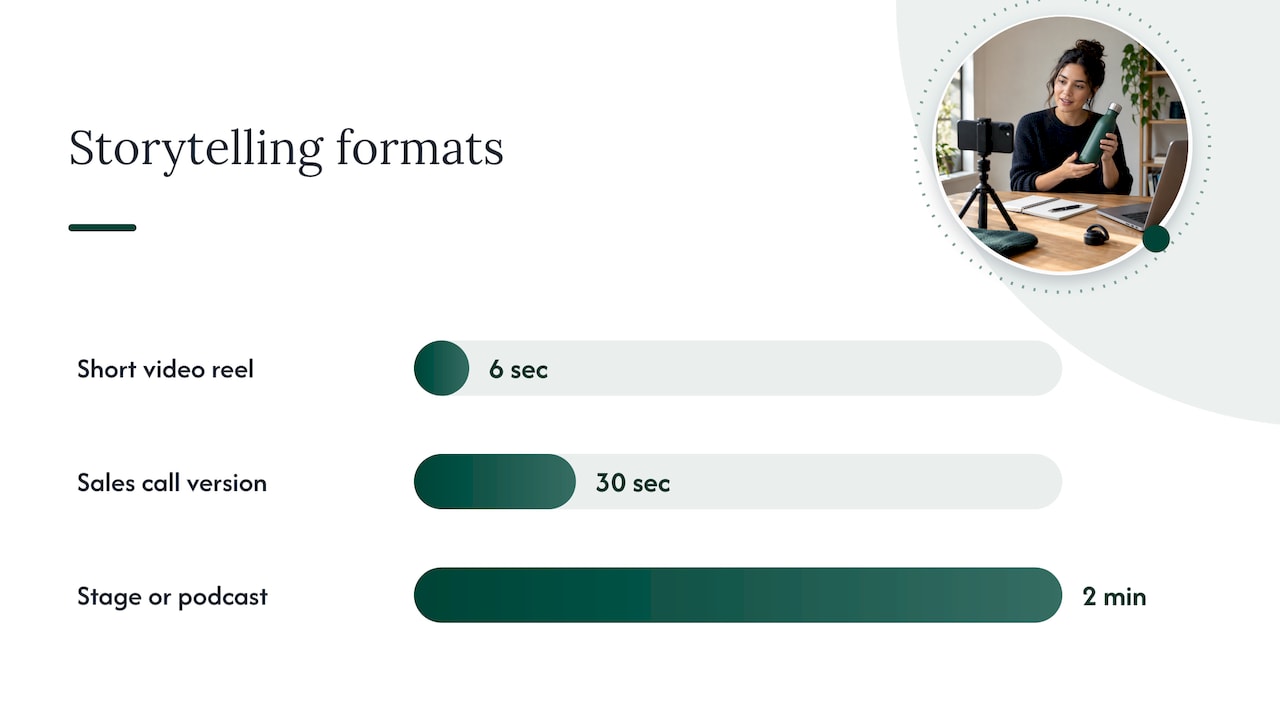
Tell it like a trailer, not a director’s cut. You will need a 30-second version for a sales call, a two-minute version for a stage or podcast, and a longer written version for your site.
Stories can also anchor go-to-market. In an interview with Data-Mania, Bala Thavarajah, founder of Getmee, described using his story as a migrant who arrived without English to anchor his early go-to-market. He said his first institutional customers signed because the mission was credible in a way a pitch deck could not manufacture.
If you are also shaping the narrative for fundraising, a guide to founder pitch decks can help you compress the same story into slides without losing the specifics. For the formats that hold up in short video, our brand storytelling framework covers how to make a story survive a six-second reel.
Step 4: Build content pillars and a distribution plan
Once the position and story are set, content is execution. Aim for three pillars, each with a different job:
| Pillar | Job | Example topics |
|---|---|---|
| Teach the method | Shows you know the craft | Your framework, how you diagnose the problem, templates |
| Show operating evidence | Builds trust through transparency | Decisions, mistakes, tradeoffs, results |
| Challenge assumptions | Makes you memorable | What your category gets wrong, and why |
The US Chamber guide recommends several tactics that fit this model: educate your audience with helpful insights, use video to build familiarity, add a clear call to action when it is relevant, and highlight proof points such as results, testimonials or experience.
Choose one or two channels where your primary audience already pays attention. For B2B founders that is usually LinkedIn, plus talks, podcasts and your own site. A practical executive LinkedIn strategy shows how to connect founder visibility to business development rather than treating posts as an end in themselves.
Two habits matter more than any tactic:
- Always have a next step. Each piece should point to one thing: a guide, a call, a conversation.
- Reuse the best material. One strong idea can become a post, a sales email, a talk segment and a section of a deck.
If you want the longer playbook for turning this into pipeline, our guide on founder-led branding as a revenue engine lays out a 90-day plan.
Step 5: Design the brand so it does not depend only on you
The most common risk of a founder brand is concentration. If every deal, hire and headline rests on your personal energy, the company’s brand is fragile and your calendar is the bottleneck.
Success magazine’s piece on the founder personal brand trap suggests three moves:
- Document your perspective, including hot takes, frameworks and opinions, as intellectual property.
- Design for absence by stepping back each quarter to see what breaks.
- Separate your personal story from your strategy, so the methodology and point of view can be licensed into the company.
In practice that means a shared model. You articulate the mission and the point of view. Practitioners on your team explain the work. Customers describe their own experience. The company owns support and institutional knowledge. Over time you move from founder-led marketing to founder-informed marketing: you still shape the story and appear at the moments that matter, but the system no longer needs you for every piece of output.
A monthly founder interview is a good engine for this. One recorded conversation can feed an article, several social posts, a sales memo, a customer newsletter section and talking points for a webinar. Your time is spent once and the company gets the output many times.
For executives who want this to hold up in front of a board, our guide to a measurable thought leadership strategy goes further.
Aligning the founder story across product, marketing and sales
As the company grows, the founder story gets retold by people who were not there. That is where drift starts: sales emphasizes price, marketing emphasizes vision, product emphasizes features, and the founder says something else on stage.
One approach we use is to treat the founder narrative as a source document, then translate it for each function:
- Product: the problem statement and the principle behind your key tradeoffs. Teams use it to decide what not to build.
- Marketing: the point of view, the three content pillars and the proof library.
- Sales: a short version of the story, the questions it answers, and the customer examples that back it up.
Run a short alignment session with leaders from each function. Ask each one to explain, without notes, who you serve, why you win and what you do not do. The gaps between their answers are your work list. Our guide to startup brand strategy explains how to make brand a growth metric, and pricing and positioning shows how to keep what you charge consistent with what you say.
How to measure whether it is working
Founder brand results are slow and noisy, so measure in three layers and review them on a fixed schedule, such as monthly for activity and quarterly for outcomes.
Trust signals. These show people are listening and believe you:
- Inbound messages that reference your ideas or content
- Prospects who arrive already knowing your point of view
- Invitations to speak, podcast or advise
Differentiation signals. These show you own your space:
- Prospects describing your company in the words you use
- Fewer sales conversations that turn into price comparisons
- Team members, from product to sales, answering “why us” the same way
Business signals. These show the strategy earns its place:
- Qualified conversations sourced or influenced by founder content
- Sales cycle length and win rate on deals where the buyer engaged with you first
- Hiring quality and speed for roles where candidates cite your story
Add a simple question to your intake forms and discovery calls: “How did you first hear about us, and what made you reach out?” Record the answers in your CRM in the buyer’s own words. Over a quarter, patterns appear that no dashboard will show you.
Be honest about attribution. Founder content rarely gets last-touch credit, so look for influence, not just source. Compare deals where the buyer engaged with your content against those that did not, and watch the direction of the trend over time.
A founder’s perspective
We approach founder brand strategy as an operator would. A founder’s visibility is only worth the effort if it makes the business easier to choose, and that requires clarity and alignment first.
The pattern we see most often is drift. The founder tells one story, the website tells another, and sales improvises a third. Buyers then fall back on comparison, because nothing has told them what is different. A founder brand that sits on top of that confusion just makes the confusion louder.
Our method connects positioning, product, marketing and sales through iterative frameworks, so the founder’s story becomes a working asset instead of a personality showcase. We tie it to measurable performance and to the customer experience, because that is where trust is either kept or lost.
If you are building a founder brand, start with the position you want to own, make it true across every function, and only then amplify it. Visibility is the last step, not the first.
Quincy
Work with us on your founder brand
If you want a second set of eyes on your positioning, story and go-to-market, we work with startup founders, executive teams and marketing teams on brand strategy, brand positioning, growth and go-to-market strategy, customer experience and founder and executive advisory. Our approach is built on an operator’s view, informed by hands-on brand building and exit experience, and aims to connect brand to measurable business outcomes rather than surface-level branding.
You can see the full range of services on our main site, explore our brand strategy frameworks, or look at speaking if you want a keynote or workshop for your leadership team.
FAQ
What is the difference between founder-led branding and a founder brand strategy?
Founder-led branding describes the practice of the founder being the public face of the company. A founder brand strategy is the plan behind it: the audience, the position, the story, the content pillars and the way you measure results. Without the strategy, founder-led branding tends to be inconsistent and hard to connect to revenue.
Should the founder or the company be the main brand?
It depends on how much trust your buyers need before they commit. A useful rule is that the founder should be as visible as the company’s trust and communication job requires, and no more. Many growing companies use a shared model: the founder articulates the mission, while practitioners and customers explain the work.
How long does it take to see results from a founder brand?
Expect trust signals, such as inbound messages and better-informed prospects, before you see revenue effects. Revenue influence takes longer because founder content shapes consideration early in the buying process. Review activity monthly and outcomes quarterly, and judge the trend and not any single post.
What should a founder avoid when building a personal brand?
Avoid being a generalist with opinions on everything, and avoid separating your story from your company’s positioning. Also avoid building a brand that only works when you personally show up. Document your frameworks and point of view so your team can carry them.
Sources
- How to Build a Strong Personal Brand, US Chamber of Commerce
- Messaging Framework & Template for Founders, Heavybit
- Personal Branding for Founders: A Step-by-Step 2026 Guide, Mediatronics PR
- Founder brand playbook, ScaleVP
- Startup Go-To-Market Strategy: Bala Thavarajah, Data-Mania
- The Personal Brand Trap Most Founders Never See Coming, Success
- Executive LinkedIn Strategy: A Practical B2B Playbook
- Custom Pitch Deck Consultant: A Founder’s Guide