
Go-to-Market Positioning: How to Define and Test It
Go-to-market positioning is the decision about who your offer is for, what it is the best choice for, and which alternatives it must beat, made before you launch and then used by product, marketing and sales alike. Get it right and every channel says the same thing. Get it wrong and each team improvises its own story. This guide shows you how to build the position, carry it across the company and check whether it is working.
TL;DR
- GTM positioning is the part of your go-to-market plan that fixes who you serve, the problem you solve and why you win against the alternatives a buyer is actually weighing.
- Targeting picks the customer segment. Positioning decides how that segment should perceive you. Targeting comes first.
- Build it in five steps: choose the segment, name the real alternatives, state the value, write a one-sentence positioning statement, then translate it into messaging.
- Keep the position stable and let messaging flex by audience. A position that changes every quarter confuses the market.
- Test it by asking prospects to repeat, in their own words, why you are different after a sales conversation.
Table of Contents
- What go-to-market positioning means
- Targeting versus positioning
- How to build your go-to-market positioning in five steps
- Making the position stick across product, marketing and sales
- How to test whether your positioning works
- Common positioning mistakes and how to avoid them
- Our perspective
- Work with us on your positioning
- FAQ
- Sources
What go-to-market positioning means
A go-to-market strategy is the plan for bringing a product to market. HubSpot describes it as a step-by-step plan that depends on identifying a market problem and positioning the product as the solution. Dovetail lists the other pieces that sit beside positioning: the target customer, the problem, the sales or distribution approach, pricing, messaging and the launch plan.
Positioning is the piece that holds those parts together. OpenStax defines product positioning as deciding and communicating how an organization wants its market to think and feel about a product or service. In a launch context, Zuora frames it as how a company tells its story and crystallizes its strategy, aligning go-to-market functions around a shared goal and guiding messaging on the website, in the product, and in sales and marketing.
Two things follow from that.
First, positioning is relative. You are never positioned in a vacuum. You are positioned against the spreadsheet a buyer already uses, the competitor on the shortlist, or the decision to do nothing. A claim like “best-in-class platform” says nothing because it names no alternative.
Second, positioning is a business decision, not a copywriting exercise. It determines which customers you will say no to, which features lead the product story and which objections sales will hear. That is why we treat it as strategy that has to be agreed by the people who build, market and sell the product.
Where it sits in the plan
Salesforce lists four pillars of a modern GTM strategy: positioning and messaging, market and audience segmentation, channel and sales strategy, and execution and measurement. A Forbes Agency Council piece offers a similar frame: market, message, mechanism and measurement. The labels differ. The logic is the same: you decide who and why first, then how you reach them, then how you know it worked. If you want the full launch sequence, our go-to-market framework for founders covers the first 90 days.
Targeting versus positioning
This is the most common confusion, and the one readers ask about most.
Stanford Online’s product marketing guide separates the two. Targeting chooses the segment or segments you will focus on: the “who”. Positioning decides the distinctive value, category and competitive meaning you want those customers to associate with you: the “how should we be perceived”. In the STP process (segmentation, targeting, positioning), targeting comes first and positioning follows.
| Targeting | Positioning | |
|---|---|---|
| Question it answers | Which customers do we serve first? | Why should those customers pick us? |
| Typical inputs | Segment size, growth, profitability, fit with your resources | Customer problem, alternatives, your proof |
| Output | A named segment and a list of who you will not pursue | A positioning statement and a clear category and comparison frame |
| Order | First | Second |
Stanford also notes that the factors for choosing a segment include its size, growth potential, profitability and fit with the organization’s resources and brand. And the decision not to pursue a segment can matter as much as choosing the right one, because it prevents you from spreading resources thin.
The Foundations of Digital Marketing text from BCcampus puts the difference this way: targeting identifies the audiences to focus on, and positioning communicates and differentiates your key benefits relative to the competition to shape how that audience sees you.
In practice, a vague target produces vague positioning. If your answer to “who is this for?” is “any company that wants to grow,” no positioning statement can rescue it. Our customer segmentation framework and ideal customer profile framework go deeper on the targeting side.
How to build your go-to-market positioning in five steps
Step 1: Choose a segment you can name
Start narrower than feels comfortable. Zuora recommends a target audience matrix so you can separate segments, because prospects are not one homogeneous blob. Stanford’s warning about serving the entire market points the same way: tailored strategies for distinct segments beat one-size-fits-all.
A workable segment description includes the company type, the role that feels the pain, the trigger that makes them act now and the size or stage where your offer fits best. “Series A B2B software companies whose founder is still closing every deal” is a segment. “Startups” is not.
Step 2: Name the real alternatives
List what your buyer would do if you did not exist. That list usually has four kinds of entries:
- A direct competitor with a similar offer.
- An adjacent category that solves part of the problem.
- An in-house effort or manual process.
- Doing nothing and living with the problem.
Talk to recent buyers and to people who chose someone else. Ask what else they considered and why they chose as they did. Our go-to-market research guide lists what to study before launch, and the competitive analysis framework shows how to turn it into a usable comparison.
Step 3: Define the value and where you are different
The Salesforce playbook advises defining a distinctive value proposition by explaining the problem you solve, the value you provide and how you differ from alternatives. Keep the order. Customer problem first, your product second.
There is a reason to start from the problem. One GTM consultancy argues that positioning built from the customer’s problem inward holds up better than positioning built from a feature list outward, because it explains why the product matters. Features change with every release. The problem tends to stay put.
A mapping exercise helps here. Adobe suggests a positioning map: plot your brand and competitors on two axes that matter to buyers (for example, speed to value against depth of support) and look for white space that represents an unmet need. Choose axes buyers care about, not axes you happen to be good at.
It also helps to remember an older principle. Ries and Trout, as The New York Times summarized, held that positioning does not create something new and different. It works with what is already in the prospect’s mind and reties existing connections. You are not inventing a perception from nothing. You are choosing which existing association to own. Our brand differentiation strategy guide shows how to find the one you can defend.
Step 4: Write the positioning statement
The Go to Market Alliance identifies four cornerstones of a positioning statement: target audience, market, differentiation and outcome. A simple template that covers all four:
For [target audience] who [need or problem], [product] is the [market or category] that [differentiation], so they can [outcome].
Write it plainly and test every word. If a competitor could sign the same sentence, it is not positioning yet. The same source points out that the statement is an internal tool, not a public asset. Its job is to make sure everyone along the go-to-market chain understands the product’s purpose and value. You will not paste it on your homepage, and that is fine.
Step 5: Turn the position into messaging
Segment8 draws the line clearly: positioning defines where the product competes, while messaging is its practical application, turning that strategic position into audience-specific language. A CFO and a head of operations can hear different messages about the same position. What they should not hear is two different positions.
Making the position stick across product, marketing and sales
Most positioning fails after it is written, not before. The deck gets approved, then marketing writes to one audience, sales sells to another, and the product team ships to a roadmap that ignores both.
Three habits prevent that.
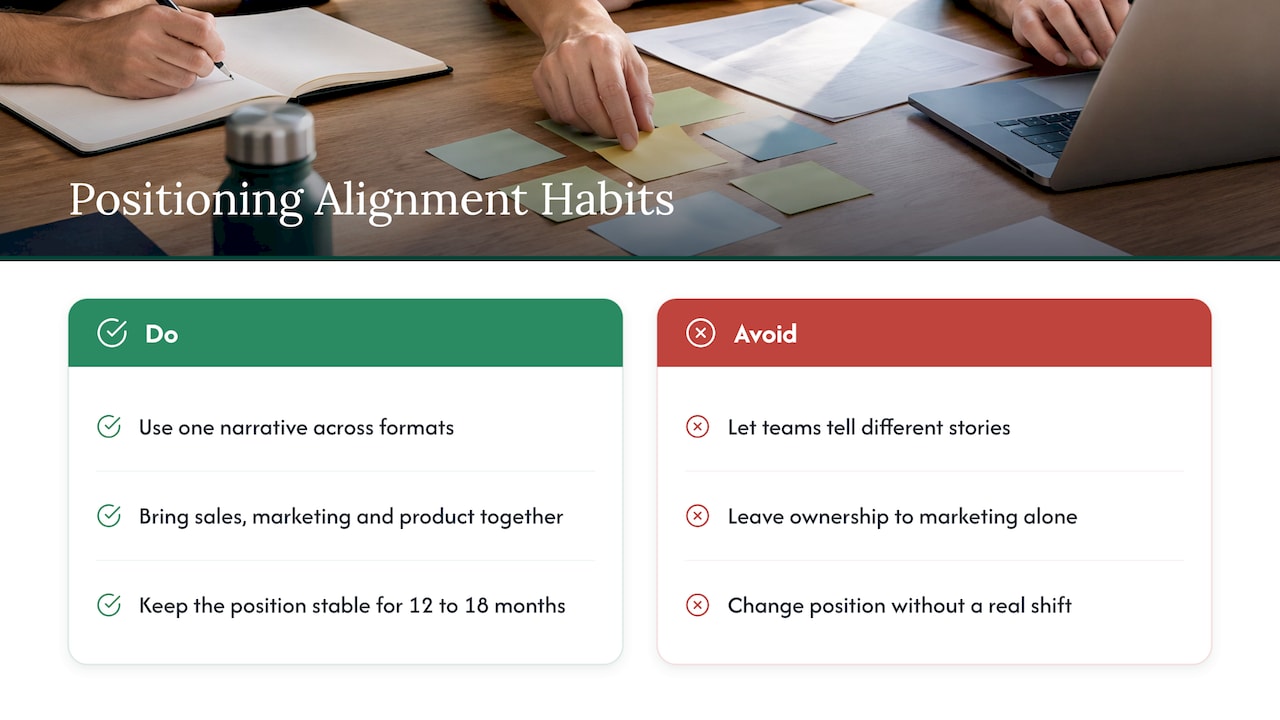
Write one company narrative. Zuora’s advice is to create an internal narrative as your core story and then use it on your website, in product messaging, in sales presentations and in marketing collateral. One narrative, many formats. Sales should be able to tell it without slides.
Create a cross-functional owner. The Forbes Agency Council article recommends a cross-departmental GTM task force that brings sales, marketing and product development together, because alignment in execution is essential. A small group that meets on a fixed rhythm beats a position owned by marketing alone. Our guides on revenue team alignment and sales and marketing alignment describe how to set that up, including shared service levels between the two teams.
Keep the position stable. Segment8 says positioning is foundational and should hold for at least 12 to 18 months so you do not confuse the market or undermine recognition. Change messaging as often as the evidence demands. Change the position only when the market, the product or the customer has truly shifted.
If you sell to organizations, remember that more than one person decides. The position has to survive a conversation among finance, operations and the end user. We cover that in why corporate positioning must win the buying committee.
How to test whether your positioning works
You do not need a large study to get a first read. Use signals you already have.
- The repeat test. After a sales call or demo, ask the prospect to explain in their own words why your offer is different and who it is for. If they can repeat it accurately, the position is landing. If they describe you as one of a category you do not want to be in, it is not.
- The sameness test. Read your homepage next to three competitors’ pages with the logos hidden. If several of you use identical words to describe yourselves, the position lacks specificity.
- The rep test. Ask three salespeople to describe your best-fit customer and your main rival. Three different answers means the narrative has not travelled.
- The lost-deal review. Look at the last ten losses. Did you lose to a named competitor, to a different category, or to no decision? The answer shows which alternative you failed to position against.
- The workshop test. Put the statement in front of product, marketing and sales in a single session and see where they disagree. Our positioning frameworks guide shows how to run that in 60 to 90 minutes.
Treat the results as evidence for the next revision, not a verdict. Confusion in the repeat test usually means the statement tries to say two things. Sameness usually means the differentiation is a claim rather than something a buyer can verify.
Common positioning mistakes and how to avoid them
- Positioning on features. A feature list answers “what” and skips “why it matters”. Lead with the problem.
- Targeting everyone. Each extra segment dilutes the message. Pick one beachhead and name the segments you will not chase yet.
- Comparing only to direct competitors. Buyers often compare you with a spreadsheet, an internal hire or inaction.
- Confusing position with tagline. A tagline is an expression of the position, not the position.
- Changing the position each quarter. You lose the repetition that builds recognition.
- Leaving sales out. If reps are not in the room when the position is built, they will rewrite it on the first call.
Our perspective
We see the same pattern in nearly every engagement: the company does not have a messaging problem, it has an alignment problem. Product describes the offer one way, marketing another and sales a third. Each version is reasonable on its own. Together they make the brand look like everyone else in the comparison.
That is why we treat positioning as a core business strategy and not as a marketing task. It decides what the product team builds first, who sales calls on and what marketing is allowed to promise. Our approach is shaped by an operator’s view: real-world brand building and exit experience, and work across more than 200 international retail locations. It has taught us that a position only counts when it shows up in customer experience and in measurable results.
Our method connects positioning, marketing, product and sales through iterative frameworks, including The Golden Spiral™ and Brand-Backed Performance™. We would rather help you test a sharp position in a workshop, refine it with real buyer feedback and wire it into how your teams work than hand you a polished deck that nobody uses.
If you do one thing after reading this, write your positioning statement in one sentence and ask your three most recent buyers to tell you if it sounds like them. Their answer is worth more than any template.
Quincy
Work with us on your positioning
If you are a founder or leader who wants this done with you rather than just read about, we offer brand positioning and go-to-market strategy work, along with customer experience mapping and founder and executive advisory. Engagements are built around connecting positioning to product, marketing and sales so the result shows up in performance, not just in a document.
Teams that prefer a structured starting point can look at our brand strategy frameworks. For a room full of executives, we also run keynotes and workshops, described on our speaking page.
FAQ
What is the difference between targeting and positioning?
Targeting chooses which customer segments you will serve. Positioning decides how those customers should perceive your offer compared with the alternatives. In the STP model, you segment, then target, then position, so the target shapes the position and not the other way around.
What is GTM positioning in simple terms?
It is the clear statement of who your product is for, what problem it solves and why it beats the other options a buyer is considering, used to guide launch messaging, sales conversations and product priorities. It sits inside the broader go-to-market plan alongside pricing, channels and the launch itself.
How long should a positioning statement be?
One sentence is enough, and it should cover four things: your target audience, the market or category, your differentiation and the outcome you deliver. It is mainly an internal tool, so clarity matters more than polish. Messaging for each audience is then built from it.
How often should we change our positioning?
Rarely. A reasonable expectation is that a position holds for at least 12 to 18 months, according to Segment8. Revise messaging more often based on feedback, and revisit the position when your market, product or ideal customer meaningfully changes.
How do we know if our positioning is working?
Ask prospects, after a sales conversation, to explain in their own words why you are different. If they repeat it accurately and your language does not match competitors’, it is working. Confusion or identical wording across rivals signals that it needs to be sharper.
Sources
- Nailing Your Go-To-Market Positioning (Zuora)
- 5.6 Product Positioning (OpenStax)
- What is a Go-to-Market Strategy? (HubSpot)
- Go-to-Market Strategy: Definition, Components (Dovetail)
- The GTM Strategy Playbook (Salesforce)
- Going To Market Is A Process (Forbes Agency Council)
- A Product Manager’s Guide to Product Marketing (Stanford Online)
- Target Market and Audiences (Foundations of Digital Marketing)
- The STP Marketing Model (Adobe)
- Jack Trout, Who Fought for Consumers’ Minds and Money (The New York Times)
- Everything you need to know about product positioning (Go to Market Alliance)
- Positioning vs. Messaging (Segment8)