Service Blueprint vs. Journey Map: Which One to Use
A journey map shows the experience from the customer’s side: what they do, think and feel at each step. A service blueprint keeps that same journey and adds the operation underneath it: the people, systems and processes that make each step happen. Use the map to find where the experience hurts. Use the blueprint to find out why, and who has to fix it.
TL;DR
- A journey map is outside-in (the customer’s view). A service blueprint is inside-out (the organization’s view).
- The blueprint is built on top of the journey. It adds frontstage actions, backstage actions and support processes.
- Start with a journey map when you do not yet know where customers struggle. Add a blueprint when the fix crosses departments.
- Most teams need both, in that order, tied to one business goal.
- A template is only a starting grid. The value comes from the interviews and the named owners behind each box.
Table of Contents
- The core difference in one minute
- Side by side: service blueprint vs. journey map
- What goes into each one
- A worked illustration: onboarding a new B2B customer
- When to use a journey map, a blueprint, or both
- How to build a blueprint from a journey map
- Making blueprints work across teams
- Service design vs. customer experience
- Where we can help
- FAQ
- Sources
The core difference in one minute
A customer journey map represents the experience from the user’s perspective: the sequence of interactions, the successes, the pain points and the emotions. The U.S. government’s digital service guidance describes a service blueprint as going behind that experience to show the systems, operations, staff interactions and support processes that deliver it.
Nielsen Norman Group puts the same split in terms of viewpoint. Journey maps reflect an outside-in view, and service blueprints reflect an inside-out view of the organization. The same source defines a blueprint as a diagram of the relationships between the people, props and processes that enable one specific customer journey.
A simple way to hold the difference: a journey map answers “what is it like to be our customer?” A blueprint answers “what do we have to do, and who has to do it, for that to be true?”
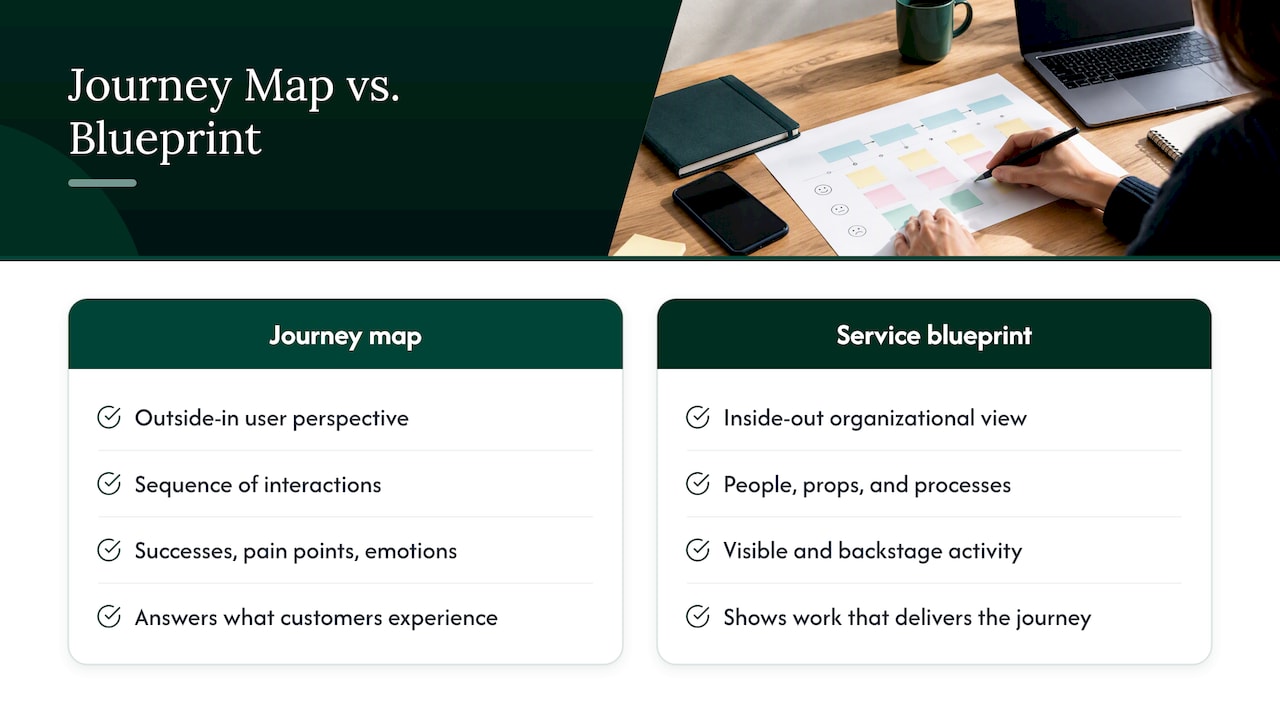
The ACM’s Interactions magazine makes the same point. A blueprint contains the customer journey plus the interactions that make it possible, both the visible frontstage activity and the invisible backstage activity. So a blueprint is not a rival to the journey map. It is the journey map with the operating model attached.
Side by side: service blueprint vs. journey map
| Question | Journey map | Service blueprint |
|---|---|---|
| Whose view? | The customer’s | The organization’s, anchored to the customer’s journey |
| Main question | What is the experience like, and where does it hurt? | What delivers the experience, and where does delivery break? |
| Typical content | Steps, touchpoints, thoughts, emotions, pain points | Customer actions, frontstage, backstage, support processes, physical evidence |
| Who is in it | The customer (sometimes a persona) | The customer, staff, systems and outside partners |
| Best for | Finding friction and building empathy | Fixing process breakdowns across teams |
| Typical output | Prioritized experience problems | Prioritized operational changes with owners |
| Main risk | Insight with no one accountable | Internal detail with no customer evidence |
Read the table by row, not by column. The two tools are not competing answers to the same question. They answer neighboring questions.
What goes into each one
Inside a journey map
A journey map follows one customer type through one goal, in stages. For each stage it records:
- What the customer is trying to do
- The touchpoints they use (website, sales call, email, product, support)
- What they think and feel
- Where they get stuck or drop off
That is deliberately all customer-side. The strength of a map is that it makes the customer’s experience hard to argue with, especially when it is built from real interviews and behavior data rather than internal opinion.
Inside a service blueprint
The federal 18F team’s template lays a blueprint out in rows: user steps, frontstage actions visible to users, backstage actions invisible to users, and support processes performed by the wider organization or by external partners. Its stated purpose is to represent the start-to-finish experience of using and supporting a service, clarify how intertwined systems and processes relate, and reveal where to improve.
Two more ideas make the blueprint work:
- Three lines. Nielsen Norman Group describes the line of interaction, the line of visibility and the line of internal interaction as the primary lines that organize a blueprint. The line of visibility is the most useful in practice, because everything below it is work the customer never sees and often never forgives when it fails.
- Secondary elements. Teams often add arrows for dependencies, time, policies, regulations, employee emotions and performance metrics. Add them only when they answer a question your team is actually asking.
The same source adds a rule worth taping to the wall: a blueprint should always align to a business goal, such as reducing redundancies or improving the employee experience. A blueprint with no goal becomes a very detailed poster.
A worked illustration: onboarding a new B2B customer
This is a hypothetical example to show how the two tools fit together, not a client case.
Imagine a software company whose new customers keep going quiet in the first month after signing.
The journey map shows the customer’s side. After the contract is signed, the buyer waits several days for a kickoff email. Then they get three separate messages from three different people. They are unsure who to ask about data import. Their mood drops at exactly that step. That is a real finding, and it is enough to say “onboarding feels disorganized.”
The blueprint takes the same stage and asks what happens underneath:
- Customer action: signs the contract, waits, gets three emails, asks about import.
- Frontstage: the account manager sends a welcome note, and a support rep sends a setup guide.
- Backstage: sales closes the deal in the CRM, but the handoff to customer success is a manual note that is sometimes forgotten.
- Support processes: billing triggers a separate automated email. No system links the contract record to the implementation queue.
Now the problem has a shape. The three emails are not a communication issue. They are three unconnected processes owned by three teams. The fix is a single handoff with one named owner, and the journey map alone would never have told you that.
This is the pattern behind most experience problems in B2B companies: the customer feels the gap between functions, but no single function owns it. We go deeper on that in why customer experience fails between corporate functions.
When to use a journey map, a blueprint, or both
Nielsen Norman Group’s guidance is that journey maps provide the customer-actions foundation, and blueprints can then be used to understand the service, identify process breakdowns, ideate changes and communicate a service vision. In practice, that gives you a simple decision rule.
Start with a journey map when:
- You suspect customers struggle but cannot say where.
- Teams disagree about what the customer actually experiences.
- You are defining a new offer and need to understand customer motivations.
Move to a blueprint when:
- Several departments contribute to one experience.
- A service is changing or being redesigned.
- You already know where the experience is weak and need to know why.
The last two triggers match the situations Miro’s guide describes: many departments contributing to one experience, and a service being redesigned or improved to lift customer experience.
Use both when the problem is cross-functional, which in a growing company is most of the time. Designers and practitioners generally treat the two as complementary, with journey maps carrying experience-centric goals and blueprints carrying the process-centric work of making them operational. John Maeda makes that point in his own write-up.
A caution on sequence: do not skip the map and jump to the blueprint because the operational detail feels more concrete. A beautifully accurate blueprint of the wrong journey just documents the wrong thing efficiently.
How to build a blueprint from a journey map
The federal digital guidance recommends researching through desk research and interviews with users, staff and stakeholders, then building rows for user steps, frontstage, backstage and support processes, and then mapping interaction flows, critical delivery points and opportunities for efficiency or a better experience. Turned into a working sequence:
- Pick one journey and one customer type. “Onboarding for mid-market buyers” works. “The whole customer experience” does not.
- Set the business goal. Faster time to first value, fewer handoff errors, lower cost to serve. Write it at the top.
- Lay out the customer steps. Use your existing journey map, ideally built from real interviews.
- Add frontstage actions. What staff, interfaces and content the customer directly meets at each step.
- Add backstage actions. What happens out of sight to make the frontstage work.
- Add support processes and systems. Tools, data, policies, partners and approvals.
- Draw dependencies. Arrows show what waits on what. This is where most breakdowns appear.
- Mark failure points and owners. Every red spot gets a name next to it, not a department.
- Choose the few changes that matter. Three fixes that ship beat thirty that live in a slide deck.
Step 8 is where many blueprints die. Naming an owner is uncomfortable, and it is also what turns a diagram into an operating decision. If you want a fast route, our walkthrough on finishing a working service blueprint in one workshop covers the session structure, and half-day customer experience mapping shows how to get the journey side done first.
What a good service blueprint template includes
Since many readers come looking for a template, here is the minimum grid. Make it a whiteboard or slide with columns for stages and these rows, top to bottom:
- Physical evidence (what the customer sees or receives)
- Customer actions
- Line of interaction
- Frontstage actions
- Line of visibility
- Backstage actions
- Line of internal interaction
- Support processes and systems
Optional extra rows: time, metrics, policies, employee emotions. Keep the grid, change nothing about the order, and spend your effort on the content.
What good examples have in common
Published examples look different across industries, but the useful ones share traits. Nielsen Norman Group’s car-dealership example, for instance, sets the customer’s research and discovery next to the dealership’s own actions, such as greeting customers, putting cars on its website and offering guidance. Notice what it does: every customer step has a matching organizational step. Look for that pairing in any example you borrow from, and drop examples that show only one side.
Making blueprints work across teams
The real payoff of a blueprint is shared understanding. Service design uses blueprints to bridge organizational silos by creating a common picture of how a service is created and delivered. Sales sees what delivery has to absorb. Product sees what support actually handles. Marketing sees which promises operations has to keep.
That only happens if the right people are in the room when it is drawn, not briefed afterward. For a practical look at getting groups to agree on who does what, see this piece on cross-functional alignment in 60 days. Pair that discipline with a blueprint and the diagram becomes a working agreement rather than a record.
For B2B companies the stakes are higher, because one customer relationship runs through sales, onboarding, product, support and renewals. That is why we treat the experience as a revenue discipline, which we cover in making B2B customer experience a revenue discipline. If your map has already surfaced a decisive step, finding and fixing your moment of truth is the natural next read.
Service design vs. customer experience
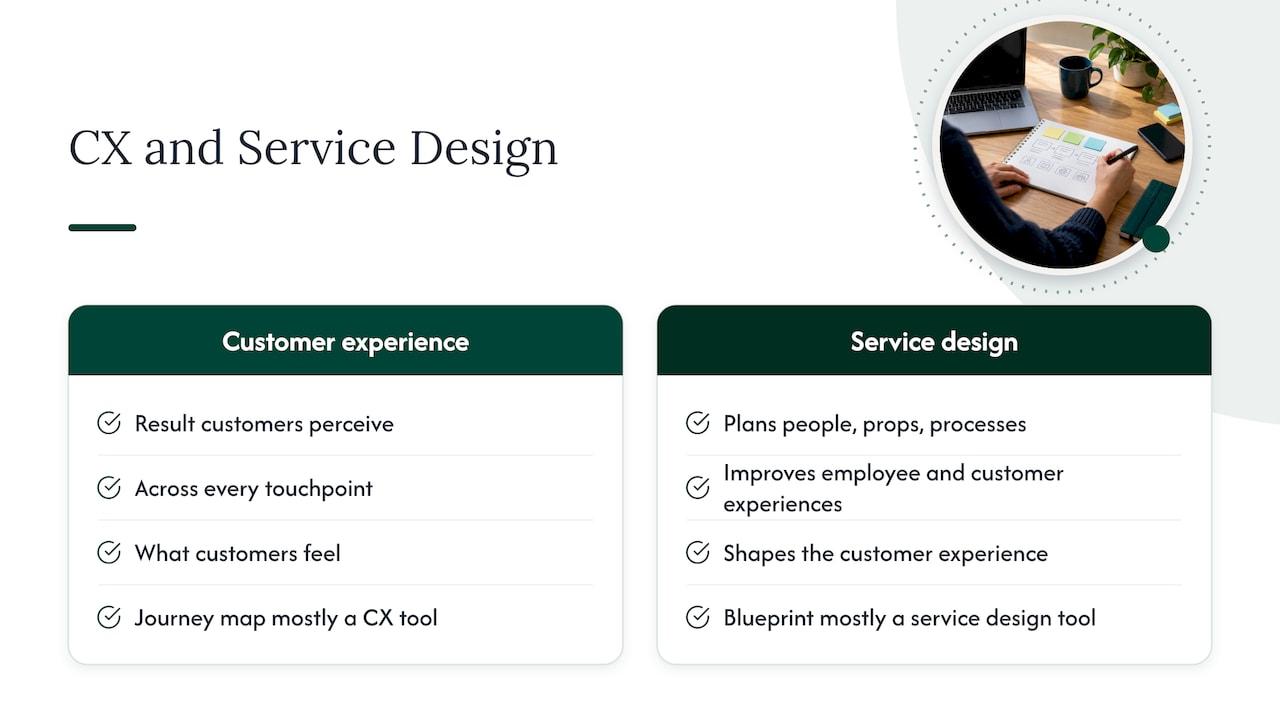
People often ask whether service design and CX are the same thing. They overlap, but they are not identical. Service design is the activity of planning and organizing people, props and processes to improve both employee and customer experiences. Customer experience is the result the customer perceives across every touchpoint.
Put simply, CX is what customers feel, and service design is one of the disciplines that shapes it. Academic work on this topic notes that delivering consistent experiences across multiple channels and touchpoints has become critical for competitive advantage, and that service design is one way organizations create cohesive experiences across them. The journey map is mostly a CX tool. The blueprint is mostly a service design tool. Strong teams use both.
Our perspective
Most companies we meet do not have a customer problem or an operations problem. They have a drift problem. Marketing promises one thing, sales sells another, product ships a third, and the customer is the one who feels the seams.
That is why we do not treat brand as a marketing layer. A brand is a promise the whole business has to keep, and a journey map shows you where the promise is being broken. A blueprint shows you which function, handoff or system is breaking it. Used together, they turn a vague “our experience is inconsistent” into a short list of owned fixes.
Our approach comes from an operator’s side of the table, shaped by building brands and by exit experience, not from running exercises for their own sake. So we are wary of any mapping effort that ends in a beautiful poster. The test is simple: does the work change a decision, an owner or a number? If not, it was decoration.
If you only have time for one, start with the journey and be honest about the worst moment in it. Then blueprint that moment and nothing else. A single well-owned fix will teach your team more than a perfect map of everything.
Quincy
Where we can help
If your team has a journey map that nobody acts on, or a blueprint that nobody trusts, the gap is usually alignment, not diagramming. We work with founders, executive teams and marketing leaders to connect brand strategy, customer experience and go-to-market so that product, marketing and sales are working from the same picture, with measurable outcomes attached.
You can see how our customer experience and growth advisory work is organized on our main site, or look at our brand strategy frameworks if you want to see how we structure the thinking before a project starts.
FAQ
What is the difference between a customer journey map and a service blueprint?
A journey map shows the experience from the customer’s point of view: steps, emotions and pain points. A service blueprint shows the same journey plus the frontstage actions, backstage actions and support processes that deliver it. The map describes the experience. The blueprint explains what produces it.
What is the purpose of a service blueprint?
Its purpose is to show the start-to-finish experience of using and supporting a service, clarify how systems and processes relate, and reveal improvement opportunities, according to 18F. It should be tied to a business goal, such as fewer handoff errors or a better employee experience.
Should I make a journey map or a service blueprint first?
Make the journey map first. It supplies the customer-actions foundation that a blueprint is built on. Once you know where customers struggle, a blueprint helps you trace those problems to the processes, systems and teams behind them.
Is a service blueprint the same as a process map?
No. A process map follows internal steps and often ignores the customer. A blueprint starts from the customer’s journey and shows how internal work supports each step, with a line of visibility separating what customers see from what they do not. That customer anchor is what makes it a service design tool.
How detailed should my first blueprint be?
Keep it narrow. Choose one journey, one customer type and one business goal, then add detail only where a failure point appears. A small, accurate blueprint with named owners is more useful than a comprehensive one that nobody maintains.
Sources
- Map your users’ and system’s journeys, Digital.gov
- Service blueprint, 18F Guides
- Service blueprints: Laying the foundation, ACM Interactions
- Service Blueprinting FAQ, Nielsen Norman Group
- Service Blueprints: Definition, Nielsen Norman Group
- UX Mapping Methods Compared: A Cheat Sheet, Nielsen Norman Group
- How To Create A Service Blueprint With Examples, Miro
- Infinite Customer Journey Map and Service Blueprints, John Maeda
- Enhancing customer journey through process, Mandic (2024)
- Leaders: Achieve Cross Functional Alignment in 60 Days