Value Proposition vs. Positioning: What Each One Does
A value proposition is the promise you make to a customer: the benefit or outcome they get from you. Positioning is the place you claim in the market: who you are for, what category you compete in, and why you beat the alternatives. The value proposition answers “why should I buy?” Positioning answers “why you, and not them?” Build positioning first, because a strong value proposition is an expression of it, not a substitute for it.
Most teams mix the two up because both end up as a sentence on a website. The difference shows when sales, product and marketing each describe the company differently. That is a positioning problem, and no amount of polished copy fixes it.
TL;DR
- Value proposition: the promise of value to a specific customer, stated in terms of benefits and outcomes. It is outward-facing.
- Positioning: the spot you want to occupy in the customer’s mind relative to alternatives. It guides your team and is mostly internal.
- Messaging: the words, by audience and channel, that express the positioning. Positioning is the input and messaging is the output.
- Order of work: decide positioning, write the value proposition from it, then build messaging. Review positioning on a slow cycle and messaging on a fast one.
- Test of success: product, marketing and sales describe the offer in the same way without a meeting to agree on it.
Table of Contents
- The difference in one table
- What a value proposition is
- What positioning is
- Value proposition vs. positioning statement
- A worked example: Amazon’s early bookselling
- Where messaging fits
- Which one to build first
- Making all three line up across teams
- Where this goes wrong
- Our view: positioning is a business decision, not a copy exercise
- Get the position settled with an advisor
- FAQ
- Sources
The difference in one table
| Value proposition | Positioning | |
|---|---|---|
| Question it answers | Why should I buy? | Why you instead of the alternatives? |
| Core content | Benefit, outcome, need met | Category, target segment, differentiator, proof |
| Main audience | Customers and prospects | Your own team first, then the market |
| Focus | What the customer gets | Where you stand against alternatives |
| How often it changes | When the offer or customer need changes | Rarely, because stability builds recognition |
| Typical form | A headline and a short supporting statement | A statement with category, segment and reasons to believe |
The table is a simplification. Practitioners draw the line in slightly different places, and the next sections show where they agree.
What a value proposition is
A value proposition is the promise of value you are about to deliver. Product Marketing Alliance describes it as your promise to the customer, while positioning is the position you want to occupy in the customer’s mind. Harvard Business School Online frames the customer value proposition as the promise your brand offers a target audience, the one that answers “Why should I buy?”
A good one has three traits:
- It names benefits and outcomes, not features. Xero’s guide says an effective proposition focuses on outcomes and is specific to a real customer need.
- It is quick to grasp. The same guide says it should be understandable in under 10 seconds.
- It is true. Gartner’s branding primer says the value you promise must correspond with the value you deliver. A promise the product, onboarding or support can’t keep is a brand liability.
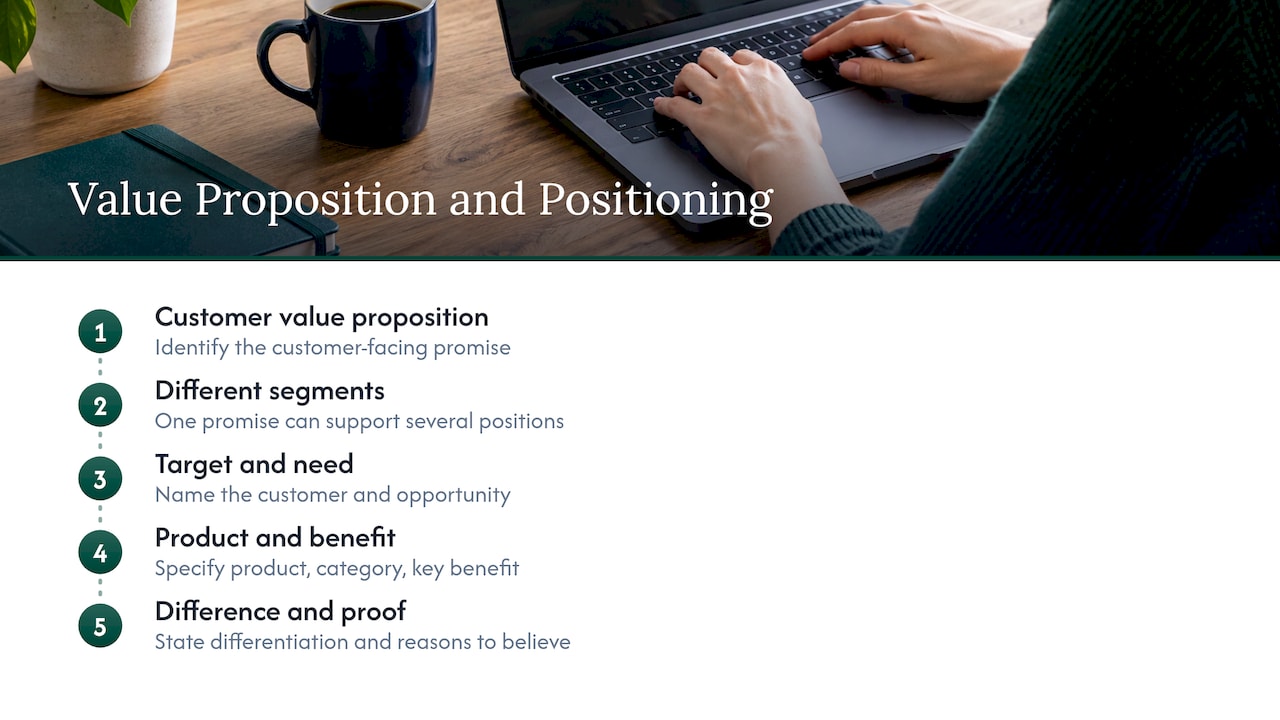
A complete value proposition covers the target customer, the need or opportunity, the offering, the key benefit, and why it beats the alternatives, per the Xero guide. If you want concrete patterns to copy, our breakdown of value proposition examples and templates walks through six of them.
What positioning is
Positioning is a set of strategic choices about where you compete. Per Pragmatic Institute, brand is the cumulative perception of a company over time, while positioning is product-specific and problem-focused. One of its experts calls positioning one element within the brand umbrella. If you’re sorting out how positioning relates to the bigger idea of purpose, see brand purpose vs. positioning.
Positioning forces three decisions:
- Category. Which frame of reference do buyers use when they evaluate you? Product Marketing Alliance gives the shortcut: are you a cybersecurity firm or an HR software company?
- Segment. Who is this for, specifically? “Everyone” is not a segment. Vestd points to Harvard Business School research showing that companies with a clear strategic focus outperform those that appeal broadly across segments.
- Difference. Why should the segment choose you over the alternatives, including doing nothing? A real difference is one customers care about, not one you find interesting.
Vestd adds that strong positioning creates constraints: it makes some opportunities irrelevant and some ideas obviously wrong. That is its practical value. If your positioning never causes you to say no, it is probably too vague to be positioning.
Value proposition vs. positioning statement
Many readers search for this pair, and it is where the confusion peaks. A value proposition and a positioning statement are separate documents that do separate jobs.
The positioning statement is the internal, structured version of your position. HubSpot describes it as a brief description of a product plus how it meets a particular need of the target market, an internal tool for appealing to buyer personas in a relevant way. The value proposition is what you show the customer.
Harvard Business School Online sets out the sequence: you build a positioning statement by first identifying the customer value proposition, then defining how customers perceive it in the marketplace. The competitive set, the primary point of difference and the reasons to believe come next. Together they form the foundation of brand strategy.
There is a useful asymmetry. A single value proposition can sit above several positioning statements, because you may need to position differently for different segments, as one product marketer notes.
Xero offers a template for the positioning statement: for [target customer] who [need or opportunity], [product] is a [category] that [key benefit]. Unlike [alternative], [product] [primary differentiator]. The Xero guide lists the elements it expects: target customer and need, product name, category, key benefit and primary differentiation. A marketing textbook hosted by Lumen Learning adds a fifth, reasons to believe. Include proof. A differentiator with no evidence is just a claim.
A worked example: Amazon’s early bookselling
The same textbook gives a clear historical case, from around 2001. Amazon’s value proposition offered web users who enjoyed books instant access to over 1.1 million titles. That is a benefit promise to a defined customer.
The positioning around it supplied the competitive context. Amazon was a retail bookseller, the alternative was traditional book retailers, and the difference was extraordinary convenience, low prices and a comprehensive selection. Read the two together and you get a complete picture. The promise tells you what you get. The position tells you why this is the better place to get it.
The pattern holds for modern product companies too. A value proposition like “build better products as a team” only becomes distinctive when the positioning, such as a collaborative design tool set against single-user tools, tells the market which alternative it displaces.
Where messaging fits
The third term in the search results is messaging, and it is the one most often mistaken for the other two.
Pragmatic Institute states it simply: positioning defines what you believe about your product’s value in the market and faces inward, while messaging expresses that belief outwardly. In its words, positioning is the input and messaging is the output. If the input lacks clarity, the output will too.
Atlassian draws the same line. Positioning is the concise statement of why you are different, internal only, to guide and align your team. Messaging is the detailed description of what you do to make that statement true, adapted for each audience segment. Salesforce adds a practical rule: your position doesn’t change, but your messaging is flexible.
A value proposition sits between them. It is broader than messaging, which Product Marketing Alliance says is far more specific and targeted, aimed at particular personas. It is more outward-facing than positioning. A practical layering looks like this:
- Positioning: category, segment, difference, proof. Stable.
- Value proposition: the core promise, derived from the positioning. Changes when the offer or the customer’s need does.
- Messaging: versions of the promise for each persona, stage and channel. Updated often.
The layering explains a common failure. Vestd observes that teams try to fix strategic ambiguity with cosmetic changes such as new copy and sharper language, yet messaging can only express what already exists underneath. If the positioning is vague, the messaging is a more polished version of the vagueness. The same logic applies to targeting: you cannot write precise messages for a fuzzy audience, which is why work such as B2B segmentation models matters before the copy does. To build the messaging layer once the position is settled, our brand messaging framework guide covers how to make one that teams actually use.
Which one to build first
Start with positioning. It is the decision the others depend on. Pragmatic Institute says strong value propositions emerge from strong positioning rather than creating it, and that without clarity on the problem, the persona and the outcome, a value proposition turns into a generic claim.
In practice, the work runs in this order:
- Learn the customer, market and competition. Salesforce says great positioning requires deep knowledge of all three: wants and pain points, how customers measure success, market trends and regulations, and how competitors price and describe themselves. Our guide to B2B customer research methods covers how to get that input.
- Choose the position. Category, segment, difference and proof. Test whether it forces tradeoffs. If it doesn’t, sharpen it. Our piece on brand differentiation strategy goes deeper on picking a difference that holds up.
- Write the value proposition. One promise, in the customer’s terms, that your position makes credible.
- Build messaging by audience. Different words for a VP and for a practitioner, for a demo and for a feed.
- Hold the position steady. Positioning is a long-cycle decision, and changing it often confuses the market. Messaging gets tested and revised against performance.
Price is part of the position too, since it signals who you serve and what you are worth. See how pricing decisions shape brand positioning before you finalize either document.
Making all three line up across teams
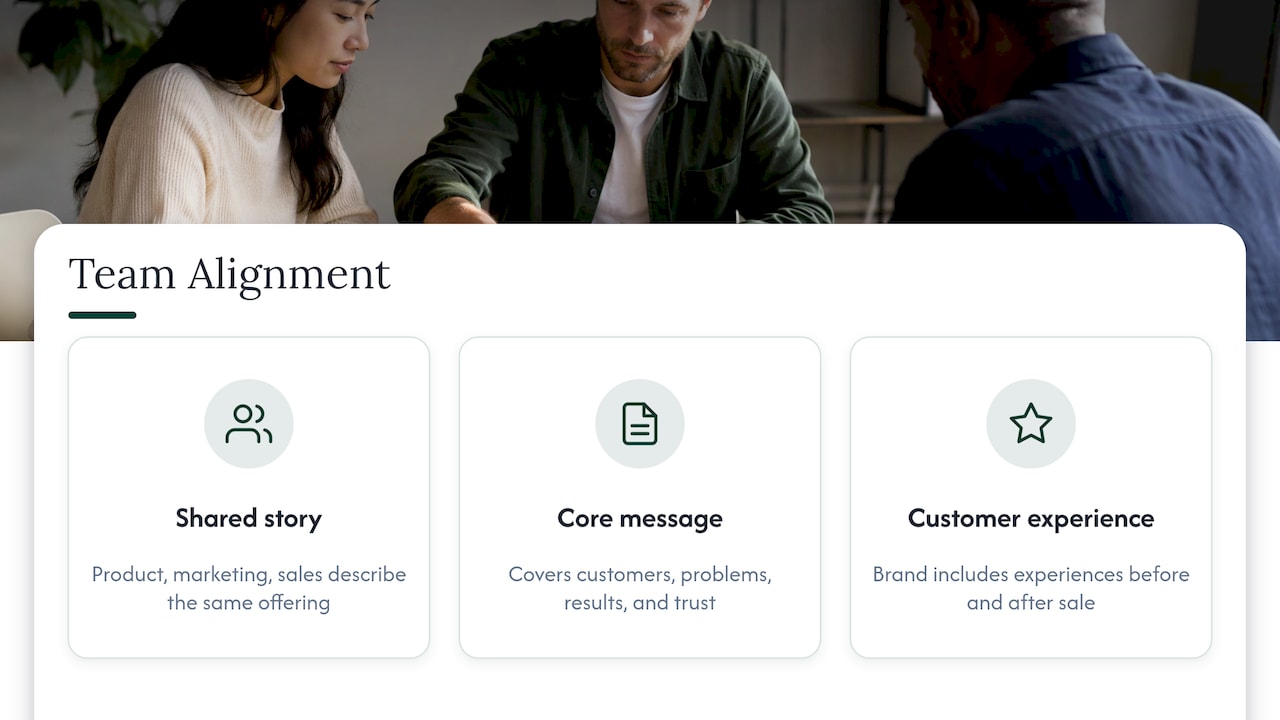
The payoff is alignment. Pragmatic Institute reports that when positioning is clear, product, marketing and sales describe the same offering in the same way. That reduces internal debate and simplifies sales conversations. When it isn’t, small differences in how teams articulate value erode credibility.
The Arizona Commerce Authority’s guide to a core marketing message gives a useful checklist for the combined document. It should cover what you do, how you do it, who your main customers are, which problems you solve, what result-based benefits you deliver compared with competition, and why you should be trusted. If your team can’t fill in each item the same way, you have found the gap.
Alignment also has to survive contact with the customer experience. Gartner defines a brand as the sum of experiences delivered before and after the sale, plus the differentiation and relevance of the value proposition, plus the agreement between them. For B2B buyers, it advises combining functional, business and personal needs so that key individuals will advocate for you. Keeping the story consistent over time is also tied to growth, as this overview of brand consistency and business growth argues.
This is also where a go-to-market plan depends on the work above. Our guide to B2B go-to-market planning shows how the position, promise and messaging feed channel and sales decisions.
Where this goes wrong
Four mistakes show up repeatedly:
- Writing the tagline first. The headline feels like progress, but without a position behind it the line is interchangeable with any competitor’s.
- Listing features as value. Features describe the product. A value proposition describes what changes for the customer.
- Claiming a category nobody uses. Buyers compare you inside the category they already know. Invent a new one and you spend your budget explaining it.
- Changing positioning when results dip. Messaging is the lever to adjust first. Repositioning is an executive decision with tradeoffs, which we cover in why repositioning fails without executive tradeoffs.
Perspective
Our view: positioning is a business decision, not a copy exercise
We treat brand as a core business strategy, not a marketing tool. That changes how we think about this question. The value proposition and the positioning statement are not two pieces of copy to be polished. They are the visible edge of decisions about who you serve, what you will not do, and what you can prove.
The failure we describe to clients is drift: product says one thing, marketing another, sales a third, and the customer compares you on price because nothing else was made clear. Fixing that with sharper words treats the symptom. Our approach ties positioning, marketing, product and sales together through iterative frameworks, so the promise your customers hear is the one your company can keep.
That is the idea behind Brand-Backed Performance™ and The Golden Spiral™, the frameworks we use through The Branded Agency: connect brand strategy to measurable business performance and to the customer experience, rather than running a branding exercise that never reaches the pipeline. Our view comes from an operator’s side, shaped by building brands and by an exit, and by work across more than 200 international retail locations.
Our advice is to settle the position first, with the executives who own the tradeoffs in the room. Everything downstream gets faster once they have.
Quincy
Get the position settled with an advisor
If your team is arguing about the difference between these terms, the real problem is usually that the position was never decided. Quincy Samycia’s brand strategy and brand positioning work is built for that: a structured method that connects positioning to growth and go-to-market strategy, customer experience and executive advisory, so product, marketing and sales describe the same offer. You can also see the brand strategy frameworks behind the method.
Founders and executive teams can start from the main page and describe where the positioning stands today. For a look at what a finished engagement hands over, see our list of brand strategy deliverables.
FAQ
What is the difference between a value proposition and positioning?
A value proposition is the promise of a specific benefit to a defined customer. Positioning is the place you want to hold in the customer’s mind relative to alternatives. The first says what the customer gets, and the second says why you are the better source of it.
What is the difference between positioning and messaging?
Positioning is the strategic decision about where you compete and why you win. It is mostly internal and stays stable. Messaging is the audience- and channel-specific language that expresses that decision, and it changes as you learn what resonates.
Do I need both a value proposition and a positioning statement?
Yes, because they do different jobs. The positioning statement aligns your team around category, segment, difference and proof. The value proposition turns that into a promise customers can understand quickly. One value proposition can support several positioning statements if you serve different segments.
What should a positioning statement include?
Include the target segment, the product or brand name, the category, the key benefits or points of differentiation, and the reasons customers should believe them. Xero’s template adds the alternative you are compared against, which keeps the statement competitive and specific.
Which should I write first?
Positioning. A value proposition written without a position tends to become a generic claim. Once you know your category, segment and difference, the promise follows from them and messaging can be built on top.
Sources
- How to Craft the Perfect Brand Positioning Statement, Harvard Business School Online
- A Practical Product Positioning Guide, Pragmatic Institute
- How to Create a Value Proposition, Product Marketing Alliance
- What is a value proposition? Xero US
- Developing Positioning Statements, Principles of Marketing, Lumen Learning
- Positioning vs. messaging: how to stop mixing them up, Vestd
- Nail Your Brand Positioning and Messaging, Atlassian
- Build Product Messaging That Stands Out, Salesforce
- 16 Examples of Positioning Statements, HubSpot
- Value Props, Positioning, Messaging: What’s the Difference?
- Constructing and Updating Your Core Marketing Message, Arizona Commerce Authority
- Branding and Value Proposition Primer for 2018, Gartner